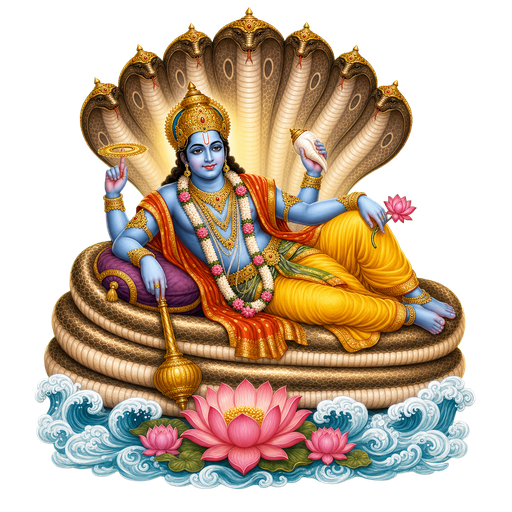
Ganga Dussehra
Ganga Dussehra falls on Jyeshtha Shukla Dashami — the day Mother Ganga is believed to have descended from heaven to earth (Gangavataran). "Dussehra" here means "dasha" (ten) + "hara" (destroy) — bathing in the Ganga is believed to wash away ten kinds of sins. This year (2026) it falls on Monday, 25 May.
This year's dates (2026)
- Sunday; Ganga Dussehra begins (the first day of the ten-day bathing observance) — this is the start, not the main day17 May
- Monday; Ganga Dussehra (main day) / Gangavataran25 May
Ganga Dussehra is also known as Ganga Dashami and Gangavataran/Gangavatar. This is not the autumn Vijayadashami ("Dussehra") — the two are entirely separate festivals and shouldn't be confused. The ten-day bathing observance begins on 17 May (Pratipada); the main day is Dashami (25 May). This festival is primarily observed in the Ganga basin/North India — at Haridwar, Varanasi, Rishikesh, Prayagraj, and Patna, where millions of devotees bathe in the Ganga, perform aarti, and give alms at the ghats.
Significance
Hindu belief holds that Ganga descended from heaven to earth on Jyeshtha Shukla Dashami; hence this tithi is called "Ganga Dussehra"/"Gangavataran." According to the legend, Ganga descended because of King Bhagirath's penance, to redeem his ancestors.
"Destruction of ten sins": "dasha" means ten, "hara" means destruction. Bathing in the Ganga is traditionally believed to wash away ten kinds of sins: three of the body (violence, theft, adultery), four of speech (harsh words, falsehood, slander, idle talk), and three of the mind (coveting others' wealth, malice, false obstinacy) — ten in total. Some sources instead read this as "the sins of ten births."
By tradition, Ganga's descent is held to have occurred on a Wednesday, under the Hasta nakshatra; hence the rare combination of Jyeshtha + Shukla Paksha + Dashami + Wednesday + Hasta nakshatra is considered the most auspicious. In 2026, the panchang data shows Uttara Falguni nakshatra and a Monday for 25 May (not Hasta/Wednesday) — but since the Dashami tithi is the decisive factor, the date still holds.
Bathing in the Ganga (and Yamuna), donating lamps, giving alms, and performing aarti are the main meritorious acts of this day; these are associated with beliefs about relief from illness and moksha.
A 2026-specific distinctive feature: 2026 is an Adhik Jyeshtha year (the Jyeshtha month occurs twice — first Adhik, then Nij). Generally, votive vrats are not performed in the Adhik month, but Ganga Dussehra is an exception — tradition holds that "the Ganga Dussehra vrat should be observed only in the Adhik Jyeshtha month." As a result, the panchang data and most panchangs place Ganga Dussehra in Adhik Jyeshtha itself (25 May), while Nirjala Ekadashi (25 June) and Vat Purnima (29 June) fall in Nij Jyeshtha, a full month later. In an ordinary year, Ganga Dussehra falls the day before Nirjala Ekadashi — in 2026, that pattern breaks, and the two observances fall a month apart.
The legend (katha) — Gangavataran (the Bhagirath story)
When King Sagar performed an Ashwamedha sacrifice, Indra stole the sacrificial horse and hid it in the netherworld, near sage Kapil's ashram. Sagar's sixty thousand sons, searching for the horse, disturbed sage Kapil's penance and were burned to ash by his wrathful fire — their souls found no release. Later, in succeeding generations, Anshuman and then Dilip attempted to redeem their ancestors, but without success.
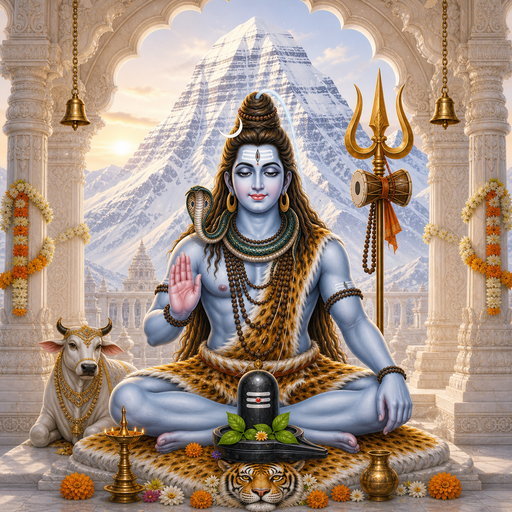
Finally, Bhagirath gave up his royal comforts and performed intense penance for thousands of years, pleasing Brahma — and requested that Ganga be brought down to earth so that his ancestors' ashes could be offered tarpan (ritual water offerings) and redeemed. Ganga's force was so immense that it would have devastated the earth; so Shiva held her in his matted locks, taming her force before releasing a single, controlled stream. Ganga flowed after Bhagirath until she reached the ashes of Sagar's sons, and the tarpan redeemed them — because of Bhagirath's efforts, the source stream of the Ganga is called "Bhagirathi."
Some versions describe Bhagirath's penance as unfolding in two stages — first pleasing Brahma, then Shiva — while others describe it as a single continuous effort. The core sequence of the story, however, is consistent across versions.
Who observes it
Mainly devotees of the Ganga and North Indian pilgrims — communal bathing and aarti take place at the ghats along the Ganga and Yamuna. Pilgrims travel from across the country to Haridwar, Varanasi, Rishikesh, and Prayagraj. Devotees at home mix Ganga water into their bath water for a symbolic bath and worship Ganga. This is not a widely observed household vrat in Maharashtra (see Regional customs below).
Puja vidhi and snan-daan
- A resolve (sankalp) to recite the Ganga Stotra daily from Pratipada through Dashami is taken where feasible.
- Bathing in the Ganga/Yamuna or a local sacred river; if that isn't possible, a bath with Ganga water mixed in at home. Reciting the Ganga Stotra ten times while bathing is a traditional practice.
- Panchopachar worship of Ganga — offering a lamp and flowers, and installing a kalash.
- Charity — food, water, cloth, cold drinks (lassi/sherbet), and summer items such as fans and earthen pots, since Jyeshtha falls in the summer.
- Donating lamps and performing aarti — floating lamps at the ghats, a grand aarti.
This is a bathing-and-charity observance — not a chain of vrats — so there is no separate closing ceremony. The exact sequence of worship is not universal; it varies by family/local tradition.
What you need
Ganga water, a kalash, a lamp, flowers, incense, an offering; for charity — food, water, cloth, and summer items (a water station/cold drinks, a fan, an earthen pot).
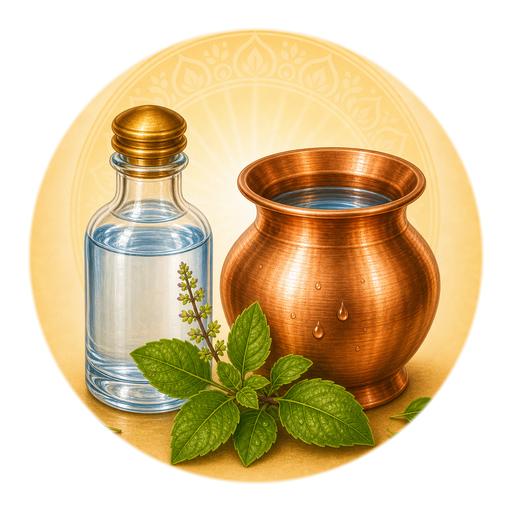 Ganga water
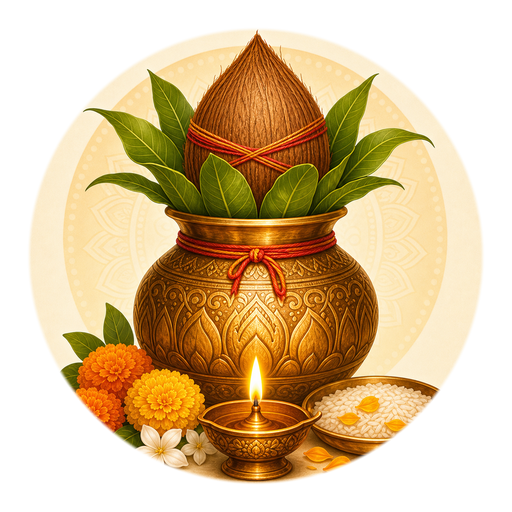 Kalash
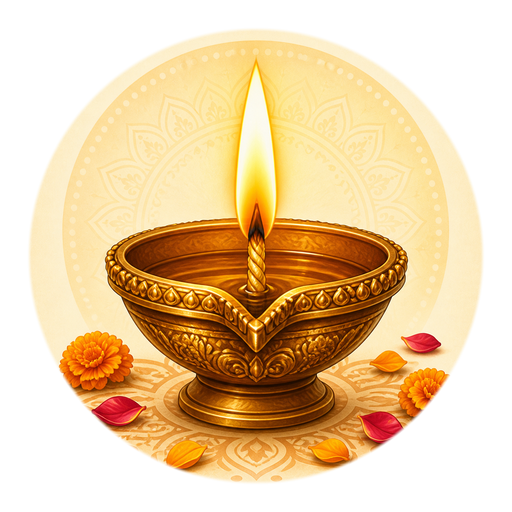 Lamp
Lamp Flowers
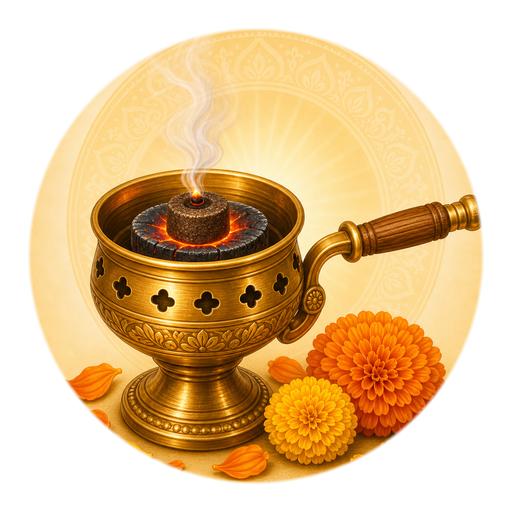 Incense
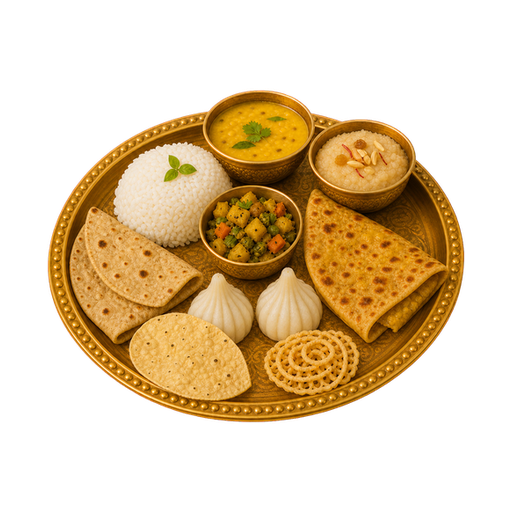 Offering (naivedya)
 Cloth
ClothFasting
Ganga Dussehra is primarily a bathing-and-charity observance; a strict waterless (nirjala) fast is not mandatory (that rule belongs to Nirjala Ekadashi, which in 2026 falls on a different day, 25 June). Some observe a light, sattvic diet or a fast — this varies by family tradition. Because of the summer heat, offering and distributing cold drinks and watermelon/cucumber is a traditional practice.
Mantra
The Ganga name-mantra — "Om Gangayai Namah" (meaning "salutations to Mother Ganga") and "Har Har Gange" (a devotional exclamation chanted while entering the water) — are well-known, short, devotional chants recited while bathing. Reciting the Ganga Stotra ten times while bathing is a traditional practice. The well-known opening line of the Ganga aarti, "Jai Jai Gange Mata," means roughly "victory to you, Mother Ganga" — sung at the start of the aarti.
Regional customs — the Maharashtra context
Ganga Dussehra is primarily a Ganga-basin/North Indian festival — it is not a major public vrat/festival in Maharashtra; it is not observed in households here. The main connection is the panchang's tithi entry and remembering Gangavataran.
Marathi devotees who go on pilgrimage to the north do bathe in the Ganga; some bathe on this tithi in local sacred rivers such as the Godavari or Narmada — but this is a general river-bathing belief, not a Ganga-Dussehra-specific Maharashtrian ritual. In Maharashtra, the Godavari holds the position of "Dakshin Ganga" (the southern Ganga) — this cultural link can be mentioned, but it isn't specific to Ganga Dussehra.
In short — this is a major festival in North India, while in Maharashtra it remains primarily of informational and panchang-reference value.
Good to know
- In 2026, because of the Adhik Jyeshtha month, Ganga Dussehra (25 May) and Nirjala Ekadashi (25 June) fall a month apart — don't treat them as the same day.
- Ganga Dussehra is a different festival from Dussehra (Vijayadashami) — both share the word "Dussehra/Dashahara," but they are entirely separate.
- Given the summer heat and ghat crowds, those going for a bath should take the usual precautions.
FAQ
- When is Ganga Dussehra in 2026?
- Monday, 25 May 2026 (Adhik Jyeshtha Shukla Dashami). The ten-day bathing observance begins on 17 May.
- Why is Ganga Dussehra celebrated / what is its significance?
- Ganga is believed to have descended from heaven to earth (Gangavataran) on this day; bathing in the Ganga and giving alms is believed to destroy ten sins and grant merit.
- What is Gangavataran — how did Ganga come to earth?
- Through King Bhagirath's penance, to redeem his ancestors; Shiva tamed her force by holding her in his matted locks.
- Are Ganga Dussehra and Nirjala Ekadashi the same, or different?
- No. In an ordinary year, Ganga Dussehra falls the day before Nirjala Ekadashi, but in 2026, because of the Adhik Jyeshtha month, Ganga Dussehra falls on 25 May and Nirjala Ekadashi on 25 June — a month apart.
- Are Ganga Dussehra and Dussehra (Vijayadashami) the same?
- No, entirely different festivals. Ganga Dussehra is the Gangavataran observance in Jyeshtha; Vijayadashami is a festival in Ashwin.
- Which ten sins are destroyed?
- By tradition: three bodily + four verbal + three mental = ten; some sources instead read this as "the sins of ten births."
- What should be done on Ganga Dussehra?
- Bathe in the Ganga or a local river (or with Ganga water mixed in at home), worship Ganga, recite the Ganga Stotra, give alms (especially cold drinks/water stations in summer), and donate lamps.