Makar Sankranti
Makar Sankranti is the festival marking the Sun’s move from Dhanu rashi into Makar rashi (Capricorn) — and, by popular tradition, the start of Uttarayan, the Sun’s northward turn. The deity is Surya (the Sun). Because it is one of India’s few solar festivals, it falls on almost the same day every year — usually 14 January (occasionally the 15th). In Maharashtra it is known for tilgul (“Tilgul ghya, god god bola”), gulachi poli, haldi-kunku and vaan, sugad puja, and boranhan.
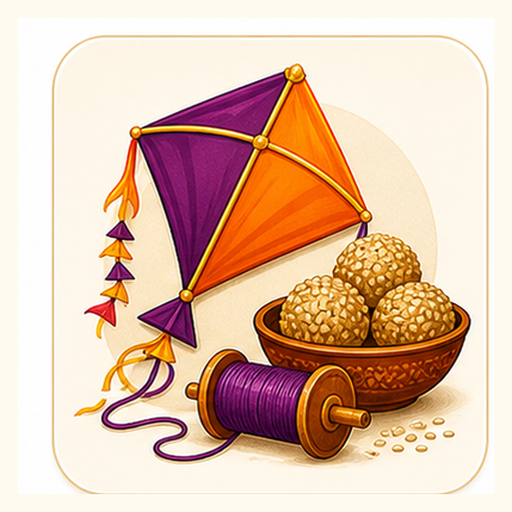
This year's dates (2026)
- Bhogi (day before) · Dhanurmas ends13 Jan
- Main day · Wednesday · Sun enters Makar 3.06 pm · punyakal 3.06 pm to sunset (6.19 pm) · Shake 194714 Jan
- Kinkrant / Karidin (day after)15 Jan
Note: this is a solar festival — its date is set by the Sun’s entry into Makar, not by a lunar tithi. So “this year’s date” and the exact time of the Sun’s entry come from that year’s panchang — see the 14 January 2026 day page.
Significance
What the name means.
Sankranti is the Sun’s transition from one rashi (zodiac sign) into the next; Makar is the Makar rashi (Capricorn). So the name literally reads “the Sun’s transition into Makar” — and that is exactly what this day marks.
Uttarayan.
Uttar (north) + ayan (movement) = the Sun’s northward turn. In Hindu tradition Uttarayan is considered the more auspicious half of the year, seen as favourable for new and spiritual undertakings.
The days start getting longer.
From around this time the depth of winter begins to ease and daylight slowly lengthens. That is why til (sesame) and gul (jaggery) — warming, oil-rich foods — carry special importance in this festival.
A subtle point: astronomical Uttarayan (the winter solstice) falls around 21–22 December, but in the festival’s popular tradition Sankranti itself is treated as the start of Uttarayan. Over the centuries these two dates have drifted apart (see “Why the date is fixed” below).
Why the date is fixed (yet still drifts slowly)
Because Makar Sankranti is tied to the Sun’s entry into Makar, its Gregorian date lands on 14 January in most years (15 January in leap years) — unlike most Hindu festivals, which follow a lunar tithi and shift date every year.
However, because of the Earth’s precession (roughly 1° every 72 years), the festival and the astronomical winter solstice are slowly separating. The last time the two coincided on the same day was long ago — around 291 CE. So the precise answer to “why is Sankranti always on 14 January?” is: it is solar, and its date creeps forward only very slowly, on the scale of centuries.
The legend (katha)
There is no single fixed scriptural story behind Sankranti; several independent legends are woven around it.
Sankranti Devi and Sankarasur.
In folk and panchang tradition, Sankranti is imagined as a goddess. In some versions she slays a demon named Sankarasur and frees people from his torment; and on the next day — Kinkrant / Karidin — she slays a demon named Kinkarasur. The heart of the story is the triumph of good over evil. This is chiefly a folk and panchang-tradition legend; its exact scriptural (Puranic) source is not established.
Surya and his son Shani.
The lord of Makar rashi is Shani (Saturn). By one legend, on Makar Sankranti Surya visits the home of his son, Shani. Though father and son are said to share a strained relationship, Surya comes to visit and Shani welcomes him with an offering of black til (sesame). Some versions trace the festival’s emphasis on til — and, in Maharashtra, the link with the colour black — to this story.
Bhishma and Uttarayan.
This story from the Mahabharata underlines why Uttarayan is held auspicious. Bhishma had the boon of choosing the moment of his own death; lying on a bed of arrows on the Kurukshetra battlefield, he did not give up his body until Uttarayan arrived — because it is believed that leaving the body during Uttarayan grants liberation from the cycle of birth and death (a belief referenced in the Bhagavad Gita). The original account is in the Mahabharata’s Anushasan Parva.
Who observes it
Makar Sankranti is a whole-family and community festival — everyone takes part. In Maharashtra the suvasini (married women) lead the haldi-kunku and vaan gatherings; children are given the boranhan shower; and a newly married woman’s first Sankranti is treated as special (the exact customs vary by household and region).
Puja vidhi (how it is observed)
Because it is a solar festival, Makar Sankranti has no single fixed formal puja sequence like a vrat. The main acts that genuinely apply to this parva are:
- Arghya to the Sun: in the morning (ideally after a bath), it is traditional to offer arghya (a water offering) to the Sun and bow to it.
- Til-bath and til-use: using til in the bath, eating tilgul, and giving til-gul in daan (charitable giving) are treated as the central acts of the parva.
- Sugad puja (Maharashtra): small earthen pots — sugad — are marked with haldi-kunku, tied with thread, and filled with carrot, ber (jujube), sugarcane pieces, groundnuts, cotton, chana, tilgul and raw khichdi. Traditionally some sugad are given to suvasini as vaan, one is offered to the tulsi, and one is kept at home. The exact order and count vary by household and region.
- Daan (in the punyakal): traditionally, charitable giving is done during the punyakal as one is able — a new vessel, fodder for a cow, food, til, gul, cloth, and so on. (The exact punyakal timing comes from that year’s panchang — see the day page for the date.)
Fasting & food (upvas)
Makar Sankranti is not a fasting festival — on the contrary, it is a day for deliberately eating and sharing tilgul and gulachi poli. Til and gul are traditionally regarded as warming and beneficial in winter (any dietary choice is, of course, per one’s own health).
Note: the Shattila Ekadashi that falls on the same day is a separate Vishnu-fast ekadashi — that is a distinct topic, not a Sankranti fast.
Mantra & aarti
There is no distinct “Sankranti aarti” or stotra tradition for this solar festival. Sun-worshippers may recite the Gayatri mantra, Surya Namaskar, or the Aditya Hridaya stotra on this day, but these belong to Sun worship in general, not to Sankranti alone. A simple daily jap-mantra is Om Suryaya Namah.
Regional variations (Maharashtra)
These Maharashtra customs are what give Sankranti its real colour:
- Tilgul and “Tilgul ghya, god god bola”: people exchange laddus and vadis of til with gul or sugar, and resolve to forget old grievances and speak sweetly to one another.
- Gulachi poli: a flatbread stuffed with gul is the signature Sankranti dish; on the preceding Bhogi, a til-topped bajra bhakri with a mixed vegetable is made.
- Haldi-kunku and vaan: suvasini gather for a haldi-kunku ceremony, share tilgul, and give away vaan (useful items); the hostess often buys a vessel for the occasion to give as vaan.
- Sugad puja: as described under Puja vidhi — the worship of earthen sugad pots is a Maharashtra speciality.
- Boranhan: young children are dressed in halva ornaments and showered on the head with a mix of puffed rice, ber, chana, sugarcane pieces and halva — a gesture of affection and protection for the child.
- Halva ornaments: ornaments made of white til coated in sugar syrup (halva) are worn by women and children.
- Black clothes: the colour black, usually avoided otherwise, is deliberately worn on this one festival (a practical link to holding warmth in winter is also cited).
- Kites: children and families fly kites (especially prominent across Maharashtra and Gujarat).
What Sankranti’s rup and phal mean
Each year the panchang describes a rup (form) for Sankranti — her vahan (mount), upavahan, garment, weapon, direction, name, and so on. From this, that year’s “Sankranti phal” (a general forecast) is drawn. Important: this rup and phal change every year — they are specific to that year and astrological in nature, not permanent. Read the exact rup and phal for a given year on that day’s panchang.
Good to know
- Kite string (manja): sharp and nylon manja injures birds and people; glass-coated manja is banned in many places. Use safe string and take care around the neck.
- Til-gul and health: those with diabetes or dietary restrictions should take jaggery- and sugar-heavy items in moderation, and anyone with a sesame allergy should avoid til (as per medical advice).
- Avoid date confusion: because the festival is solar, it falls on 14 January in most years and occasionally on the 15th — take “this year’s date” from the table above.
- Customs vary: sugad, vaan, and boranhan differ by household and region — check local practice if unsure.
FAQ
- When is Makar Sankranti in 2026?
- Wednesday, 14 January 2026. The Sun enters Makar rashi at 3:06 PM that day (source: the site’s panchang). The punyakal runs from 3:06 PM to sunset — see the day page (linked in the dates table) for details.
- Why does Makar Sankranti always fall on 14 January?
- Because it is a solar festival — it is set by the Sun’s entry into Makar, and its Gregorian date usually lands on 14 January (15 in leap years). Precession makes that date creep forward very slowly, over centuries.
- What is Uttarayan and when does it begin?
- Uttarayan is the Sun’s northward movement, considered an auspicious period. Astronomically it begins around 21–22 December, but in the festival’s popular tradition Sankranti itself is treated as the start of Uttarayan.
- Why do people give tilgul and say “Tilgul ghya, god god bola”?
- Til and gul are considered beneficial in winter; and the exchange stands for a resolve to forget old grievances and speak — and behave — sweetly with one another.
- Why are black clothes worn on Makar Sankranti?
- Black, usually avoided in Indian tradition, is deliberately worn on this one festival. A practical reason is also cited — black holds warmth in the cold of winter.
- What is a sugad and what goes in it?
- A sugad is a small earthen pot. It is marked with haldi-kunku and filled with items such as carrot, ber, sugarcane pieces, chana and tilgul, then worshipped and given away as vaan by tradition.
- What is the difference between Bhogi, Sankranti and Kinkrant?
- Bhogi is the day before (13 Jan) — of til-bhakri and mixed vegetables; Sankranti is the main day (14 Jan); and Kinkrant/Karidin is the day after (15 Jan).
- What is made / offered as naivedya on Makar Sankranti?
- Gulachi poli, tilgul laddus and vadis, and til-topped bhakri are the signature dishes. As it is not a fasting festival, sweets are made in plenty.