Vishwakarma Jayanti / Vishwakarma Puja
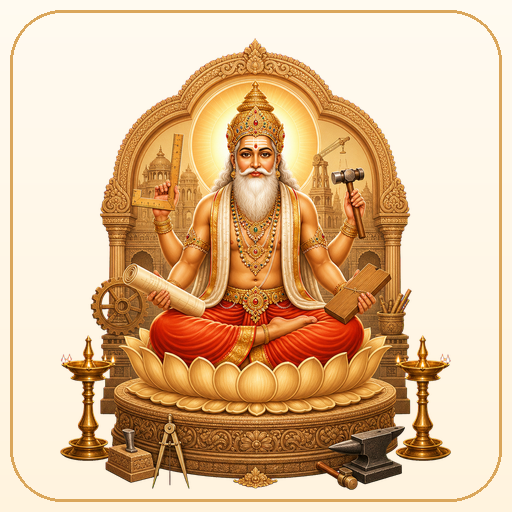
Vishwakarma Jayanti/Puja honours Vishwakarma, the divine architect who built the palaces and weapons of the gods. It's especially significant for architects, engineers, artisans (carpenters/blacksmiths/goldsmiths/stonemasons), and factory workers. This is a hybrid festival — two distinct, parallel date traditions under one name:
This year's dates (2026)
- Thursday; the widely observed tradition (Kanya Sankranti/Vishwakarma Din); the panchang's main festival that day is 'Jyeshtha Gauri Avahan'17 Sep
- Saturday; the panchang directly calls this 'Vishwakarma Jayanti'; the parallel tithi-based tradition31 Jan
- 17 September 2026 (Thursday) — Kanya Sankranti (the Sun's entry into Kanya rashi, a solar reckoning); the widely observed date across most of India (North India, East India, industrial regions) — with tool-worship in factories/workshops.
- 31 January 2026 (Saturday) — Magh Shukla Trayodashi (tithi-based); the panchang directly calls this day "Vishwakarma Jayanti" — a parallel tradition observed in parts of Gujarat and Rajasthan, and broadly across "North India."
Which date Maharashtra actually follows isn't clearly established by research — both claims rest on equally thin evidence, and neither is treated as settled here.
Significance
Vishwakarma first appears in Rigveda Mandala 10, Sukta 81-82 — where he isn't a personal deity but a title for an abstract, universal creative principle ("the all-seeing one" — with eyes, faces, hands, feet, and wings in every direction). He was transformed into a personal deity in the later Puranic period. In the early Vedas, the role of craftsmanship belonged to the deity Tvashtar, which was later linked to Vishwakarma.
Vishva (all) + karman (maker/creator) = "the maker/architect of all." The Sthapatya Veda (the science of mechanics and architecture) is associated with him.
As the gods' official architect, he built Dwarka (for Krishna), Indraprastha (for the Pandavas), Lanka (originally for Shiva-Parvati), and Swargalok (heaven); he also crafted divine weapons/vehicles such as the Sudarshan Chakra (Vishnu), the Trishul (Shiva), the Vajra (Indra), and the Pushpak Vimana (Kubera).
Carpenters, blacksmiths, goldsmiths, stonemasons, and coppersmiths — these five groups together form the traditional "Vishwakarma community"/"Panchal" — for whom he is regarded as the kuladevata. Names vary by region (Panchal in Punjab, Lohar in North India, Suthar in West India). His modern relevance has expanded from traditional craftsmanship to modern engineering/machine industries — as a festival honouring skill, labour, and creativity.
The legend
Four different Puranic accounts of Vishwakarma's origin/parentage are found — none is presented here as "correct." The creation stories (Dwarka/Lanka/weapons), however, are consistent across all sources.
Common core: Vishwakarma is regarded as the divine architect/craftsman of creation — connected to Brahma (either as his son or his creation). What he built includes Dwarka (for Krishna), Indraprastha (for the Pandavas, a palace creating illusions of land and water), Lanka (originally a golden city for Shiva-Parvati, later seized by Ravana), Swargalok, the Pushpak Vimana, and divine weapons — the Sudarshan Chakra/Trishul/Vajra.
Variations on parentage/origin:
- The Vashishtha Purana traces a lineage: Dharma (Brahma's son) → Vastudeva → Vishwakarma.
- The Skanda Purana and the Mahabharata's Adi Parva describe him as the son of Prabhas (Dharma's eighth son) and Bhuvana (Brihaspati's sister).
- The Vayu Purana places him within the lineage of sage Bhrigu.
- The Varaha Purana holds that Brahma created him directly on Earth for the welfare of the universe.
The names in these versions partly overlap, but the details/textual attribution don't agree.
One account holds that Vishwakarma married the apsara Ghritachi; his daughters were Sanjna (married to Surya), Barhishmati, and Chitrangada. Sanjna, unable to bear Surya's intense brilliance, returned to her father's home — Vishwakarma then reduced Surya's brilliance and crafted the Sudarshan Chakra, Trishul, and Vajra from the shavings.
The Brahma Vaivarta Purana also describes various artisan castes (florists, metalworkers, weavers, carpenters, stonemasons, potters) as having originated from Vishwakarma and Ghritachi.
Related but distinct — avoid confusion: Rishi Panchami (Bhadrapad Shukla Panchami) is, per one view, said to commemorate Vishwakarma's five children — this is a separate festival, not to be merged with Vishwakarma Jayanti/Puja.
Who observes it
Generally, architects, civil/mechanical/industrial engineers, factory/workshop owners and workers, machine operators, and mechanics/welders observe this day.
The traditional artisan community — carpenters, blacksmiths, goldsmiths, stonemasons, coppersmiths (collectively the "Vishwakarma community"/Panchal) — regard him as their kuladevata; this community is active in Maharashtra too.
No source found any selective/strict eligibility condition — the general tone across all sources is that ordinary people (especially those who use vehicles/appliances) may also worship their tools/machines on this day.
Puja vidhi
A general sequence (combined across sources): bathing → cleaning the puja space → installing an image/idol of Vishwakarma → offering betel leaf-nut, turmeric, akshata, flowers → incense-lamp and aarti → naivedya (fruit/sweets) → distributing prasad.
Industrial/factory context (chiefly 17 September): cleaning and worshipping machines, tools, and equipment — applying turmeric-kumkum/tilak, flowers-garlands, incense-lamp; distributing prasad to workers; many factories are closed that day.
Household/community context (Magh Shukla Trayodashi): worship at the individual/family level, worship of tools/equipment — one source describes this occasion as "a deeper, personal prayer for one's craft." The exact sequence/details, however, weren't found.
What you need
Turmeric-kumkum, akshata, flowers-garlands, betel leaf-nut, incense-lamp, fruit/sweets for naivedya, an image/photo of Vishwakarma, materials for cleaning (for tools/machines).
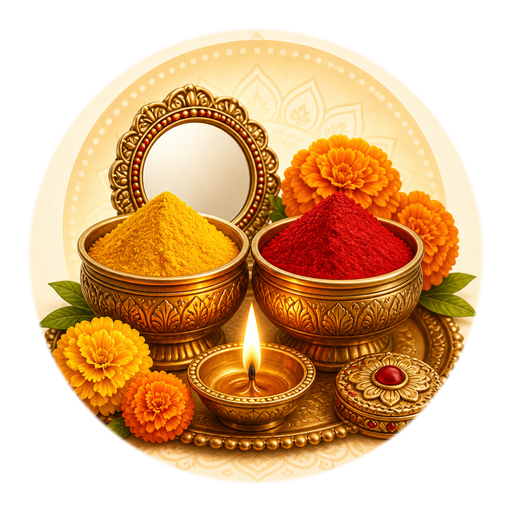 Turmeric-kumkum
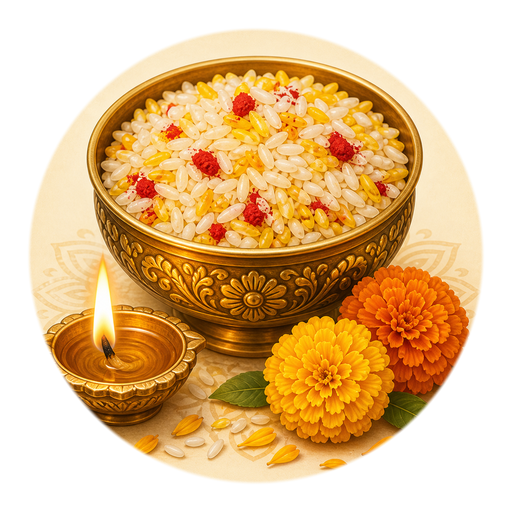 Akshata
 Flowers
 Garlands
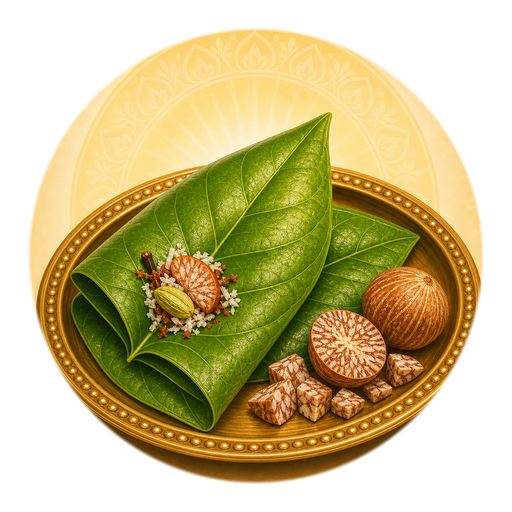 Betel leaf and nut
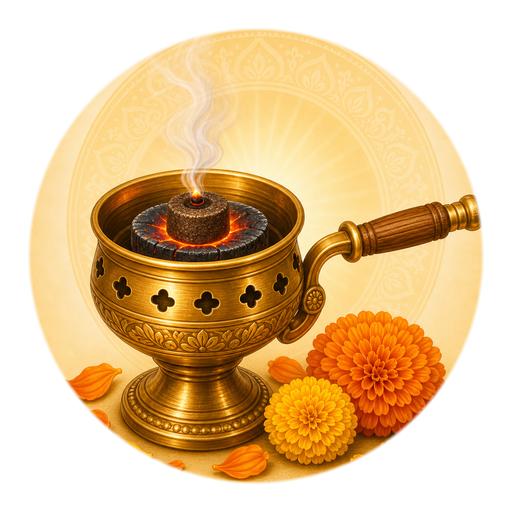 Incense
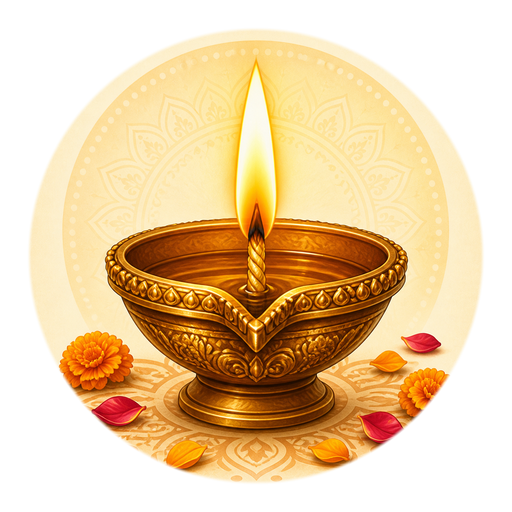 Lamp
Lamp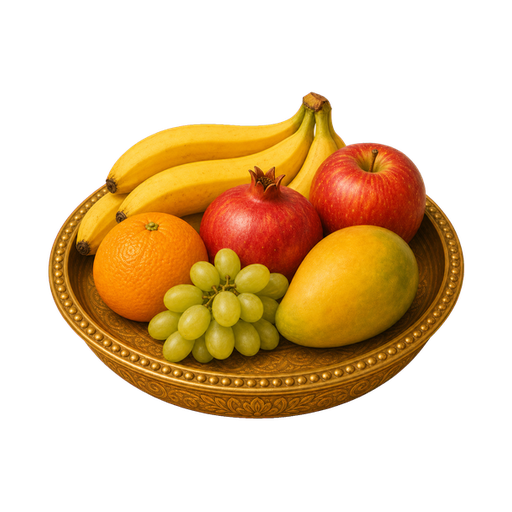 Fruit
Fruit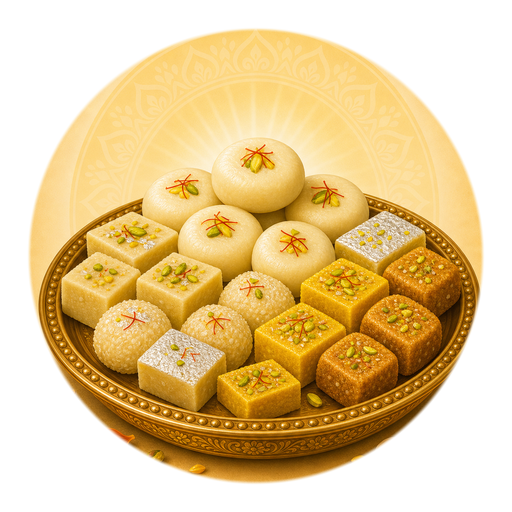 Sweets
Fasting
No source mentions fasting — this isn't a fasting festival; instead, naivedya and prasad distribution are central (distributing sweets/treats to workers is a common practice).
Mantra
The meaning of the dhyana mantra is a general hymn of praise, saluting Vishwakarma through Adhara-shakti, Kurma, Ananta, and Prithvi, invoking him for the accomplishment of creation.
Regional customs
Evidence for Maharashtra-specific customs is limited — most of what's documented is either pan-Indian or specific to other states.
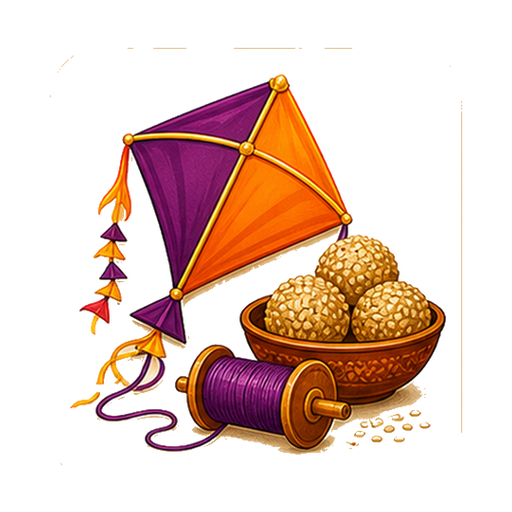
In West Bengal and Gujarat, a kite-fighting custom ("Ebo Kata") is popular on Kanya Sankranti day; in Bihar-Jharkhand, the emphasis is instead on tool-worship, with kite-flying being secondary. Maharashtra does not appear to have a comparable kite-flying custom.
There's a soft signal that in industrial states like Gujarat and Maharashtra, many factories remain closed on 17 September so workers can participate.
Eastern India (in a West-Bengal-like pattern) shows a strong tradition of idol installation — Maharashtra does not appear to have a comparable large public idol tradition.
State list (hedged due to source inconsistency): 17 September is chiefly observed in North India, East India (West Bengal, Odisha, Jharkhand, Bihar, Assam, Tripura), and industrial states; per some sources, Rajasthan-Haryana-Punjab are in this group too; the Magh date is observed in parts of Gujarat and Rajasthan, and broadly across "North India" — but these two claims partly overlap/conflict, and no state list is treated as settled here.
A special note on Maharashtra: one unverified claim suggests that Maharashtra's Panchal/carpenter-goldsmith-blacksmith community observes the jayanti specifically on the Magh date, while an equally unverified soft signal suggests Maharashtra's industrial areas observe 17 September — both claims rest on the same (thin) evidence level, and neither is treated as settled here.
Good to know
- Don't answer "when is Vishwakarma Jayanti?" with a single date — clarify which tradition is being asked about first.
- 17 September is a "restricted holiday" per the Government of India — not all banks/offices/schools will necessarily be closed; check local notices.
- Take safety precautions with sharp or electrical equipment while cleaning and worshipping tools/machines.
- The puja sequence and date choice vary by state/community — avoid making a firm claim, especially about Maharashtra.
FAQ
- When is Vishwakarma Jayanti in 2026?
- Two dates — 17 September 2026 (Thursday, Kanya Sankranti, the widely observed one) and 31 January 2026 (Saturday, Magh Shukla Trayodashi, a parallel tithi-based tradition).
- Why is Vishwakarma Jayanti observed twice a year?
- One tradition is based on the solar calendar (the Sun's entry into Kanya rashi, 17 September); the other on the lunar tithi (Magh Shukla Trayodashi) — two different regional panchang traditions place the same deity's festival on two different dates.
- Is there a difference between Vishwakarma Puja and Vishwakarma Jayanti?
- Generally the two terms are used interchangeably — but the panchang makes a subtle distinction, using "Jayanti" specifically for the Magh (January) date and "Din" for September.
- Whose son is Lord Vishwakarma?
- The Puranas give different answers — some say he's Brahma's son/creation, some say he's the son of Prabhas (one of the Ashta Vasus) and Bhuvana/Varastri, some place him within the Bhrigu lineage. No single version is treated as final.
- What did Vishwakarma create?
- Dwarka, Indraprastha, Lanka (the original), Swargalok, the Pushpak Vimana, and the divine weapons Sudarshan Chakra/Trishul/Vajra.
- How is puja performed on Vishwakarma Jayanti?
- Cleaning and worshipping tools/machines (turmeric-kumkum, flowers, incense-lamp, naivedya), and distributing prasad — communally in factories, individually at home/in communities.
- Is there a holiday for Vishwakarma Jayanti/Puja?
- A "restricted holiday" (optional) per the Government of India — not a gazetted national holiday; it varies by state/organization.
- Which date does Maharashtra observe Vishwakarma Jayanti on?
- This can't be stated with certainty — there's a soft signal that Maharashtra's industrial areas observe 17 September; the link to the Magh date is equally unverified — both claims rest on the same (thin) evidence level.