Vasant Panchami
Vasant Panchami falls on Magh Shukla Panchami — known mainly for the puja of Saraswati, the goddess of learning, arts, and music, and for welcoming Vasant Ritu (spring). This year (2026): Friday, 23 January. Maharashtra doesn't celebrate it on the grand scale seen in North India or Bengal, but the same day brings together two Maharashtra-specific occasions: Sant Tukaram Maharaj's birth anniversary at Dehu, and the Vitthal-Rukmini wedding ceremony at Pandharpur.
This year's dates (2026)
Significance
Vasant Panchami marks the passing of Shishir Ritu and the arrival of Vasant Ritu (spring) — celebrated as a symbol of nature's renewal, yellow mustard blossoms, and mango trees coming into bloom. Its central significance is Saraswati puja — students, artists, and musicians worship Saraswati on this day, seeking her blessing for learning, the arts, and knowledge. The akshararambha rite (a child's first formal letters) is also commonly performed on this day.
Some traditions also worship Lakshmi-Vishnu on this day, while others hold Kamadev-Rati puja as the primary observance. "Vasant Panchami is Saraswati Jayanti" is a widely repeated equivalence, but it isn't a universally accepted statement — some traditions place Saraswati's birth on a different tithi altogether.
The legend
The story behind Vasant Panchami varies by tradition — three distinct threads are in circulation: Saraswati's manifestation, the Kamadev-Rati legend, and the arrival of Ritu-raja Vasant.
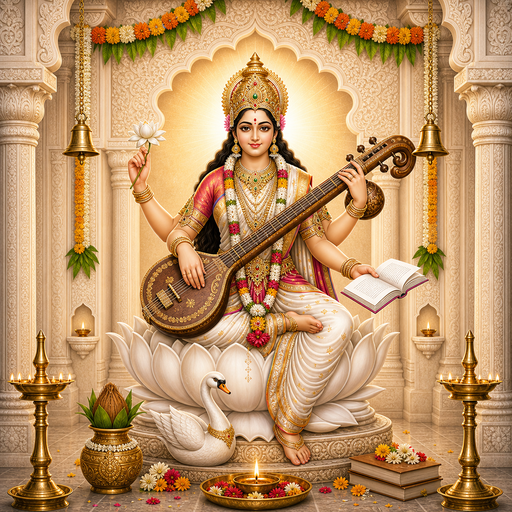
Saraswati's manifestation: by one tradition, after Brahma created the universe, he felt it lacked speech, sound, and knowledge; through his resolve and from his own mouth, veena-bearing Saraswati manifested — her veena's music gave creation its voice and rhythm. This day is held to be that day of manifestation.
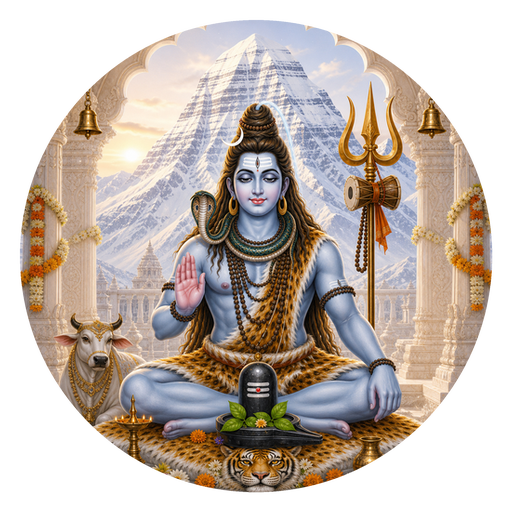
The Kamadev-Rati legend: while Shiva was deep in penance after Sati's death, the gods asked Kamadev (the god of desire) to disturb his meditation; Kamadev shot a flower-arrow at Shiva, who, enraged, burned him to ash with his third eye. After his wife Rati's grief and penance, Shiva restored Kamadev to life (in a bodiless form, or his original form, depending on the version). Some traditions place this revival on Vasant Panchami.
The arrival of Ritu-raja Vasant: some traditions treat Vasant Panchami as a pure seasonal festival — Vasant Ritu is honoured as "Ritu-raja" (king of seasons), and its arrival is welcomed, with no specific divine legend behind it.
Who observes it
Students, teachers, artists, musicians, and those connected to literature and the arts worship Saraswati. Parents commonly have their young children's akshararambha (first-letters) rite performed on this day. Ordinary households also worship an image of Saraswati, or their books and instruments, at home.
Puja vidhi
The sequence below is compiled from multiple sources as a general guide — not a fixed, single-correct ritual; it can vary by family and local custom.
- An image or picture of Saraswati is placed on a yellow cloth or low platform (chaurang); yellow flowers (especially mustard or marigold) and yellow cloth are offered.
- Books, notebooks, pens, and instruments (especially a veena or harmonium) are placed at the puja spot and worshipped too — as tools of knowledge and art.
- Haldi-kumkum, akshata, incense and lamps, and a yellow-coloured naivedya (saffron rice, boondi, or halwa) are offered.
- The traditional Saraswati Vandana is recited; its exact wording varies by household.
- Children's akshararambha rite — tracing the first letter with a finger or pen on rice or a slate — is performed on this day.
- The puja concludes with the distribution of prasad.
Puja samagri
An image or murti of Saraswati, yellow cloth, yellow flowers (mustard/marigold), books-notebooks-pens, an instrument (veena/harmonium if available), haldi-kumkum, akshata, incense-lamps, and a yellow-coloured naivedya (saffron rice/boondi/halwa).
Fasting / naivedya
There's no widespread custom of a strict fast on Vasant Panchami — it's a celebratory day, not a vrat. The custom of offering yellow-coloured food (saffron rice, boondi, halwa) as naivedya is well documented. Some sources mention raw-mango dal or panhe (raw-mango drink) as naivedya, but raw mangoes are in season around Chaitra, roughly two months later, not Magh — so this claim looks doubtful.
Regional customs
- Maharashtra's low-key scale: Vasant Panchami in Maharashtra isn't marked by the large public celebrations seen in Bengal — it's mostly confined to household and school-level Saraswati puja.
- Sant Tukaram Maharaj Jayanti (Dehu): in the Warkari tradition, this day is held to be Sant Tukaram Maharaj's birth anniversary — a special observance takes place at Dehu. His exact birth year is disputed across sources (roughly Shake 1530, though the precise year varies), but his birth falling on Vasant Panchami is widely accepted.
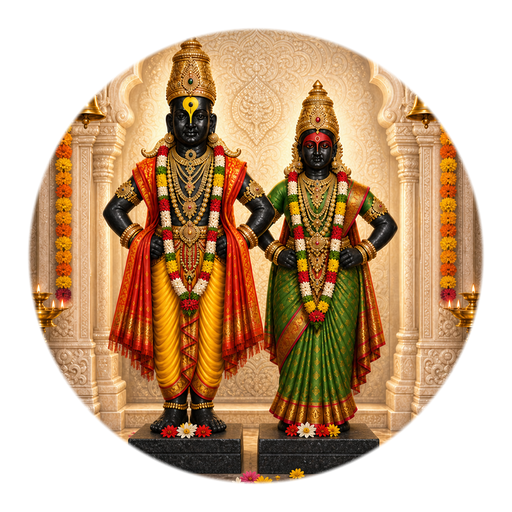
- The Vitthal-Rukmini wedding at Pandharpur: the same day sees the Vitthal-Rukmini wedding ceremony at Pandharpur — one of the Pandharpur Vitthal temple's annual traditions. The exact clock-time varies from year to year — check the day page or that year's local temple schedule.
- Bengal marks the day with grand public pandals installing and later immersing Saraswati images; Maharashtra's observance is considerably smaller and more homely in scale by comparison.
This year's date
| Date (2026) | Day | Tithi | Nakshatra | Note |
|---|---|---|---|---|
| 23 January | Friday | Magh Shukla Panchami | Purva Bhadrapada | Saraswati puja; Sant Tukaram Jayanti (Dehu) and the Vitthal-Rukmini wedding at Pandharpur fall on the same day |
Preceding/following reference: Makar Sankranti (the major festival before Magh) falls roughly 10 days before Vasant Panchami; Mahashivratri follows later in Magh. Future years: the tithi stays the same (Magh Shukla Panchami); the Gregorian date follows that year's panchang.
Good to know
- Yellow is the colour of the day — cloth, flowers, and naivedya favour yellow, as a symbol of spring.
- An auspicious day for akshararambha — starting a child's education is traditionally performed on this day.
- A low-key festival in Maharashtra — no grand scale expected; a household puja is enough.
- The legend varies by tradition — Saraswati's manifestation, the Kamadev-Rati story, and the welcome of the season are three separate threads; none is presented as the sole "correct" one.
FAQ
- When is Vasant Panchami in 2026?
- Friday, 23 January 2026 (Magh Shukla Panchami, Purva Bhadrapada nakshatra).
- Which deity is worshipped on Vasant Panchami?
- Mainly Saraswati; some traditions also worship Lakshmi-Vishnu or Kamadev-Rati.
- Is Vasant Panchami the same as Saraswati Jayanti?
- It's widely held to be, but this isn't a universally accepted equivalence — some traditions place Saraswati's birth tithi elsewhere.
- Why is akshararambha performed on Vasant Panchami?
- Since Saraswati is the goddess of learning and knowledge, this day is considered auspicious for starting a child's education.
- What's the connection between Vasant Panchami and the spring season?
- The day symbolizes the arrival of Vasant Ritu (spring) after Shishir — celebrated as nature's renewal and the welcome of the season.
- How is Vasant Panchami celebrated in Maharashtra?
- Rather than the grand public festivities seen in Bengal, Maharashtra observes household and school-level Saraswati puja; the same day also brings Tukaram Jayanti at Dehu and the Vitthal-Rukmini wedding at Pandharpur.
- What is offered as naivedya on Vasant Panchami?
- Yellow-coloured food — saffron rice, boondi, or halwa — is the well-documented custom.