Pandharpur Vitthal-Rukmini Temple
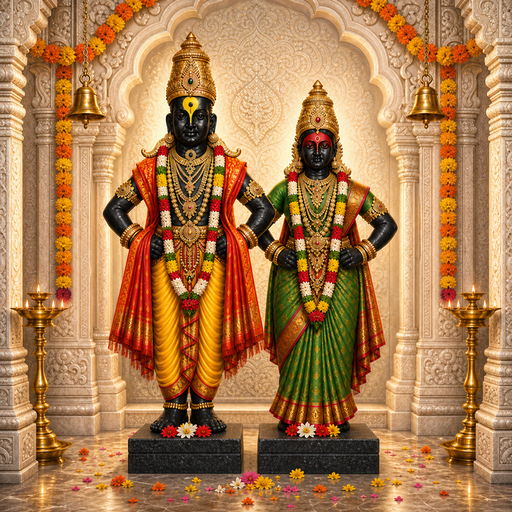
Pandharpur (in Solapur district, on the banks of the Bhima/Chandrabhaga river) is the great kshetra (holy place) of Vitthal (Vithoba / Panduranga) and Rukmini (Rakhumai), and the central tirtha (pilgrimage centre) of the Varkari tradition. The black-basalt idol of Vithoba in the garbhagriha (sanctum), about three-and-a-half feet tall, stands on a brick with both hands on the hips — this is the temple's most recognisable form. Four annual waris (pilgrimages) come here — Chaitri, Maghi, Ashadhi and Kartiki (each on a Shukla-paksha ekadashi); Ashadhi is the biggest. For Ashadhi, the palkhis (palanquins) carrying the padukas (sacred footwear) of Sant Dnyaneshwar from Alandi and Sant Tukaram from Dehu walk on foot to Pandharpur.
This year's dates (2026)
- Maghi Wari (Jaya Ekadashi)29 Jan
- Chaitri Wari (Kamada Ekadashi) — first wari of the year29 Mar
- Ashadhi Wari (Devshayani Ekadashi) — the biggest wari25 Jul
- Kartiki Wari (Prabodhini, smarta Ekadashi) — second-biggest wari20 Nov
Deity & significance
The main deity is Shri Vitthal — regarded as an avatar of Vishnu/Krishna; the names “Vithoba” and “Panduranga” are commonly used. His consort Rukmini (Rakhumai) stands in a separate garbhagriha, also with hands on the hips on a brick.
This temple is the heart of the Varkari tradition. It is the central pilgrimage site for the bhakti tradition of the Dnyaneshwar–Namdev–Eknath–Tukaram lineage of saints; abhang, bhajan, kirtan and the “Vitthal Vitthal” naam-gajar (chanting of the name) are the living forms of devotion here. Vitthal is regarded as the kuldaivat (family deity) of many Marathi families.
Near Pandharpur the Bhima river bends like a crescent, so it is called the Chandrabhaga; a bath in it during the wari is held to carry special merit.
The significance, mahatmya (glory) and ritual details can vary by family and region — no single practice should be taken as universal.
History & legend (sthala-purana)
The sthala-purana below is an original retelling built on the common thread across several versions. The exact version recognised by the temple trust and local tradition may differ.
The story of Pundalik
Pundalik (Pundarik) was a devotee absorbed in the service of his parents. It is said that when the Lord himself came to meet him, Pundalik did not think it right to interrupt his parents' service midway. He threw out a brick and asked the Lord to stand on it and wait a while.
The Lord stood quietly on the brick with his hands on his hips. Pleased by Pundalik's devotion to his parents and his humility, he is believed — in Varkari faith — to have remained there forever in the form of Vithoba. This is why Vithoba is said to stand on a brick to this day.
Where the versions differ
The details of this story differ across sources; no single version should be treated as final:
- By some accounts the Lord comes as Gopala-Krishna from Govardhan with his cows and accepts the request to stay on the banks of the Bhima.
- By other accounts (including the compositions of Sant Tukaram) Vithoba is shown in the form of Bala-Krishna (the child Krishna).
- Sridhar's Panduranga-Mahatmya gives an expanded narrative in which Pundalik first neglects his parents while caught up in worldly life, and later reforms through the company of the wise.
Origin and historicity — a scholarly debate
Scholars disagree about the origin of Vitthal and the historicity of Pundalik; this should be read as an open debate, not a conclusion:
- The derivation of the name “Vitthal” is contested. The Varkari tradition offers a simple derivation — “vit (brick) + thal (place) = one who stands on a brick”; some scholars instead link it to the Kannada word “Vitthu” (a variant of Vishnu).
- The name “Panduranga” (meaning the white/fair one) applied to a dark deity is itself debated; some scholars suggest an original Shaiva connection later attached to Vithoba.
- Theories about the original nature of the deity also differ — some hold Vithoba to have been originally a pastoral/cowherd god, some a pre-Vedic folk deity, and some a tradition that migrated to Pandharpur from Karnataka. Pundalik's own Shaiva shrine (with a Shiva linga) is treated as one pointer to a Shaiva-to-Vaishnava transition.
- Whether Pundalik was historical or mythical also has two camps among scholars — one treats him as a historical figure of about the 12th century, the other as wholly mythical. This disagreement remains unresolved.
By some accounts, inscriptions and copper plates of around the 13th century carry the name “Vitthal”, and the older parts of the temple are held to be from the Yadava period (12th–13th century), with much of the construction later. There is also a legend that the idol was taken to Hampi during the Vijayanagara period and later brought back by Bhanudas.
Architecture
- Hemadpanti style — built with black basalt and lime; the large stones are mostly laid dry-stone, without mortar.
- The temple has six gates / mahadwaras; the main eastern entrance is the Namdev gate.
- Namdev Payari: at the mahadwar is a step that holds the samadhi of Sant Namdev; following Namdev's wish, devotees touch it as they enter. (It is commonly described as “the first of the steps”; verify the exact step count at the temple itself.)
- Inside is a sola-khambi (sixteen-pillar) sabha-mandap (assembly hall) and a deepmala hall; the garbhagriha houses the roughly three-and-a-half-foot black-basalt Vithoba idol standing on a brick, with a separate Rukmini garbhagriha alongside.
Festivals & yatra (wari)
Pandharpur has four waris a year, and all are tithi-based (each on a Shukla-paksha ekadashi) — there is no solar-fixed event (nothing like a Kiranotsav) here. In the table below, the tithi of each wari is the real anchor; this year's (2026) dates resolve from that day's panchang.
| Wari | Tithi (masa / paksha / tithi) | This year's date (2026) | Nakshatra | Note |
|---|---|---|---|---|
| Chaitri Wari | Chaitra Shukla Ekadashi (Kamada) | 29 March 2026 | Ashlesha | first wari of the year |
| Maghi Wari | Magh Shukla Ekadashi (Jaya) | 29 January 2026 | Rohini / Mrig | — |
| Ashadhi Wari | Ashadh Shukla Ekadashi (Devshayani) | 25 July 2026 | Jyeshtha | the biggest wari; Chaturmas begins; see the Ashadhi Ekadashi page for more |
| Kartiki Wari | Kartik Shukla Ekadashi (Prabodhini, smarta) | 20 November 2026 | Uttara Bhadrapada | second-biggest wari; during the yatra the temple stays open for 24-hour darshan |
Verify the yatra dates and parvakaal with the temple trust.
- A note on Kartiki 2026: this year's Kartiki is the smarta Prabodhini Ekadashi (20 November); the next day (21 November) marks the start of Tulsi Vivah. Whether the culmination falls on the smarta day or the Bhagavata day, per the temple's yatra, should be checked with the temple trust.
- Ashadhi Wari (palkhi): the padukas of Sant Dnyaneshwar from Alandi and Sant Tukaram from Dehu are carried in palkhis to Pandharpur; the journey runs from the Indrayani to the Chandrabhaga (Bhima) over about 21 days and roughly 250 km on foot. The wari tradition is held to be about seven to eight centuries old.
- The history of the palkhi tradition is told differently by different sources. By some accounts, the paduka-palkhi practice began in the late 17th century and Haibatravbaba Arphalkar gave it its present dindi (procession-group) organisation in the early 19th century; by other accounts, this practice and reform are attributed to different people. So no single account should be treated as definitive.
- The number of devotees who join the wari is reported differently across sources; without giving a firm figure, one can only say that Ashadhi is the largest, followed by Kartiki, with Maghi and Chaitri comparatively smaller.
Darshan & aarti timings
The timings below were published on the official temple trust website (accessed 30 June 2026). Timings can change, and during the yatra there is extended or 24-hour darshan — verify with the temple trust before publishing and before your visit. (These are the temple's own timings; they are not location-dependent.)
Per the official trust's daily schedule:
- Darshan: 6:00–11:00 AM · 11:15 AM–4:30 PM · 5:00 PM–11:15 PM (the Namdev Payari door is closed 1:00–4:00 AM).
- Kakad aarti & nitya-puja: 4:00–5:30 AM.
- Maha-naivedya: 10:45–11:00 AM (darshan closed during this window).
- Poshakh (adorning the deity): 4:30–5:00 PM (darshan closed roughly 4:40–5:00 PM).
- Dhoop aarti: 6:45–7:00 PM.
- Shej aarti: 12:00–1:00 AM.
- Maha-puja booking and the padasparsha/mukh darshan arrangement are handled through the official portal — check details with the temple trust. (Note that an unofficial/private booking portal is not the temple trust.)
Special rituals
The practices below have been handed down by tradition; their exact current arrangement should be checked with the temple trust.
- Padasparsha darshan and mukh darshan: there are usually two arrangements — darshan by touching the feet of the idol (padasparsha) and darshan of the face from a distance (mukh darshan); the queue and timings change during the yatra and should be checked with the trust.
- It is a customary practice to touch the Namdev Payari while entering the temple.
- A bath in the Chandrabhaga, dindi–abhang–kirtan, and the “Vitthal Vitthal” naam-gajar are the main devotional practices of the wari.
- Ashadhi Wari is the day of Chaturmas arambh (Devshayani); the details of the ekadashi upvas (fast) and vrat vidhi connected with Vitthal are on the Ashadhi Ekadashi page.
How to reach
- Location: Pandharpur, Solapur district, Maharashtra; on the banks of the Bhima (Chandrabhaga) river.
- Rail: Pandharpur has its own railway station (on the Miraj–Kurduwadi–Latur line); Kurduwadi is about 50 km, and Solapur (about 74 km) is the nearest major railway junction.
- Road / bus: there are regular MSRTC buses from Mumbai, Pune, Solapur and Kolhapur.
- Approximate distances: Pune about 204 km, Mumbai about 386 km, Solapur about 74 km.
Nearby places
- Shri Pundalik temple — on the banks of the Chandrabhaga.
- Sant Namdev temple / Namdev Payari — at the mahadwar.
- Vishnupad temple — to the south of the Pundalik temple, by the river.
- Gopalpur — Shri Gopalkrishna temple.
- For other major kshetras in and beyond the Solapur region, you can also see pages like the Jyotiba temple.
Travel tips
- During the yatra (especially Ashadhi and Kartiki) there are huge crowds — the darshan queue and timings change and the temple may stay open 24 hours; check the trust's portal or contact number before your visit.
- For the summer Ashadhi Wari, take care with the heat, enough water and footwear; stay alert about safety in the crowds by the river.
- Book darshan slots and maha-puja only through the official portal; avoid unauthorised touts.
- Crowds, timings and rates vary from year to year — so get up-to-date information before you visit.
Mantra & aarti
The traditional aartis below are public-domain compositions. Pronunciation, tune and the exact variant can differ a little by tradition.
Naam-jap (any time): “Vitthal Vitthal” and “Jai Jai Ram Krishna Hari” are the beloved naam-gajar (chant of the name) of the Varkaris.
Vitthal aarti — “Yuge atthavis vitevari ubha…” (by Sant Namdev): this aarti, usually sung at darshan and during the wari, pictures the Lord who has stood on the brick “for twenty-eight ages” with Rakhumai at his side; it recalls Pundalik's meeting, the Bhima/Chandrabhaga at his feet, and the Vaishnavas dancing with dindis and flags at Pandhari.
Vitthal aarti — “Yei ho Vitthale majhe mauli ye…” (by Vishnudas Nama): a devotee's tender call to Vithoba as “mother”, waiting with a hand on the brow, saying that in Pandharpur is his mother-and-father, and that Vithoba's reign is a daily Diwali for his devotees.
Good to know
- Always verify the darshan-aarti timings and yatra dates with the temple trust — the schedule changes especially during the yatra.
- The versions of the sthala-purana / Pundalik katha differ.
- Book only through the official temple portal; a private booking portal is not the temple trust.
FAQ
- Who is the Vitthal of Pandharpur?
- Vithoba (Panduranga) — regarded as an avatar of Vishnu/Krishna and the beloved deity of the Varkaris. His idol stands on a brick with both hands on the hips.
- What are the temple's darshan timings?
- Per the official trust, from 6:00 AM to about 11:15 PM (darshan is closed during the naivedya/poshakh windows). Verify the timings and the yatra-time schedule with the temple trust.
- Why does Vitthal's idol stand on a brick?
- Pundalik, busy in the service of his parents, had the Lord wait on a brick; in memory of that devotion Vithoba is said to stand on a brick (the versions of the story differ).
- How many waris does Pandharpur have, and which ones?
- Four — Chaitri, Maghi, Ashadhi and Kartiki (all on a Shukla-paksha ekadashi). Of these, Ashadhi is the biggest and Kartiki the second-biggest.
- What is Ashadhi Wari, and when is it?
- The palkhis carrying the saints' padukas from Alandi and Dehu walk to Pandharpur, and the wari culminates on Ashadh Shukla Ekadashi. In 2026: 25 July. For more, see the Ashadhi Ekadashi page.
- What is the Namdev Payari?
- A step at the mahadwar holding the samadhi of Sant Namdev; following Namdev's wish, devotees touch it as they enter.
- How do you reach Pandharpur?
- Solapur (about 74 km) is the nearest major railway junction; Pandharpur also has its own railway station. There are regular buses from Pune, Mumbai and Solapur.
Related Info
 Ashadhi Ekadashi25 Jul
 Jyotiba (Wadi Ratnagiri, Kolhapur)8 Feb
 Alandi Sant Dnyaneshwar Samadhi Mandir8 Jul
 Paithan — Sant Eknath Maharaj Samadhi Mandir9 Mar
 Dehu — Sant Tukaram Maharaj5 Mar
 Akkalkot Swami Samarth19 Feb
 Shegaon Gajanan Maharaj8 Feb
 Shirdi Sai Baba26 Mar
 Sajjangad — Samarth Ramdas Samadhi11 Feb