Chaitra Gauri
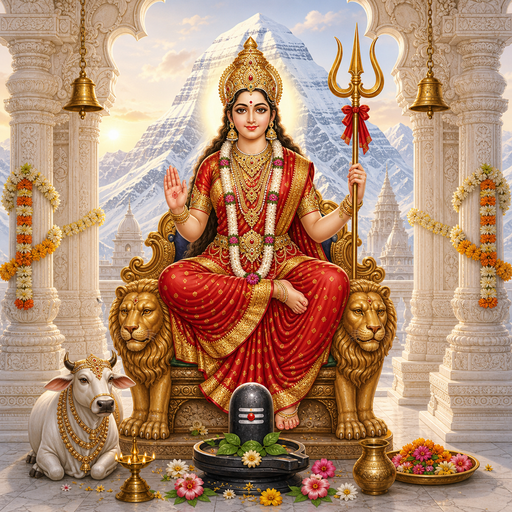
Chaitra Gauri is a month-long women's vrat (observance) in Maharashtra — from Chaitra Shukla Tritiya to Akshaya Tritiya, Gauri (Parvati, often in her Annapurna form) is seated in a small zhopala (a swing/cradle) and worshipped daily. The belief is that in Chaitra, Gauri comes home to her maher (parents' home), so she is fussed over for a whole month — the chaitrangan rangoli in the courtyard and a haldi-kunku (a women's turmeric-and-vermilion gathering) on one day of the month are this vrat's special draw.
This year's dates (2026)
- Aarambh / installing Gauri (sthapana)21 Mar
- Sangata / udyapan — the last haldi-kunku day of the month19 Apr
Significance
Chaitra is the first month of the Marathi new year; Gudi Padwa and Chaitra Navratri also fall in it. Against this backdrop, treating Gauri as a maherwashin (a married daughter visiting her parents' home) and doting on her for a month is the central idea of Chaitra Gauri.
In Maharashtra, Gauri's puja is often linked with her Annapurna form — that is, the honouring of the homemaker who gives food and runs the household. This is why it is regarded as a women-centred vrat, tied to the home.
Social significance: the haldi-kunku is an occasion for the women of the neighbourhood and family to meet, chat and share hospitality — a warm gathering for women.
The month ends on Akshaya Tritiya — regarded as one of the three-and-a-half fully auspicious muhurats of the year — so the festival closes on an auspicious note.
The legend (katha)
There are two separate stories tied to Chaitra Gauri.
(a) The maherwashin folk-belief (specific to Chaitra Gauri).
The vrat turns on this feeling. The belief is that in the month of Chaitra, Gauri (Parvati) comes home to her maher; she arrives as a young girl and, on Akshaya Tritiya, returns grown to her husband's home. Just as a daughter who comes to her parents' house is doted upon, so is Gauri for a whole month — the zhopala, the daily puja, the haldi-kunku, the oti (a lap offering of grains and fruit). This is not a fixed puranic event but a tender idea/belief — and it is the real ‘why’ of Chaitra Gauri.
(b) The Annapurna puranic story (of the goddess Annapurna, indirectly linked).
Once, in a conversation on Kailas, Shiv said that the whole world — food included — is only maya (illusion), and that Brahman alone is real. Parvati did not agree; to call food an illusion felt like a denial of her very self, and she vanished. The moment she disappeared, the world lost its abundance of food, a famine set in, and gods, humans and all creatures, tormented by hunger, began to pray. Moved by compassion, Parvati appeared in Kashi as Annapurna and began serving food to all. Shiv too came to Kashi with a begging bowl and accepted that food is not mere illusion — it is needed to nourish the body and one's spiritual practice. The heart of this story is that the homemaker who runs the house and gives food (Annapurna) is worthy of reverence.
In some versions the argument is set on Kailas in general terms, while in others the emphasis is on Kashi; the length and details of the famine differ from version to version. Only the heart of the story stays constant.
Who observes it
This is mainly a women's vrat — suvasinis (married women) and unmarried girls. Gauri is installed in homes, and women of the neighbourhood and family are invited for the haldi-kunku.
It is a home-centred, women-led vrat (an honouring of the homemaker and of Annapurna). No standard source gives a strict rule of age or eligibility — participation is decided by regional and family custom.
Puja vidhi (how to perform)
Below is the general shape of the puja vidhi; the details differ by household and region.
- Sthapana (Chaitra Shukla Tritiya) — Gauri (often a metal Annapurna murti) is installed — seated in a small zhopala (swing/cradle).
- Chaitrangan — a chaitrangan rangoli is drawn in the courtyard or by the threshold (motifs like Gauri in the swing, Ganpati, samai lamp, lotus, and the shankh-chakra-gada-padma).
- Daily puja — Gauri is worshipped every day through the month with fresh flowers, fruit and naivedya (a food offering, often kheer).
- Haldi-kunku — on one convenient day of the month, a haldi-kunku gathering is held — suvasinis and girls are invited and given haldi-kunku, an oti (soaked harbhare/chana and fruit), kairiche panhe (a raw-mango summer drink) and kairichi dal (chana dal ground with raw mango), along with karanji, watermelon, battase and khirapat.
- Udyapan / close (Akshaya Tritiya) — on Akshaya Tritiya, Gauri is taken down (the send-off); this is regarded as the last haldi-kunku day of the month (carrying the feeling that Gauri ‘returns to her husband's home’).
Konkan custom: the visiting women and girls have their feet washed and sandalwood applied to their hands, after which the oti is filled.
What you need (samagri)
(Varies by region and family custom):
- A Gauri murti (often Annapurna), a small zhopala (swing/cradle).
- Rangoli (for the chaitrangan), haldi-kunku, akshata, flowers (mogra / gajra), incense, samai / niranjan lamps.
- Aaras (decoration) items: shankh, chakra, gada, padma; and saubhagya items like the comb, kumkum box, mirror and mangalsutra.
- Naivedya and giveaways: kairiche panhe, kairichi (chana) dal, soaked and sprouted harbhare (chana), karanji, watermelon, battase, khirapat.
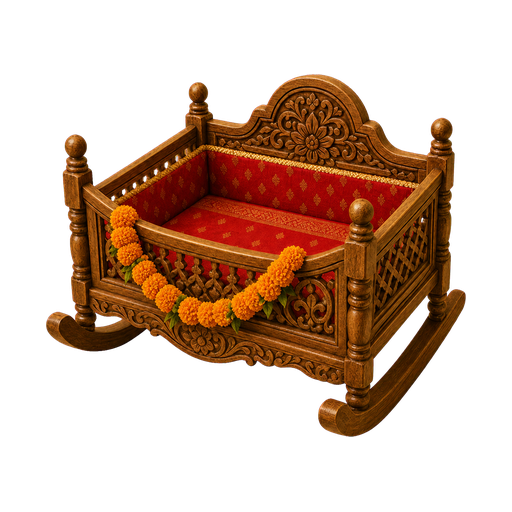 Zhopala (swing/cradle)
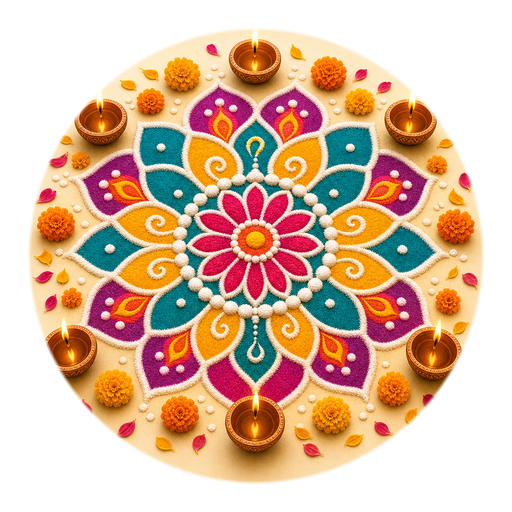 Rangoli (chaitrangan)
 Haldi-kunku
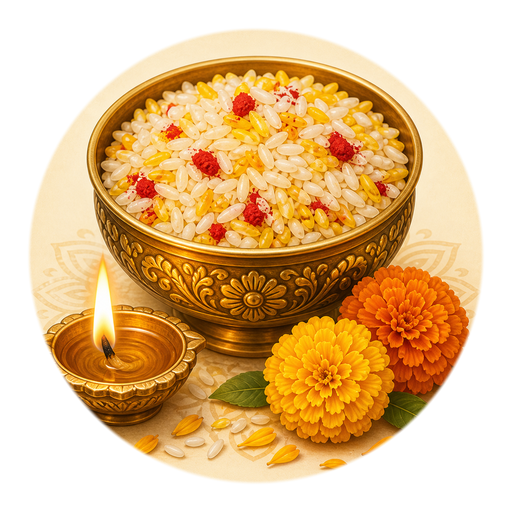 Akshata
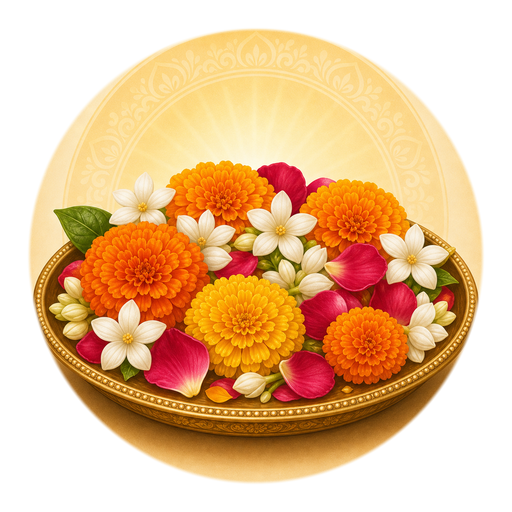 Flowers (mogra/gajra)
 Incense
 Samai lamp
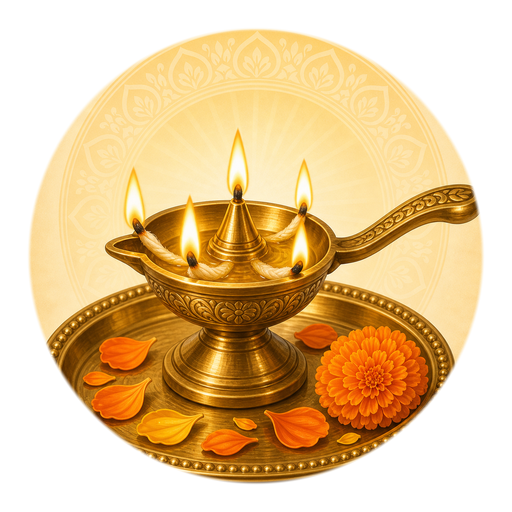 Niranjan lamp
 Comb and mirror
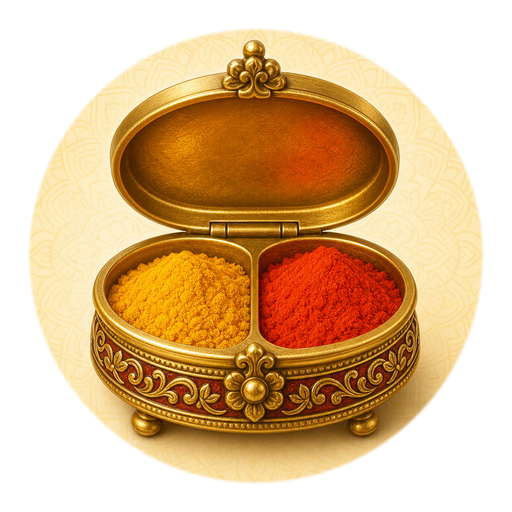 Kumkum box (karanda)
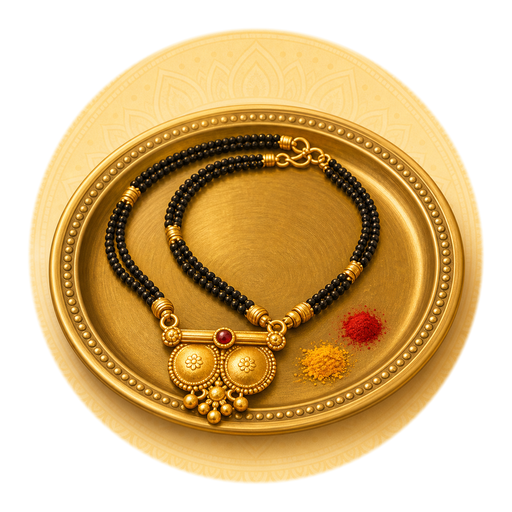 Mangalsutra
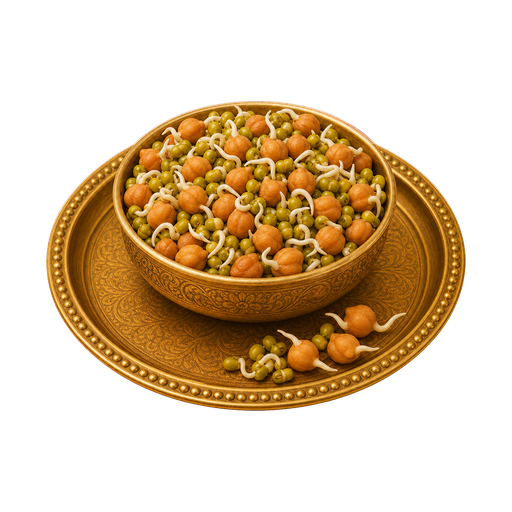 Sprouted harbhare (chana)
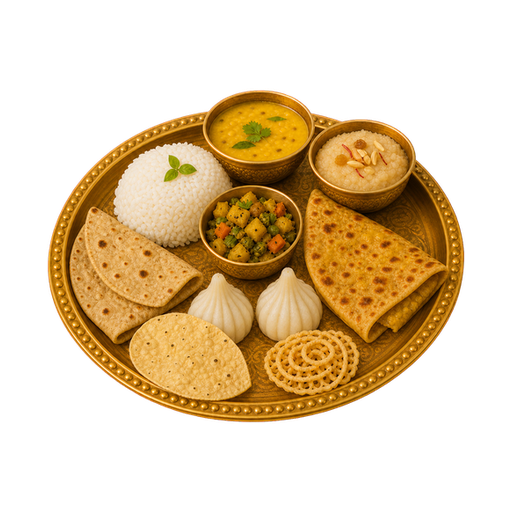 Naivedya (kairiche panhe, khirapat)
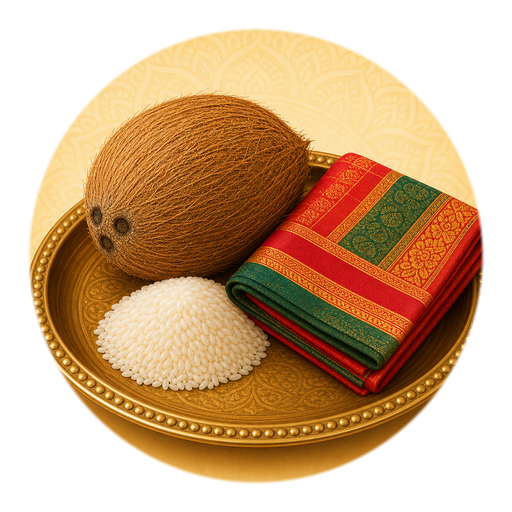 Oti items (coconut, cloth, bangles)
Fasting & food (upvas)
Chaitra Gauri is mainly a vrat of daily puja and haldi-kunku — not a strict fasting vrat. No standard source gives a fixed set of ‘fasting rules’; where any exist, treat them as limited to family custom.
The items given and eaten at the haldi-kunku are seasonal cooling foods (for the Chaitra-Vaishakh heat) — kairiche panhe, watermelon and harbhare — and this is a food hallmark of the vrat.
Mantra & aarti
There is no dedicated mantra or aarti for Chaitra Gauri in the standard sources; generally the Gauri / Mahalakshmi aarti is sung — the traditional (public-domain) ‘Jay Devi Jay Devi Jay Mahalakshmi’ (Mukeshwar Nagar), given in full below, with its meaning, when to sing it, and the recognizable opening line.
- When to sing: during the daily Gauri puja and especially at the haldi-kunku, after the naivedya is offered.
- Meaning, in brief: the aarti hails the Devi as Mahalakshmi who pervades everything, gross and subtle; it invokes her as the goddess of Karvir (Kolhapur), mother of the gods and sages, remover of hardship and destroyer of the demons, and closes with the devotee asking her to wash away the lines of ill fate written on the brow, taking refuge at her feet.
- Opening line (romanized): ‘Jay Devi Jay Devi Jay Mahalakshmi…’
Jap-mantra (traditional): Om Mahalakshmyai Namah.
Regional variations
- Maharashtra (general): Gauri in the zhopala + the chaitrangan + a month of daily puja + haldi-kunku — this is the signature of Chaitra Gauri; it is rarely found in pan-India calendars.
- Konkan: washing the visiting women's feet, sandalwood on the hands, then filling the oti.
- A comparative note (carefully): in Karnataka there is a Gauri puja with sprouted grains, and in Rajasthan there is Gangaur around roughly the same time — these can be seen as parallel festivals, but should not be treated as ‘the same as Chaitra Gauri.’
Good to know
- Health: kairiche panhe and watermelon are seasonal cooling foods; prepare them with home hygiene.
- Ritual: puja details, aaras and the katha vary by home and local custom — don't take one method as universal.
- Date: the haldi-kunku is on a convenient day of the month; Akshaya Tritiya is the last and udyapan day. (This year, 21 March → 19 April 2026.)
FAQ
- What is Chaitra Gauri?
- It is the daily puja and haldi-kunku festival in which Gauri (Parvati, often in her Annapurna form) is seated in a zhopala and worshipped over the month from Chaitra Shukla Tritiya to Akshaya Tritiya; it is kept mainly by women in Maharashtra.
- When is Gauri installed and when is she sent off?
- It begins on Chaitra Shukla Tritiya and closes on Akshaya Tritiya (Vaishakh Shukla Tritiya). This year, per the panchang, 21 March → 19 April 2026.
- Why does Gauri come to her maher?
- The folk-belief is that in Chaitra, Gauri comes to her maher as a young girl and returns to her husband's home on Akshaya Tritiya; so she is doted upon for the whole month.
- What motifs are drawn in the chaitrangan?
- Gauri in the swing, Ganpati, the samai lamp, lotus, tortoise, shankh, sun and moon, swastik, trishul, the shankh-chakra-gada-padma, tulsi, Om and more — the motifs vary by region.
- What is given at the Chaitra Gauri haldi-kunku?
- Haldi-kunku, an oti (soaked harbhare and fruit), kairiche panhe, kairichi dal, karanji, watermelon, battase and khirapat.
- Why is Akshaya Tritiya the last day of Chaitra Gauri?
- The belief is that Gauri returns to her husband's home that day; and Akshaya Tritiya is regarded as the last (udyapan) day of the Chaitra haldi-kunku gatherings.