Ganesh Chaturthi / Ganeshotsav
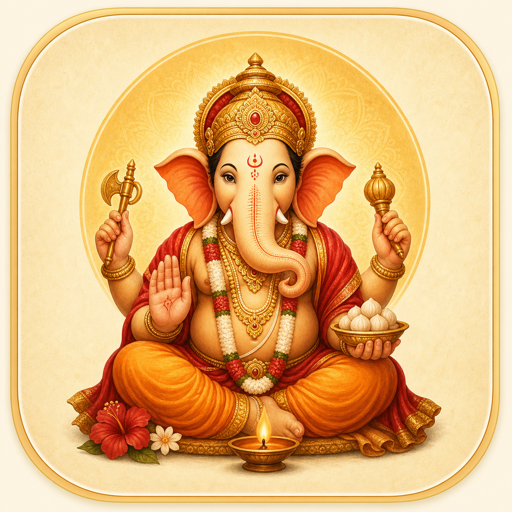
Ganesh Chaturthi marks the birth and sthapna (installation) of Ganpati Bappa, fixed by the tithi Bhadrapad Shukla Chaturthi. A clay Ganesh murti is installed with pran-pratishtha in homes and public mandaps to begin Ganeshotsav. Depending on family custom, the murti is worshipped for 1.5 / 5 / 7 / 10 days and then given visarjan (immersion); public Ganpatis conclude on Anant Chaturdashi. The main puja is performed at madhyanha (midday).
This year's dates (2026)
- Ganesh Chaturthi — Ganpati sthapna / Ganeshotsav begins (Monday, public holiday)14 Sep
- Rishi Panchami15 Sep
- Jyeshtha Gauri Avahan17 Sep
- Jyeshtha Gauri Pujan18 Sep
- Jyeshtha Gauri Visarjan + household Ganesh visarjan19 Sep
- Anant Chaturdashi + public Ganesh visarjan (Ganeshotsav ends); Friday, public holiday25 Sep
Significance
Ganesh Chaturthi is taken as the birthday of Shri Ganesh and is observed on Bhadrapad Shukla Chaturthi. Ganpati is the deity of learning, intellect and prosperity, and also the Vighnaharta — the remover of obstacles.
Before any auspicious task, Ganesh is worshipped first, because he is regarded as adipujya (the first to be honoured) and the giver of wisdom. As the deity of new beginnings, this festival is tied to auspiciousness, knowledge and prosperity.
Ganesh is believed to have been born at madhyanha (midday), which is why the main puja is performed at midday. (In the Hindu day, sunrise to sunset is divided into five parts — pratah, sangava, madhyanha, aparahna and sayam — and madhyanha is considered best for Ganesh puja.)
In Maharashtra the festival also has a large social and cultural dimension — public mandals build elaborate displays (dekhave), decorations and cultural programmes that bring the community together.
The legend (katha)
Two stories are linked to Ganesh Chaturthi — one about Ganesh's birth and his elephant face, and one behind the custom of not looking at the moon on this tithi. The Puranas carry different versions of both; the retelling below is the commonly told version, not a single fixed account.
Ganesh's birth and the elephant face. In some versions (the Shiva Purana tradition), Goddess Parvati fashions a boy from the sandal paste of her own body, breathes life into him and sets him as her doorkeeper. When Shiv tries to enter while she bathes, the boy stops him; in the struggle the boy's head is severed. Moved by Parvati's grief, Shiv restores him with an elephant's head and grants him the boon of becoming the lord of the ganas — ‘Ganpati’ — and the first to be worshipped.
In other versions (the Brahmavaivarta Purana, Ganesa Khanda), Parvati pleases Vishnu by observing the Punyaka vrat for a son, and all the gods gather at the birth celebration. Because of a curse, Shani avoids looking at the child; but when Parvati insists and he does look, the child's head falls away. Vishnu then brings the head of an elephant from the banks of the Pushpabhadra river and revives the child.
The shared core of both is the same — Ganpati becomes elephant-faced, lord of the ganas and the first to be worshipped. Only the detail differs: in one it is Shiv's blow, in the other Shani's glance.
Why the moon is not seen on this tithi. It is widely held that one should avoid looking at the moon on Bhadrapad Shukla Chaturthi; seeing it by mistake is said to bring a mithya kalank (a false accusation). The story told as an illustration is that of the Syamantaka mani (jewel) — wearing the brilliant Syamantaka jewel that Surya had given Satrajit, Prasena went hunting and was killed by a lion, and the lion was in turn killed by Jambavan. A false suspicion of stealing the jewel fell on Shri Krishna, but Krishna fought Jambavan in his cave, recovered the jewel and proved his innocence.
In the original Puranic text (Vishnu Purana), the false suspicion arises simply from public rumour — the reason ‘because he saw the chaturthi moon’ is not in that source text. That link is a folk-tradition layer: it was later said that Krishna had unknowingly seen the chaturthi moon and so incurred the blame. In some versions the reason for the moon's curse is told differently — the moon laughed at Ganpati when he fell off his mouse, so Ganesh cursed the moon.
Who observes it
- Families across homes — especially in Maharashtra and the Konkan-Goa belt — install a clay Ganpati; in many households this is a kulachar (family tradition).
- Public Ganeshotsav mandals install large murtis for a collective celebration.
- Before any auspicious beginning, all devotees worship Ganesh first, as the deity honoured first.
History of the public Ganeshotsav
Alongside home worship, the festival has a public form in Maharashtra, and there is a long history behind it.
- The royal-patronage phase: from the time of Chhatrapati Shivaji Maharaj and later in Peshwa-era Pune, Ganeshotsav had royal patronage (Ganpati was the Peshwas' family deity). After the fall of the Peshwas it became mainly a household affair again.
- The public revival: around 1892–1893 the festival was revived in a public form. Some sources point to 1892 and the public installation by Bhausaheb Rangari and the Khajgiwale family in Pune; while Lokmanya Bal Gangadhar Tilak in 1893 gave the public Ganeshotsav its momentum, turning it into a platform for anti-British awareness and social unity. Rather than settling ‘who was exactly first,’ it is these two phases together that shaped today's public Ganeshotsav.
Puja vidhi (how to perform)
The general sequence is below; the exact mantras, sankalp and steps vary by family and by the priest's tradition, so it should not be taken as the only ‘rule.’
- Sthapna / pran-pratishtha: a clay (shadu) Ganesh murti is placed on a clean chaurang or low stool, and pran-pratishtha is done at madhyanha (midday) with a sankalp.
- Shodashopachar puja: worship through sixteen upacharas — avahan, asan, snan, vastra, gandha, akshata, pushpa, dhoop, deep, naivedya, and so on.
- Offerings: durva (a bunch of 21 durva blades), red jaswand (hibiscus) flowers, coconut and jaggery (gul) are offered.
- Naivedya: ukdiche modak (Ganpati's favourite) and other sweets.
- Aarti and jap: the aarti (Sukhkarta Dukhharta…) morning and evening, and mantra-jap.
- Visarjan: after 1.5 / 5 / 7 / 10 days as per family custom, an uttar-puja is done and the murti is given visarjan; at farewell people say ‘Ganpati Bappa Morya, come again soon next year.’
About the sthapna time: the main puja is done at madhyanha (midday). The exact sthapna muhurat shifts with the day's panchang and your city, so check the precise clock time on the Ganesh Chaturthi day page.
What you need (samagri)
A clay / shadu Ganesh murti, a chaurang or low stool, red cloth, a kalash with supari, durva (21), red jaswand and other flowers, durvankur, akshata, haldi-kunku, gandha and ashtagandha, incense, a samai / niranjan with ghee and wicks, camphor, coconut, gul-khobre (jaggery and dry coconut), rice flour and a coconut-jaggery filling for the ukdiche modak, betel leaves and supari, dakshina and fruit. (The samagri varies a little by family tradition.)
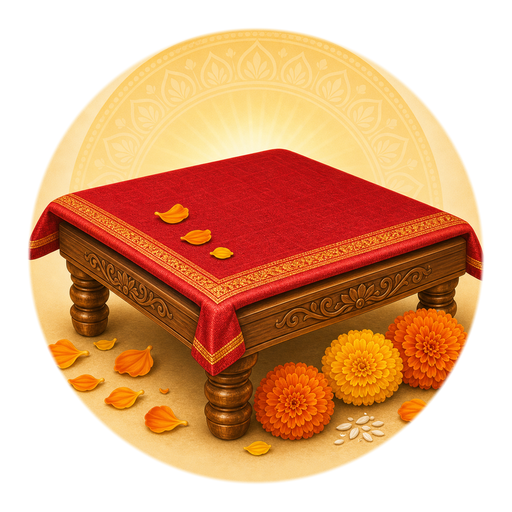 Chaurang / low stool
 Red cloth
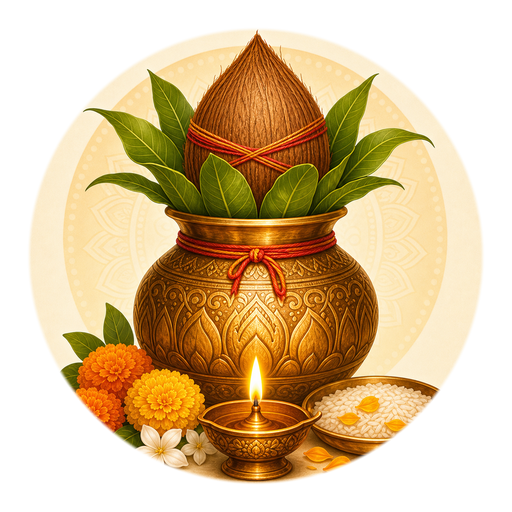 Kalash
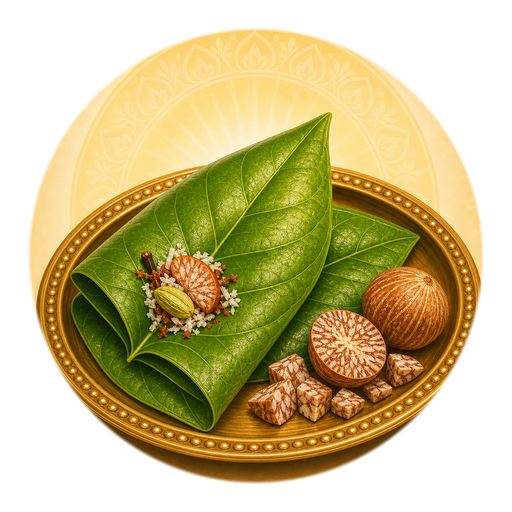 Supari
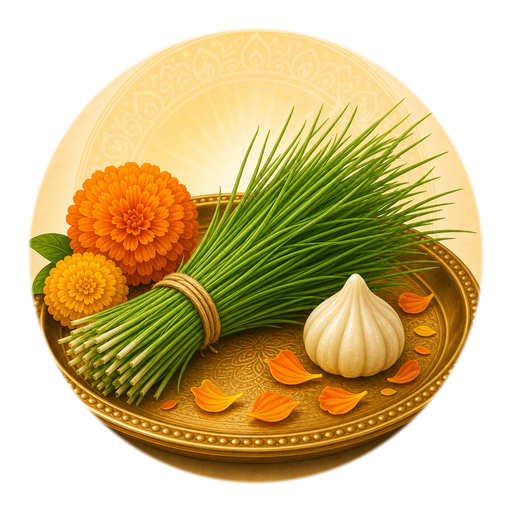 Durva
Durva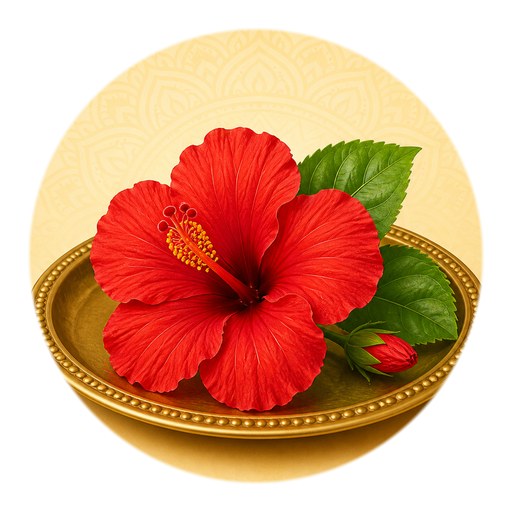 Jaswand
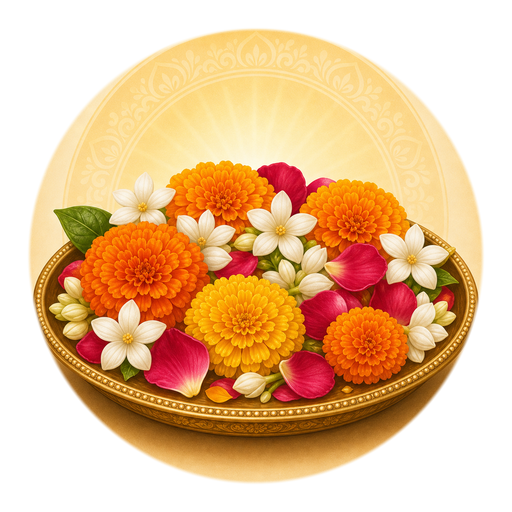 Flowers
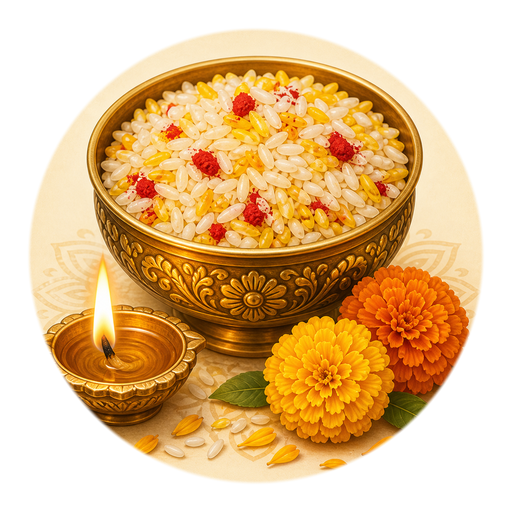 Akshata
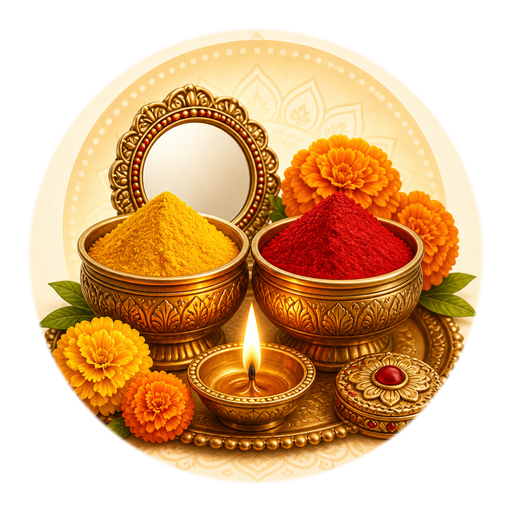 Haldi-kunku
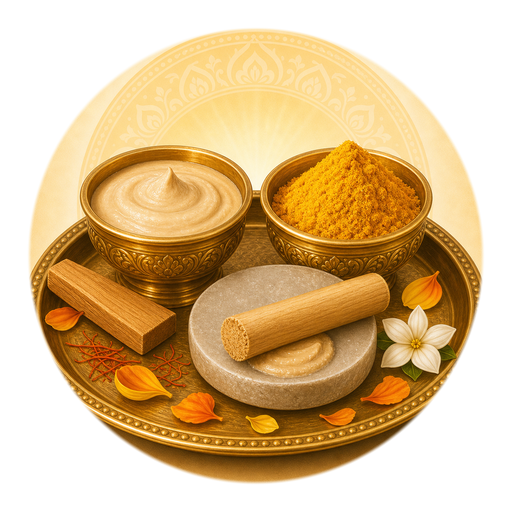 Gandha-ashtagandha
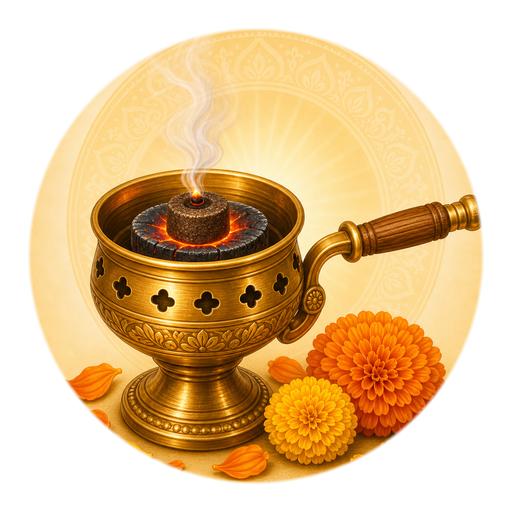 Dhoop (incense)
 Agarbatti
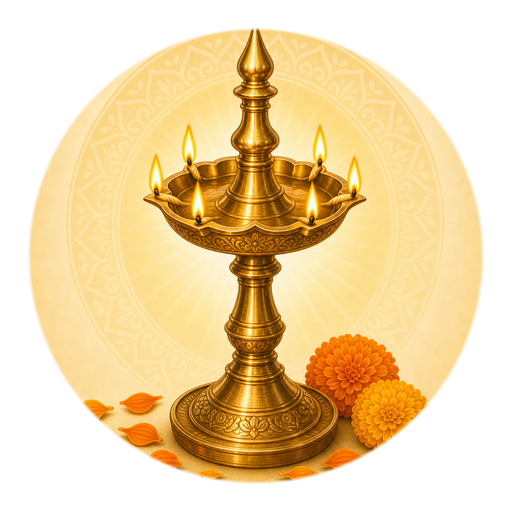 Samai
Samai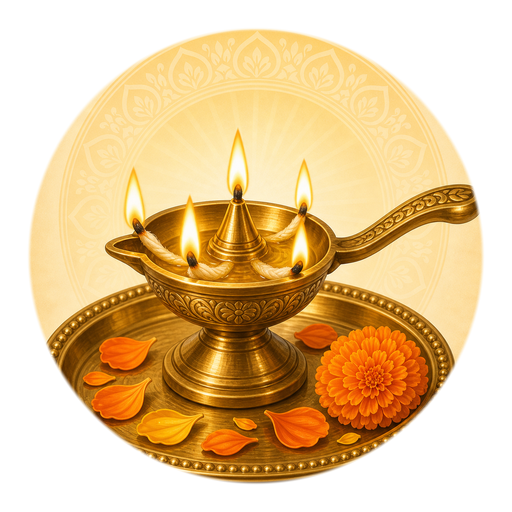 Niranjan
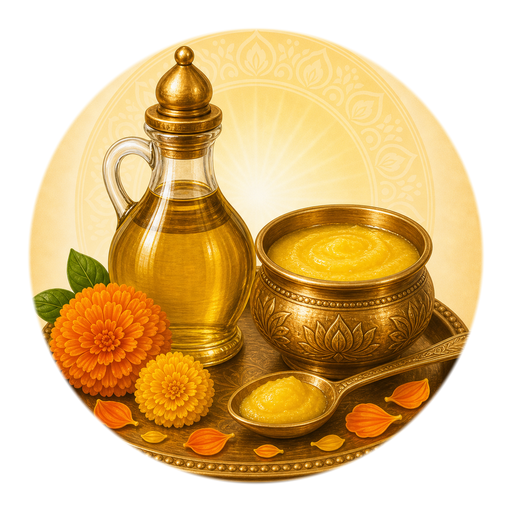 Ghee and wicks
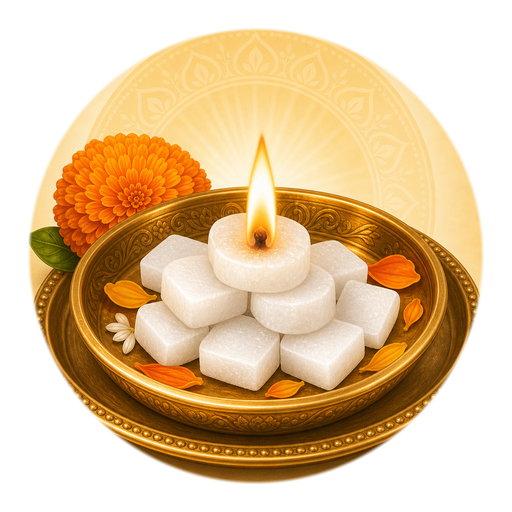 Camphor
 Coconut
 Gul-khobre
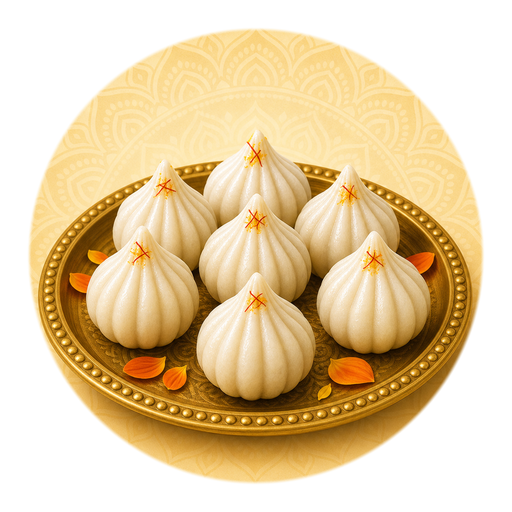 Modak
Modak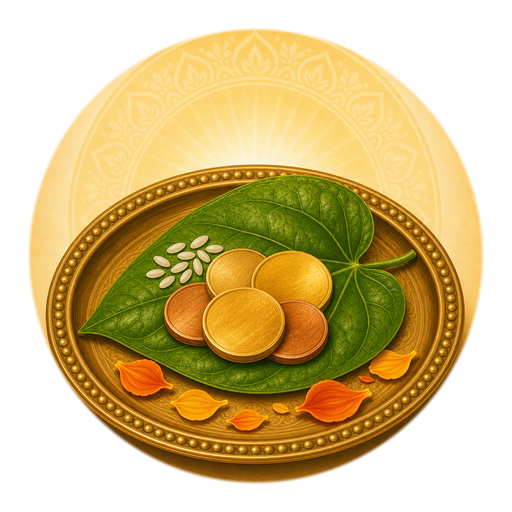 Dakshina
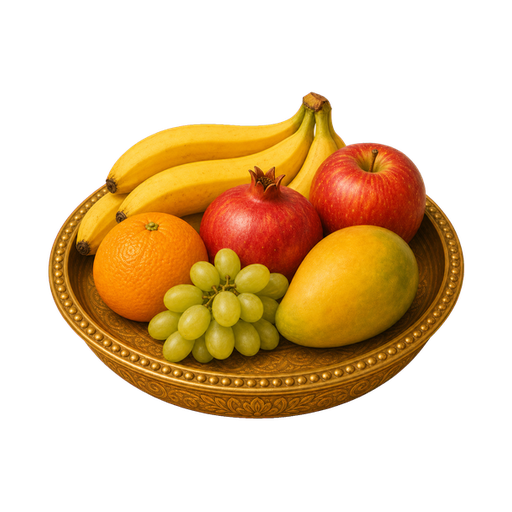 Fruit
FruitFasting & food (upvas)
- On Ganesh Chaturthi many devotees keep an upvas and break it after the midday puja or in the evening with a fruit-and-naivedya meal; some keep only sattvik food. A strict fast is not binding on everyone — this varies by home and local custom.
- A special rule — avoid the moon: it is widely held that one should not look at the moon on this night (to avoid the mithya kalank). If it is seen by mistake, worshipping Ganesh or reciting a shloka is suggested as a remedy.
Mantra & aarti
Mool mantra — Om Gam Ganapataye Namah. This is the seed (beej) mantra of Ganpati worship; its meaning is ‘salutations to Ganpati.’ The full jap mantra:
Aarti — Sukhkarta Dukhharta (from the Samarth Ramdas tradition; sung in Marathi homes). It praises Ganpati as the giver of happiness and the remover of sorrow and obstacles, and is sung morning and evening and before visarjan. Its recognizable opening line is ‘Sukhkarta Dukhharta, varta vighnachi…’. The words and tune can vary slightly by household or sect.
Besides these, the Ganpati Atharvashirsha (‘Om namaste Ganapataye…’) is a principal Vedic text of Ganesh worship, and ‘Vakratunda Mahakaya…’ is a popular meditation shloka. Their meaning is a salutation to Ganpati with a prayer to remove obstacles and grant success in one's work.
Regional variations (Maharashtra)
- Home vs public: both forms are prominent in Maharashtra — the home Ganpati (1.5/5/7/10 days) and the public mandals' grand displays and visarjan processions. (Not to be confused with the separate, year-round Ashtavinayak pilgrimage tradition.)
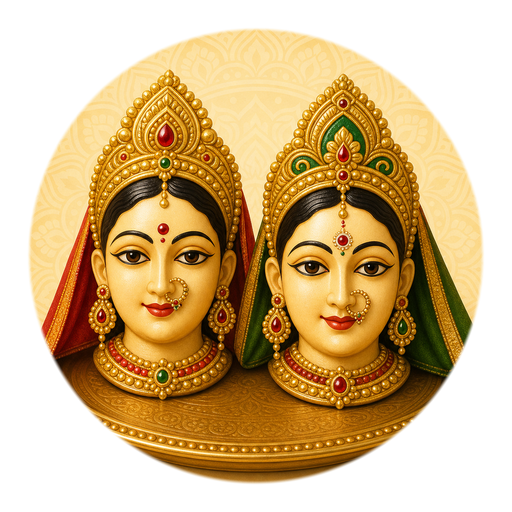
- Jyeshtha Gauri (Mahalakshmi): many Maharashtrian homes keep the three days of Jyeshtha Gauri alongside Ganpati — avahan (17 Sep), pujan (18 Sep) and visarjan (19 Sep 2026). Gauri is the maherwashin / Mahalakshmi; on pujan day a naivedya of puran poli and sixteen vegetables is a common tradition. This pairing and the number of days vary by family and region — it is not a universal practice in every home.
- Ukdiche modak: steamed modak of rice dough with a coconut-jaggery filling — the signature naivedya of Ganeshotsav.
- Stages of visarjan: the 1.5-day visarjan is on the day after sthapna (after midday); the 5/7/10-day ones are as per the devotee's tradition. Do not map the number of days strictly to a date — the panchang records the household Ganesh visarjan on 19 Sep (with Gauri) and the public visarjan on 25 Sep (Anant Chaturdashi).
- Eco-friendly Ganeshotsav: shadu-clay murtis, immersion at home or in artificial tanks, and nirmalya collection are a growing recent practice; PoP murtis are restricted in many places.
Good to know
- Muhurat: the main puja is at midday; check the exact local time in that day's panchang.
- Moon-sighting: it is held that one should avoid looking at the moon on the night of Bhadrapad Shukla Chaturthi. If seen by mistake, worshipping Ganesh or reciting a shloka is suggested. (This is a tradition — read it as cultural context, not as a universal rule.)
- Environment: use a shadu-clay murti, immerse at home or in an artificial tank, and dispose of nirmalya at a proper place; avoid PoP.
- Crowds & safety: visarjan processions get crowded — take care with children, elderly people and near water, and follow the local administration's instructions.
- Don't confuse the dates: Bhadrapad Ganesh Chaturthi (Sep) is not the same as Maghi Ganesh Jayanti (Jan/Feb, Magh Shukla Chaturthi), and it is also different from the monthly Sankashti / Vinayak Chaturthi.
FAQ
- When is Ganesh Chaturthi in 2026?
- Monday, 14 September 2026 (Bhadrapad Shukla Chaturthi; the chaturthi is present at midday).
- How do you install Ganpati Bappa (sthapna)?
- Place a clay murti on a clean chaurang, do pran-pratishtha at midday with shodashopachar puja, and offer durva, jaswand and modak. (The exact vidhi varies by family tradition.)
- When and after how many days is Ganesh visarjan?
- As per tradition, after 1.5, 5, 7 or 10 days. The panchang records the household Ganesh visarjan on 19 September and the public visarjan on Anant Chaturdashi, 25 September 2026. The number of days varies by family.
- Why should the moon not be seen on Ganesh Chaturthi?
- On this tithi, seeing the moon is said to bring a ‘mithya kalank’ (false accusation), per the Syamantaka mani–Shri Krishna legend. This is a folk-tradition belief.
- What is ukdiche modak?
- A steamed modak of rice dough filled with a coconut-jaggery mixture — Ganpati's favourite naivedya.
- What is the link between Gauri and Ganpati?
- During Ganeshotsav many Maharashtrian homes keep the three days of Jyeshtha Gauri (Mahalakshmi) — avahan, pujan and visarjan. This pairing varies by region and family.
- What is the difference between Ganesh Chaturthi and Maghi Ganesh Jayanti?
- Ganesh Chaturthi = Bhadrapad Shukla Chaturthi (September); Ganesh Jayanti = Magh Shukla Chaturthi (January/February). They are different days.