Valmiki Jayanti
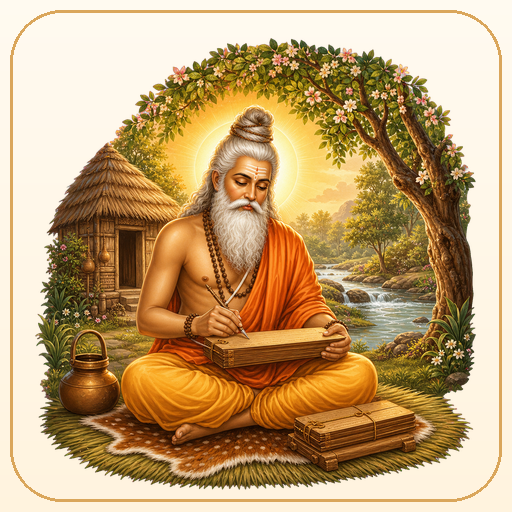
Maharishi Valmiki — regarded as the Adi Kavi (first poet) of Sanskrit literature — is honoured on his jayanti, observed on Ashwin Shukla Purnima (the same tithi also known as Sharad/Kojagiri Purnima). In 2026, this tithi falls on Monday, 26 October. Valmiki composed the Valmiki Ramayana (the original Sanskrit Ramayana — roughly 24,000 shlokas across 7 kands). This jayanti is noted across India; it's especially significant as the biggest festival ("Pargat Diwas") for the Valmiki/Balmiki community in North India — in Maharashtra, it's mainly observed at the level of a panchang notation.
This year's dates (2026)
Significance
The Ramayana that Valmiki composed is regarded as the first epic ("Adi Kavya") in Sanskrit literature — not merely first in chronology, but as the first work of poetry to express elevated/divine principles.
"A shloka born from shoka (grief)": a hunter killed the male of a pair of krauncha birds in the midst of courtship; seeing the female's anguished cry, a verse in the anushtubh metre spontaneously emerged from Valmiki's mouth out of grief — this came to be regarded as the first shloka in Sanskrit literature, and he went on to compose the entire Ramayana in that same metre.
In the Ramayana's Uttarkand, Sita finds refuge at Valmiki's ashram; Lava and Kusha are born and raised there, and Valmiki himself teaches them the very Ramayana he composed — meaning he is both the epic's author and, later, a character within its story. (Some scholars hold that the Uttarkand may be a later addition to the Valmiki Ramayana.)
For the Valmiki/Balmiki community, he is regarded as their guru/ancestral figure; "Pargat Diwas" (the day of manifestation) is their biggest religious-social festival.
The legend
For the Valmiki/Balmiki community, he is their guru — so this legend is presented in neutral, respectful language.
A common thread runs through both versions — a person commits violence/banditry to support their family; becomes so absorbed in intense austerity that an anthill (valmik) forms around their body; the austerity bears fruit, and the person is given the name "Valmiki" (one who emerged from the anthill) along with the blessing to compose the story of Rama.
In some versions (the popular, widely current one): his original name was Ratnakar; lost in the forest as a child, he was raised by a hunter's family. To support his family, he took to banditry. One day he attempted to rob sage Narada; Narada asked him, "Will your family share in the fruit of the sin you commit?" When he asked at home, everyone refused — shaken by this, Ratnakar returned to Narada. Narada told him to chant the name "Rama"; unable to pronounce it, he was told to chant it in reverse, "mara-mara" — through continuous repetition, this itself became "rama-rama." Sitting motionless in chanting for years, an anthill formed around his body. Narada returned, cleared away the anthill, and blessed the now-purified Ratnakar with the name "Valmiki" and the gift of composing the story of Rama.
The Skanda Purana, however, holds that Valmiki was originally a Brahmin named Lohajangha — obedient to his parents and devoted to his wife. During a twelve-year drought in the Anarta region, he took to robbing travellers to support his family. One day he attempted to rob the Saptarishi (seven sages); the sages took pity on him, and one of them, sage Pulaha, gave him a mantra. He became so absorbed in chanting it that an anthill formed around his body. The sages returned, and hearing the chant emanating from the anthill, blessed him, saying — "Seated within the valmik (anthill), you have attained great accomplishment, so you shall be known in the world as 'Valmiki.'"
The two versions differ on his original name, social standing, and guide — which is older or more original cannot be determined.
The krauncha-vadha (killing of the krauncha bird) episode and the first shloka (part of the Ramayana's own prologue, a relatively more stable version): once, as Valmiki was going to bathe at the Tamasa river, a hunter shot and killed the male of a pair of krauncha birds engaged in courtship. Hearing the female's grief-stricken cry, a spontaneous, curse-like verse emerged from Valmiki's mouth:
Meaning (a rendering): O hunter, since you have killed one of this pair of krauncha birds absorbed in passion, may you find no peace for a long time.
This is regarded as the first shloka in Sanskrit literature — Valmiki went on to compose the entire Ramayana in this same anushtubh metre, which is why he is called "Adi Kavi" and the Ramayana "Adi Kavya."
Who observes it
For the Valmiki/Balmiki community (North India — Punjab, Haryana, Delhi, Himachal Pradesh, and others), this is "Pargat Diwas" — their biggest festival; grand processions carrying Valmiki's image/idol are organized, along with devotional singing.
Literary/cultural circles and general devotees pay tribute to him as the Adi Kavi, organize Ramayana recitation/remembrance programs, and in some places, distribute food to those in need.
In Maharashtra, this day mainly appears at the level of a panchang jayanti notation; since the same day also carries other notations (Navanna Purnima, the start of Kartik Snan, the Mahalakshmi Mahaprasad at Kolhapur), Valmiki Jayanti doesn't appear to be prominently observed as a major standalone public festival in Maharashtra.
Puja vidhi
This is chiefly a memorial/procession-centred jayanti, not a ritual-heavy household vrat:
- At the public/social level, special puja-aarti is held at Valmiki temples/sites, along with processions (carrying his image/idol), devotional singing, Ramayana recitation, and in some places, food donation.
- At the household/personal level, interested devotees may recite/remember the Ramayana and pay tribute to Valmiki.
- Since this isn't a standalone vrat, no udyapan (closing ritual) applies.
What you need
For public events: an image/idol of Valmiki, a lamp, flowers and garlands, a copy of the Ramayana (for recitation), and incense. No specific, widely established household item list exists.
 Lamp
Lamp Flowers
 Garlands
 Ramayana text
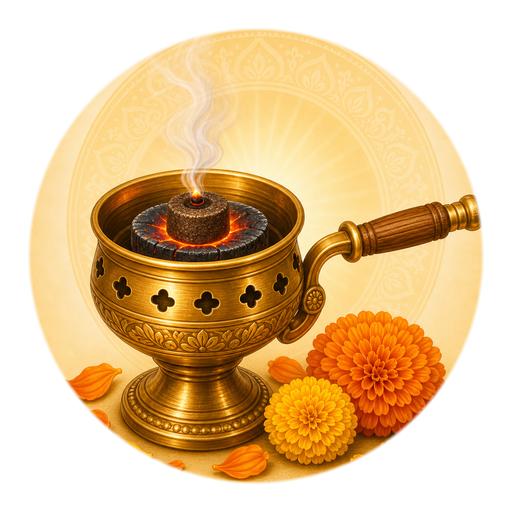 Dhoop (incense)
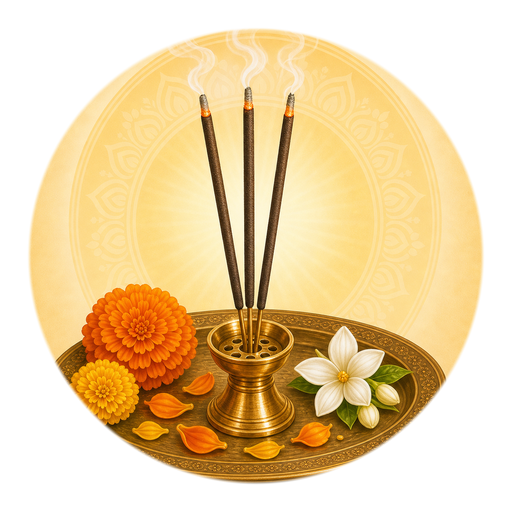 Agarbatti (incense sticks)
Fasting
No specific, widely agreed fasting/dietary rule was found for Valmiki Jayanti. Some devotees may observe a general Purnima fast on this day, but that's part of the Purnima vrat tradition, not a rule specific to Valmiki Jayanti.
Mantra
The first shloka — "Ma nishada pratishtham tvam agamah shashvatih samah, yat kraunchamithunad ekam avadhih kamamohitam" — is given above; this is an ancient verse, part of the Valmiki Ramayana itself and in the public domain.
No separate, widely current Valmiki aarti/stotra collection exists — instead, Ramayana recitation/remembrance is generally practised.
Regional customs
In North India (Punjab/Haryana/Delhi/Uttar Pradesh/Himachal Pradesh), this is the biggest festival ("Pargat Diwas") for the Valmiki/Balmiki community — grand processions and temple visits. The "Bhagwan Valmiki Teerth Sthal" at Amritsar (Punjab) is regarded as Valmiki's birthplace — this is a matter of belief/tradition, without independent historical verification.
Holiday status: not a national public holiday; per one secondary source, Himachal Pradesh, Haryana, Karnataka, Madhya Pradesh, and Punjab observe it as a restricted/state holiday — Maharashtra doesn't appear on that list, suggesting it may be a regular working day in Maharashtra.
Genuine, panchang-based references for the same day in Maharashtra — Navanna Purnima, the start of Kartik Snan, the Shri Mahalakshmi Mahaprasad at Kolhapur — are notable but separate topics, mentioned here only for reference.
Good to know
- Some calendars/websites may show Valmiki Jayanti on the same day as Sharad/Kojagiri Purnima (25 October), since the same Purnima tithi is split across two days — under the sunrise-tithi convention (the most widely accepted rule), the correct date works out to 26 October, which is the date shown here; other traditions/panchangs may calculate this day differently.
- Two legend versions exist for Valmiki's early life; for the Valmiki/Balmiki community, he is their guru/ancestral figure.
- Not a national holiday; some states may observe it as a restricted/state holiday; in Maharashtra it may be a regular working day.
- Procession/event timings are location-specific — check with local organizers/temple committees.
FAQ
- When is Valmiki Jayanti in 2026?
- Monday, 26 October 2026 (Ashwin Shukla Purnima).
- Who was Valmiki? What was his original name?
- He was the Adi Kavi of Sanskrit literature, the sage-author of the Valmiki Ramayana. Accounts of his original name vary — one popular version says Ratnakar, the Skanda Purana says Lohajangha; both versions describe him gaining the name "Valmiki" after intense austerity within an anthill.
- Why is Valmiki called "Adi Kavi"?
- The "Ma Nishad..." verse, which spontaneously emerged from his grief at the krauncha-vadha episode, is regarded as the first shloka in Sanskrit literature; he went on to compose the entire Ramayana in that same metre.
- How many shlokas and kands does the Valmiki Ramayana have?
- Roughly 24,000 shlokas across 7 kands (Bala Kand, Ayodhya Kand, Aranya Kand, Kishkindha Kand, Sundara Kand, Yuddha Kand, and Uttara Kand).
- Why do Valmiki Jayanti and Sharad/Kojagiri Purnima fall on the same day?
- Both relate to the Ashwin Purnima tithi; since the Purnima tithi spans two days (25-26 October), the night-centred Kojagiri Purnima is observed on 25 October, while the sunrise-tithi-based Valmiki Jayanti/Navanna Purnima fall on 26 October.
- Is Valmiki Jayanti a public holiday?
- Not a national holiday; some states (e.g. Punjab, Haryana) may observe it as a restricted/state holiday; in Maharashtra it's likely a regular working day.
- What is the connection between Sita, Lava-Kusha, and Valmiki?
- Per the Ramayana's Uttara Kand, Sita found refuge at Valmiki's ashram; Lava and Kusha were born and raised there, and Valmiki himself taught them the Ramayana.