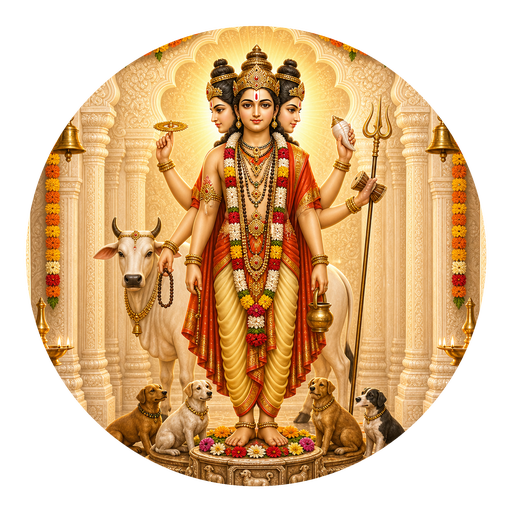
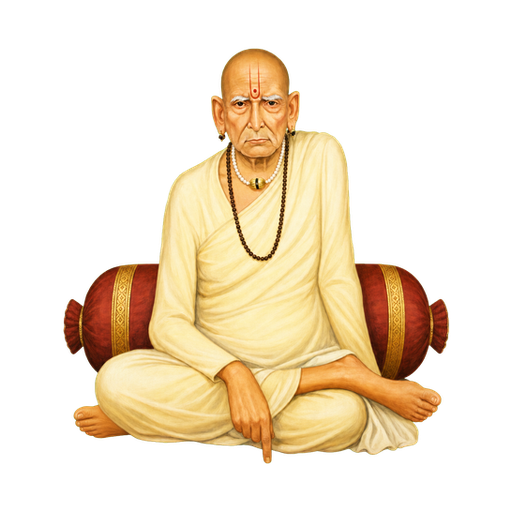
Gangapur Datta (Shri Narasimha Saraswati)
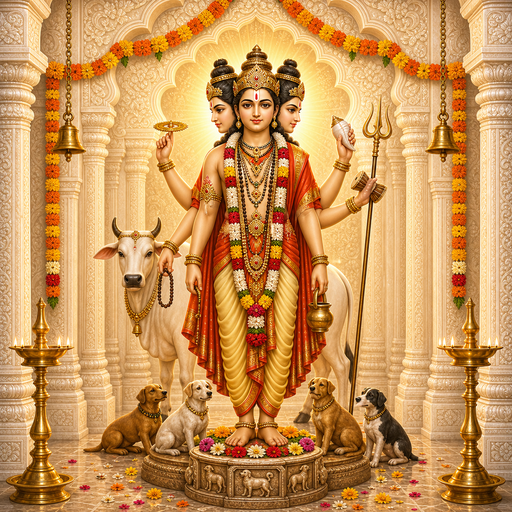
Gangapur — in Kalaburagi (Gulbarga) district, Afzalpur taluka, Karnataka, at the confluence of the Bhima and Amarja rivers — is a major Datta kshetra. Its principal deity is Shri Narasimha Saraswati, widely regarded as the second incarnation of Dattatreya, after Shripad Shrivallabh. Narasimha Saraswati resided here for a long period (more than two decades, by estimate); on departing, he left the Nirgun Paduka at the math — devotees believe his sagun (manifest) presence remains within them. Its main festival is Guru Pratipada (Magh Krishna Pratipada — the day of Narasimha Saraswati's departure from Gangapur), Gangapur's own biggest festival; Datta Jayanti is also observed here, as at every Datta kshetra. Bathing at the Bhima-Amarja confluence, the Ashtatirtha circuit, the midday Madhukari tradition, and Bhasma-prasad give Gangapur its distinctive identity.
This year's dates (2026)
- Monday; Guru Pratipada — the Gangapur Yatra and Guru's Shailya-yatra departure, Gangapur's own biggest festival2 Feb
- Wednesday; Datta Jayanti at Gangapur kshetra — the same day as the main Shri Dattatreya Jayanti everywhere23 Dec
Deity & significance
Shri Narasimha Saraswati is regarded as an incarnation of Dattatreya; he was born at Karanja (Lad), Washim district (Maharashtra), around 1378 CE (Shaka 1300), on Paush Shukla Dwitiya. By the Gurucharitra, he is regarded as the second Datta incarnation, after Shripad Shrivallabh. (One single-source mention also claims he was the "third incarnation" and "later became Swami Samarth of Akkalkot" — this runs counter to the broad consensus and is a contested claim.)
(This deity is entirely distinct from Vishnu's Narasimha incarnation — the lion-avatar associated with Narasimha Jayanti; despite the similar name, the two shouldn't be confused.)
Narasimha Saraswati resided at Gangapur for a long period — sources give varying estimates: "about 20 years," "22-23 years," and "24 years"; one mention suggests an arrival around 1435 CE and a departure around 1458 CE — so, by most estimates, he resided there for more than two decades.
On departing, he is said to have given a disciple padukas, saying his manifest presence would remain within them — these same padukas are worshipped today at Gangapur's Nirgun Math; they are known by a different name ("Nirgun Paduka") from Narsobawadi's "Manohar Paduka." The sanctum has restricted entry, with darshan given through a small silver-framed window. This paduka-centred worship is one of Gangapur's distinctive features.
Many devotees, out of devotion, give Gangapur the epithet "Dattabhaktancha Pandhari" (the Pandharpur of Datta devotees).
History & legend (sthala-purana)
The main sources draw on the Shri Gurucharitra text; many modern devotional sites retell this same text — so the details below should be read as drawing on one shared tradition.
Narasimha Saraswati, born at Karanja (Lad), settled at Gangapur near the Bhima-Amarja confluence after a long period of wandering and pilgrimage. Here, his circle of disciples grew; a small math and temple arose around him. Devotees still observe his daily practice of Madhukari (begging).
In one well-known episode, a Brahmin named Narahari served a withered audumbar tree on the Guru's command, and by the Guru's grace, the tree sprouted fresh leaves — this episode is tied to the audumbar tree at Gangapur. (This is a traditional account.)
On Magh Krishna Pratipada (Guru Pratipada), Maharaj left Gangapur for the Shrishailya (Mallikarjuna) kshetra — during this same journey, he is believed to have given devotees the Nirgun Paduka and concealed his avatar-mission (around 1458 CE, by some sources 1459). This day is regarded as the basis of today's "Gangapur Yatra."
Neither the residence-duration figure nor the incarnation count should be treated as settled.
Architecture & layout
The main place of worship is the Nirgun Math, at the centre of the village, with two entrances, east and west — the west gate is larger, and a nagarkhana (drum-house) is mentioned there. The sanctum has restricted entry; darshan of the Nirgun Paduka is given through a small silver-framed window.
The Bhima-Amarja confluence is about 2-3 km from the math; devotees first bathe at the confluence before going to the math for paduka-darshan. The confluence area has the Ashtatirtha (Shatkul, Narasimha, Bhagirathi, Papvinashi, Koti, Rudrapad, Chakreshwar, Manmath — the list varies slightly by source).
The village and surrounding area also have an audumbar tree, the Kaleshwar temple, and the Vishranti Katta (a memorial spot where Maharaj is believed to have rested).
Festivals & yatra
Only two rows carry a Gangapur-specific panchang entry (bolded); the other traditional festivals have no Gangapur-specific panchang entry — the tithi is given, but the exact 2026 date could not be fixed.
| Festival | Tithi | 2026 date | In brief |
|---|---|---|---|
| Guru Pratipada (Gangapur's main festival) | Magh Krishna Pratipada | 2 February (Monday) | Narasimha Saraswati's day of departure from Gangapur, on his Shailya-yatra; the "Gangapur Yatra" is believed to begin on this same day. |
| Datta Jayanti | Margashirsha Purnima | 23 December (Wednesday) | A mahaprasad day at Gangapur, as at every Datta kshetra; for the birth story and puja vidhi, see Datta Jayanti. |
| Guru Purnima (Vyasa Puja) | Ashadh Shukla Purnima | (no Gangapur-specific panchang entry) | The traditional Vyasa Puja day, also observed here. |
| Shravan Gurucharitra Parayan | The whole month of Shravan | (month-long, no specific date applies) | A tradition of collective Gurucharitra recitation. |
| Shripad Shrivallabh Jayanti | Bhadrapad Shukla Chaturthi (Ganesh Chaturthi tithi) | (no Gangapur-specific panchang entry) | The birthday of Dattatreya's first incarnation, Shripad Shrivallabh — observed here too, by tradition. |
| Dussehra (Simollanghan) | Ashwin Shukla Dashami | (no Gangapur-specific panchang entry) | A Simollanghan procession. |
| Narasimha Saraswati Jayanti | Paush Shukla Dwitiya | (no Gangapur-specific panchang entry) | The Maharaj's own birthday (distinct from Datta Jayanti). |
Darshan & aarti timings
Sources show major discrepancies — no single "correct" schedule could be established. What follows is a rough outline only, not to be taken as exact timings.
- General opening time: early dawn, around 3 AM — consistent across most sources.
- Midday: around 12 to 12:30 PM, mahanaivedya and madhyana aarti, followed by the Madhukari custom. (One source states the temple stays closed from 12 to 4 PM — this is inconsistent with other sources.)
- Night: closes around 9 to 9:30 PM, or the last aarti-palanquin.
- Nirgun Paduka darshan: one source mentions a separate, limited window — free darshan around 7 to 11:30 AM — no other source notes this distinction.
- Confirm exact timings with the temple committee or through local inquiry.
It isn't clear which single registered trust manages the Gangapur temple — several private priests and booking sites call themselves "official," but none has clearly established itself as a registered managing trust.
Special rituals here
Sangam-snan and Ashtatirtha: devotees first bathe at the Bhima-Amarja confluence (by some sources, around 3:30-4:30 AM) and, where possible, complete the Ashtatirtha circuit, before going to the Nirgun Math for paduka-darshan.
Madhukari: Narasimha Saraswati himself used to beg for alms; in his memory, devotees observe the custom of begging at a minimum of five houses in Gangapur (by one source, over seven consecutive days), around noon. An "Akshaya Madhukari Yojana" is also mentioned — a scheme funding a day of madhukari distribution in a donor's name year-round, from interest on a donation (by tradition).
Bhasma-prasad: Gangapur's principal guru-prasad is regarded as bhasma (sacred ash) — a distinctive feature compared to other Datta kshetras.
Gurucharitra recitation under the audumbar tree: devotees are recorded as sitting beneath the tree for a continuous week-long recitation of the Gurucharitra.
(For the general Datta guru-mantra/aarti meaning and opening line, see Datta Jayanti; not repeated here.)
How to reach
Location: Afzalpur taluka, Kalaburagi (Gulbarga) district, Karnataka — at the Bhima-Amarja confluence.
By rail: the nearest station is "Gangapur Road" (on the Solapur-Gulbarga line), about 20-21 km from the village; Gulbarga (Kalaburagi) station is about 40 km away. The Kolhapur-Kalaburagi new express runs via Gangapur Road, Solapur, Kurduwadi, and Pandharpur — convenient for Pandharpur, Akkalkot, and Gangapur devotees.
By air: the nearest airport is Kalaburagi, about 38-52 km away (sources vary).
By road/bus: on the Solapur-Gulbarga highway; state buses run from Gulbarga roughly every 2 hours (6 AM to 6 PM). One estimate found gives about 327 km by rail from Pune (to Gangapur Road station), plus about 21 km further by road — check a live map or booking site for the exact distance before you travel.
Nearby places
- Audumbar (Sangli) and Narsobawadi (Kolhapur district) — the remaining two of Narasimha Saraswati's three principal residences; a traditional saying goes, "The places where we reside eternally are Audumbar, Narsobawadi, and Gangapur." Audumbar is regarded as his seasonal chaturmas residence, Narsobawadi as his main, 'capital'-like site, and Gangapur as the site of his longest continuous stay. Since the three kshetras lie across different districts and states, the actual distances between them are considerable — visiting all three on one trip isn't realistic, so plan ahead.
- Akkalkot (Swami Samarth) — Solapur district; about 70-100 km from Gangapur (sources vary). A contested strand of Datta tradition regards Swami Samarth as a related or later incarnation — no firm claim is made here.
- Solapur city and Pandharpur/Tuljapur — part of the same regional pilgrim circuit; rail and bus services run along the same route.
Travel tips (good to know)
- Gangapur is in Karnataka (outside Maharashtra) — plan your travel, accommodation, and the local language (Kannada) in advance.
- Expect special crowds on Guru Pratipada, Datta Jayanti, Purnima, and Thursdays — many sources advise booking accommodation ahead; set aside time for the Nirgun Paduka darshan queue.
- Darshan, aarti, and Madhukari timings can change by season and yatra period — confirm before an actual visit.
FAQ
- Where is Gangapur, and who is worshipped there?
- In Kalaburagi district, Karnataka, at the Bhima-Amarja confluence; the Nirgun Paduka of Shri Narasimha Saraswati is worshipped here.
- How many years did Shri Narasimha Saraswati reside at Gangapur?
- By various sources, about 20 to 24 years (no single figure is certain).
- What is the Nirgun Paduka?
- The padukas Maharaj gave to a disciple on departing, believed to hold his manifest presence; they are worshipped today at Gangapur's Nirgun Math.
- How far is Gangapur from Solapur/Pune?
- The Gangapur Road railway station lies on the Solapur-Gulbarga line; one estimate gives about 327 km by rail from Pune (to Gangapur Road station), plus about 21 km further by road — check a live map or booking site for the exact distance before you travel.
- How do I reach Gangapur?
- The nearest station is "Gangapur Road" (about 20-21 km away), Gulbarga station (about 40 km), Kalaburagi airport (about 38-52 km); regular bus service runs from Gulbarga.
- What is Guru Pratipada, and how is it connected to the Gangapur Yatra?
- Magh Krishna Pratipada — Narasimha Saraswati's day of departure from Gangapur on his Shailya-yatra; Gangapur's own biggest festival. In 2026, it falls on 2 February.
- What are Gangapur's Ashtatirtha?
- Shatkul, Narasimha, Bhagirathi, Papvinashi, Koti, Rudrapad, Chakreshwar, and Manmath (the list varies slightly by source).
- What is Madhukari, and how is it observed at Gangapur?
- The tradition of begging for alms — Narasimha Saraswati himself used to beg, and in his memory, devotees at Gangapur beg at a minimum of five houses, around noon.
- What's the difference between Gangapur, Audumbar, and Narsobawadi?
- All three are regarded as residences of Narasimha Saraswati — Audumbar a chaturmas stay, Narsobawadi his main, 'capital'-like site, and Gangapur the site of his longest continuous residence.
- What are the darshan timings at the Gangapur temple?
- Roughly from early dawn (around 3 AM) to about 9-9:30 PM, with Madhukari and mahanaivedya at midday — but sources vary, so confirm exact timings with the temple committee.