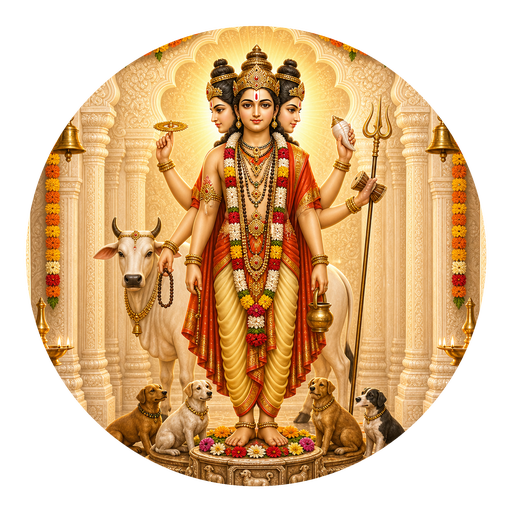
Narsobawadi (Narsobachi Wadi) Datta Temple
Narsobawadi (Narsobachi Wadi) is a Datta kshetra at the confluence of the Krishna and Panchganga rivers, in Shirol taluka, Kolhapur district — about 45-50 km from Kolhapur and 19-22 km from Sangli. It is one of the three principal Datta kshetras in Datta tradition (Audumbar, Narsobawadi, and Gangapur). Shri Narasimha Saraswati — regarded in Datta tradition as the second avatar of Dattatreya — performed roughly twelve years of tapasya here and established the Manohar Paduka at this spot. Unlike most temples, the sanctum here has no idol — only the paduka (footprints) are worshipped, the site's most distinctive feature. The daily Palkhi Sohala and the Dakshin Dwar Sohala (when the rising Krishna river touches the paduka — not tied to any tithi, but to the water level) are its signature identity. Main festivals: Datta Jayanti (Margashirsha Purnima) and Narasimha Saraswati Jayanti (Paush Shukla Dwitiya).
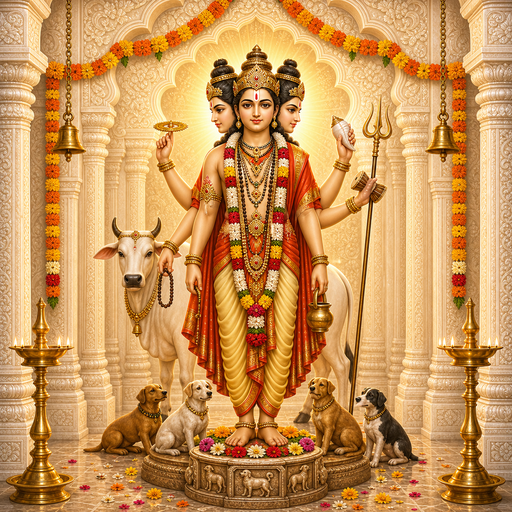
This year's dates (2026)
- Wednesday; Datta Jayanti — the panchang tags this date as 'Gangapur kshetra', with no Narsobawadi-specific entry23 Dec
- Wednesday; Guru Purnima — a general pan-Hindu festival, also observed here29 Jul
- Monday; Shripad Shrivallabh Jayanti (same tithi as Ganesh Chaturthi) — the Narsobawadi-specific claim rests on a single source14 Sep
Deity and significance
Shri Narasimha Saraswati is regarded, in Datta tradition, as the second avatar of Lord Dattatreya (the first being Shripad Shrivallabh) — most sources agree, though one government source (Incredible India) calls him the third. He is believed to have been born at Karanja (Lad), Washim district, in Shaka 1300 (1378 CE), on Paush Shukla Dwitiya at noon, to parents Ambabhavani and Madhav (of the Kale lineage).
Datta is regarded as the combined form of Brahma-Vishnu-Mahesh and a symbol of the guru principle — Narasimha Saraswati is regarded as the embodied, historically-recorded figure of that guru tradition.
"Capital of the Datta Lord": Datta tradition knows Narsobawadi by this title. One account holds that the 19th-20th century Datta saint Vasudevanand Saraswati (Tembe Swami) gave it this title after his travels across India — this detail rests on a single source.
No idol, only paduka: unlike most temples, there is no idol in the sanctum here. What is worshipped is the Manohar Paduka (established by Narasimha Saraswati himself) together with Annapurna Janhavi — believed by devotees to symbolize the guru's eternal presence and blessing.
One account mentions a "Kanyagat Mahaparva," tied to the Guru-Kanya rashi transit, observed once every twelve years at a few Krishna-riverside kshetras (Wai, Narsobawadi, and others) — the next such year could not be pinned down here, so it is not linked to 2026.
History and legend (sthal-purana)
The primary source is the Shri Gurucharitra (roughly 15th century, composed by Saraswati Gangadhar) — the principal hagiographic text of Datta tradition. The dates and years below belong to religious tradition (hagiography); they are not independently verified by history or archaeology.
Birth and childhood: at Karanja (Lad), Washim district — Shaka 1300 (1378 CE), Paush Shukla Dwitiya, at noon; mother Ambabhavani, father Madhav. His childhood name is given as Narahari or Shaligramadev Kale. Tradition holds that from birth he uttered only "Om" and kept silent, and began Vedic recitation only after his upanayana.
Renunciation and early pilgrimage: he is said to have left home alone at age seven; at Kashi he took sannyasa initiation from Guru Krishna Saraswati and was renamed "Narasimha Saraswati."
Pilgrimage route: he visited various sites — Parali Vaijnath (Beed district), then Audumbar (near Bhilawadi, Sangli district).
Residence at Narsobawadi (the central chapter): about twelve years (roughly 1422-1434 CE) of rigorous tapasya at the Krishna-Panchganga confluence. Around 1434, he is believed to have established the Manohar Paduka and Annapurna Janhavi beneath an audumbar tree, promising, "I shall remain eternally present here." The Gurucharitra's eighteenth chapter is noted to describe miracles from this period.
Departure for Gangapur: he then resided at Gangapur (Karnataka) for about twenty-three years; an encounter with the Sultan of Bidar is also recorded from this later period.
Final chapter: at Kardali van near Shrishailya (Andhra Pradesh), in 1459 CE, he is believed to have taken Nijanandagamana (passing into concealment) — held by tradition to remain present there for the next three hundred years.
Temple construction: sources based on the Gurucharitra note that the present temple was built by Adilshah of Bijapur — this too is a hagiographic-tradition detail, not verified by an independent historical record.
The discrepancy about the avatar number is noted above (second vs. third avatar); the discrepancy about the village's old name is noted further below, in the "Nearby places" section — neither should be treated as settled.
Architecture
The temple faces east. The Krishna river flows in from the north, touches the feet of the paduka in the sanctum, and exits through the southern gate — which is how the "Dakshin Dwar Sohala" gets its name.
There is no idol in the sanctum; the Manohar Paduka (together with Annapurna Janhavi) is the focal point of worship.
A detailed architectural description — mandap style, expansion periods, specific structural features — was not found in this research. This is a genuine gap, so no firm claims beyond a general description are made here.
Main festivals and yatra
Dates are taken from the panchang; events that aren't tithi-based (water-level or weekly) are recorded as such. Verify all yatra dates and timings with the temple committee.
| Festival | Tithi | 2026 date | In short |
|---|---|---|---|
| Datta Jayanti | Margashirsha Shukla Purnima | 23 December (Wednesday) | The principal festival across all Datta kshetras; the panchang tags this day as belonging to "Gangapur kshetra," with no Narsobawadi-specific entry — it is nonetheless observed here with equal importance. For fuller detail, see Datta Jayanti. |
| Shri Narasimha Saraswati Jayanti | Paush Shukla Dwitiya, at noon | Outside this panchang's 2026 coverage — check next year's panchang | Narsobawadi's own principal festival; one account describes it as a seven-day celebration. |
| Guru Dwadashi | Tithi unresolved | Unknown | This name appears in Narsobawadi's own festival list, but no source pins down its exact tithi. |
| Guru Purnima | Ashadh Shukla Purnima | 29 July (Wednesday) | A general pan-Hindu festival, also observed here. For fuller detail, see Guru Purnima. |
| Weekly Thursday | Every Thursday | No fixed date | The daily Palkhi Sohala happens every day; Thursday, Datta's day, is generally held to carry special devotional significance — this is a general Datta-tradition belief, not a Narsobawadi-specific claim. |
| Dakshin Dwar Sohala | Water-level based (no tithi or solar date) | Uncertain; roughly twice a year | When the Krishna river rises or recedes to touch the paduka — the most special and singular occurrence here; the date cannot be predicted in advance. |
| Gopalkala Utsav | Claimed: Magh Purnima to Phalgun Panchami | Date unconfirmed | This claim rests on a single source, and independent research found that "Gopalkala" generally refers to a different festival tied to Shravan Krishna Ashtami. |
| Shripad Shrivallabh Jayanti | Bhadrapad Shukla Chaturthi (same tithi as Ganesh Chaturthi) | 14 September (Monday) | Dattatreya's first avatar; the claim that it is specially observed at Narsobawadi rests on a single source, with no independent corroboration. For the general tithi meaning, see Ganesh Chaturthi. |
Darshan and aarti timings
Sources disagree substantially here — no single timing schedule should be taken as final; check the updated schedule with the temple committee before you plan a visit.
- One detailed source gives: Kakad Aarti at 5:00 AM; Rudrabhishek from 8:00 AM to 12:00 PM; Mahapuja and Aarti from 12:30 to 1:30 PM; Dhoop Aarti at 7:30 PM; Palkhi Sohala at 8:00 PM; Shej Aarti at 10:00 PM.
- Two other sources describe a general daily routine spanning roughly 3:00 AM to 10:00 PM, including Kakad Aarti, Panchamrit Abhishek, Mahapuja, Pavamaan recitation, Dhoop-deep Aarti, the Datta-gajarath Palkhi Sohala, and Shej Aarti.
- One government source gives yet another framework — darshan from 5:00 AM to 12:00 PM and 3:30 PM to 8:00 PM, with aarti at 3:00 PM — which does not match either of the sources above.
- Midday prasad is offered; a bhaktaniwas (pilgrim rest-house) and dharmashala are available.
No single website is named here as the "official trust" — one site refers to itself as the "sansthan," but that alone does not establish it as the temple's actual managing body.
Special rituals here
Dakshin Dwar Sohala (the most special): during the monsoon, when the Krishna river's level rises enough to touch the feet of the paduka, devotees believe that Krishnamai (mother Krishna) directly meets Dattaguru; large crowds gather to bathe in this sacred flow. It happens roughly twice a year (as the water rises and recedes), and its date cannot be predicted in advance.
Daily Palkhi Sohala: the paduka are carried in procession every day on a Datta-gajarath (chariot).
Panchamrit Abhishek, Mahapuja, and Dhoop-deep Aarti — performed multiple times a day.
Details can vary by family and local tradition — confirm the exact rituals with the temple committee.
Mantra and aarti
The general Datta-tradition invocation — "Digambara Digambara Shripad Vallabh Digambara" and "Shri Gurudev Datta" — is also prevalent here (general Datta-tradition knowledge, with no independent Narsobawadi-specific verification). The full text is not given here. The Datta aarti ("Jai Dev Jai Dev Jai Shri Gurudatta...") is commonly sung — its meaning and opening line are already recorded on the Datta Jayanti page, so they aren't repeated here.
How to reach
By road: about 45-50 km east of Kolhapur; about 19-22 km south of Sangli. ST buses and private vehicles run from Kolhapur, Sangli, Miraj, and Jaysingpur.
By rail: the nearest station is Jaysingpur (about 14-17 km); Miraj (about 16 km); Sangli railway station (a major station on the Kolhapur-Mumbai line, about 21-22 km).
By air: the nearest airport is Kolhapur (Chhatrapati Rajaram Maharaj Airport); Pune airport is a farther alternative.
Kurundwad is a village very close to Narsobawadi (about 1 km) — it can also serve as an access point.
Nearby places
- Audumbar (Sangli district) — Narasimha Saraswati's stop before Narsobawadi, a sibling Datta kshetra.
- Gangapur (Karnataka) — Narasimha Saraswati's next and final long residence.
- Kolhapur Mahalakshmi (Ambabai) — one of the three-and-a-half Shaktipeeths, a major site in the same district.
- Amrapur — one source calls this a neighboring village across the river, while another source states it is Narsobawadi's own old name. This discrepancy is unresolved, and both possibilities are recorded here. Amareshwar (mentioned in the Gurucharitra) is also in this same area.
- Kurundwad, Sangli, and Miraj — nearby towns and cities.
Good to know before you go
- Expect special crowds on Datta Jayanti, Narasimha Saraswati Jayanti (a seven-day celebration), and on Thursdays.
- During the Dakshin Dwar Sohala period (the monsoon river rise), pay attention to riverbank safety — water levels can change quickly.
- The absence of an idol — only paduka — can surprise first-time visitors; understanding the paduka-worship tradition beforehand makes the darshan more meaningful.
FAQ
- Where is Narsobawadi?
- It is in Shirol taluka, Kolhapur district, at the confluence of the Krishna and Panchganga rivers — about 45-50 km from Kolhapur and 19-22 km from Sangli.
- Why is Narsobawadi also called "Narsobachi Wadi"?
- Shri Narasimha Saraswati (the second avatar of Datta) is believed to have resided here for about twelve years, and the name is understood to come from that residence.
- How far is Narsobawadi from Kolhapur?
- About 45-50 km, with a small variation depending on the source.
- Why is there no idol at the Narsobawadi temple — why is only the paduka worshipped?
- Instead of an idol, the sanctum holds the Manohar Paduka established by Narasimha Saraswati himself — this is the site's distinguishing feature.
- What is the Manohar Paduka?
- The sacred paduka that Narasimha Saraswati is believed to have established around 1434 CE beneath an audumbar tree, together with Annapurna Janhavi — devotees regard it as the guru's eternal presence.
- What is the Dakshin Dwar Sohala, and when does it happen?
- It is the occasion when the Krishna river's rising or receding level touches the feet of the paduka — it depends on the water level, not on any tithi or fixed date, and occurs roughly twice a year.
- How do I reach Narsobawadi — which is the nearest railway station?
- Jaysingpur (about 14-17 km) and Miraj (about 16 km) are the nearest railway stations; Sangli station is about 21-22 km away. ST buses and private vehicles are available from Kolhapur and Sangli.
- What is the connection between Narsobawadi and Gangapur?
- Narasimha Saraswati resided at Narsobawadi for twelve years before moving on to Gangapur, where he stayed for twenty-three years — the two are sequential pilgrimage sites of the same avatar.
- How is Datta Jayanti celebrated at Narsobawadi?
- It falls on Margashirsha Purnima (23 December in 2026); the full story and puja vidhi are given on the Datta Jayanti page — this page carries only the site-specific reference.
- When is Narasimha Saraswati Jayanti?
- It falls on Paush Shukla Dwitiya, at noon; one source describes it as being celebrated on a large scale at Narsobawadi over seven days. Its 2026 Gregorian date falls outside this panchang's coverage, so it is not given here — check next year's panchang.