Audumbar Datta (Shri Narasimha Saraswati)
Audumbar — in Palus taluka, Sangli district, on the bank of the Krishna river, near the villages of Bhilawadi and Ankalkhop — is a Datta kshetra. Its principal deity is Shri Narasimha Saraswati, widely regarded as the second incarnation of Dattatreya. Worship here centres mainly on his padukas (sacred footprints). Narasimha Saraswati is said to have come here for a chaturmas (the four-month monsoon retreat) — most sources place this stay before his later 12-year residence at Narsobawadi; on departing, he is believed to have promised an eternal presence under the audumbar tree. Audumbar's two main festivals are Datta Jayanti (Margashirsha Purnima) and Mahashivratri (Magh Krishna Chaturdashi) — an unexpected but well-corroborated major yatra for a Datta site. The Bhuvaneshwari Devi temple, the Brahmanand Swami math, and the Krishna riverbank give Audumbar its own identity, distinct from Gangapur and Narsobawadi. Full details follow below.
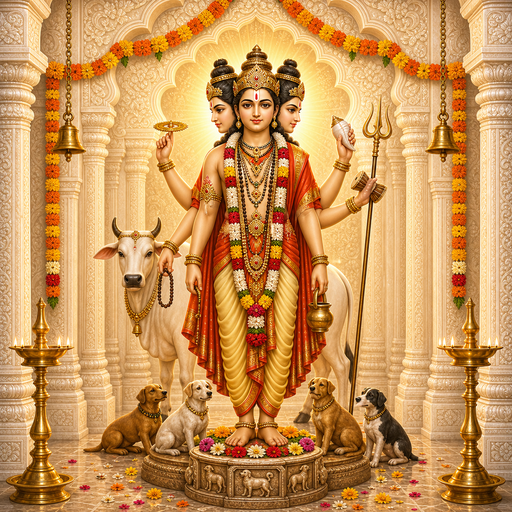
This year's dates (2026)
- Monday; Guru Pratipada — the panchang tags this day for Gangapur; noted here as the start of the Guru Pratipada-to-Audumbar Panchami week-window2 Feb
- Friday; the panchang labels this day 'Audumbar Panchami' — but the connection to this specific place carries a caveat6 Feb
- Sunday; Mahashivratri — Audumbar's government-source-corroborated major yatra15 Feb
- Sunday; Akshaya Tritiya19 Apr
- Wednesday; Guru Purnima29 Jul
- Monday; Shripad Shrivallabh Jayanti (the general Datta-tradition tithi) — Audumbar-specific sources instead give Chaitra, a month discrepancy14 Sep
- Wednesday; Datta Jayanti — Audumbar's most widely-corroborated main festival23 Dec
Deity & significance
Shri Narasimha Saraswati is regarded as an incarnation of Dattatreya (the shared Datta principle — a combined form of Brahma, Vishnu, and Mahesh; for general background on the twenty-four Gurus tradition, see Datta Jayanti). By broad devotional belief, he is held to be Dattatreya's second incarnation.
He was born at Karanja (Washim district) — 1378 CE (Shaka 1300) is the figure used here. (Some Audumbar-specific sources instead give "1304," but since this figure appears in nearly identical, brief phrasing across those sources, it isn't treated as independent corroboration.)
The padukas Narasimha Saraswati established on leaving Audumbar are still worshipped here as the main object of devotion today — this fact is consistent and well-corroborated. By one source, they are known as the "Vimal Paduka" — a distinct local name, similar to Gangapur's "Nirgun Paduka" and Narsobawadi's "Manohar Paduka." This name, however, rests on only a single independent source, so it's given here with that caveat rather than as a settled, sole name.
One government source also mentions a "black flint-stone idol," while a different source suggests a third, separate location — an "idol in Shiva form" at the Brahmanand Swami math — so the exact form and location remain unclear; the safest statement is "padukas are the main object of worship, with a mention of an idol as well."
By Datta-tradition belief, Narasimha Saraswati is held to have resided across three kshetras — Audumbar, Narsobawadi, and Gangapur; of the three, Audumbar is regarded as the seasonal chaturmas residence, while Narsobawadi was his main 12-year stay and Gangapur the site of his longest residence.
Across the Krishna river, next to the Audumbar temple, stands the Bhuvaneshwari Devi temple — a local legend holds that a mute Brahmin boy from Kolhapur was directed here by her vision, and here, by Narasimha Saraswati's grace, he gained speech and knowledge. (One source calls this temple a "Shakti Peeth," but this claim isn't corroborated elsewhere.)
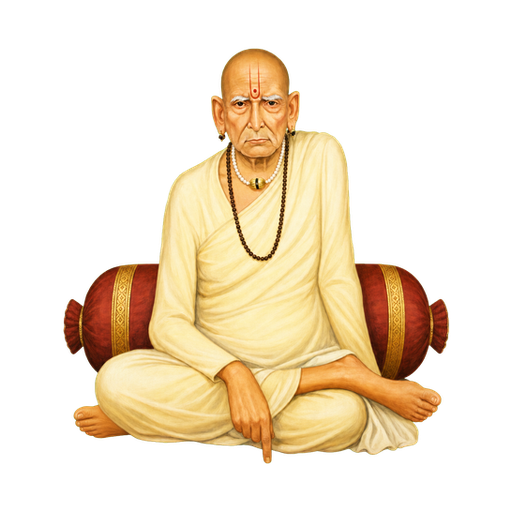
Audumbar is also connected, by shared devotional belief, to other sant-tradition sites — for example, Swami Samarth of Akkalkot, whom some devotees also regard as a Dattatreya incarnation.
History & legend (sthala-purana)
This katha mainly comes from the tradition recorded in the Shri Gurucharitra; the sources telling Audumbar's own specific story may ultimately trace to this same textual root. This entire story is legend/devotional tradition.
After his birth at Karanja, renunciation, and pilgrimage, Narasimha Saraswati came to Audumbar for a chaturmas — this stay is held to have come before his 12-year residence at Narsobawadi. After this came Narsobawadi (12 years), then Gangapur. Sources disagree sharply on the exact year, however — some give "1441 CE," which actually falls in the period after the Narsobawadi stay, inconsistent with the sequence above — so the exact year should not be treated as settled; only the sequence, a chaturmas stay before Narsobawadi, is treated as settled.
A mute Brahmin boy from Kolhapur came to Audumbar, directed by a vision from Bhuvaneshwari Devi; here, by the grace of Narasimha Saraswati, who was performing austerities under the audumbar tree, he gained speech and knowledge. On departing, the guru is said to have promised that he would remain here always, in the form of the audumbar tree and the padukas — devotees believe that sitting under the tree to worship or recite the Gurucharitra earns merit. (This same "eternal presence" motif also appears at Narsobawadi, so it is a recurring Datta-tradition motif, not unique to Audumbar.)
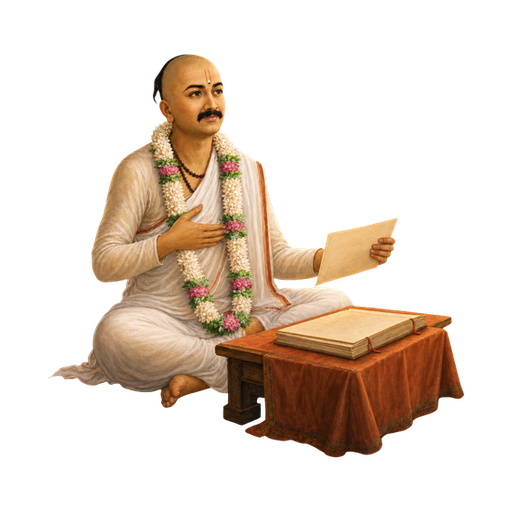
In the pre-modern period, in 1826 CE, Brahmanand Swami came to Audumbar from Girnar; by one source, he brought this site back into prominence following his own vision of Dattatreya. He established a math here and took samadhi. His disciple Sahajanand Swami built the Krishna ghat through devotee donations (in the early 20th century). Eknath Maharaj and his guru Janardan Swami are also recorded as having had a vision of Datta here, though the details are thin.
In 1926, because the original riverside paduka shrine used to go underwater during the monsoon, a new temple was built at a higher location, and the padukas began to be moved there during the rains — two independent sources corroborate this.
Architecture & layout
The paduka shrine originally stood on the Krishna riverbank and still goes underwater during the monsoon; since 1926, the padukas have been moved for darshan to a new temple built on higher ground. By one account, the dome over the padukas was built by the Deshpande family of Ankalkhop.
An extensive Krishna bathing ghat, built by Sahajanand Swami through devotee donations, connects directly to the temple.
The Brahmanand Swami math is reached by a flight of steps from the temple; established in 1826, it is also where the swami took samadhi.
The Bhuvaneshwari Devi temple stands across the river — by one source, of Hemadpanthi stone construction, with sub-shrines to Hanuman, Ganesh, Kalbhairav, and Mahadev, plus a stone rampart and deep-stambha (lamp pillars); these architectural details come from a single source, though the temple's existence itself is corroborated by several sources.
Near the ghat stands the Shri Guru Shivshankaranand Ashram — a centre for Vedic study and priestly training, said by one source to hold valuable Sanskrit manuscripts.
The temple complex is surrounded by dense audumbar and banyan trees.
Festivals & yatra
Audumbar's festivals are set by tithi. Datta Jayanti and Mahashivratri are the two most firmly tied to Audumbar. "Audumbar Panchami" is a misleading name, though — its primary connection is more firmly with Narsobawadi than with Audumbar (see below). The other festivals' dates are reliably fixed by their respective tithi.
| Festival | Tithi | 2026 date | In brief |
|---|---|---|---|
| Datta Jayanti | Margashirsha Shukla Purnima | 23 December (Wednesday) | The most widely-corroborated main festival — noted across four independent Audumbar-specific sources; for the birth story and puja vidhi, see Datta Jayanti. |
| Mahashivratri | Magh Krishna Chaturdashi (nishith period) | 15 February (Sunday) | Called an "annual major yatra" by a government source — an unexpected but well-corroborated festival for a Datta kshetra. See Mahashivratri for details. |
| Guru Pratipada to Audumbar Panchami | Magh Krishna Pratipada to Panchami | 2 February to 6 February | The remembrance window for Narasimha Saraswati's departure/reappearance; despite the name "Audumbar Panchami," its primary connection is more firmly with Narsobawadi than with Audumbar. |
| Guru Purnima | Ashadh Shukla Purnima | 29 July (Wednesday) | A general guru-tattva festival, mentioned here too. See Guru Purnima for details. |
| Akshaya Tritiya | Vaishakh Shukla Tritiya | 19 April (Sunday) | Noted in one local source's list. See Akshaya Tritiya for details. |
| Shripad Shrivallabh Jayanti | Bhadrapad Shukla Tritiya/Chaturthi (general) vs. "in Chaitra" (Audumbar sources) | 14 September (Monday) — but a month discrepancy exists | Dattatreya's first incarnation; Audumbar-specific sources say "in the month of Chaitra," while the general Datta-tradition tithi is Bhadrapad — this discrepancy is unresolved. |
| Shri Narasimha Saraswati Jayanti | Paush Shukla Dwitiya | outside the panchang's 2026 coverage | The Maharaj's own birthday (distinct from Datta Jayanti); noted across four Audumbar-specific sources. |
| Krishnamai Utsav | in the month of Chaitra (exact tithi uncertain) | uncertain | Two sources place this in Chaitra, but the exact tithi could not be found anywhere. |
| Nirvana Utsav | uncertain | unknown | Given as a separate item in one local source's list — possibly another name for one of the days above. |
"Audumbar Panchami" cannot be regarded as Audumbar's own signature festival — the name resemblance can cause confusion, but this tithi's primary religious connection is more firmly with Narsobawadi; the name's origin also appears in a completely unrelated Vishnu-Narasimha-avatar legend. Datta Jayanti and Mahashivratri are Audumbar's more firmly-corroborated main festivals.
Darshan & aarti timings
The timings below are a rough outline drawn from the available sources — plan for general darshan roughly 6 AM to 7 PM and rudrabhisheka roughly 7-8 AM, but call the temple committee once before your visit to confirm.
- General darshan: by one source, 6 AM to 7 PM — no other source independently confirms this.
- Rudrabhisheka: a regular rudrabhisheka on the padukas around 7-8 AM — two independent sources agree. Alankara (decoration) follows the abhisheka.
- Nijaroopa darshan is noted as available in the morning hours.
Confirm exact timings with the temple committee or through local inquiry — a detailed daily schedule (kakad aarti, naivedya, shej aarti, etc.) could not be found in available sources.
It isn't clear which single organisation formally manages the temple as a registered trust, so no organisation is named here as "the official trust."
Special rituals here
- Rudrabhisheka and alankara: a rudrabhisheka on the padukas in the morning, followed by decoration.
- Cradle immersion on Nirvana day: on Narasimha Saraswati's nirvana/remembrance day, a flower-decorated cradle is said to be immersed in a deep pool of the Krishna; when the water level recedes, the Siddhanath temple is said to become visible.
- Worship/Gurucharitra recitation under the audumbar tree: devotees sit under the tree to recite scripture, believed to earn merit.
- Bathing in the Krishna before darshan — the general pattern common to Datta kshetras.
(For the general Datta guru-mantra/aarti meaning and opening line, see Datta Jayanti.)
How to reach
Location: Palus taluka, Sangli district; on the Krishna riverbank, near the villages of Bhilawadi and Ankalkhop.
By road: about 25-27 km from Sangli (most independent sources agree); about 50 km from Kolhapur (three independent sources match — comparatively more reliable); about 54 km from Karad. Regular bus service runs to Audumbar/Ankalkhop from the Sangli ST bus stand.
By rail: the nearest station is Bhilawadi (on the Pune-Miraj-Londa line) — but the exact distance varies widely across sources, from about 3 to 8 km (and even the direction differs by source) — take this as a range, not a single figure. Kirloskarwadi station is about 15 km away; Sangli station (the major junction) is about 26 km away.
By air: the nearest airport is Kolhapur, about 58 km away; Pune international airport is much farther (sources vary widely, roughly 250-350 km).
Nearby places
- The Bhuvaneshwari Devi temple — across the Krishna river, directly tied to Audumbar's own legend.
- Narsobawadi (Kolhapur district) and Gangapur (Karnataka) — the remaining two of Narasimha Saraswati's three principal residences; see their own pages for details.
- Bhilawadi, Ankalkhop, Palus — the nearby villages and taluka centre.
- Karad, Sangli, Miraj, Kolhapur — regional cities along the same travel route.
Travel tips (good to know)
- Expect larger crowds on Datta Jayanti and Mahashivratri — plan your travel and darshan in advance.
- Many devotees combine a visit here with Narsobawadi and Gangapur — all three are regarded as residences within the same Datta tradition.
FAQ
- Where is Audumbar, and who is worshipped there?
- In Palus taluka, Sangli district, on the Krishna riverbank; the padukas of Shri Narasimha Saraswati (regarded as the second incarnation of Dattatreya) are worshipped here.
- Why is Audumbar called by this name?
- The area had, and still has, a large number of audumbar (cluster fig) trees, and Narasimha Saraswati is believed to have performed austerities under an audumbar tree here.
- What is the Vimal Paduka?
- The padukas Narasimha Saraswati established on leaving Audumbar are the main object of worship here; by one source they are called the "Vimal Paduka" — a distinct local name, similar to Gangapur's "Nirgun" and Narsobawadi's "Manohar" padukas (this name rests on a single source, so it's given with that caveat).
- How far is Audumbar from Sangli/Kolhapur?
- About 25-27 km from Sangli, about 50 km from Kolhapur (distances vary slightly by source).
- How do I reach Audumbar?
- The nearest railway station is Bhilawadi (on the Pune-Miraj-Londa line); direct bus service is available from the Sangli ST bus stand.
- What is the difference between Audumbar, Narsobawadi, and Gangapur?
- All three are regarded as residences of Narasimha Saraswati — Audumbar a seasonal chaturmas stay, Narsobawadi his main 12-year residence, and Gangapur the site of his longest stay.
- What is Audumbar's main festival?
- Datta Jayanti (Margashirsha Purnima) is the most widely-corroborated main festival; a large Mahashivratri yatra is also held here.
- What is Audumbar Panchami, and is it connected to Audumbar itself?
- This tithi, falling on Magh Krishna Panchami, is regarded as tied to Narasimha Saraswati's departure/reappearance memory — but its primary connection is more firmly with Narsobawadi; the connection to Audumbar (Sangli) specifically is noted by only one local source.
- What are the darshan timings at the Audumbar temple?
- General darshan runs roughly 6 AM to 7 PM, with rudrabhisheka around 7-8 AM — call the temple committee once before your visit to confirm.
- What is Brahmanand Swami's connection to Audumbar?
- He came to Audumbar from Girnar in 1826 CE, established a math here, and took samadhi — this is regarded as the pre-modern phase of the present temple-math complex.
Related Info
 Datta Jayanti (Shri Dattatreya Jayanti)23 Dec
 Maha Shivratri15 Feb
 Guru Purnima (Vyas Puja)29 Jul
 Akshaya Tritiya19 Apr
 Ganesh Chaturthi / Ganeshotsav14 Sep
- Gangapur Datta (Shri Narasimha Saraswati)2 Feb
- Narsobawadi (Narsobachi Wadi) Datta Temple29 Jul
 Akkalkot Swami Samarth19 Feb
 Paithan — Sant Eknath Maharaj Samadhi Mandir9 Mar