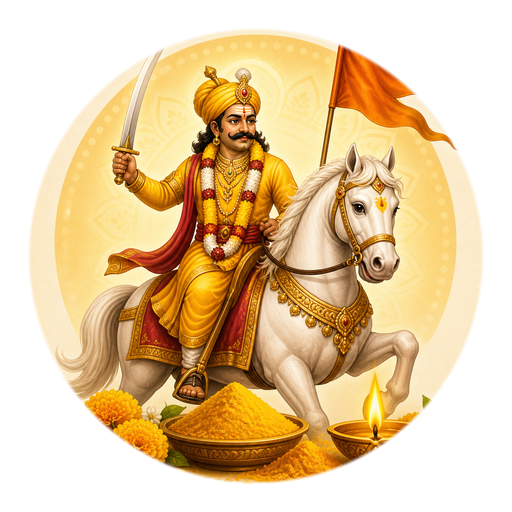
Pali Khandoba Temple, Satara
Pali Khandoba is a Khandoba site at Pali (Pal) village in Karad taluka of Satara district, on both banks of the Tarali river — about 25-33 kilometres from Satara city. This page is about the Khandoba site in Satara district — it has no connection to the "Pali" that is home to the Ballaleshwar Ganpati temple (one of the Ashtavinayak) in Raigad district; the two are entirely separate places. Every year in Paush month, a symbolic wedding ceremony between Khandoba and Goddess Mhalsa is celebrated here — Jejuri is regarded as Khandoba's main seat, while Pali is known as the wedding site.
This year's dates (2026)
Deity and significance
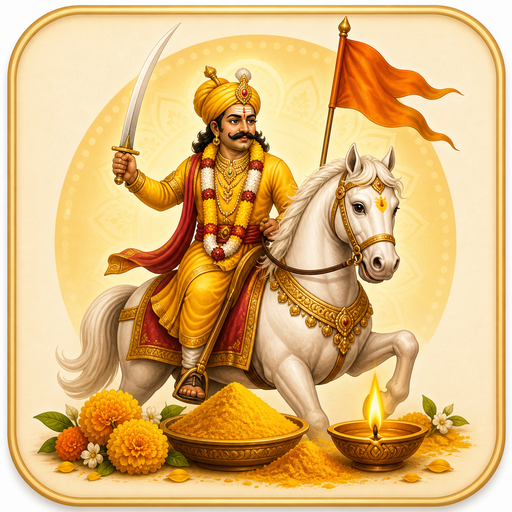
Khandoba = Martand Bhairav — regarded as an incarnation/folk form of Shiv; one of Maharashtra's principal kuladaivats. Pali's site is specifically known as the location of the Khandoba-Mhalsa wedding.
The sanctum holds a mask of Goddess Mhalsa; according to some sources, a black-stone image/mention of the second wife, Banai/Balubai, is also present. By Jejuri's tradition, Mhalsa is associated with the Vani/Lingayat community and Banai with the Dhangar community — this general reference may apply here too, though no Pali-specific detail on this was independently documented.
Pali is regarded as one of Khandoba's principal/established sites — though the total count varies by source (some say eleven, some twelve, some thirteen).
Devotees believe that vows (navas) made to Khandoba are fulfilled here — this is a matter of belief.
History and legend
The village's original name was Rajapur. A Khandoba devotee named Palai, a milkmaid, is said to have lived here. Her devotion is said to be why Khandoba manifested here in linga form; the village is said to have taken the name "Pal"/"Pali" after her. The Marathi Vishwakosh separately notes that in Sanskrit, "pal" means king/protector — this etymological note complements the Palai legend rather than contradicting it.
One version of the legend also tells that a black cow is said to have shown Palai the spot in a dream; a self-manifested linga was found after six days of digging; Palai is said to have attained samadhi at the temple entrance.
Sources vary considerably on the temple's construction year. The Marathi Vishwakosh records the temple as built in Shake 1614 (approximately 1692 CE). Other sources say it was built about 500 years ago by Aba (bin) Sheti Padghode of the Vani community, with an expansion in 1635 CE by Ragho Mambaji (of Khatav). Some sources regard the temple's architecture as 13th-century, while local belief holds the temple to be roughly a thousand years old. The Maratha sardar Dhanaji (Sambhaji) Jadhav is also said to have added pillars to the sabhamandap.
Architecture and layout
The temple is built in Hemadpanthi style, with fortification on all four sides; the outer walls carry carvings of snakes, rivers, elephants, horses, and sheep. The sanctum holds a self-manifested linga — described as bearing masks of Khandoba and Mhalsa, or as a dual-linga form (the exact description varies slightly by source). A black-stone image of the second wife (Banai/Balubai) is also mentioned by some sources.
The sabhamandap was built by the Maratha sardar Dhanaji (Sambhaji) Jadhav — sources vary on the pillar count, giving either twelve or sixteen (the majority lean toward sixteen); the pillars carry a brass covering. One single source mentions a spire roughly 50 feet high.
The grounds hold small shrines to Maruti, Vitthal, Jyotiba, Yamai, Mhasoba/Mhalsoba, Satai, Omkareshwar Mahadev, Hegadi, Nandi, Ganapati, Bhavani, and Panchalinga — the list varies by source, but the shared theme is "a complex of many subsidiary deities." A lamp tower stands within the grounds. Several sources describe three entrance gates.
Main festivals and pilgrimage
| Festival | Tithi/Nakshatra | 2026 date | In short | Link |
|---|---|---|---|---|
| Khandoba-Mhalsa wedding ceremony (main yatra) | Paush month, Mrig nakshatra | 2 January (estimated — confirm before visiting) | A symbolic wedding ceremony between Khandoba and Mhalsa; the Tarali river and Pali area fill with devotees; bhandara (turmeric) is thrown to mark the ceremony's start/close. Sources give different figures for the festivities' duration — some say 3-4 days, others describe roughly fifteen days; confirm the exact duration with the temple committee or locals before planning your visit | 2 January day page |
The exact ceremony date can shift from year to year — sources aren't settled on whether it's fixed by the nakshatra (Mrig) or by the tithi (Purnima); see below. Confirm the exact ceremony day with the temple committee or the local gram panchayat before visiting.
This page covers only Pal, Satara district (Karad taluka). The panchang entry for this day groups several other villages together under one event name — those villages (in Ambegaon/Khatav talukas) are separate local Khandoba yatra sites, not covered here.
Web sources generally describe the ceremony as falling "on Paush Purnima," but more precise sources say it falls on Mrig nakshatra. In 2026, Mrig nakshatra falls a day before Purnima (on Chaturdashi, 2 January), while the actual Purnima tithi falls on 3 January — meaning tithi and nakshatra diverge by a day this year. This ceremony may be governed by the nakshatra (Mrig) rather than the pure tithi (Purnima).
Champashashti (Margashirsh Shukla Shashthi — the general Khandoba legend of the Mani-Malla slaying) is not Pali's own festival — it is associated with Jejuri and other villages; it is referenced here only for context, pointing to the Champashashti page.
Darshan and aarti timings
A general description found here says puja takes place four times a day; no exact clock-time was found in any source. No independent official website for Pali's Khandoba devasthan was found — only one devasthan Facebook page turned up, and its authenticity has not been verified. Confirm darshan/aarti timings with the temple committee/local gram panchayat before relying on them.
Rituals here
The idols of Khandoba and Mhalsa are brought in a palkhi procession amid music for the wedding ceremony; one source says the honour of carrying this palkhi belongs to the twelve balutedars. Bhandara (turmeric) is thrown to mark the ceremony's start and close.
By one local account, coconuts are not offered to Khandoba at Pali — this may be a distinct local custom.
General Khandoba worship practices (bhandara/turmeric, tali-bharane, the "Yelkot" invocation) likely apply at Pali too, by tradition; see the Jejuri Khandoba page for details.
How to reach
Pali can be reached via the Satara-Karad road, through the villages of Atit and Kashil; it lies about 6-7 kilometres west of Kashil (sources vary slightly). A motorable road reaches the temple's southern gate. Distance from Satara city is about 25 to 33 kilometres (sources vary — the district administration's official list records 33 km). About 32 kilometres from Karad. About 135-144 kilometres from Pune, roughly a 2 to 2.5-hour drive. Direct state transport buses run from Satara and Karad. The nearest railway station is Satara; the nearest airport is Pune (Lohgaon).
Nearby places
- Kashil — about 6-7 kilometres from Pali, a stop on the Satara-Karad road.
- Karad — the Krishna-Koyna confluence area, the Yashwantrao Chavan memorial, Ratneshwar temple, and other attractions.
- Jejuri Khandoba — Khandoba's main seat (Pune district); a general belief holds Pali as the wedding site and Jejuri as the main seat.
Traveller tips
Large numbers of devotees arrive from the surrounding region for the Paush-month wedding ceremony — arrange vehicle parking and accommodation in advance. December-January is the cold season — carry warm clothing for the mornings and evenings. Since the temple stands on the Tarali riverbank, take care of children/elderly near the water during the yatra crowds. Confirm darshan/aarti timings and the exact yatra day with the temple committee/local gram panchayat before visiting.
Good to know
This Pali is the Khandoba site in Satara district — it has no connection to the "Pali" that is home to the Ballaleshwar Ganpati temple (one of the Ashtavinayak) in Raigad district; the two are entirely different deities in different districts. The ceremony's exact date each year may be governed by the nakshatra (Mrig) rather than the Purnima tithi alone — worth checking for this when confirming future years' dates.
FAQ
- Where is Pali Khandoba temple?
- In Karad taluka of Satara district, on the Tarali riverbank; about 25-33 km from Satara city.
- How far is Pali from Satara?
- Sources vary, roughly 25-33 km (no single fixed figure; the district administration's list records 33 km).
- Is Pali Khandoba different from Jejuri Khandoba?
- Yes; Jejuri (Pune district) is Khandoba's most famous/main site, while Pali (Satara district) is a distinct site known for the Khandoba-Mhalsa wedding ceremony.
- What is the history of Pali Khandoba temple?
- Sources vary considerably on the construction year (Shake 1614 / about 500 years / 13th century / a thousand years by local belief) — no single year can be stated with certainty.
- How did Pali village get its name?
- The original name was Rajapur; by local belief, it became "Pal"/"Pali" after the Khandoba devotee Palai, a milkmaid.
- When is the Pali Khandoba-Mhalsa wedding ceremony?
- Every year in Paush month, on Mrig nakshatra (around Purnima); in 2026, the relevant date is 2 January. Confirm the exact ritual day with the temple committee.
- What are the darshan timings at Pali Khandoba temple?
- A general description says puja happens four times a day; no exact clock-time was found in available sources — confirm with the temple committee.
- What subsidiary deities are at Pali Khandoba temple?
- Small shrines to Maruti, Vitthal, Jyotiba, Yamai, Mhasoba, Omkareshwar Mahadev, and others stand around the grounds (the list varies by source).
- Are Pali (Satara) Khandoba and Pali (Raigad) Ballaleshwar the same place?
- No. Pali (Raigad) is the site of the Ballaleshwar Ganpati temple, one of the Ashtavinayak (a different district, a different deity); Pali (Satara) is a Khandoba site in Karad taluka. The two are entirely separate pages.
- How do I reach Pali Khandoba?
- Via the Satara-Karad road through Atit/Kashil; state transport buses run from Satara and Karad; the nearest railway station is Satara, and the nearest airport is Pune.