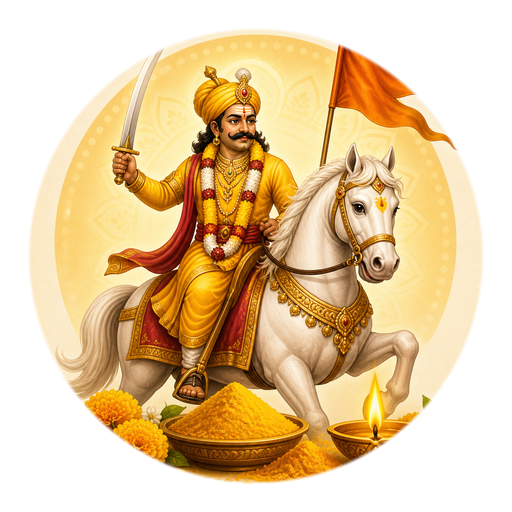
Jejuri Khandoba (Martand Bhairav)
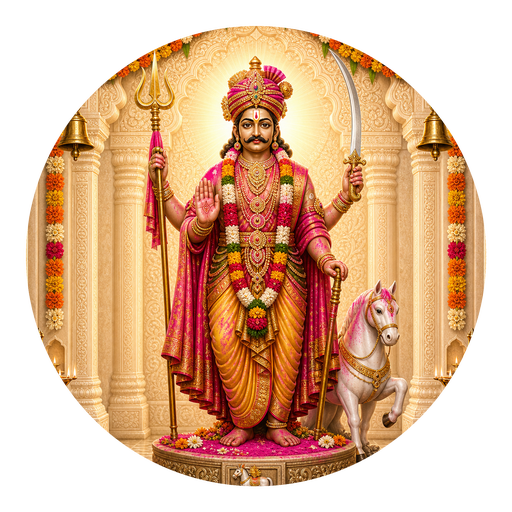
Jejuri is the famous hill-fort temple of Khandoba, also called Martand Bhairav — in Purandar taluka, Pune district, about 48–50 km from Pune. Khandoba is the kuldaivat (family deity) of countless families in Maharashtra; devotees see him as a composite folk-form of Shiv, Bhairav and Surya. On Somvati Amavasya and the big festivals, so much yellow bhandara (turmeric) is thrown that the whole hill turns golden — hence “Sonyachi Jejuri” (the golden Jejuri) — to the roaring chant “Yelkot Yelkot Jai Malhar!” Jejuri's two biggest occasions are Champa Shashti (Margashirsh Shukla Shashti — the peak of a six-day festival, this year on 15 December 2026) and the Somvati Amavasya yatra, when Khandoba's palanquin is taken to the Karha river for a ritual bath. Below is the deity's form, the fort's history, its architecture, the festival calendar, and travel details.
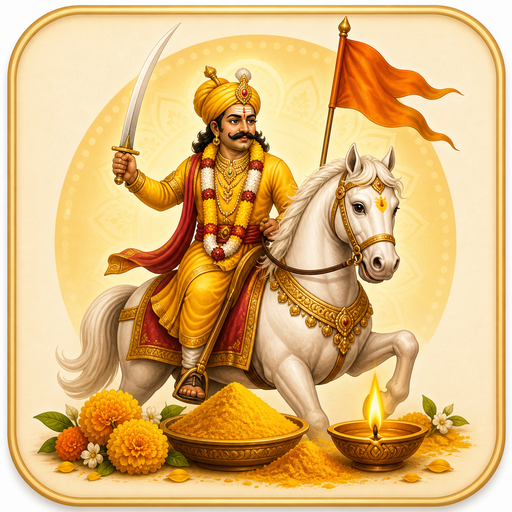
This year's dates (2026)
- Shadraratrotsav begins — Champa Shashti six-day festival starts9 Dec
- Champa Shashti / Martand Bhairav utthapan / Skanda Shashti — the peak day (Tuesday)15 Dec
- Shri Khandoba Shikharkathi yatra - Jejuri (Sunday)1 Feb
- Somvati Amavasya (Monday)16 Feb
- Somvati Amavasya (Monday)15 Jun
- Somvati Amavasya (Monday)13 Jul
- Somvati Amavasya (Monday)9 Nov
Deity & significance
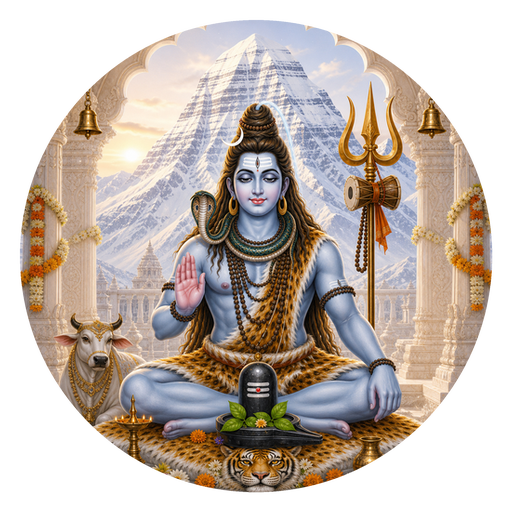
Khandoba is Martand Bhairav. The same deity is also known as Malhari, Mallari, Mailar, Khanderay and Mallanna. Devotees revere him as an avatar of Shiv; in scholarly terms he is a composite folk-deity carrying the attributes of Shiv, Bhairav and Surya (and Kartikeya/Skanda). That is why Champa Shashti is also linked with Skanda Shashti — on this site's panchang, 15 December 2026 carries both notes together.
Khandoba is the kuldaivat of millions of families across Maharashtra and Karnataka. His devotion runs especially deep among the Maratha, Kunbi, Dhangar (shepherd) and Ramoshi communities. This close bond with farming and pastoral life gives Khandoba the character of a “god of farmers and shepherds” — and that is the heart of Jejuri's folk devotion.
Mhalsa and Banai — the two consorts.
Khandoba's two wives are seen as symbols of two different ways of life:
- Mhalsa — from a Vani/Lingayat merchant lineage; she is regarded as a form of Parvati (in one legend, the daughter of Timmashet the merchant of Newase). She stands for settled, householder culture.
- Banai (Banu) — from the Dhangar (shepherd) community, linked with the Ganga. She stands for nature and the pastoral world.
Through these two consorts, Khandoba's worship bridges farming and herding, and also joins different communities under one deity — a distinctive strand of Jejuri's folk culture. (Details of these stories vary by place and version.) His well-known symbols are the horse and the dog, and the main offering is bhandara (turmeric).
History & legend (sthala-purana)
The root sthala-purana of Khandoba's descent is taken to be the Malhari Mahatmya. The story below appears, in the same outline, across several independent versions. Details differ by version.
The shared story. Two demon brothers, Mani and Malla, spread havoc across the land; sages and ordinary people alike were tormented by them. To protect his devotees, Shiv took the radiant form of Martand Bhairav and fought these demons. By one version the battle lasted six days and ended on Margashirsh Shukla Shashti — which is why Champa Shashti is observed on that day. Because he became the “enemy of the demon Malla,” the deity earned the name Mallari / Malhari Martand. Khandoba then settled on Jejuri hill to guard his devotees; among Khandoba's principal seats, Jejuri is regarded as the foremost.
Where the versions differ. The fate of the demons is told differently — in some versions both are slain, while in others one is killed and the other, on surrendering, is forgiven and absorbed into worship. Likewise Mhalsa's birth story (Newase/Pali) and Banai's story (Chandanpuri/a Dhangar hamlet) are told with local variations.
Historical building. Worship of Khandoba is believed to go back to the 12th–13th century; the temple complex on the hill developed in stages under the Maratha, Holkar and Peshwa periods. By some accounts the temple was built around 1608, the sabhamandap and other work in 1637 under Ragho Mambaji (a Maratha chief), the stone pillars in 1742 under the Holkars, and the fort wall and tank around 1770 — while other records credit the restoration to the Holkars (Ahilyabai) and the Peshwas. One striking detail: Chimaji Appa gifted the temple the Portuguese church bells taken during the Vasai campaign of 1737–1739. (By one account, Aurangzeb is also recorded as having given the temple 1,25,000 silver coins.)
Architecture & layout
- Style — Hemadpanthi: this black-stone construction is considered an important milestone in Marathi temple architecture.
- Steps: roughly 200 steps lead up to the fort (on yatra days, with detours, some put it at ~385 to ~450). Its popular name is “Navlakh Payricha Dongar” (“the hill of nine lakh steps”) — a name of faith, not a literal count.
- Deep-stambha and lamps: the fort has around 350 deep-stambha (lamp-pillars), about 18 arches, and an eight-sided fort wall (~350 yards); a large brass-coated tortoise (~20 ft) is a notable feature.
- Two seats: Jejurigad (the main temple) and Kadepathar — Khandoba's older seat on a plateau about 300 m high. The hill rises to roughly 718–798 m.
- Sanctum: the sanctum holds image-pairs of Khandoba and Mhalsa (by some accounts, three pairs).
Festivals & yatra
Jejuri's festivals are set by the tithi; the table below gives each occasion's tithi, this year's (2026) date, and a link to that day's panchang page. All yatra dates and timings should be checked with the temple committee — the programme can change on festival and yatra days.
| Festival | Tithi | This year's date (2026) | In brief |
|---|---|---|---|
| Champa Shashti (Shadraratrotsav — main) | Margashirsh Shukla 1 to 6 (peak on Shashti) | 9 Dec → peak 15 Dec | Six-day remembrance of the Mani-Malla victory; telhanda on Shukla Panchami, the big yatra and Martand Bhairav utthapan on Shashti (linked with Skanda Shashti) |
| Somvati Amavasya yatra | Amavasya falling on a Monday (2–3 times most years, four in 2026) | 16 Feb · 15 Jun · 13 Jul · 9 Nov | Khandoba's palanquin goes to the Karha river for a bath (~7 km procession); the bhandara throw turns Jejuri golden |
| Shikharkathi yatra (Jejuri) | Magh Purnima | 1 February | A special yatra on the fort; Magh Purnima is taken as Mhalsa's birthday, with a ‘kathya lavane’ ceremony the next day |
| Navratri / Dasara (Shilangan) | Ashwin Shukla 1–10 | by tithi | On the tenth day, the Ramana/Shilangan palanquin (~4–6 km), fireworks and khand-spardha |
| Mahashivratri | Magh/Phalgun Krishna Chaturdashi | by tithi | Only at set times of the year is the underground guptaling opened for darshan |
| Paush Purnima (donkey fair) | Paush Purnima | local yatra nearby | Horse and donkey fair (this is mainly at nearby local Khandoba seats such as Pal) |
The biggest occasions are Champa Shashti (six days) and the Somvati Amavasya Karha-bath yatra. On this site's panchang, Somvati Amavasya is a generic entry (not tied to any town) — so the Somvati dates above are given as “Somvati Amavasya”; which Somvati Amavasya the Jejuri yatra actually falls on should be checked with the temple committee.
The exact daily ritual order across Champa Shashti's six days (telhanda, chhabina, the Mhalsa-Banai wedding form) and the precise meaning of ‘Martand Bhairav utthapan’ are told differently by different versions.
Darshan & aarti timings
The timings below are based on information from the Shri Martand Dev Sansthan, Jejuri. Temple timings change and are different during yatra periods, and travel websites list different hours — so check the current timing with the temple committee before you go.
- Early morning: the temple opens around 5:00 AM; 5:00–6:30 AM — Bhupali, aarti and abhishek.
- Midday: 12:30–1:30 PM — dupaarti (dhooparti) and abhishek.
- Night: 9:00 PM — shejaarti (the temple then closes).
Sansthan contact: Shri Kshetra Jejuri, Ta. Purandar, Dist. Pune 412303; office +91 9689010000, bhaktaniwas +91 9689020000. The Sansthan also offers an online darshan pass. (This official Sansthan site describes itself as the “Shri Martand Dev Sansthan”; this page claims no official association with that trust.)
Special rituals here
Jejuri's devotional traditions are distinctive. The rituals below vary by local and family custom, so take them as “by tradition.”
- Bhandara (turmeric) throw — “Sonyachi Jejuri”: devotees throw yellow bhandara (turmeric) in great quantities, and the whole fort, its steps and roads turn golden — hence “Sonyachi Jejuri.” It has a folk-cultural parallel with the gulal tradition at Jyotiba.
- Tali bharane: a tamhan (metal tray) is filled with a betel leaf, a coin, a betelnut, bhandara and dry coconut, and lifted three times while chanting “Sadanandacha Yelkot” or “Yelkot Yelkot Jai Malhar” three times; the bhandara is then thrown up with the call “Yelkot ghe.” It is described as a rite for fulfilling a vow to the kuldaivat (by local custom).
- Vaghya-murali (jagran-gondhal): boys and girls dedicated to Khandoba as a vow are called vaghya (boy) and murali (girl); through the night's jagran-gondhal, songs are sung to the tuntune and khanjiri, and there is dancing. (The historical-social context of this tradition is sensitive; it should be viewed with respect and present-day awareness.)
- Somvati Karha-bath: on Somvati Amavasya, Khandoba's palanquin is taken to the Karha river for a bath; in the evening the deity is bathed in the river water, aarti is performed, and the palanquin returns to the fort.
- Offerings: bhandara (turmeric), dry coconut, betel leaf and betelnut are the main offerings; naivedya and rituals vary by local custom.
Mantra & aarti
The main devotional cry of Khandoba worship is “Yelkot Yelkot Jai Malhar!” and “Sadanandacha Yelkot” — shouted aloud while throwing bhandara and performing tali bharane. ‘Yelkot’ is a traditional chant-word in Khandoba devotion, and its precise meaning is told differently across versions.
Khandoba's traditional aarti is popular among devotees. Its full text is not given here; only its meaning is noted — praise of Khandoba-Martand Bhairav (as Shiv-Malhari) and the devotee's act of offering the aarti. It is sung mainly at the morning and evening aarti times and in home puja.
How to reach
- By road: Jejuri is about 48–50 km from Pune (via Pune–Saswad–Jejuri). ST buses, private vehicles and taxis are easily available from Pune.
- By rail: Jejuri has its own railway station; a local/passenger train from Pune reaches Jejuri, and an autorickshaw or vehicle takes you from the station to the foot of the fort.
- By air: the nearest airport is Pune (about 50 km), from where Jejuri is reached by road.
- The climb: from the base to the main temple you climb roughly 200 steps.
Nearby places
- Kadepathar — Khandoba's older seat on the high plateau near the fort; many devotees also go here for a quieter darshan.
- Purandar Fort — a historic fort near Jejuri (important in Maratha history).
- Saswad — a town on the way, with several old temples.
- Pune city — the nearest large city; a convenient base for stay, transport and other pilgrim sites.
- Cluster links: many devotees pair this trip with Kolhapur's Jyotiba (‘Changbhala’ and the bhandara/gulal tradition) and Kolhapur Mahalakshmi, the Shakti Peeth.
Travel tips (good to know)
- Crowds: on Somvati Amavasya and Champa Shashti, lakhs of devotees come from across the state — it gets extremely crowded. Plan ahead for parking, water and queues.
- The climb: it is a climb of about 200 (and more) steps — the elderly, small children and the unwell should take care; carry enough water and take rest breaks.
- Bhandara (turmeric): turmeric is thrown in large amounts — if you have respiratory or eye sensitivity, use a mask/glasses; clothes will stain yellow, so old/cotton clothes are convenient.
- Timings change: darshan timings change during yatra periods and on festivals — check the current timing with the temple committee or the Sansthan.
FAQ
- Where is the Jejuri Khandoba temple?
- On Jejuri hill — Purandar taluka, Pune district; about 48–50 km from Pune.
- How far is Jejuri from Pune?
- About 48–50 km (sources say ~30 miles to ~50 km); roughly a 1.5–2 hour drive.
- How many steps are there on the Jejuri fort?
- Actually about 200 steps (some say ~450 on yatra days). “Navlakh Payricha Dongar” is the popular name of faith, not a literal figure.
- Is Khandoba a form of Shiv or Bhairav?
- Devotees revere Khandoba as an avatar of Shiv (Martand Bhairav/Malhari); in scholarly terms he is a composite folk-deity of Shiv, Bhairav and Surya (this is traditional belief; details vary by telling).
- Why is Jejuri called ‘Sonyachi Jejuri’?
- Because the yellow bhandara (turmeric) thrown here makes the whole hill look golden — hence ‘Sonyachi Jejuri.’
- What is the Somvati Amavasya yatra, and when is it?
- On an Amavasya that falls on a Monday, Khandoba's palanquin is taken to the Karha river for a bath, and the bhandara throw turns Jejuri golden. Such an Amavasya comes 2–3 times most years — four in 2026; the exact Jejuri yatra date should be checked with the temple committee.
- What is Champa Shashti, and how is it celebrated at Jejuri?
- Margashirsh Shukla 1 to 6 is Khandoba's six-day festival remembering the Mani-Malla victory, with the peak on Shukla Shashti (this year, 15 December 2026) — the big yatra and Martand Bhairav utthapan.
- Who are Khandoba's consorts — Mhalsa and Banai?
- Mhalsa (Vani/Lingayat lineage) and Banai/Banu (Dhangar community) are Khandoba's two consorts; they are seen as symbols of the bridge between farming and pastoral culture.
- What are the darshan and aarti timings?
- Per the Sansthan, the temple opens around 5:00 AM; Bhupali/aarti 5:00–6:30 AM, dupaarti 12:30–1:30 PM, shejaarti 9:00 PM — but verify with the temple committee.
- What does ‘Yelkot Yelkot Jai Malhar’ mean?
- It is the traditional victory cry of Khandoba devotion, shouted while throwing bhandara and performing tali bharane. (Its precise meaning varies by version.)