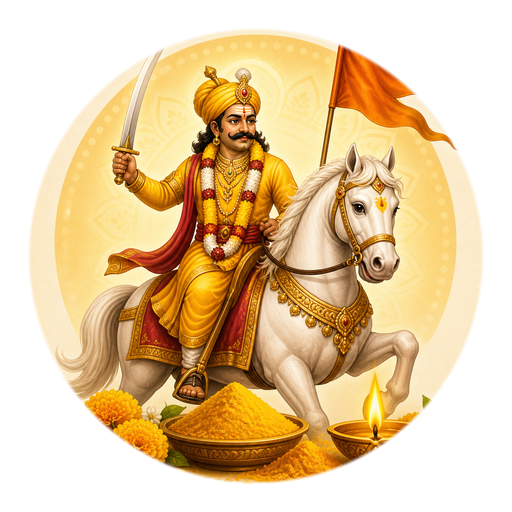
Naldurg Khandoba Temple (Andur–Naldurg twin-shrine)
Naldurg-Andur Khandoba is a twin site spanning the villages of Andur and Naldurg in Dharashiv (Osmanabad) district — about 46-48 kilometres from Solapur, about 32-35 kilometres from Tuljapur. A single idol of Khandoba moves between two temples through the year — spending roughly ten and a quarter months at Andur and about one and three-quarter months at Naldurg (locally called "Mailarpur"), by formal agreement between the two villages. The main annual festival is the Paush Purnima mahayatra — 3 January in 2026 — drawing roughly five lakh devotees.
This year's dates (2026)
- Naldurg-Andur Khandoba Mahayatra (Paush Purnima, PRIMARY) — per web sources; this site's panchang records 'Shakambhari Purnima/Savitribai Phule Jayanti/Yamai Yatra-Aundh' on this day, with no direct 'Naldurg' tag3 Jan
- Martand Bhairav Shadratrotsav begins — per web sources, the idol's departure from Andur toward Naldurg happens around this time; no 'Naldurg' tag in this site's panchang. This cycle's Paush Purnima falls in January 2027, outside this panchang's 2026 scope9 Dec
- Champashashti/Skanda Shashthi/Martand Bhairavotthapan — also observed at Naldurg-Andur, but as a secondary occasion (it is Jejuri's own signature tithi); no Naldurg tag in this site's panchang15 Dec
Deity and significance
Khandoba = Martand Bhairav — also known as Malhari, Mailar, and Khanderaya; devotees regard him as an incarnation of Shiv. See the Jejuri Khandoba page for a detailed discussion of this general Khandoba theology.
Andur is the original/permanent seat — its sanctum permanently holds a fixed Shivling form of Khandoba (along with a Khandoba-Mhalsa metal idol). Naldurg is the seasonal residence — the festival idol (with a silver crown, coated in turmeric) is taken to Naldurg for a set period each year; when the idol moves, a Shivling is said to remain behind in the empty sanctum.
By scholarly accounts, Naldurg is regarded as the fourth of Khandoba's eleven principal "jagrut kshetras" (awakened sites); this account draws on Sontheimer-based scholarship. The same account holds that Khandoba's centre of worship originated at Premapuri (present-day Pember, Karnataka) and journeyed through Naldurg → Pali → Jejuri — giving Naldurg a special standing as an ancient/intermediate stop in Khandoba's story.
The Adil Shahi sultan Ibrahim II (r. 1580-1627) is recorded as having patronised the Khandoba fair — reinstating the annual fair and granting pilgrims ritual rights at the Naldurg temple; a Muslim devotee is also recorded as traditionally playing the naqara drum during Naldurg's residence period — a theme consistent with the broader tradition of Hindu-Muslim participation in Khandoba worship.
History and legend
This account is legend/sthala-purana, not history — the Marathi Vishwakosh (state encyclopaedia) also explicitly states that the exact date/founder is not settled.
Naldurg's name is tied to Raja Nal — some sources say he was a feudatory of the Kalyani Chalukya kings and built a fort here called "Ranmandal," which later came to be known as Naldurg. The Marathi Vishwakosh, however, treats this as "legend" — the claim that "Raja Nal built the fort" comes from the Tarikh-i-Firishta, a 1606 Persian historical text, with no contemporaneous evidence; it also notes the region was known as "Nalwadi Vishay" during the earlier Badami Chalukya period — a possible alternate (administrative) origin for the name "Nal." Both possibilities are recorded here, with neither treated as settled history.
Raja Nal's wife Damayanti (names from the Mahabharata's Nal-Damayanti legend) is said to have been a devotee of Khandoba; her devotion is said to be why Khandoba first came to this place. One source gives the king's name as "Nalsinh" instead — possibly a conflation with a Narsimha idol reference.
Over time, villagers built a Khandoba temple on the banks of the Bori river, northwest of the village; that site too faced "some difficulties," leading to the temple's move to its present location about 2.5 kilometres north of Naldurg. One single source makes a more specific claim — that in 1694, Ibrahim Adil Shah demolished the temple while building a bastion, later reinstalling it in an arched sanctum beneath the northern bastion — but this claim is chronologically inconsistent: Adil Shahi rule had already passed to the Mughals by 1686, making it impossible for any Adil Shahi sultan to have been active in 1694 — either the year or the ruler's name appears to be incorrect.
In this way, Andur and Naldurg came to be regarded as "one site" — the idol residing at Andur for roughly ten and a quarter months and at Naldurg for about one and three-quarter months. Andur's original name is said to have been "Anandpur," which changed to "Andur" over time.
The marriage referenced on Paush Purnima is a point of version divergence — some sources describe it as commemorating the marriage to Mhalsa, while one source says a marriage to Banai took place at Naldurg itself.
Architecture and layout
The Andur temple (the main/original seat) faces north; it stands within a fortified enclosure (walls roughly 35 feet high, about 190 by 105 feet) — inscriptions dated 1746 and 1749 CE appear on the walls; the main construction is dated to 1739 CE, per an inscription on the river-mandap. A separate source, however, calls this same temple "16th century" — a gap of nearly 200 years.
The sanctum holds standing metal idols of Khandoba-Mhalsa with a metal canopy/halo; the original form is a Khandoba "sayani linga." In the northwest corner of the enclosure stands a platform bearing a Shivling, a standing Surya, a seated Shiv-Parvati, and a Ganesh idol — these are said to have been brought from the nearby, now-ruined Narayangudi temple (along with a Narsimha sculpture). The gateways bear the names of Chhatrapati Shahu Maharaj and Rajmata Jijabai Bhosale (a modern naming, not a construction-era claim).
The Naldurg (village) temple was built by villagers on the Bori riverbank, later moved about 2.5 kilometres north of Naldurg — its own architectural details are comparatively limited compared to Andur's.
The famous Naldurg Fort (with its Pani Mahal, the Bori river dam, and bastions) is a separate structure — legend places Khandoba's earlier site within or near the fort grounds, but the currently functioning Khandoba temple stands at a different location (in the village/to the north).
Main festivals and pilgrimage
| Festival | Tithi | 2026 date | In short | Link |
|---|---|---|---|---|
| Paush Purnima Mahayatra (main) | Paush Shukla Purnima | 3 January | The peak of the Naldurg residence period; roughly five lakh devotees; pre-dawn kakada aarti, abhishek, abhyangasnan, mahavastra, mahaprasad, bhandara, coconut ritual, village-flag processions | 3 January day page |
| Margashirsh Shukla Pratipada (yatra season begins) | Margashirsh Shukla Pratipada | 9 December | The idol's departure from Andur toward Naldurg happens around this time | 9 December day page |
| Champashashti/Skanda Shashthi (secondary) | Margashirsh Shukla Shashthi | 15 December | Jejuri's main tithi; also observed at Naldurg-Andur, but as a secondary occasion | 15 December day page → Champashashti |
| Weekly Sunday yatra | Every Sunday (during the Naldurg residence period) | (no annual date applies) | A yatra held every Sunday while the idol resides at Naldurg; over fifty thousand devotees weekly | — |
| The idol's return to Andur | Approximately in Magh month | Tithi unconfirmed | After about one and three-quarter months, the idol is taken back to Andur per the agreement; no source gives an exact tithi | — |
Paush Purnima is Naldurg's own signature festival (much as Champashashti is Jejuri's); Champashashti here is secondary.
A note on the two cycles in this table: the 3 January 2026 Paush Purnima mahayatra is the culmination of the residence cycle that began in December 2025 — it belongs with the previous year, not with 9 December 2026. The 9 December 2026 departure instead starts a new residence cycle, whose own Paush Purnima mahayatra falls in January 2027 — outside this panchang's 2026 scope. Don't read December 2026 and January 2026 as one continuous cycle.
Darshan and aarti timings
Regular puja takes place twice daily (morning and night); a night shejarti is held. On yatra day, a special sequence applies — a 4 AM kakada aarti, followed by abhishek/abhyangasnan/mahavastra/mahaprasad. Confirm exact timings with the temple committee/Andur devasthan.
Rituals here
A formal written agreement between the villages of Andur and Naldurg governing the idol's transfer is recorded as having been followed for centuries — this is the most distinctive, rare practice of this site.
The Paush Purnima yatra ritual sequence runs: pre-dawn kakada aarti → idol abhishek → abhyangasnan → mahavastra and ornamentation → mahaprasad → day-long bhandara (turmeric) throwing → a coconut-offering ritual → flag processions from various villages → wrestling bouts. During the Naldurg residence period, a smaller weekly yatra is held every Sunday.
A Muslim devotee is recorded as playing a traditional role in the naqara drumming. Offerings include bhandara (turmeric), coconut, and betel leaf — consistent with general Khandoba naivedya tradition, though local custom may vary.
See the Jejuri Khandoba page for the site-wide "Yelkot" invocation and Khandoba aarti details.
How to reach
About 46 to 48 kilometres from Solapur; about 32 to 35 kilometres from Tuljapur; about 46 to 58 kilometres from Dharashiv (Osmanabad) city (these figures vary by source but are internally consistent — Andur's figures generally match Naldurg's figures plus about 4-4.5 km).
Nearby places
- Naldurg Fort (Pani Mahal) — a famous historic fort, known for its dam on the Bori river and the "Nar"/"Madi" waterfalls; a structure distinct from the Khandoba temple.
- Tuljapur Tuljabhavani — a major Devi site in the same Dharashiv district; Naldurg-Andur and Tuljapur are considered a popular same-trip pairing.
- Ramtirth — about 1.5 kilometres from Naldurg, with Ram-Hanuman-Mahadev temples on the Bori riverbank.
Traveller tips
Roughly five lakh devotees are expected at the Paush Purnima mahayatra — plan for heavy crowds, vehicle parking, water, and queues. Devotees should remember that Andur and Naldurg are separate villages (about 4-4.5 km apart) — check where the idol currently resides before visiting. Set aside time to see Naldurg Fort (Pani Mahal), but note it is separate from the Khandoba temple complex. Large amounts of turmeric are thrown during the yatra — take care if sensitive to it around eyes/breathing, and old/cotton clothing is convenient. Timings and rules can change — contact the temple committee or local tehsil/gram panchayat sources before setting out.
Good to know
Naldurg's local name is "Mailarpur" — don't confuse this with the separate Mailar Khandoba (Adimailar, Bidar) in Karnataka; the two are completely distinct, distant sites.
FAQ
- Where is Naldurg Khandoba temple?
- In Dharashiv (Osmanabad) district, Maharashtra; about 46-48 km from Solapur, about 32-35 km from Tuljapur.
- What exactly is the relationship between Naldurg and Andur Khandoba temples?
- Both are regarded as "one site" sharing a single Khandoba idol; the idol resides at Andur for roughly ten and a quarter months and at Naldurg for about one and three-quarter months, by village agreement.
- Why does Khandoba's idol move between Andur and Naldurg each year?
- A centuries-old local tradition and a formal agreement between the two villages; the exact historical cause is told in legend form.
- When is Naldurg Khandoba's main yatra?
- Paush Purnima — 3 January in 2026 — the peak of the idol's Naldurg residence, with roughly five lakh devotees.
- Are Naldurg Fort and the Khandoba temple the same place?
- No. The famous Naldurg Fort (Pani Mahal) is a separate structure; the current Khandoba temple stands at a different location from the fort, though legend ties them together historically.
- What is Mailarpur — is it the Mailar Khandoba in Karnataka?
- No. "Mailarpur" is Naldurg's own local name; the Mailar/Mallari Khandoba in Karnataka is a completely separate, independent site.
- How many months a year does Khandoba reside at Andur?
- About ten and a quarter months; the remaining roughly one and three-quarter months at Naldurg.
- What rank does Naldurg-Andur Khandoba hold among Maharashtra's major Khandoba sites?
- By scholarly accounts, the fourth of Khandoba's eleven principal "jagrut kshetras."
- What are the darshan timings at Naldurg Khandoba temple?
- Generally, puja takes place twice daily with a night shejarti; confirm exact timings with the temple committee.
- How far is Naldurg from Solapur and Tuljapur?
- About 46-48 km from Solapur, about 32-35 km from Tuljapur.