Tirupati Venkateshwara (Andhra Pradesh)
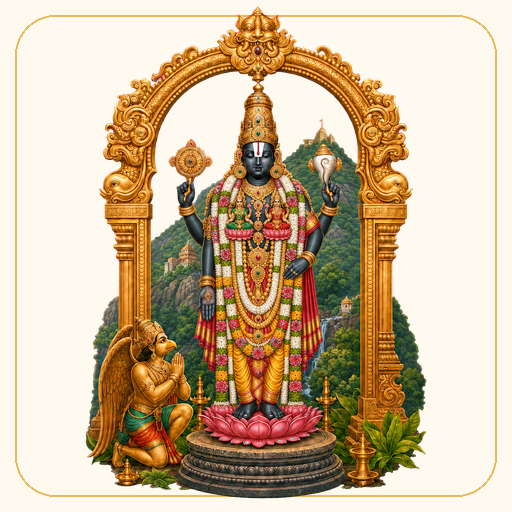
Tirupati Venkateshwara Balaji is a Vishnu temple on the Tirumala hills (part of the Seshachalam range, about 853 metres above sea level) in Andhra Pradesh — the deity is worshipped as Venkateshwara/Balaji/Srinivasa, believed to be "the living deity of Kali Yuga." Wikipedia puts annual footfall at roughly 2.4 crore devotees, making it widely considered India's most-visited temple. There is also a genuine historical Maharashtra connection — in 1740, Maratha general Raghoji (I) Bhonsle visited the temple and donated valuable jewels, still preserved today in a chest called the "Raghojivari Pette." The temple is also known for its GI-tagged laddu prasadam, its hair-donation (tonsuring) tradition, and the annual Brahmotsavam festival.
This year's dates (2026)
Like Kashi Vishwanath, Tirumala lies outside Maharashtra, yet it remains a major pilgrimage stop for Marathi devotees — both because it is India's most-visited temple and because of this Maratha connection.
Deity and significance
The deity is Lord Vishnu, worshipped here as Venkateshwara; Balaji, Govinda, and Srinivasa are other names for the same form. He is regarded as "Kali Yuga Pratyaksha Daivam" — the deity who manifested directly in the present age.[1]
This is one of Vishnu's eight self-manifested (swayambhu) shrines, and also one of the 108 Divya Desam temples named in the Nalayira Divya Prabandham. Worship follows the Vaikhanasa Agama tradition, said to have been more formally organised by Ramanujacharya in the 11th–12th century.[1]
Thanks to centuries of donations and land holdings, the temple trust is considered one of the wealthiest in the world — its 2015–16 annual budget alone was about ₹2,530 crore.[1] Visitor figures vary by source — Wikipedia estimates about 2.4 crore a year, while some tourism sources claim up to 5 crore and call it "the world's most-visited religious site."
History and legend
The temple's development is believed to date back to around 300 CE. The Pallava queen Samavai made the first recorded donation in 966 CE; the Cholas and Pandyas later extended patronage too. In 1117 CE, Ramanujacharya is said to have installed the Govindaraja idol, laying the foundation of Tirupati town.[1]
Most of the temple's present wealth and expansion is attributed to gold and diamond donations made during the Vijayanagara empire (14th–16th centuries). Krishnadevaraya funded the gold-plating of the sanctum roof and installed his own statue in the temple on 2 January 1517.[1]
The Maharashtra connection: In 1740, during a campaign in Chittoor district, the Nagpur Maratha general Raghoji (I) Bhonsle visited the temple and offered valuable jewels — including one particularly notable large emerald. These jewels are still preserved today in a chest called the "Raghojivari Pette," much like Ahilyabai Holkar's contribution at Kashi Vishwanath.[6] Some accounts also credit Raghoji with setting up the temple's first formal administrative structure for worship and finances.
The temple's modern administration rests with the Tirumala Tirupati Devasthanams (TTD), constituted by the Madras government in 1933, reconstituted under the 1951 Madras Hindu Religious and Charitable Endowments Act, and given an autonomous management board again under the 1979 TTD Act (before 1933, the British East India Company had handed administration to the Hathiramji Math mahants in 1843).[1]
The Venkateshwara–Padmavati marriage legend
By tradition, Vishnu descended to earth as Srinivasa (Venkateshwara). While chasing a wandering elephant, he reached the garden of King Akasha and met his daughter, Padmavati — believed to be an earthly form of Lakshmi. King Akasha demanded a huge dowry for the marriage; to pay it, tradition says Srinivasa borrowed one crore fourteen lakh gold coins from Kubera, on condition of repaying it with interest by the end of Kali Yuga.
Tradition holds that Venkateshwara is still repaying this debt — devotee donations in the temple's hundi (donation box) are believed to be a way of participating in that repayment, and are said to bring merit. This is presented purely as a devotional tradition, with no promise of any specific financial return.
The hair-donation (tonsuring) tradition
Tirupati's hair-donation tradition is world-famous, but two different legend versions exist for its origin — neither is presented here as the definitive one. One legend holds that a cow used to pour milk daily over an anthill (believed to conceal an idol of Venkateshwara); when the cow's angry keeper struck it, the blow accidentally wounded the deity, and a woman named Neela Devi cut off her own hair to dress the wound — starting the hair-donation tradition. A second, parallel belief is that devotees tonsure their heads as a symbol of gratitude and surrender of ego — hair being seen as a symbol of vanity, making this sacrifice a significant act of surrender. Both traditions are also linked to the Kubera-debt belief — proceeds from selling the donated hair are said to fund food-distribution, education trusts, and other charitable work.
Architecture and layout
The temple stands on the seventh peak of the Tirumala hills ('Venkatadri') — the seven peaks are traditionally seen as symbolising the seven hoods of Adishesha. The architecture is Dravidian; the sanctum is called 'Ananda Nilayam', and the deity faces east. The main entrance, Mahadwaram, is a five-tiered gopuram about 15 metres tall.[1]
The temple has a total of 640 inscriptions in Kannada, Sanskrit, Tamil, and Telugu, along with about 3,000 engraved copper plates that include the Telugu compositions of Tallapaka Annamacharya. Records also note that between 1320 and 1369 CE, the idols of the Srirangam Ranganathaswamy temple were kept here for safekeeping from invasions.[1]
Key festivals and pilgrimage calendar
| Festival | Approximate period (2026) | Details |
|---|---|---|
| Brahmotsavam (the temple's largest annual festival) | Traditionally about nine days, roughly in the Bhadrapad/Ashwin period | Begins with Dhwajarohanam; the fifth day's Garuda Seva draws the biggest crowds (100,000+ devotees); followed by Rathotsavam; concludes with Chakrasnanam |
| Vaikuntha Ekadashi ('Vaikuntha Dwara Darshanam', a roughly ten-day festival) | 20 December, Margashirsh Shukla Ekadashi | The general panchang calls this same tithi Mokshada Ekadashi; special darshan through the Vaikuntha Dwara — an extremely crowded period |
| Annual Snapana Tirumanjanam | Second to fourth day of Brahmotsavam | Special abhishekam for the Malayappaswamy, Sridevi, and Bhudevi festival idols at Ranganayakula Mandapam |
Sources genuinely conflict on Brahmotsavam's exact 2026 dates — one source places it in mid-September, another in late September to early October, and some even suggest two Brahmotsavam festivals due to an adhik maas (leap month). These figures also don't line up with this panchang's own Ashwin masa start date (11 October) — so no firm Gregorian date is given here. Check TTD's own annual calendar before travelling.
Darshan and aarti timings
According to TTD's own information, the two main darshan types are Sarvadarshanam (free, general queue, no token needed)[4] and Special Entry Darshan (₹300, a fixed time slot with a faster, better-managed queue, booked only online — roughly up to three months in advance)[5]. Tourism-guide sources also describe a Slotted Sarva Darshan (free but token-based, available in Tirupati from 5 AM for same-day entry), a priority queue called Divya Darshan for devotees who walk to the temple, and separate arrangements for senior citizens, persons with disabilities, and families with young children — worth confirming on the official site before you travel.
A fast-track 'break darshan' linked to a ₹10,500 donation via the SRIVANI Trust is also available with a limited number of online tickets each day. All darshan types and fees can change over time — it's worth checking TTD's live website or app closer to your visit.
Special rituals here
Tirupati laddu prasadam received a Geographical Indication (GI) tag in 2009, after TTD applied in 2008 — a step said to have been taken to curb the sale of counterfeit or adulterated laddus.[7][8] The laddu tradition is believed to go back to 2 August 1715 (evolving from an earlier sweet called 'Manoharam'); the current round shape was standardised in 1940. About 2.8 lakh laddus are made here daily.[7] The exact GI registration number isn't listed here.
Details of the hair-donation and hundi-donation traditions are covered above under "History and legend." All ritual details here can vary according to the temple's own practice — no official priest affiliation is implied.
How to reach
The nearest airport is Tirupati Airport (code TIR) — with direct flights from Mumbai, Chennai, Hyderabad, and Bengaluru. From Mumbai or Pune, flying takes about two hours.
Tirupati Railway Station is a major junction with direct or connecting trains from Mumbai and Pune — the journey takes roughly 14 to 24 hours depending on the train. From Tirupati, you'll still need a bus, taxi, or the ghat footpath to reach Tirumala hill. By road, Mumbai–Tirupati is roughly 1,150–1,230 km and Pune–Tirupati roughly 950–1,090 km — long enough that flying is the most practical option.
Nearby places
- Sri Padmavati Ammavari Temple, Tiruchanur — the temple of goddess Padmavati; tradition holds that devotees should visit here before Tirumala darshan.
- Sri Kalyani/Akasha Ganga waterfall — a scenic spot in the Tirumala area.
- Chandragiri Fort — a historic site near Tirupati.
Traveller tips
- Expect very heavy crowds during Brahmotsavam, Vaikuntha Ekadashi, and major holiday periods — booking darshan online in advance is a good idea. Exact festival dates shift from year to year, so confirm with TTD's live calendar while planning travel.
- Traditional, modest clothing is generally expected; check the official website for the detailed dress code and list of restricted items before you go.
- The free Sarvadarshanam queue can take several hours — if your time is limited, booking the ₹300 Special Entry Darshan online in advance is worth it.
- Carry a government ID — it's needed for ticket booking and security checks.
Good to know
- Brahmotsavam's exact dates shift every year and vary across sources — confirm with TTD's official calendar before you travel.
- Vaikuntha Ekadashi (Margashirsh Shukla Ekadashi) falls on 20 December 2026 — Tirumala's Vaikuntha Dwara Darshanam festival is centred around this day.
- Raghoji Bhonsle's jewel donation gives this temple a genuine historical connection with Marathi devotees.
FAQ
- Which state and hill is the Tirupati Balaji temple in?
- It's in Tirupati district, Andhra Pradesh, on the Tirumala hills (part of the Seshachalam range).
- Are Venkateshwara and Balaji names for the same deity?
- Yes — Venkateshwara, Balaji, Govinda, and Srinivasa are all names for the same form of Vishnu.
- When and why did Tirupati laddu get a GI tag?
- TTD applied in 2008 and received the tag in 2009 under the GI Act, 1999 — to curb the sale of counterfeit or adulterated laddus.
- Why is there a hair-donation tradition at Tirupati?
- Two parallel traditions exist — tonsuring as a symbol of gratitude and surrender of ego, and a legend where Neela Devi offered her own hair to dress the deity's wound. Which is the original story is not clear from the sources.
- What is the Venkateshwara–Padmavati marriage legend?
- By tradition, Srinivasa (Venkateshwara) married Padmavati, the daughter of King Akasha and believed to be a form of Lakshmi; the legend includes borrowing gold from Kubera to pay the dowry.
- Why is Venkateshwara believed to still be repaying a debt to Kubera?
- Tradition holds he borrowed one crore fourteen lakh gold coins from Kubera for the wedding; devotee hundi donations are seen as participating in that ongoing repayment.
- What is Tirumala Brahmotsavam, and when is it held?
- It's the temple's largest annual festival, traditionally nine days long, usually around the Bhadrapad-Ashwin period. Exact 2026 dates vary across sources, so check TTD's own calendar.
- What is the difference between Sarvadarshanam and the ₹300 Special Entry Darshan?
- Sarvadarshanam is free but the wait can be long and unpredictable; the ₹300 darshan gives a fixed time slot and a faster queue, bookable only online.
- Does the Tirupati temple have any connection to Maratha or Maharashtra history?
- Yes — in 1740, the Nagpur Maratha general Raghoji (I) Bhonsle donated valuable jewels to the temple, still preserved today in the "Raghojivari Pette."
- How do you reach Tirupati from Mumbai or Pune?
- Flying is fastest (about two hours, airport code TIR); by train it takes roughly 14 to 24 hours.