Kashi Vishwanath (Varanasi, Uttar Pradesh)
Kashi Vishwanath is one of the twelve Jyotirlingas, on the western bank of the Ganga in Varanasi, Uttar Pradesh — the deity is Vishwanath/Vishweshwar ("Lord of the Universe"). After being destroyed several times under Mughal rule, the temple standing today was built by Maharani Ahilyabai Holkar of Indore in 1780 — the site's strongest connection for Marathi devotees. Around 1839 (some sources say 1835), Maharaja Ranjit Singh is said to have donated gold to plate its domes — the exact quantity donated is given differently across sources, ranging from roughly 820 kg to a tonne. The temple is known for its five daily aartis, the abir-gulal procession of Rangbhari Ekadashi, and the grand corridor built in 2021.
This year's dates (2026)
- Sunday — Mahashivratri (the temple's biggest day of the year, the Shiv Baraat procession)15 Feb
- Friday — Rangbhari Ekadashi (called Amalaki Ekadashi in the panchang; Kashi's own abir-gulal procession)27 Feb
- First Shravani Monday (Maharashtra/amanta reckoning)17 Aug
- Second Shravani Monday (amanta reckoning)24 Aug
- Third Shravani Monday (amanta reckoning)31 Aug
- Fourth Shravani Monday (amanta reckoning — Kashi's own local Shravan falls on different dates, see the note below)7 Sep
- Tuesday — Tripurari Purnima/Dev Diwali (a citywide ghat illumination across all of Varanasi)24 Nov
Deity and significance
The deity is Lord Shiv — in the form of Vishwanath/Vishweshwar, one of the twelve Jyotirlingas. Kashi is also regarded as the place where the Jyotirlinga first manifested — a claim distinct from its numbered position in the traditional hymn-order.
Sources disagree on Kashi Vishwanath's numbered position in the Jyotirlinga hymn order — the temple's own official website places it seventh in the list, while Wikipedia's traditional dvadash-Jyotirlinga hymn order places it ninth.
Kashi is one of Hinduism's seven moksha-granting cities (Sapta Puri — Ayodhya, Mathura, Haridwar, Kashi, Kanchipuram, Ujjain, Dwarka), and is often called "the holiest of all." According to a tradition rooted in the Shiv Purana and Skanda Purana, Kashi is an "Avimukta Kshetra" — a place Shiv never abandons, even during cosmic dissolution; belief holds that dying within Kashi's boundary earns a taraka mantra from Shiv and moksha. This is presented as a matter of religious belief, not historical fact.
History and legend
The original Adi Vishweshwar temple was destroyed in 1194; over the following centuries it was rebuilt and destroyed again more than once — it was rebuilt under Akbar's reign by Raja Man Singh and Raja Todar Mal.
Aurangzeb destroyed the then-standing temple in 1669, and the Gyanvapi Mosque was built on the same site in 1678 — remnants of the old temple are recorded as still visible in the mosque's foundation and pillars today.
The temple standing today was built by Maharani Ahilyabai Holkar of Indore in 1780, on a separate site next to the mosque — this detail is corroborated by five independent sources and is very solidly established. Later, in 1839, Maharaja Ranjit Singh (the "Lion of Punjab") donated roughly a tonne of gold to plate two of the domes — the third dome remains without gold to this day. Some secondary sources give the year as 1835 and the quantity as 820 kg instead.
Temple management rests with the "Board of Trustees for Sri Kashi Vishwanath Temple" under the state law "The Uttar Pradesh Sri Kashi Vishwanath Temple Act, 1983" — brought in following a theft in January 1983, to strengthen the temple's security arrangements. For current information about the trust board's chairperson/officials, see the temple's official website.
The general pan-Indian Jyotirlinga origin story is told here as it is for every other Jyotirlinga — while Brahma and Vishnu argued over their own supremacy, Shiv manifested as an infinite pillar of light. Vishnu took the form of a boar to search downward and Brahma flew upward as a swan to find the pillar's end — both failed. Brahma falsely claimed to have found the top; an enraged Shiv cut off his fifth head and cursed him that he would never again be worshipped in temples.
A second, distinct legend specific to Kashi concerns King Divodasa — his rule over Kashi was so righteous and complete that even the gods came to live there, forcing Shiv (with Parvati) to leave Kashi for Mount Mandara. Shiv first sent a messenger, then several apsaras, to corrupt Divodasa and drive him out — but all of them fell under Kashi's spell and settled there themselves. Finally, Brahma himself went to Divodasa disguised as an ascetic and persuaded him to perform an Ashwamedha yagna — this opened the way for the Shivling to be established, and Shiv returned to Kashi for good.
Architecture and layout
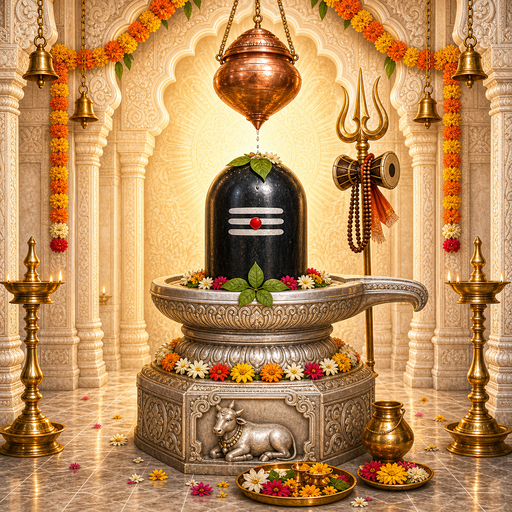
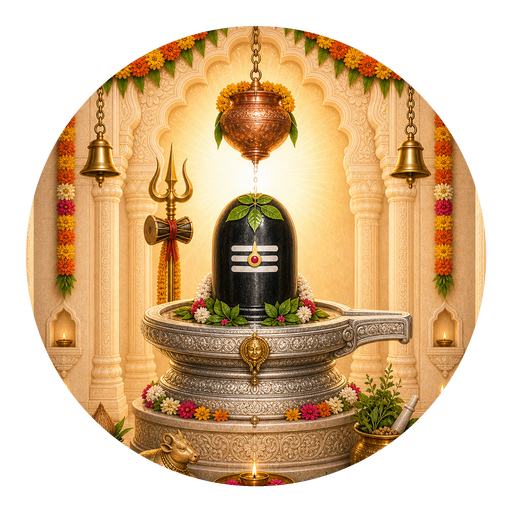
The Shivling is said to be about 60 cm tall and 90 cm in circumference, set in a silver altar.
The main shikhara stands about 15.5 metres tall, topped with a golden dome and, within it, a golden spire bearing a trishul flag. Around the sanctum are shrines to Kalbhairav, Kartikeya, Avimukteshwar, Vishnu, Ganesh, Shani, and Parvati.
The Kashi Vishwanath Corridor, built in 2021, is the temple's biggest modern transformation — the project began in 2019 and was inaugurated by Prime Minister Modi on 13 December 2021. The temple precinct was expanded from about 3,000 square feet to roughly 5 lakh square feet; more than forty old, forgotten temples were discovered and rebuilt in the process. The corridor connects the temple directly to the Ganga ghats (the Manikarnika/Dashashwamedh area). The trust reports that the number of devotees visiting the temple has grown substantially since.
Main festivals and pilgrimage
| Festival | Date (2026) | Day | Connection |
|---|---|---|---|
| Mahashivratri | 15 February | Sunday | The temple's biggest day of the year — a grand "Shiv Baraat" procession symbolising the Shiv-Parvati wedding |
| Rangbhari Ekadashi (called Amalaki Ekadashi in the panchang) | 27 February | Friday | An abir-gulal procession marking Shiv-Parvati's "arrival" in Kashi, taken to Manikarnika Ghat — exactly 12 days after Mahashivratri; a highly distinctive tradition unique to Kashi |
| Shravani Monday (4) | 17, 24, 31 August & 7 September | — | Maharashtra/amanta reckoning |
| Tripurari Purnima / Dev Diwali | 24 November | Tuesday | Not temple-specific — a citywide ghat illumination across all of Varanasi |
According to the temple's official website, Kashi's own local "Shravan" month is reckoned by the purnimanta calendar tradition — for 2026, roughly 29 July to 29 August. The four dates above follow Maharashtra's amanta reckoning, so Kashi's actual local Shravan crowd-dates may differ — when planning a Kashi visit, check the local dates on the temple's official website.
Darshan and aarti timings
The temple opens at 2:30 AM. According to the temple trust's own website, the general schedule is: Mangala Aarti 3-4 AM (for ticket holders), general darshan 4-11 AM, the midday Bhog Aarti 11:30 AM-12 PM, darshan again from 12 PM-7 PM, Saptarshi Aarti 7-8:30 PM, Shringar/Bhog Aarti from 9 PM, and Shayan Aarti from 10:30 PM — the temple closes at 11 PM.
A second official government source gives slightly different timings — so confirm the current schedule on the temple's official website or app before visiting.
"Sugam Darshan" — a paid, skip-the-queue fast darshan service — is available along with online booking, though booking availability changes frequently (for instance, it was found temporarily suspended during this research due to expected Shravan crowds). Foreign devotees face no restriction based on religion or nationality — just a separate registration process requiring the original passport and a visa copy.
Rituals here
Rudrabhishek and Jalabhishek bookings are available through the temple trust (including via its mobile app). On Rangbhari Ekadashi, the Shivling is smeared with abir-gulal and a Shiv-Parvati procession is taken to Manikarnika Ghat. On Mahashivratri, a grand "Shiv Baraat" procession with musicians and sword-dancers takes place. On Annakut (the fourth day after Diwali), Goddess Annapurna is honoured with a large-scale food offering distributed to devotees. All this ritual detail can change per the temple's own schedule — no official-priest association is implied here.
How to reach
The nearest airport is Lal Bahadur Shastri International Airport (Babatpur, code VNS) — about 24-25 km from the temple. From Mumbai or Pune, flying takes roughly two to two-and-a-half hours — since the distance exceeds 1,500 km, flying is by far the most practical option.
The nearest railway station is Varanasi Junction (Varanasi Cantt, station code BSB) — about 4.5 km from the temple. Direct trains run from Mumbai (several weekly services, roughly 24-30 hours); direct service from Pune is limited (a few days a week, roughly 27-32 hours). By road, Mumbai-Varanasi is about 1,610 km and Pune-Varanasi about 1,655 km — too long a distance to recommend driving.
Nearby places
- Annapurna Temple — right next to Kashi Vishwanath.
- Vishalakshi Shakti Peeth — about 250 m northwest; one of the 51 Shakti Peeths.
- Kalbhairav Temple — regarded as the "kotwal (guardian) of Varanasi."
- Manikarnika Ghat and Dashashwamedh Ghat — Ganga ghats directly connected to the temple via the corridor; the evening Ganga Aarti takes place here.
- Sarnath — a Buddhist pilgrimage site, about 10 km away.
- Prayagraj (Sangam) — about 128 km away; a combined Kashi-Prayag pilgrimage is common.
Traveller tips
- Tourism-guide sources say mobiles, cameras, large bags, and belts with large metal buckles may be barred from the sanctum; lockers are available nearby. Covering the shoulders and knees is suggested for attire. Confirm these rules on the official website before your visit.
- Kashi's local Shravan falls on different dates from Maharashtra's amanta-reckoned Shravan — don't plan a Kashi visit purely off the Maharashtra panchang; check the local dates too.
- Online booking availability changes often — always confirm on the official website or app before travelling.
- Expect very large crowds during Mahashivratri, Rangbhari Ekadashi, and Shravan — booking Sugam Darshan in advance is convenient.
Good to know
- Details like the Jyotirlinga's numbered position and the year of the gold donation are inconsistent across sources — don't treat either as a single settled figure.
- The temple itself was built by Ahilyabai Holkar, giving it a direct historical connection to Maharashtra.
- The Gyanvapi detail here is past-tense history.
FAQ
- Which state and river is the Kashi Vishwanath temple on?
- In the city of Varanasi, Uttar Pradesh, on the western bank of the Ganga.
- Which of the twelve Jyotirlingas is Kashi Vishwanath?
- It varies by source — the temple's own website places it seventh, Wikipedia's traditional hymn order places it ninth. There's no single settled number.
- When did Ahilyabai Holkar build the Kashi Vishwanath temple?
- In 1780, on a site next to the earlier Mughal-era destruction — this is the temple still standing today.
- Who gave the golden dome at Kashi Vishwanath, and when?
- Maharaja Ranjit Singh, who donated roughly a tonne of gold in 1839 according to most sources; some sources say 1835.
- What is Rangbhari Ekadashi, and when is it?
- Phalgun Shukla Ekadashi (called Amalaki Ekadashi in the panchang) — an abir-gulal procession in Kashi marking Shiv-Parvati's arrival, exactly 12 days after Mahashivratri. In 2026, it falls on 27 February.
- What is the Kashi Vishwanath Corridor?
- A grand temple-to-Ganga-ghat corridor built in 2021 — the temple precinct was expanded from about 3,000 square feet to roughly 5 lakh square feet.
- What are the aarti timings at Kashi Vishwanath temple?
- Five daily aartis (Mangala at 3 AM, Bhog at 11:30 AM, Saptarshi at 7 PM, Shringar at 9 PM, Shayan at 10:30 PM) — official sources differ slightly, so check live timings.
- How do I reach Varanasi from Mumbai or Pune?
- Flying is fastest (roughly two to two-and-a-half hours); direct trains take roughly 24-32 hours. Since the distance exceeds 1,500 km, flying is more practical.
- How is the Gyanvapi Mosque related to the Kashi Vishwanath temple?
- Aurangzeb destroyed the then-standing temple in 1669 and built a mosque on the same site in 1678; Ahilyabai built the present temple on a separate, adjacent site in 1780 — this is purely historical fact.
- What items are barred from the Kashi Vishwanath temple for darshan?
- Items such as mobiles, cameras, large bags, and metal-buckle belts, according to tourism-guide sources — confirm against the official list before your visit.
Related Info
 Maha Shivratri15 Feb
 Amalaki Ekadashi27 Feb
- Shravani Somvar17 Aug
- Tripurari Pournima24 Nov
 Mahakaleshwar (Ujjain, Madhya Pradesh)15 Feb
- Kedarnath15 Feb
- Mallikarjuna Jyotirlinga (Srisailam)15 Feb
 Trimbakeshwar14 Jan
 Bhimashankar15 Feb
 Grishneshwar15 Feb
 Aundha Nagnath15 Feb
 Parli Vaijnath13 Feb
- Deoghar Baidyanath Dham15 Feb
- Dwarka Nageshwar15 Feb
- Omkareshwar (Madhya Pradesh)25 Jan
- Rameshwaram (Tamil Nadu)15 Feb
- Somnath15 Feb