Sabarimala Ayyappa (Kerala)
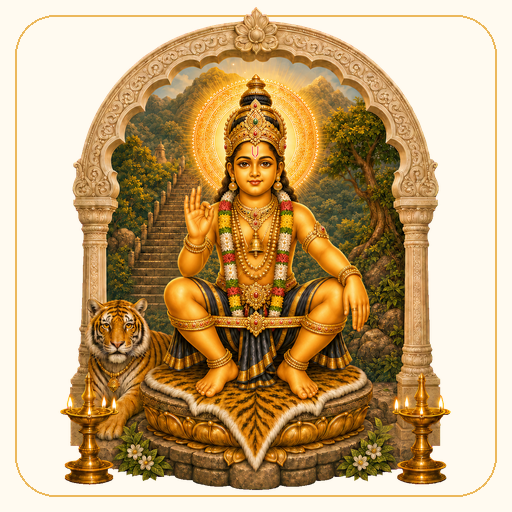
Sabarimala is an Ayyappa temple on a hill in Pathanamthitta district, Kerala — by tradition, Ayyappa is held to be the son of Shiv and Mohini (Vishnu's female form). Devotees observe a 41-day vratham (austerity period) before the pilgrimage, and the temple is open to visitors mainly during the Mandala Kalam season, from Vrishchik Sankranti to Makar Sankranti each year.
This year's dates (2026)
- मकर संक्रांती/मकरविलक्कू — बुधवार; याच दिवशी शबरीमल्यातील (नोव्हेंबर २०२५ पासून सुरू झालेल्या) हंगामाची सांगता होते (सामान्य पर्व → /info/makar-sankranti)14 Jan
- वृश्चिक संक्रांती — वृश्चिक मासारंभ; शबरीमला मंडल काळम् (४१-दिवसीय यात्रा-हंगाम) याच दिवसापासून सुरू होतो16 Nov
- मंडल पूजा — ४१-दिवसीय मंडल-काळम् समाप्ती; मंदिर काही काळ बंद होऊन मकरविलक्कूच्या दुसऱ्या टप्प्यासाठी पुन्हा उघडते27 Dec
The temple stands on a hill surrounded by 18 hills inside the Periyar Tiger Reserve, at about 1,260 metres above sea level. The deity is known as Ayyappan — also called Dharmashasta, Hariharaputra, or Manikandan. Sabarimala is not open year-round; darshan is mainly available during the roughly two-month Mandala Kalam season (Vrishchik Sankranti to Makar Sankranti). An estimated 10-15 million pilgrims are said to visit annually, making it one of the largest pilgrimage gatherings in the world.
Sabarimala is one of the major temples outside Maharashtra covered in this series, alongside Kashi Vishwanath, Tirupati Venkateshwara, and Vaishno Devi. No historical Maharashtra or Maratha connection to Sabarimala is documented.
Deity and significance
By tradition, Ayyappan is held to be the son of Shiv and Mohini (Vishnu's female avatar form) — hence the name "Hariharaputra," a figure bridging the Shaiva and Vaishnava traditions.
Ayyappa's status as a lifelong celibate (naishtika brahmachari) is considered central to his worship tradition. This role is also the traditionally stated religious basis for the historic restriction on entry for women of menstruating age — a detailed, neutral account of that legal case is given in its own section below.
Ayyappa is worshipped differently at some other shrines — at the Achankovil Sastha temple, for instance, Ayyappa is worshipped as married, with consorts Purna and Pushkala and a son Satyaka. This is a distinct local tradition from Sabarimala's celibate form — the two are best understood as separate worship traditions of the same deity, not as contradicting each other.
A sub-shrine within the temple complex, Vavar Nada, is associated with Vavar, a Muslim warrior figure said in one version to have been a close friend of Ayyappa's — regarded as an example of Hindu-Muslim coexistence.
History and legend
Sabarimala is administered by the Travancore Devaswom Board (TDB), a statutory body established under the Travancore-Cochin Hindu Religious Institutions Act, 1950, which manages more than a thousand temples. Before the 1949 merger of Travancore and Cochin, these temples were run by the Travancore royal family. Day-to-day rituals are led by priests from the Thazhamon Madom family, who traditionally hold the Thantri (chief priest) role, while the Pandalam royal family holds a traditional custodial role.
By Malayalam folklore, King Rajashekhara and Queen Koperundevi of Pandalam, who had no children, found a radiant infant on the bank of the Pampa river — a golden bell around his neck earned him the name Manikandan (mani = bell, kandan = neck). The king adopted him. Later, prompted by ministers' scheming, the queen feigned illness and asked for tigress's milk as medicine; Manikandan went into the forest and confronted the demoness Mahishi there. By tradition, Mahishi had a boon from Brahma that she could only die at the hands of the joint son of Shiv and Vishnu — so Manikandan, born of Shiv and Mohini's union, killed her and returned to the king riding a tiger. Recognising Manikandan's divinity, the king decided to build a temple for him; by tradition, Manikandan then appeared in his Ayyappa form and shot an arrow to mark the spot where the temple should stand.
Some versions of this story differ in detail — in a few, Ayyappa is described as the king's sister's son; in others, he is said to have left the kingdom to become a forest ascetic. Scholars suggest Ayyappa worship likely developed from a merging of an original Dravidian tribal deity tradition with the Puranic Shiv-Mohini legend.
Architecture
The temple stands on a hill surrounded by 18 hills within the Periyar Tiger Reserve. The main sanctum's roof is gold-plated, topped with four golden finials. The temple's most distinctive feature is the 18 sacred steps (Pathinettampadi) — only devotees carrying an irumudi kettu (the sacred bundle) may climb them. A popular belief holds that each step represents a specific human vice.
Main festivals and pilgrimage season
Makar Sankranti is a general solar festival — see the Makar Sankranti page for its general details; here only the Sabarimala-specific Makaravilakku/Makara Jyothi detail is covered. The dates below are panchang sankranti dates, not temple-specific entries.
| Festival/season | Basis | This year | Day | Detail |
|---|---|---|---|---|
| Makar Sankranti — Makaravilakku/Makara Jyothi | Solar sankranti | 14 January | Wednesday | Marks the end of the season that began in November 2025 |
| Vrishchik Sankranti — Mandala Kalam begins | Solar sankranti | 16 November | Monday | The 41-day Mandala Kalam pilgrimage season begins this day |
| Mandala Pooja | End of the 41-day Mandala Kalam | 27 December | Sunday | The temple closes briefly and reopens for the second phase leading to Makaravilakku |
Vrishchik Sankranti typically falls near the end of Kartik masa, and most of the Mandala Kalam season runs through Margashirsh masa. The exact dates for Vrishchik Sankranti and Mandala Pooja can shift by a day or two from year to year — check the Travancore Devaswom Board's official season calendar before planning a visit.
A separate 10-day Utsavam festival is held in March-April (the Malayalam month of Meenam), including flag-hoisting, Pallivetta (a symbolic hunt), and Aarattu (a ceremonial immersion bath) in the Pampa river.
Makaravilakku and Makara Jyothi
Makaravilakku and Makara Jyothi are two related but distinct things. Makara Jyothi is described as a star (Sirius) visible in the sky around Makar Sankranti, while Makaravilakku is a physical flame lit at Ponnambalamedu hill by the Travancore Devaswom Board — visible from the Sabarimala temple. An estimated 500,000 devotees gather each year to see this flame.
Darshan and timings
At Sabarimala, climbing the 18 steps for darshan requires carrying an irumudi kettu (a sacred bundle containing a ghee-filled coconut). Neyyabhishekam — pouring pure ghee over the deity's idol — is the most popular ritual offering, typically available from about 3:30 AM to 11:00 AM; the fee is nominal (around ₹10) and can change.
Unlike Kashi Vishwanath or Tirupati, Sabarimala is not open 24/7 year-round — darshan is possible only during the Mandala Kalam season, specific masa-start days, and the Utsavam festival. It is worth checking the Travancore Devaswom Board's official website for that year's opening schedule before planning a visit.
Special rituals
At the start of the vratham, devotees perform Malayidal — wearing a mala (bead necklace) with an Ayyappa locket, received from a priest or guruswami. This begins the 41-day Mandala Vratham, a period of strict austerity — vegetarian food, celibacy, abstaining from alcohol, not cutting hair or nails, and typically wearing black clothing.
Before the pilgrimage, the Kettu Nirakkal ritual ties the irumudi kettu (a two-compartment sacred bundle), with a ghee-filled coconut at its centre. Along the pilgrimage route, Petta Thullal — a traditional dance symbolising the victory of good over evil — is performed. On reaching the temple, devotees perform Neyyabhishekam.
These ritual details follow the temple's own tradition; no official association with any particular priest or organisation is implied here.
Women's entry — legal timeline
Sabarimala traditionally restricted entry to women and girls of menstruating age (roughly 10 to 50 years), based on the stated religious rationale of Ayyappa's celibate vow. This practice operated under Rule 3(b) of the Kerala Hindu Places of Public Worship (Authorisation of Entry) Rules, 1965.
In 1991, the Kerala High Court (in S. Mahendran v. The Secretary, Travancore Devaswom Board) ruled that the restriction was in keeping with tradition and did not violate the Constitution. In 2006, six members of the Indian Young Lawyers Association filed a writ petition in the Supreme Court, arguing the restriction was unconstitutional.
On 28 September 2018, a Constitution Bench of the Supreme Court ruled 4:1 (Indian Young Lawyers Association v. State of Kerala) that women of all ages had a right to enter — the majority held that the restriction violated Article 14 (equality) and Article 25 (freedom of religion) of the Constitution. The majority comprised Chief Justice Dipak Misra, Justice A.M. Khanwilkar, Justice R.F. Nariman, and Justice D.Y. Chandrachud; Justice Indu Malhotra dissented, holding that a person should be free to practise their faith according to their own belief, and that questions of rationality were secondary in matters of religious practice.
Protests followed across the state; more than 3,000 arrests were recorded by the end of October 2018. On 2 January 2019, Bindu Ammini and Kanakadurga became the first women to actually enter the temple after the verdict; the temple was briefly closed afterward for a purification ritual. In a counter-protest, millions of women formed the "Vanitha Mathil" (women's wall).
On 14 November 2019, the Constitution Bench, ruling 3:2 on review petitions, referred the matter to a larger bench with broader constitutional questions. This referral did not set aside or stay the 2018 verdict — that ruling remained in force — it only left the underlying question pending before the larger bench.
A nine-judge Constitution Bench, led by Chief Justice Surya Kant, began a wide-ranging hearing of the matter in April 2026; after about 16 days of hearings, the bench reserved its verdict. As of July 2026, a final decision has not yet been announced.
How to reach
The nearest airports are Kochi International Airport (about 154 km) and Thiruvananthapuram (about 170 km). The nearest railway stations are Kottayam, Ernakulam, and Chengannur. A road connects up to Pampa (Kottayam-Pampa is about 119 km); from Pampa, it is about a 5 km uphill walk to Sannidhanam (palanquin/doli options are also available). There are three main trekking routes — Erumeli (the traditional route, about 61 km, starting from the Vavar mosque), Vandiperiyar, and Chalakkayam (the easiest).
From Mumbai or Pune, Sabarimala is roughly 1,600-1,700 km away. Flying to Kochi or Thiruvananthapuram and continuing by road is the most practical option — plan for roughly a full day of combined travel.
Nearby places
- Pampa river — a sacred bathing spot along the pilgrimage route.
- Vavar Mosque (Erumeli) — the starting point of the Erumeli trekking route, linked to the Vavar legend.
- Nilakkal — a helipad and an important stop along the pilgrimage route.
Traveller tips
- Darshan up the 18 steps is not possible without completing the 41-day vratham and carrying an irumudi kettu.
- Crowds are extremely heavy during Mandala Kalam and especially around Makaravilakku — following crowd-management and safety instructions closely is worthwhile.
- The trekking route runs through hilly forest terrain — good physical preparation and sturdy footwear are worth planning for.
- ID and vratham compliance may be checked at checkpoints; black or traditional clothing is generally advisable — check the official website for current rules before your visit.
Good to know
- Sabarimala is not open year-round — plan a visit around the Mandala Kalam season, masa-start days, or the Utsavam festival.
- The women's-entry case is still pending before a nine-judge Constitution Bench — worth checking the current status from an official source before travel.
- No historical Maharashtra connection was found for this temple — yet pilgrims from Mumbai and Pune travel here every year.
FAQ
- Which state and hill is the Sabarimala temple located on?
- In Pathanamthitta district, Kerala, on a hill inside the Periyar Tiger Reserve, at about 1,260 metres above sea level.
- Why is Ayyappa believed to be the son of Shiv and Mohini (Vishnu)?
- By tradition, the demoness Mahishi had a boon that she could only be killed by the joint son of Shiv and Vishnu — so Ayyappa's birth from the union of Shiv and Mohini (Vishnu's female form) is held to have served that purpose. This is a devotional belief.
- What are the rules of Ayyappa's 41-day vratham?
- Vegetarian food, celibacy, abstaining from alcohol, not cutting hair or nails, typically wearing black, and bathing/prayer twice a day.
- What are irumudi kettu and neyyabhishekam?
- Irumudi kettu is a two-compartment sacred bundle carrying a ghee-filled coconut; neyyabhishekam is the ritual of pouring ghee over the deity's idol.
- What is the difference between Makaravilakku and Makara Jyothi?
- Makara Jyothi is described as a star in the sky, while Makaravilakku is a physical flame lit by the Travancore Devaswom Board at Ponnambalamedu — two related but distinct things.
- When does the Sabarimala Mandala Kalam season start and end?
- It starts at Vrishchik Sankranti (16 November in 2026) and the 41-day Mandala Kalam ends at Mandala Pooja (27 December in 2026); the wider pilgrimage season continues to roughly Makar Sankranti (about 14 January).
- What was the Supreme Court's verdict on women's entry to Sabarimala?
- On 28 September 2018, a 4:1 majority ruled that women of all ages have a right to enter, based on Articles 14 and 25 of the Constitution.
- What is the current status of the Sabarimala women's-entry case?
- On 14 November 2019, the matter was referred to a larger bench without undoing the 2018 verdict. A nine-judge Constitution Bench completed hearings in April 2026 and reserved its verdict — a final decision is still pending.
- What is Sabarimala's connection with Vavar, a Muslim figure?
- By one legend, Ayyappa formed a close friendship with a Muslim warrior named Vavar; the Vavar Nada sub-shrine within the temple complex is associated with him.
- How do I reach Sabarimala from Mumbai or Pune?
- Fly to Kochi or Thiruvananthapuram, then travel by road to Pampa, and finally on foot or by palanquin to Sannidhanam.