Vaishno Devi (Katra, Jammu & Kashmir)
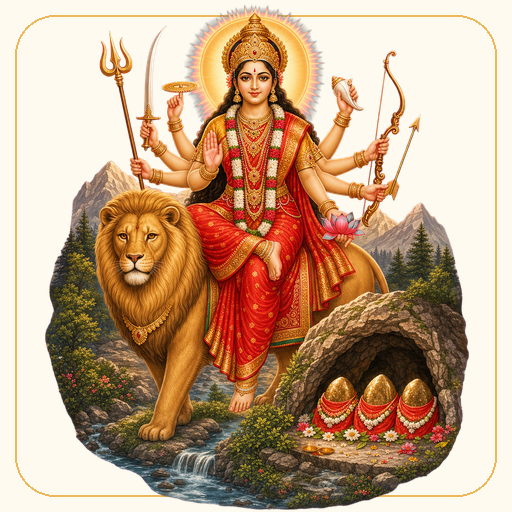
Vaishno Devi is a cave shrine on Trikuta hill at Katra (Reasi district), Jammu & Kashmir — the deity Vaishno Devi/Vaishnavi is worshipped as the combined Shakti form of Mahakali, Mahalakshmi, and Mahasaraswati, present in the cave as three self-manifested pindis. About 95 lakh devotees visit every year (2023 figure), making it one of India's most-visited Devi shrines, with Navratri drawing the heaviest crowds.
This year's dates (2026)
- Thursday — start of Chaitra Navratri; pilgrim numbers at Katra begin picking up noticeably19 Mar
- Sunday — Ghatasthapana, start of Shardiya Navratri; Vaishno Devi's busiest crowd season of the year begins from this day11 Oct
- Tuesday — Vijayadashami/Dussehra; the end of Shardiya Navratri, and the Vaishno Devi crowd season also tends to ease off around this time20 Oct
No solid historical connection between Vaishno Devi and Maharashtra or any Maratha ruler is documented — the temple's administrative history is tied to the Dogra royal family (Maharaja Gulab Singh, Maharaja Ranjit Dev). Even so, it remains a major pilgrimage destination for devotees from across India, including Marathi devotees.
Deity and significance
The deity Vaishno Devi/Vaishnavi is a form of Shakti, self-manifested in the cave as three natural pindis. The whitish pindi on the left represents Mahasaraswati (sattva guna — creation, wisdom, knowledge), the yellowish-red one in the middle represents Mahalakshmi (rajo guna — sustenance, prosperity), and the black one on the right represents Mahakali (tamo guna — destruction, dissolution).[1]
Scholars also offer a separate historical-cultural view — the original deity of Trikuta hill is believed to have been a local, pre-Aryan 'Trikuta Devi'; after migrations around the 12th century, cultural assimilation is thought to have merged her identity with the pan-Hindu Vaishno Devi. This view is corroborated both by Wikipedia and by an independent scholarly publication (University of Nebraska-Lincoln).[1][4] This should be understood as a complementary historical angle, not a rival to the devotional legend.
Sources clearly disagree on Vaishno Devi's Shakti Peeth status — most reliable sources do not list her among the classical 51 Shakti Peeths, while some popular devotional sources call her a "Shakti Peeth" and claim a body part of Sati fell here.
History and legend
Administrative history: From 1846, the temple was managed by a charitable trust set up by Maharaja Gulab Singh of Jammu, along with hereditary baridar priests, until 1986 — a period marked by growing complaints about a lack of pilgrim facilities and mismanagement. In 1986, then-Governor Jagmohan took over management; under the 1988 Jammu and Kashmir Shri Mata Vaishno Devi Shrine Act, the Shri Mata Vaishno Devi Shrine Board (SMVDSB) was established — the Governor/Lieutenant Governor of Jammu & Kashmir serves as ex-officio chairman, along with nine nominated members.[2][3]
Some older royal chronicles (recorded by tradition) hold that Raja Jas Dev visited in 996 CE and Guru Gobind Singh in 1672 CE; Maharaja Ranjit Dev (18th century) is also said to have built the first formal pilgrim facilities.
Visitor numbers grew from about 13.96 lakh in 1986 to about 1.01 crore in 2011; in 2023, about 95 lakh (9.52 million) devotees visited.[2]
The origin legend and the Ram episode
By tradition, in the Treta Yuga, Mahasaraswati, Mahalakshmi, and Mahakali combined their divine energy to create a new Shakti called Vaishnavi — for the protection of dharma and the destruction of evil. An early mention appears in the Mahabharata, where Arjuna refers to the goddess as one who "dwells in a temple on the slopes of Jamboo hill" — believed to refer to present-day Jammu.[1]
Another tradition holds that during his exile, Ram received a marriage proposal from Vaishnavi; he declined, citing his vow of monogamy in the Treta Yuga, but promised to marry her in the Kali Yuga as the Kalki avatar. He is said to have directed her to Trikuta hill to perform penance in a sacred cave and grant boons to devotees.
The Bhairavnath episode
The temple's central legend goes like this: in the Kali Yuga, a tantric disciple named Bhairavnath demanded meat and liquor at Pandit Shridhar's community feast; the goddess refused and fled to Trikuta hill, with various sacred sites said to have formed along her route. At the entrance to the sacred cave, she is said to have taken the fierce form of Kali and beheaded Bhairavnath — his torso fell at the cave's entrance, while his severed head flew and landed on a nearby peak. As he lay dying, Bhairavnath is said to have realised his error and begged forgiveness — the goddess granted him moksha along with a boon: that her own darshan would remain incomplete without also visiting the Bhairavnath temple.[1]
Pandit Shridhar, a poor Brahmin from the nearby village of Hansali, is said to have been asked by the goddess to host a grand feast, with food that never ran out; she later revealed the location of the cave to him in a dream. His descendants, known as 'baridars,' are said to have carried this worship tradition forward until 1986.[1][2] The exact route of Bhairavnath's pursuit and the precise year of Pandit Shridhar's feast vary slightly across sources, but the core sequence — the feast, Bhairavnath's demand, the goddess's flight, the beheading, and the boon of moksha — remains consistent.
Architecture and layout
The sacred cave is natural, about 30 metres (98 feet) long — reaching the three pindis requires wading through a narrow, water-filled passage called Charan Ganga. Artificial tunnels have been built alongside the original cave to accommodate roughly 20,000 devotees a day.[2]
The shrine sits on Trikuta hill at about 1,585 metres (5,200 feet), roughly a 12–13 km trek from Katra.[2]
Ardhkuwari is a stop midway along the trek (near Indraprastha) — believed to be where the goddess performed nine months of penance. Its 'Garbh Joon' cave is extremely narrow (womb-like), and devotees crawl through it on their knees and elbows — a symbolic act of purification, said to represent rebirth.
The Bhairavnath temple stands further up the mountain past Bhavan — legend holds that Bhairavnath's severed head landed here. Tradition holds that devotees should visit here after Bhavan darshan (per the goddess's boon); a ropeway connects Bhavan and the Bhairavnath temple.[1][3]
Key festivals and pilgrimage calendar
| Festival/season | Date (2026) | Day | Connection |
|---|---|---|---|
| Start of Chaitra Navratri | 19 March (Chaitra) | Thursday | Pilgrim numbers at Katra begin picking up noticeably |
| Start of Shardiya Navratri / Ghatasthapana | 11 October (Ashwin) | Sunday | Vaishno Devi's busiest crowd season of the year begins — extra crowd-management measures come into effect during this period |
| Vijayadashami/Dussehra (end of Navratri) | 20 October | Tuesday | The crowd season tends to ease off around this time |
All three dates above are general panchang Navratri observances — they coincide with Vaishno Devi's own crowd season but are not temple-specific events. The exact intensity of crowds varies year to year — it's worth checking the Shrine Board's live advisories before your yatra.
Darshan and aarti timings
Bhavan darshan is open all year, 24 hours a day — darshan is only paused temporarily during the roughly two-hour aarti window. The morning aarti begins around 6:20 AM year-round; the evening aarti shifts with the season (later in summer, earlier in winter). Registration for aarti darshan must be done 30 minutes in advance, and booked aarti darshan carries a fee.
Yatra registration is mandatory — free, either online via the official website or at the Yatra Registration Counter (YRC) in Katra, along with a government ID. Even with an online parchi, the RFID card must still be collected in person at the YRC.[3] This process can change from time to time — confirm on the official website before you travel.
Helicopter service, battery-operated vehicles for senior citizens and persons with disabilities, and a passenger ropeway between Bhavan and the Bhairavnath temple (operating since 2018) are all available — the ropeway can occasionally close temporarily for maintenance.[3]
Special rituals here
Priests perform daily havan and puja with mantra chanting at the yagyashala. Crawling through the Garbh Joon cave at Ardhkuwari is regarded as a symbolic act of purification representing rebirth. Visiting the Bhairavnath temple after Bhavan darshan is a tradition, tied to the boon in the legend that considers the yatra "complete" only after that visit.
How to reach
Katra sits in the Reasi district of Jammu & Kashmir, about 43 km from Jammu city.
The nearest airport is Jammu Airport (code IXJ) — about 50 km from Katra. A direct flight from Mumbai to Jammu takes about 2.5 hours, followed by the road journey to Katra — the total trip takes roughly six hours.
Katra has its own direct railway station — Shri Mata Vaishno Devi Katra (station code SVDK) — with direct or connecting trains from Delhi, Mumbai, Chennai, and other major cities. By train from Mumbai, the journey takes roughly 30–32 hours. By road, Mumbai–Katra is over 1,500 km — long enough that flying or the train is more practical.
The trek from the Banganga checkpoint to Bhavan is about 12–14 km on foot (helicopter and battery-car options are also available), open 24x7; the climb typically takes 5–8 hours.
Nearby places
- Bhairavnath temple — further up the mountain past Bhavan; legend holds that Bhairavnath's severed head landed here.
- Ardhkuwari and the Garbh Joon cave — midway along the Katra–Bhavan trek.
- Jammu city — home to the Raghunath temple and other historic sites, about 43 km from Katra.
Traveller tips
- Expect very heavy crowds during both Navratri seasons (Chaitra and Shardiya), summer holidays, and long weekends — booking your yatra parchi online in advance is a good idea.
- Crowd management on narrow paths and stairways matters a great deal during peak seasons — following government and Shrine Board safety advisories is worthwhile. On 1 January 2022, a stampede occurred at Katra amid New Year crowds[5] — staying in an orderly queue and following instructions during busy periods helps keep the yatra safe.
- Carry sturdy shoes, warm clothing (it gets cold in winter), and enough water; the helicopter or battery-car option is useful for senior citizens and persons with disabilities.
- Modest clothing is generally expected; check the official website for detailed rules.
- A government ID is mandatory for yatra parchi registration.
Good to know
- Both Navratri seasons (Chaitra and Shardiya) bring the heaviest crowds to Vaishno Devi — plan your yatra and book your parchi online in advance where possible.
- Sources disagree on Shakti Peeth status and on the historical origins of Trikuta Devi — don't treat either as a settled fact.
- This temple has no proven connection to Maharashtra or Maratha history, yet it remains a major Shakti pilgrimage for devotees from across India.
FAQ
- Which state and hill is the Vaishno Devi temple on?
- It's at Katra (Reasi district) in Jammu & Kashmir, on Trikuta hill.
- Which goddesses do the three pindis in the Vaishno Devi cave represent?
- Mahasaraswati (left, whitish), Mahalakshmi (middle, yellowish-red), and Mahakali (right, black).
- What is the legend of Bhairavnath and Vaishno Devi?
- Bhairavnath demanded meat and liquor at a community feast; the goddess refused and fled, with Bhairavnath in pursuit. She beheaded him at the cave entrance, but on his deathbed repentance, granted him moksha along with a boon that his temple's darshan is also part of the completed yatra.
- Why is the yatra parchi (RFID) required for Vaishno Devi?
- The Shrine Board made this registration mandatory to track pilgrims' safe movement and manage crowds.
- How far is it from Katra to Vaishno Devi Bhavan, and how long does the trek take?
- About 12–14 km; the climb typically takes 5–8 hours (helicopter and battery-car options are also available).
- What are Ardhkuwari and the Garbh Joon cave?
- Ardhkuwari is a stop along the route where the goddess is believed to have performed nine months of penance; Garbh Joon is its narrow cave, where crawling through is seen as a symbol of rebirth.
- When and why was the Vaishno Devi Shrine Board established?
- In 1986, to address mismanagement under the earlier trust and baridar system; the 1988 state law gave it formal shape.
- When is the Vaishno Devi yatra busiest?
- During Chaitra and Shardiya Navratri — in 2026, that's around 19 March and 11–20 October respectively.
- Does Vaishno Devi have any connection to Maharashtra or Maratha history?
- No solid connection is documented — the temple's administrative history is tied to the Dogra royal family (Maharaja Gulab Singh, Maharaja Ranjit Dev).
- How do you reach Katra from Mumbai or Pune?
- Fly to Jammu (about 2.5 hours), then travel by road to Katra (about 50 km); or take a direct or connecting train to Katra's own station (SVDK).