Brahma
Brahma is regarded as the creator god in the Hindu Trimurti (Brahma-Vishnu-Mahesh). Yet compared to Vishnu and Shiv, an independent, widespread worship tradition for Brahma is almost absent today — this is itself a well-known, well-documented feature. The temple at Pushkar, Rajasthan is the major exception.
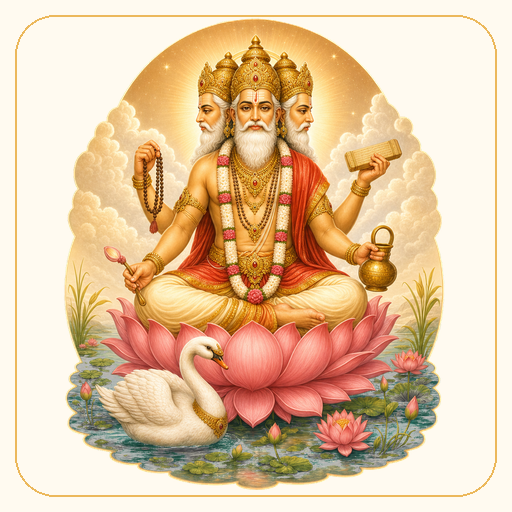
Brahma is said, in the Puranas, to have emerged from Hiranyagarbha (the golden cosmic egg) and to have created the universe, the earth, and living beings from it. This page covers Brahma's role in the Trimurti, the curse legends (two versions) behind why his worship became rare, and the Pushkar temple — since no fixed date like a "Brahma Jayanti" exists, this is evergreen background information, not an annual festival.
Significance
The Trimurti concept
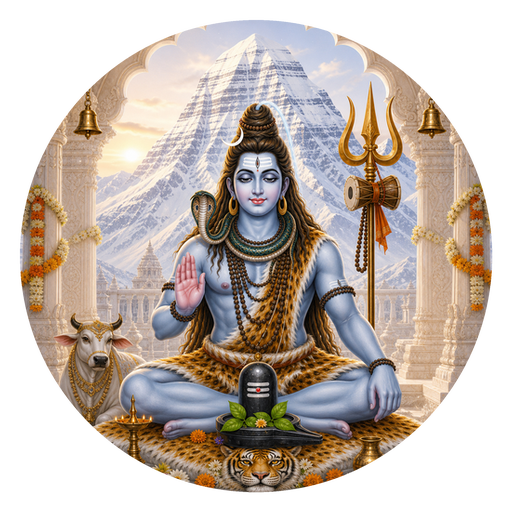
In the Puranic Hindu cycle of creation, three principal functions are assigned to three deities: Brahma (creation), Vishnu (preservation), and Shiv (destruction/dissolution). This is the Trimurti (Brahma-Vishnu-Mahesh) concept.
The absence of worship — a notable feature in its own right
Some texts record that Brahma's prominence gradually declined by roughly the 7th century CE, as deities like Vishnu, Shiv, and the Devi took his place; today, no major, independent sect devoted to Brahma exists in India. That is the core of this page — Brahma is not "unworshipped" out of disrespect; rather, an independent, household worship tradition for him is comparatively rare.
Pushkar, the exception
The Pushkar temple is the most famous of the handful of major, active Brahma temples in the world, especially during Kartik Purnima. A few other Brahma temples exist across India, few enough to count on one hand.
The legend (katha)
At least two independent, widely told curse legends explain why Brahma's independent worship became rare.
Version one — the curse of the sage Bhrigu
By some Puranic accounts, when the sages wanted to settle who among the Trimurti was greatest, they sent the sage Bhrigu to test them. When Bhrigu arrived in Brahma's realm, he deliberately showed disrespect — Brahma grew angry, but his consort Saraswati calmed Bhrigu down. Insulted, Bhrigu cursed that no one would worship Brahma in the Kali Yuga.
Version two — the curse of Saraswati/Savitri (the Pushkar yajna legend)
In a second version, tied directly to Pushkar, Brahma was performing a great yajna (fire ritual) there. His consort (called Savitri in some versions, Saraswati in others) could not arrive by the fixed auspicious moment for the ritual. So that the yajna would not remain incomplete, Brahma married Gayatri and completed it. Finding another in her place, his consort grew furious and cursed Brahma that he would never be worshipped — but Gayatri is said to have softened the curse, excluding Pushkar from it, which is why Brahma continues to be worshipped there to this day.
Some versions add that this curse also fell on Indra, Vishnu, and Agni, and was later softened for them too — these details are sub-episodes of the main legend, not its core.
The Pushkar temple
The Brahma temple at Pushkar, Rajasthan, is India's most famous and active Brahma temple. The present structure is generally dated to around the 14th century; some sources instead say Adi Shankaracharya consecrated a temple here in 718 CE — given this discrepancy, both dates are noted here rather than settling on a single firm date.
The temple's red spire rises roughly seventy feet; a hansa (swan, Brahma's vahana/mount) is one of its recognizable emblems, and the sanctum holds a four-faced marble idol. During Kartik Purnima, thousands of pilgrims bathe in Pushkar lake and take darshan at the temple — the same period as the famous Pushkar Camel Fair. This year's exact date for Kartik Purnima is on the Tripurari Purnima page, which covers a separate, Shiv-centred Maharashtrian festival; the Pushkar fair falls on the same panchang tithi but is a distinct, Rajasthani occasion.
Besides Pushkar, Rajasthan itself has another major Brahma temple at Asotra (Barmer); temples to Brahma are also mentioned at Kullu (Himachal Pradesh), Kumbakonam (Tamil Nadu), and Bramha Karmali in Goa — a handful of temples across India in all.
Who observes it
An individual or household worship tradition for Brahma (like a vrat) is not prevalent in general Hindu society — this is itself the central fact of this page. So "who observes it" does not apply here the way it does on most other vrat/festival pages.
The exception is the Pushkar temple, where regular worship follows the temple's own priestly tradition, and large numbers of pilgrims arrive for darshan on Kartik Purnima.
Puja vidhi
Since no general household puja vidhi for Brahma exists, no concrete daily/vrat-style ritual can be given here. The specific puja and pilgrimage rites at the Pushkar temple should be verified with the temple trust itself.
Mantra
No well-known, independent stotra or aarti dedicated to Brahma is widely found. Instead, the Gayatri mantra is traditionally associated with Brahma — Gayatri is regarded as his second consort/shakti. However, the Gayatri mantra is itself a Vedic mantra originally addressed to Surya/Savitri, a different deity; presenting it directly as "Brahma's mantra" could be misleading. Only this cultural connection is noted here; the complete mantra text is not given.
Regional customs
Brahma's main centre is Rajasthan (Pushkar) — there is no direct regional connection to Maharashtra.
Brahma already appears as a supporting/sub-story character on existing Maharashtrian festival pages:
- Gudi Padwa — by one tradition, Brahma created the universe on this very day, one of the origin legends already given there.
- Ashadhi Ekadashi — the narrative frame of that legend has Brahma telling the story to Narada.
- Raksha Bandhan — one version mentions Brahma advising Indrani to tie the raksha sutra.
- Ravi Pushya — a single source there mentions "Brahma's curse" as a reason weddings are avoided under the Pushya nakshatra, but that page itself notes it is uncorroborated elsewhere — the same caution is kept here.
In all these places, Brahma appears in a supporting role; this page is the first to give him a dedicated, detailed profile of his own.
Good to know
- There is no fixed date like a "Brahma Jayanti" — this is evergreen background information, not an annual festival.
- Both versions of the curse legend (Bhrigu, and Saraswati/Savitri) deserve equal respect; neither should be called "true" while dismissing the other.
- Darshan and pilgrimage timings at the Pushkar temple change from year to year — verify with the temple trust before you travel.
FAQ
- Why is Brahma rarely worshipped?
- By Puranic accounts, Brahma is said to have been cursed (versions differ — the sage Bhrigu in one, Saraswati/Savitri in another), which is why his widespread worship became rare. Historically too, Brahma's prominence is recorded as having declined after roughly the 7th century CE.
- Who cursed Brahma, and why?
- There is no single agreed account. One version has the sage Bhrigu cursing him; the other, Pushkar-centred version has his consort Saraswati/Savitri doing so — both traditions are current.
- Where is Brahma's temple in India?
- The most famous and active temple is at Pushkar, Rajasthan. Comparatively less-known Brahma temples also exist at Asotra (Rajasthan), Kullu (Himachal Pradesh), Kumbakonam (Tamil Nadu), and in Goa.
- What is the connection between the Pushkar temple and Kartik Purnima?
- During Kartik Purnima (the Pushkar fair period), thousands of pilgrims bathe in Pushkar lake and take darshan at the temple — the temple's biggest occasion of the year. The Maharashtrian, Shiv-centred identity of that same panchang tithi is covered on the Tripurari Purnima page.
- What are the roles of the Trimurti (Brahma-Vishnu-Mahesh)?
- By the traditional division, Brahma handles creation, Vishnu preservation, and Shiv destruction/dissolution.
- How many Brahma temples are there in India?
- Various sources mention roughly five to six major temples, with Pushkar the foremost among them — treat this as an estimate.