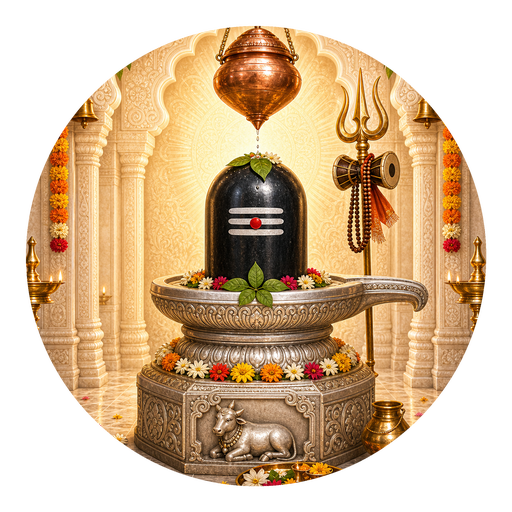
Kunkeshwar
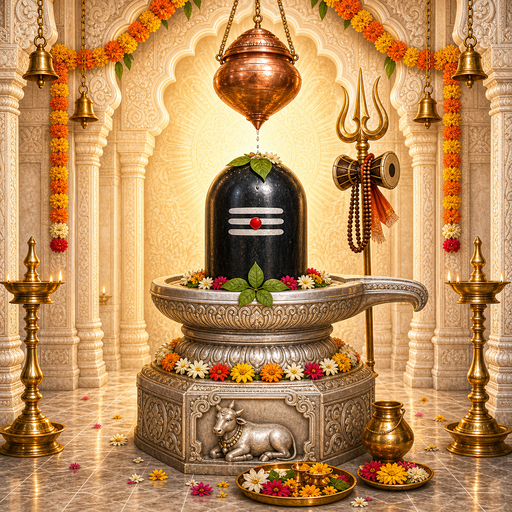
Kunkeshwar is a Shiv temple on a hill by the Arabian Sea, in Devgad taluka of Sindhudurg district — about 14 kilometres from Devgad town (sources vary between 7 and 20 km). The idol in the sanctum is regarded as a self-manifested (swayambhu) Shiv linga. The site is known as "Konkan's Kashi," owing to the many Shivlingas said to stand near the temple and along the shore. The currently visible temple was built, by most accounts, in the 12th century under Yadav rule; according to a single recent report, remains of an even older (11th-century) temple have been found within the temple grounds — this claim has no independent corroboration. The main annual festival is the Mahashivratri yatra — 15 to 17 February in 2026 — drawing lakhs of devotees.
This year's dates (2026)
- Mahashivratri — the main/opening day of the yatra15 Feb
- Second day of the yatra16 Feb
- Third day of the yatra — closing day with a sea bath17 Feb
- Gudi Padwa — celebrated enthusiastically around Kunkeshwar19 Mar
- First Shravan Monday17 Aug
- Second Shravan Monday24 Aug
- Third Shravan Monday31 Aug
- Fourth Shravan Monday7 Sep
Deity and significance
The idol in the sanctum is regarded as a self-manifested (swayambhu) Shiv linga — not man-made, but according to legend, manifested from a rock. Because Kunkeshwar sits right by the sea, and owing to legends of storms and sailors, local tradition also regards Shiv here as a "guardian deity of the sea."
The "Konkan's Kashi" identity comes from the many Shivlingas said to be near the temple and along the shore. Two distinct figures turn up here — a traditional comparison saying "Kashi has 108 Shivlingas, Kunkeshwar has 107," and a separate claim of 21 shore Shivlingas, believed to have been shaped by the Pandavas, which appear and disappear with the tide. These are two distinct claims — they shouldn't be conflated.
Kunkeshwar is regarded as the presiding deity of seventy-two villages — by tradition, the deities of surrounding villages are believed to "visit" Kunkeshwar on Mahashivratri (some sources give no specific number, simply saying "deities of the surrounding villages"). This is a matter of belief, not presented here as universal fact.
History and legend
The currently visible temple was built, according to most sources, in the 12th century CE under Yadav rule (some sources give a date of roughly 1100 CE). One source, however, states the 11th century directly. A single recent report claims excavations within the temple grounds uncovered remains of an earlier, 11th-century temple (from the Kadamba/Chalukya/Shilahara period) — suggesting the site has remained sacred across centuries and that the current temple may be one in a series of rebuildings, though this specific two-layer explanation is not a stated conclusion from any single source.
Three versions of the name's origin exist. The most commonly told version holds that Shiv resides in a "kanak" (golden) forest, giving rise to the name "Kunkeshwar." One source says the name instead comes from local "kunki" trees that grew abundantly in the area. A third, single-source version attributes the name to sage Kunak's penance here. All three are recorded here, with none treated as final.
By the most widely shared origin legend, a cowherd's or Brahmin's cow began giving progressively less milk each day. On investigation, she was found going to a particular spot on her own and releasing her milk there. In anger, the cow's keeper struck the rock at that spot with an axe — blood is said to have flowed from the rock, and on examination, a self-manifested Shivling was found there.
Another legend is associated with the temple's construction — a foreign (Iranian/Arab) merchant, caught in a sea storm, is said to have seen a lamp burning on the shore, surrendered to that unknown power, and vowed to build a temple if saved. The storm calmed, he reached the shore safely, and fulfilled his vow by building or restoring the temple. According to some sources, his memorial/tulsi-vrindavan still stands in the temple grounds today as "a symbol of Hindu-Muslim unity." Other details of this legend come from single sources and aren't consistent.
Historical researchers have recently presented documentary evidence that Naro Nilkanth, a minister under Chhatrapati Shivaji Maharaj, has a samadhi right next to the Kunkeshwar temple — his descendants' long-standing connection to the Kunkeshwar area is also recorded. A local/devotee website associated with Kunkeshwar mentions that the aarti sung during Kunkeshwar's palkhi procession was composed by Naro Nilkanth himself. According to one source, senior historian Babasaheb Purandare is recorded as suggesting that the foreign-merchant legend may have been devised later, during the Mughal invasions, to protect the temple, and that the real figure behind it may have been Naro Nilkanth himself — but this is not a settled claim.
Architecture and layout
The temple stands on a hill right by the sea, with a stone sea-wall roughly 10 metres high protecting it from wave damage. The shikhara's height is given as roughly 20 metres by most sources; one source says 22-24 metres — a minor difference.
Sources disagree on architectural style — most describe it as resembling Dravidian/South Indian style (a notable distinction for the Konkan region), one source calls it "Hemadpanthi," and another describes it as "Konkani style."
Gandabherunda (a two-headed mythological bird) and Kamadhenu sculptures on the shikhara are mentioned by two sources. Dashavatar carvings on the door pillars, a Sheshashayi Vishnu at the sanctum entrance, and surrounding Garuda/Hanuman/Matsya/Narad/Vamana sculptures and a five-faced cow-and-calf sculpture are also mentioned — mostly from a single source. Six deepmalas (lamp towers) and a Nandi in front are mentioned by two sources; one source, however, says "two Nandi idols" and a single lamp pillar — a discrepancy in the numbers.
The temple courtyard (roughly three-quarters of an acre) holds sub-shrines to Jogeshwari Devi, Ganesh, Narayan, Mandlik/Mankoji, and Pavanai Devi (the exact list varies slightly by source), as well as a samadhi shrine. An ancient sweet-water well, despite being right by the sea, is also mentioned.
Main festivals and pilgrimage
| Festival | Tithi | 2026 date | In short | Link |
|---|---|---|---|---|
| Mahashivratri Yatra (main, 3 days) | Magh Krishna Trayodashi → Amavasya | 15-17 February | Kunkeshwar's biggest festival — lakhs of devotees; deities of 72 surrounding villages are believed to visit; a sea bath on the closing day | 15 February day page → Mahashivratri |
| Gudi Padwa | Chaitra Shukla Pratipada | 19 March | Celebrated enthusiastically around Kunkeshwar; a daily palkhi is also said to be taken out through Chaitra month (single-source) | 19 March day page → Gudi Padwa |
| Shravan Mondays (all four) | Every Shravan Monday | 17, 24 August; 31 August; 7 September | Being a Shiv temple, devotees come from far during Shravan | Shravani Somvar |
Although the Mahashivratri yatra is exceptionally large specifically for Kunkeshwar, it remains a site-specific observance of the general Mahashivratri tithi — see that page for the tithi and its broader significance. A local/devotee website associated with Kunkeshwar records the same date (15-17 February), which independently matches the panchang's own calculation.
Darshan and aarti timings
The only figure found, from a single source, is that the temple is open for darshan roughly from 5:30 AM to 9 PM every day. A local/devotee website associated with Kunkeshwar shows a separate "Aarti Timings" section, but the exact timings couldn't be extracted from it. Timings and crowds change considerably during the Mahashivratri yatra days — confirm in advance if travelling then.
Rituals here
Ekadashi puja, Rudrabhishek, and Laghurudra are recorded as regular rituals. A sea bath and the yatra's conclusion take place on Mahashivratri. A daily palkhi procession through Chaitra month is also mentioned (single-source). The aarti sung during Kunkeshwar's palkhi is said to have been composed by minister Naro Nilkanth — the text of this mantra/aarti, however, has not been verified. The exact sequence of puja/abhishek rituals should be confirmed with the temple committee.
How to reach
About 14 kilometres from Devgad town, according to most sources (sources vary between 7 and 20 km); two routes are mentioned — via Kankavli and via Devgad. About 20-54 kilometres from Malvan (a wide variance). The nearest railway station is Nandgaon on the Konkan Railway (roughly 42-45 km); the larger junction is Kankavli (roughly 52-60 km). The nearest major airport is Goa Dabolim (roughly 130 km). About 510-535 km from Mumbai and 351-358 km from Pune — check a live map before you travel. State transport buses reach Kunkeshwar; the temple is about a 5-7 minute walk from the bus stand. Pilgrim accommodation is also available through the temple trust/local management.
Nearby places
- Kunkeshwar beach — right by the temple, a roughly 5-kilometre stretch of white-sand coastline.
- Devgad fort (about 14 km), Vijaydurg fort (about 45 km), Tarkarli beach (about 55 km), Amboli ghat (about 80 km).
- Sindhudurg fort, Mithbav (about 12 km), Tambaldeg, Kotkamte.
- This region is known for Alphonso mangoes — an added draw for visitors during the March-May season.
Traveller tips
Crowds are very heavy during the Mahashivratri yatra (February) — plan stay and travel in advance; parking and queues may take time depending on local arrangements. November to February is the best season to visit (cool weather, calm sea); the sea is rough during the monsoon (June-September) — exercise caution near the shore. If you want to see the shore Shivlingas, check the low-tide timing beforehand. Being right by the coast, a temple visit can be combined with watching the beach and sunset.
Good to know
Kunkeshwar is not one of the twelve Jyotirlingas — it is nonetheless an extremely ancient and important Shiva site in the Konkan, known as "Konkan's Kashi." The traditional "Kashi has 108, Kunkeshwar has 107" comparison and the 21 Pandava-shaped shore Shivlingas are two distinct claims — don't conflate them. It's worth confirming darshan/aarti timings and yatra arrangements with the temple committee before visiting.
FAQ
- Where is Kunkeshwar temple?
- In Devgad taluka of Sindhudurg district, Maharashtra, on the Arabian Sea coast.
- Why is Kunkeshwar called 'Konkan's Kashi'?
- Because of the many Shivlingas said to be near the temple and along the shore (the traditional "Kashi has 108, here 107" comparison), and because it is an extremely ancient and important Shiva site in the Konkan.
- What is the history of Kunkeshwar temple?
- Most sources say it was built by the Yadav kings around the 12th century; it was restored during Chhatrapati Shivaji Maharaj's era. A single recent report claims that remains found within the temple grounds point to an even older (11th-century) temple — this hasn't been independently corroborated.
- How old is Kunkeshwar temple?
- Roughly over a thousand years (most sources say 12th century; a single recent report suggests an earlier 11th-century layer beneath it, but that claim is uncorroborated).
- What is Kunkeshwar's biggest festival?
- The Mahashivratri yatra (15-17 February in 2026) — drawing lakhs of devotees over three days.
- How far is Kunkeshwar from Devgad?
- Sources vary between roughly 7 and 20 km (most say around 14 km).
- Is Kunkeshwar a Jyotirlinga?
- No. Kunkeshwar is not one of the twelve Jyotirlingas; it is nonetheless an extremely ancient and important Shiva site in the Konkan.
- How do I reach Kunkeshwar temple?
- The nearest railway station is Nandgaon (Konkan Railway); the nearest major junction is Kankavli; the nearest airport is Goa Dabolim; it's easily reached by road/state transport bus from Devgad.