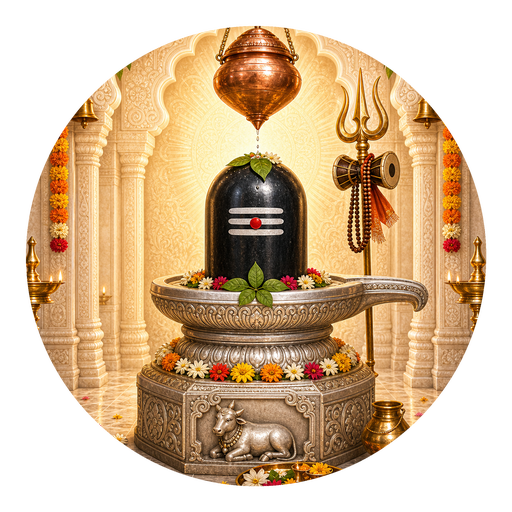
Harihareshwar
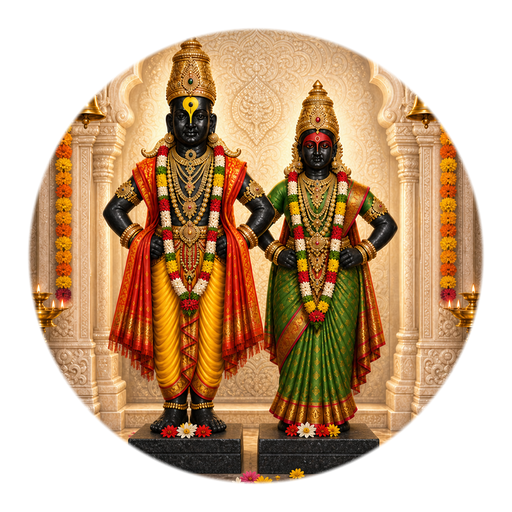
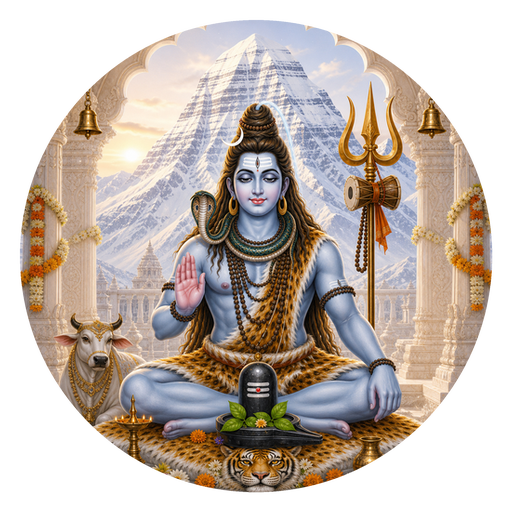
Harihareshwar is an ancient site in Shrivardhan taluka of Raigad district, on the Konkan coast, where the Savitri river meets the Arabian Sea — about 20 kilometres from Shrivardhan. The deity is regarded as the combined form of Hari (Vishnu) and Har (Shiva) — the square linga in the sanctum is believed to embody Brahma, Vishnu, Mahesh, and Adimaya Parvati together. The site is known as "Dakshin Kashi" (the Kashi of the South) and is held as the kuladaivat (family deity) of the Peshwas (the Bhat family). The complex has a separate shrine to Kalbhairav and Yogeshwari Devi, and by tradition, devotees visit them first before Harihareshwar. The site's distinctive "Kosachi Pradakshina" circumambulation runs over hillside and shoreline rocks, and is possible only at low tide.
This year's dates (2026)
- Harihareshwar Yatra (Prabodhini/Kartiki Ekadashi) — the only Harihareshwar-specific yatra directly recorded in this site's panchang20 Nov
- Kalbhairav Jayanti / Bhairavnath Yatra — this site's panchang entry is a combined record for three villages, but independent web research confirms this is Harihareshwar's own major festival too (cannon-firing tradition since 1733)1 Dec
- Mahashivratri — also a major festival at Harihareshwar, with the cannon-firing tradition observed the same day15 Feb
- Chaitra Navami (Ram Navami) — recorded as a Harihareshwar festival in web sources26 Mar
- Devshayani Ashadhi Ekadashi — mentioned as a Harihareshwar festival in only one web source (single-source, lower confidence)25 Jul
- Tripurari/Kartik Purnima — recorded as a Harihareshwar festival in web sources24 Nov
Deity and significance
The main temple's idol is regarded as a square Shiva linga, believed to embody Brahma, Vishnu, Mahesh, and Adimaya Parvati together — so the sanctum represents not Shiva alone, but a combined concept of the Trimurti and Shakti. The name itself signals this union — "Hari" (Vishnu) and "Har" (Shiva) — making this not simply a Shiva site but a site of joint Hari-Har worship.
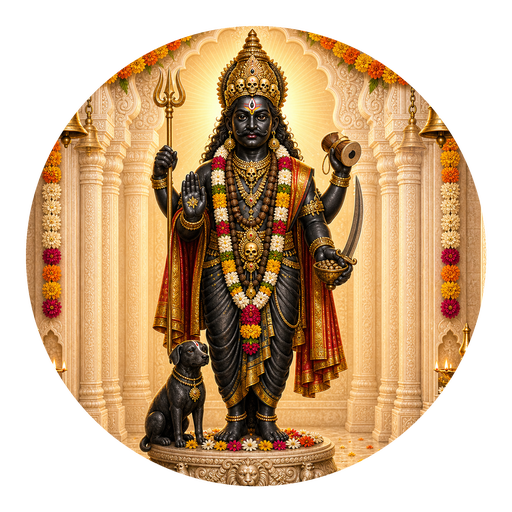
The temple complex has a separate (smaller) shrine to Kalbhairav and Yogeshwari Devi — by tradition, devotees visit Kalbhairav-Yogeshwari first, then Harihareshwar. Some sources say devotees then visit Kalbhairav once more afterward. The complex is also said to include shrines to Siddhivinayak and Hanuman, and a Mahalakshmi temple stands nearby.
Kalbhairav is regarded as a deity who wards off evil spirits and pacifies restless souls — devotees are seated near a carved wooden pillar in the hall and given a "kaul" (a specific question-answer oracle ritual) before him. According to one source synthesis, the Kalbhairav idol here faces north, unlike the more common south-facing convention — this detail comes from a single source and is not independently verified.
Harihareshwar's standing as the Peshwas' kuladaivat is very well established — Shrivardhan, the ancestral village of Balaji Vishwanath Bhat, the first hereditary Peshwa under Chhatrapati Shahu Maharaj, lies close to this site.
History and legend
The site has been considered sacred since Puranic times; the current temple structure was built, by most sources' account, in the late medieval period. A major fire damaged the temple in 1723, after which Peshwa Bajirao I rebuilt it. Chhatrapati Shivaji Maharaj is also said to have visited the site in 1674.
The name "Harihareshwar" means Hari (Vishnu) + Har (Shiva) + Ishwar — all sources agree this symbolises the union of these two deities.
At least five distinct versions of the origin legend are in circulation, so none is treated here as final. In the most widely shared version, sage Agastya, wandering in search of peace, arrived at this site; the sight of the self-manifested lingas here calmed his mind, and he is said to have established Kalbhairav and Yogeshwari Devi here. One sub-version says the linga first appeared in the form of the single-faced Dattatreya before settling into linga form (single-source). Another sub-version says a demon named Kalasura disrupted Agastya's penance here, and the enraged sage cursed him to turn to stone (single-source, not corroborated elsewhere).
A second version holds that Lord Vishnu, in his Vamana avatar, measured the universe in three strides as Trivikrama from King Bali, and that the second stride landed on this very ground. A third version says Brahma performed a yagna here with Savitri and granted her a boon (two sources, though possibly from the same underlying tradition) — this story is linked to a text called "Shri Harihareshwar Mahatmya." Rather than treating these five versions as contradicting each other, the fairer approach is to read them as complementary stories from different traditions.
The pradakshina path around the temple is said to have been built by Chandrarao More — not independently corroborated. According to one source, the Kalbhairav Jayanti festival was established by a historical administrator named Yashwant Balwant Nagle, who also donated property for the temple's upkeep — treated cautiously here as single-origin, without independent corroboration. A tradition of firing a cannon on Mahashivratri and Kalbhairav Jayanti has continued since 1733.
Architecture and layout
The temple stands at the foot of four hills — Brahmagiri, Vishnugiri, Shivgiri, and Parvatigiri — according to most independent sources. One English-language source, however, names a different set — "three hills: Harihareshwar, Harshinachal, and Pushpadri." This discrepancy is unresolved; the four-hills version is used here as the majority account.
The complex has two adjoining temples — a smaller Kalbhairav temple (on a raised platform) and the main Harihareshwar temple. Sources disagree on architectural style — one calls it "tiled-roof, two-storeyed," while another separately describes it as "Hemadpanti style"; other sources use only the general term "late medieval." No single style is treated here as settled.
The sanctum is said to sit roughly three to four feet below ground level. The main idol is a square Shiva linga, with Nandi and Ganesh idols also near the sanctum. The complex is said to have four temples in total — Harihareshwar, Kalbhairav-Yogeshwari, Siddhivinayak, and Hanuman. A cracked rock behind the temple is linked, in one source, to a Mahabharata-era legend involving Bhima — this is single-source and unverified.
The temple stands near the mouth of the Savitri river, right by the coast; there are separate beaches to the north and south, with an MTDC resort near the southern one.
Main festivals and pilgrimage
| Festival | Tithi | 2026 date | In short | Link |
|---|---|---|---|---|
| Harihareshwar Yatra (Prabodhini/Kartiki Ekadashi) | Kartik Shukla Ekadashi | 20 November | The only Harihareshwar-specific yatra directly recorded in this site's panchang | 20 November day page → Prabodhini Ekadashi |
| Kalbhairav Jayanti / Bhairavnath Yatra | Kartik Krishna Ashtami (Kalashtami) | 1 December | This site's panchang entry is a combined record for three villages, though this is Harihareshwar's own major festival in its own right; cannon-firing tradition since 1733 | 1 December day page → Kalbhairav Jayanti / Kalashtami |
| Mahashivratri | Magh Krishna Trayodashi | 15 February | A general tithi; also a major festival at Harihareshwar, with the cannon-firing tradition observed the same day | 15 February day page → Mahashivratri |
| Chaitra Navami (Ram Navami) | Chaitra Shukla Navami | 26 March | Recorded as a Harihareshwar festival in web sources | 26 March day page → Ram Navami |
| Ashadhi Ekadashi (Devshayani) | Ashadh Shukla Ekadashi | 25 July | Mentioned in only one source — single-source, lower confidence | 25 July day page → Ashadhi Ekadashi |
| Kartik Purnima (Tripurari) | Kartik Purnima | 24 November | Recorded as a Harihareshwar festival in web sources | 24 November day page → Tripurari Purnima |
The two biggest of these — the Harihareshwar Yatra and Kalbhairav Jayanti — both fall in Kartik month. See the linked festival and day pages above for more detail on each.
Darshan and aarti timings
Three different claims turned up here — confirm with the temple committee before an actual visit. One source gives general darshan hours as 6 AM to 8 PM, while another gives 7 AM to 9 PM (with aarti at 7 AM). The Kalbhairav kaul timing, though, is consistently given as 11 AM to 2 PM across three independent sources — comparatively more reliable. A special Mahaaarti is also said to be held on Mahashivratri and the second Shravan Monday (single-source). Timings and crowds vary considerably on festival/yatra days.
Rituals here
Darshan order — Kalbhairav-Yogeshwari first, then Harihareshwar. Some sources say devotees visit Kalbhairav once more afterward. Devotees are seated near a carved wooden pillar in the hall and given a "kaul" before Kalbhairav (for release from evil influences), between 11 AM and 2 PM; the exact form and words of this ritual should be confirmed with the temple committee.
The "Kosachi Pradakshina" runs over hillside and shoreline rocks around the temple — roughly one kos (an estimated ~3 kilometres, no firm measurement found) — and is possible only at low tide; it is extremely dangerous at high tide. This circumambulation should not be attempted without first asking locals or the temple management. The path is also said to pass "Shukla Tirtha" and "Gayatri Tirtha," sacred spots near the Savitri river.
A traditional cannon-firing practice on Mahashivratri and Kalbhairav Jayanti has continued since 1733. No authoritative text for the mantras/aarti is available — confirm with the temple committee.
How to reach
From Shrivardhan, it's about 20 kilometres. Mangaon (the nearest Konkan Railway station) is about 53-60 kilometres away, with an alternate route via Dasgaon also available. From Mumbai it's roughly 192-230 kilometres, and from Pune roughly 175-190 kilometres. The nearest major airports are Mumbai (Chhatrapati Shivaji Maharaj) or Pune (Lohgaon) — both at roughly similar distances. State transport buses run from Mumbai, Thane, and Raigad; private vehicles can reach the parking area. You can also reach Harihareshwar by boat from Shrivardhan. Check a live map before you go.
Nearby places
- Shrivardhan (about 20 km) — the ancestral village of Peshwa Balaji Vishwanath Bhat; a beach town.
- Diveagar beach — a popular nearby tourist spot.
- Mahalakshmi temple — nearby, recorded by two independent sources.
- Bagmandla, Bankot Fort — mentioned as being across the Savitri river (single source).
- Murud Janjira, Parshuram temple — mentioned in regional tourism listings.
- Harihareshwar beach has two separate stretches, north and south (with an MTDC resort near the southern one).
Traveller tips
The Kosachi Pradakshina should only be attempted at low tide — it is extremely dangerous at high tide; don't start it without first checking timing with locals or temple management. October to February/March is considered the best season to visit (cool, pleasant weather); summer and monsoon are best avoided. Crowds are heavy on Kartiki Ekadashi and Kalbhairav Jayanti (cannon-firing day) — plan stay and travel in advance. The area is also said to fill with devotees during Shravan month (single-source). The sea here is considered locally dangerous — exercise caution while swimming or near the shore.
Good to know
Harihareshwar is not one of the twelve Jyotirlingas — it is often mentioned alongside Kunkeshwar and Marleshwar due to their shared Konkan-coast location, but the deity here is different (the combined Hari-Har form), which is worth keeping in mind. A few other temples elsewhere in Maharashtra also share the name "Harihareshwar" — this page is specifically about the one in Shrivardhan taluka, Raigad district, and shouldn't be conflated with details from those other sites. It's also worth remembering the darshan order — Kalbhairav first, then Harihareshwar.
FAQ
- Where is Harihareshwar temple?
- In Shrivardhan taluka of Raigad district, Maharashtra, where the Savitri river meets the Arabian Sea; about 20 km from Shrivardhan.
- Why is Harihareshwar called 'Dakshin Kashi'?
- Because of its ancient/Puranic significance, its combined Hari-Har deity, and its extensive temple complex including Kalbhairav-Yogeshwari — regionally compared to Kashi (Varanasi).
- Who are the main deities at Harihareshwar temple?
- The sanctum holds Brahma, Vishnu, Mahesh, and Adimaya Parvati together in linga form; the complex also has a separate shrine to Kalbhairav and Yogeshwari Devi, plus Siddhivinayak and Hanuman.
- Why is Harihareshwar considered the Peshwas' kuladaivat?
- Because Shrivardhan, the ancestral village of the Peshwa (Bhat) family, lies close to this site, and Peshwa Bajirao I rebuilt the temple in 1723 — a well-established connection.
- What is Harihareshwar's 'Kosachi Pradakshina'?
- A circumambulation of roughly one kos (an estimated ~3 km) over hillside and shoreline rocks around the temple, which can only be done at low tide.
- What is Harihareshwar temple's main festival?
- Kartiki/Prabodhini Ekadashi (20 November in 2026) and Kalbhairav Jayanti (1 December in 2026, with its cannon-firing tradition since 1733) are the two major yatra days; Mahashivratri is also significant.
- How far is Harihareshwar from Shrivardhan?
- About 20 kilometres.
- Is Harihareshwar a Jyotirlinga?
- No. Harihareshwar is not one of the 12 Jyotirlingas, nor is it a pure Shiva temple — it is a site of joint Hari (Vishnu) and Har (Shiva) worship. It's often mentioned alongside Kunkeshwar and Marleshwar due to their shared Konkan-coast location, but the deity here is different.
- What is the darshan order at Harihareshwar temple?
- By tradition, devotees visit Kalbhairav(-Yogeshwari) first, then Harihareshwar (in some accounts, Kalbhairav once more afterward).