Kali Mata
Kali is regarded as one of the fiercest forms of the Devi (Adishakti) — by Puranic legend, she manifests out of Durga's rage during battle. Kali Mata has no independent, dedicated date of her own on Maharashtra's own panchang; instead, Kalaratri (Navratri's seventh day) and Kali Puja (a Bengali tradition observed on Diwali night) are two related-but-distinct occasions, explained below.
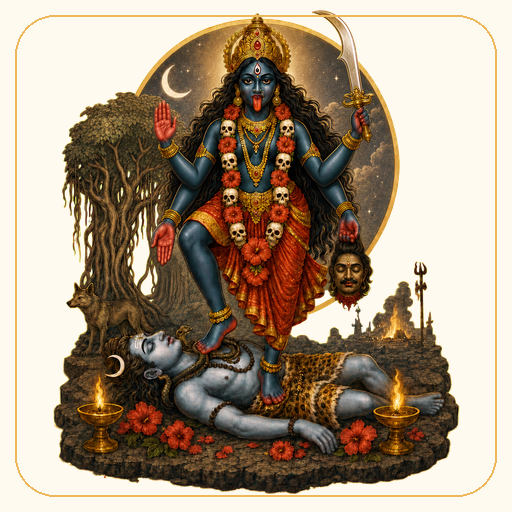
In Puranic and folk tradition, Kali is generally held to be a fierce form of Durga/Parvati — not a separate, distinct deity in her own right. But in Shakta and Tantric tradition, she is worshipped as a distinct, supreme principle (Brahman).
Significance
Per the Devi Mahatmya (Durga Saptashati), Kali manifests as the embodiment of Durga's rage and plays a central role in the slaying of demons such as Shumbha-Nishumbha and, especially, Raktabija — the Navratri page's own Mahishasuramardini legend already notes that this goddess is called "Mahakali" in some versions.
In Shakta tradition, Kali is held to be the supreme Shakti; in Tantric tradition, she is regarded as the supreme principle/Brahman itself — a Prakriti (nature/manifest) counterpart to Shiv's Purusha (spirit) principle.
Kali is regarded as the first/foremost of the Dus Mahavidyas (the Ten Mahavidyas: Kali, Tara, Tripura Sundari, Bhuvaneshwari, Chhinnamasta, Bhairavi, Dhumavati, Bagalamukhi, Matangi, and Kamala) — the centre of Kalikula worship tradition. Mahakali is an elevated form of Kali herself, connected to the concept of Mahakal (great time/death) and to cosmic dissolution — Kali and Mahakali are distinct but very closely linked concepts.
No major, independent Kali-centred festival is found on Maharashtra's own calendar; the Bengali tradition of Kali Puja should not be mistaken for a Maharashtrian one.
The legend (katha)
Per the Devi Mahatmya, when Durga/Ambika grows extremely enraged in battle, Kali emerges from her brow (or her body) — an extremely fierce, gaunt, dark-complexioned power who slays demons such as Shumbha-Nishumbha and, in particular, Raktabija. A popular sub-story tells that a new demon was born from every drop of Raktabija's blood that touched the ground, so Kali drank his blood with her tongue before it could fall.
Some versions hold that Kali is a power that manifests separately out of Durga, while others describe Parvati herself becoming Kali through rage — this version-difference is already noted on the Navratri page too (regarding the Chamunda/Durga/Mahakali name variations).
A widely told folk explanation for Kali's protruding tongue is that Shiv lay down beneath her feet to halt her destructive tandava dance, and she stuck out her tongue in shame — though some hold this to be simply a symbol of rage/bloodlust.
Three distinct, related occasions — Kalaratri, Kali Puja, and a tag
Kali Mata's name is often linked to three distinct, date-adjacent occasions. It helps to understand clearly that all three are different — treating them as a single "Kali Mata's day" would be a misunderstanding.
Kalaratri — the seventh day of Sharadiya Navratri
Kalaratri is the seventh of the Navadurga, worshipped on the seventh day of Sharadiya (autumn) Navratri — in 2026, this date is split across 17 October and 18 October on the Navratri page, owing to a saptami vriddhi (a tithi spanning two calendar days). The names Kali and Kalaratri are sometimes used interchangeably, while by some views they are considered separate deities.
Kali Puja — the Bengali tradition of Diwali night
Kali Puja is observed on the Kartik/Ashwin amavasya (new moon) — the very same night as Maharashtra's Lakshmi Pujan during Diwali. It is celebrated chiefly in West Bengal (and also in Jharkhand, Odisha, Assam, Tripura, and Bangladesh). While it falls on the same tithi, these are two distinct regional traditions observed together, not two names for one festival — in Maharashtra, Lakshmi-Kuber Pujan is the main rite of this same night, and Kali Puja finds no mention in Maharashtra's own Diwali tradition. In 2026, this night falls on 8 November.
In the Brahminical stream, the puja is offered with red hibiscus flowers, sweets, and a rice-lentil naivedya; in the Tantric stream, an animal-sacrifice practice is also found in some places. This vidhi detail belongs chiefly to the Bengal/eastern-India tradition and is not directly applicable to Maharashtra.
A January tag — not a distinct occasion
The panchang carries a mention on 1 January 2026 reading "Kalaratri Navratrarambha" (the start of a Kalaratri Navratri). This appears not to be an independent, Kali-related occasion at all, but rather part of the Shakambhari Navratri cycle already underway at that time. So this is not presented here as an independent "Kali Mata day."
Who observes it
An ordinary household or individual worship of Kali is not widely practised in Maharashtra. It is mainly Shakta/Tantric practitioners, families from the Bengal/eastern-India tradition, and devotees at Kali temples who take part in Kali Puja. During Sharadiya Navratri, general Navadurga worshippers do worship Kalaratri (day 7) — but that is not independent Kali worship, it is part of the Navadurga cycle, described in full on the Navratri page.
Mantra & stotra
Stotras and beeja mantras associated with Kali invoke her fierce, protective power — devotees turn to her to dispel fear and negativity. They are recited chiefly during Navratri and on the Kali Puja amavasya night.
Regional customs
Kali Puja is chiefly a West Bengal tradition (Barasat, Kolkata, Tamluk, and others); it is also observed in Jharkhand, Odisha, Assam, Tripura, and Bangladesh. In Maharashtra, Diwali's own identity is tied to Lakshmi-Kuber Pujan, not the Kali tradition.
The "Lakshmi vs. Adishakti/Mahakali" deity-tradition divergence already noted about the Kolhapur Mahalakshmi (Ambabai) temple is a consistent example for this page too — some Shakta traditions within Maharashtra itself do regard the Devi in a Mahakali form, but this is a minority view distinct from the mainstream, Lakshmi-centred one. Similarly, the Durgashtami page already notes one version's claim that, during Navratri's Sandhi Puja (the ashtami-navami junction), "the goddess's power transforms into a Kali form."
Good to know
- Kali Mata has no independent date of her own on Maharashtra's panchang — Kalaratri, Kali Puja, and the January tag are three distinct, easily-confused-but-different references; keep that in mind.
- Kali Puja is a Bengal/eastern-India tradition — it should not be assumed to be part of the Maharashtrian Diwali.
- Both deity traditions (a fierce form vs. a distinct supreme principle) deserve equal respect; neither should be called wrong.
- Details like the Tantric/sacrifice practice are given here purely for information — not as encouragement or prescription.
FAQ
- Who is Kali Mata, and is she different from Durga?
- In Puranic tradition, Kali is generally regarded as an extremely fierce form of Durga/Adishakti — not a separate, distinct deity. But in Shakta/Tantric tradition, she is held to be a distinct supreme principle — both views are current.
- Why is Kali Puja celebrated on the same night as Diwali?
- Kali Puja falls on the Kartik/Ashwin amavasya — the very same tithi as Diwali. In the Bengali tradition, Kali Puja takes centre stage on this night instead of Maharashtra's Lakshmi Pujan — the same tithi, a different regional tradition.
- Is Kali Puja celebrated in Maharashtra?
- No particular mention of Kali Puja is found in Maharashtra's own panchang tradition; here, Lakshmi-Kuber Pujan is the main rite of this same night. Kali Puja is chiefly celebrated in Bengal and eastern India.
- What is Kalaratri — is she the same as Kali Mata?
- Kalaratri is one of the Navadurga, worshipped on the seventh day of Sharadiya Navratri. Because of her name and fierce form, some consider her to be Kali, while others hold her to be a separate deity — there is no firm consensus.
- What is Mahakali, and how is she different from Kali Mata?
- Mahakali is regarded as an elevated form of Kali herself, linked to the concept of "great time/death," encompassing the combined power of the Ten Mahavidyas — Kali and Mahakali are distinct but very closely linked concepts.
- What is the meaning of Kali Mata's fierce form and her weapons?
- Her severed head is taken to symbolise the destruction of ego, her blood-stained sword divine knowledge, and her garland of skulls the Sanskrit letters/sound — this is a symbolic interpretation, not a literal one.
- What is Kali Mata's place among the Ten Mahavidyas?
- Kali is regarded as the first/foremost of the Dus Mahavidyas (Kali, Tara, Tripura Sundari, Bhuvaneshwari, Chhinnamasta, Bhairavi, Dhumavati, Bagalamukhi, Matangi, and Kamala).