Kolhapur Mahalakshmi (Ambabai)
The Shri Ambabai / Mahalakshmi temple at Kolhapur (Karvir) is one of Maharashtra’s foremost Devi shrines, counted among the saade teen shaktipeeth (the “three and a half” full and half power-seats) as a full peeth. Built in black stone in the Hemadpanti style in the Karvir kshetra by the Panchganga, its signature is the Kiranotsav — twice a year the setting sun’s rays fall directly on the west-facing murti (idol) of the Devi. The temple is administered by the Paschim Maharashtra Devasthan Samiti.
This year's dates (2026)
- Ghatasthapana, Sharadiya Navratri begins11 Oct
- Lalita Panchami15 Oct
- Durgashtami19 Oct
- Vijayadashami / Dasara20 Oct
- Kojagiri / Sharad Purnima25 Oct
Deity & significance
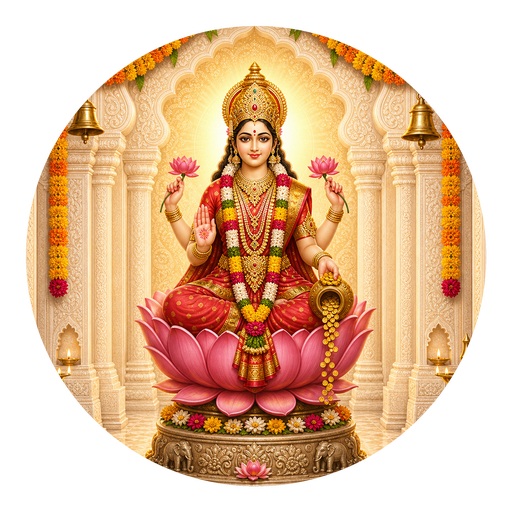
Ambabai is worshipped as Mahalakshmi — the goddess of wealth, abundance and prosperity. Many sources hold her to be Lakshmi, consort of Maha-Vishnu. In the Shakta tradition, however, Ambabai is also revered as Adishakti / Mahakali. Both traditions deserve to be stated with respect — no single view should be treated as the only one.
Here the Devi is known as Karvirnivasini (she who dwells in Karvir); the temple’s formal name is given as “Shri Karvirnivasini Ambabai Mahalakshmi.”
Shaktipeeth significance: in Maharashtra, Kolhapur is regarded as a full peeth among the saade teen shaktipeeth. But the classification of shaktipeeths varies by tradition — some count “three and a half” (Maharashtra), some “four”, and the wider traditions count “eighteen maha-shaktipeeth” or “fifty-one shaktipeeth”. So it is better to note the traditions than to fix on a single number.
Maharashtra’s saade teen shaktipeeth are usually taken to be — Kolhapur (full), Tuljapur (full), Mahur (full) and Saptashrungi–Vani (half). Besides Mahalakshmi, the temple also holds shrines for Vishnu, Shiv and Ganesh.
History & legend
Building history: the temple’s original construction is held to be from the Chalukya period. By some accounts it was built by king Karnadeva, around 634 CE; but the builder’s name (Karnadeva / Karandeva) and the exact date (634 CE / ~550–660 CE / 6th–7th century) differ across sources. So all that can be said with confidence is “around 634 CE — roughly the 6th–7th century, of the Chalukya era.” Later, the temple is believed to have been renovated and expanded under the Shilahara and Yadava dynasties.
The sthala-purana source: the story of this kshetra is told in the Karvir Mahatmya — originally in Sanskrit, seventy-two adhyaya (chapters) and over five and a half thousand ovi (verses); it describes the tirthas and glory of the kshetra through sage Agastya’s travels in Karvir. The text is associated with the Padma Purana.
The Kolhasura legend (in brief): in ancient times a demon named Kolhasura tormented the sages and common folk beyond bearing. To end his arrogance, the Devi Mahalakshmi is said to have slain him. By one version of the Karvir Mahatmya, Kolhasura had a boon that “he could be killed only by a woman”; so Vishnu himself manifested in Karvir in the form of Mahalakshmi and destroyed him. As he died, Kolhasura asked that “this place bear my name” — and so, the folk-tale says, the town came to be called Kolhapur.
Some versions tell the details a little differently; the core of the story, though — the slaying of Kolhasura and the name Kolhapur that came from it — stays the same. The precise standard version of the Karvir Mahatmya, especially the “killed only by a woman” detail, is best verified from the temple trust or an authoritative text.
Architecture & structure
- Style: Hemadpanti (Deccan) — built in black stone, with fine carvings of deities and Puranic scenes on the walls and pillars.
- Layout: five shikhars (spires) over a central garbhagriha (sanctum); a main sabhamandap and the Garuda mandap. During Kiranotsav, the sun’s rays are said to reach the sanctum along this very axis.
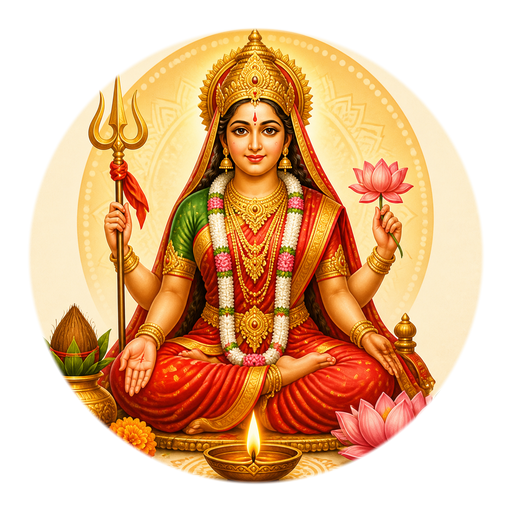
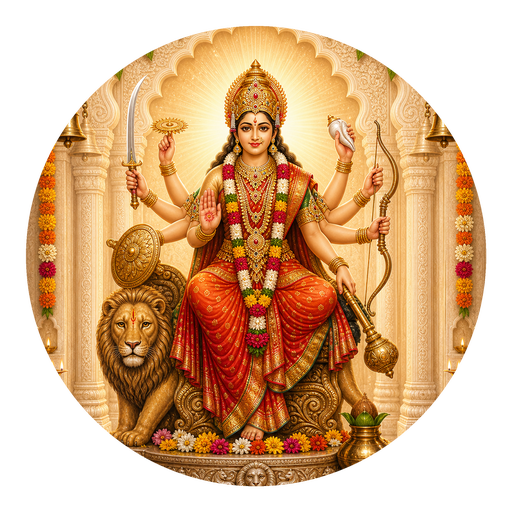
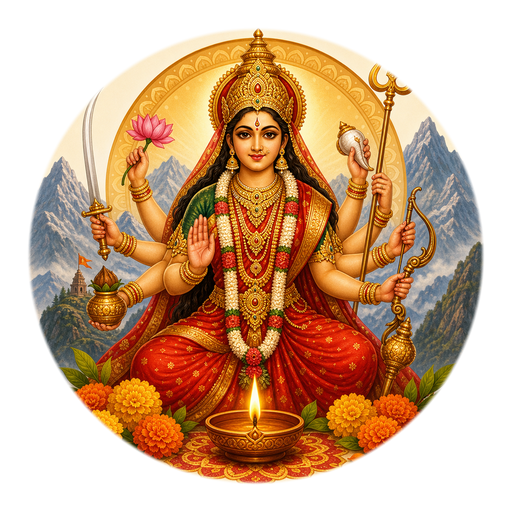
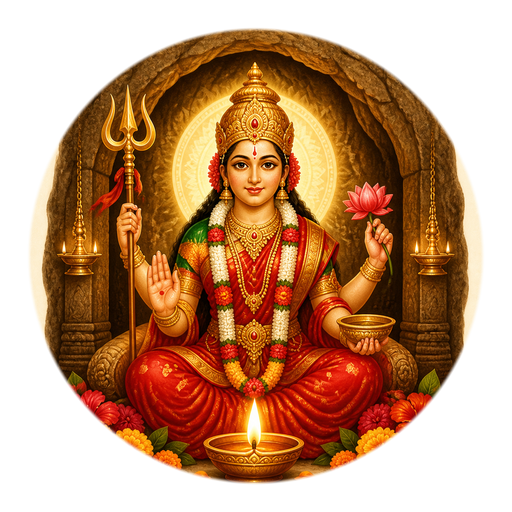
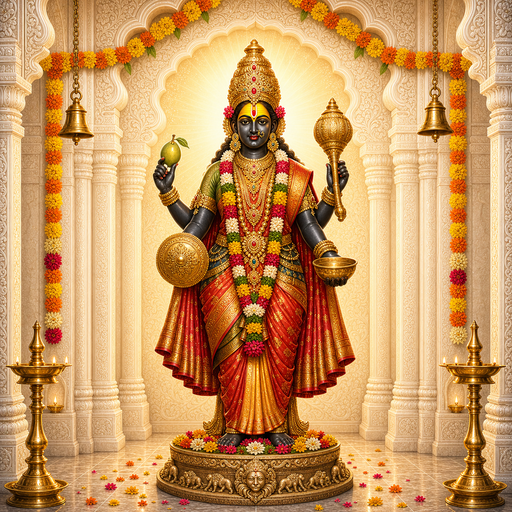
- The murti: a monolithic black-stone four-armed idol about three feet tall (roughly forty kilograms, adorned with gems); a five-headed snake over the head, a lion vahana (mount) behind, and in the hands a matulinga (a citron fruit), a gada (mace), a shield and a panapatra (drinking vessel).
- The Kiranotsav design: because the murti faces west, at sunset the rays coming from the west fall directly on the idol — a precise meeting of architecture and solar geometry.
Festivals & yatra
The this-year (2026) dates of the tithi-based festivals are taken from this site’s panchang data, and each date links to that day’s page. Because Kiranotsav is a solar event (a sun-ray alignment), its Gregorian window is given below — its exact dates can shift slightly from year to year.
| Festival | Type / tithi | This year’s date (2026) |
|---|---|---|
| Kiranotsav (Uttarayan) | Solar (sun-ray alignment) | approx. 31 January – 2 February |
| Kiranotsav (Dakshinayan) | Solar (sun-ray alignment) | approx. 9 – 11 November |
| Ghatasthapana / Sharadiya Navratri begins | Ashwin Shukla Pratipada | 11 October |
| Lalita Panchami | Ashwin Shukla Panchami | 15 October |
| Durgashtami | Ashwin Shukla Ashtami | 19 October |
| Vijayadashami / Dasara | Ashwin Shukla Navami | 20 October |
| Kojagiri / Sharad Purnima | Ashwin Shukla Chaturdashi | 25 October |
| Mahalakshmi Jagar (Kolhapur) | Navratri nights (local tradition) | during Navratri |
⚠️ Kiranotsav — exact dates and order: the Kiranotsav windows above rest on external sources and this site’s content plan; the official trust page could not be opened directly. Verify the exact dates each year against the temple committee’s announcement.
⚠️ Rathotsav and other annual yatras: the exact tithi/date of the temple’s Rathotsav and other annual yatras could not be confirmed from any authoritative source — so it is not given here; obtain it from the temple committee.
Darshan & aarti timings
⚠️ Verify with the temple trust: darshan and aarti timings differ across sources and the committee can change them. Do not take any time as fixed before checking the official schedule.
- The temple opens at dawn with kakad aarti and morning darshan begins; darshan closes for a few hours at midday and reopens in the evening, continuing until late at night (with a dhup/shej aarti in the evening) — so darshan generally runs in two sessions, morning and evening.
- Most sources agree the evening session runs roughly from about 4 PM to about 10 PM; the morning session, the midday closure and the exact kakad/evening aarti times are recorded differently across sources — verify against the official schedule.
- During Navratri, Kiranotsav and festival periods the schedule and darshan queues change — check the official notice before you travel.
Special rituals here
- Kiranotsav darshan: on the Kiranotsav days, when the sun’s rays fall on the Devi at sunset, devotees gather in large numbers. The rays are said to fall in sequence on the Devi’s feet, chest and face / whole idol; but the exact order differs across sources, so it should not be taken as fixed.
- Navratri worship and Mahalakshmi Jagar: during Navratri the Devi receives special puja and alankar (adornment), with the night jagar (a local tradition).
- The exact sequence, mantra and schedule of the daily puja, abhishek and alankar should be verified with the temple committee — an authoritative order was not found from external sources.
How to reach
- By air: Kolhapur airport (Chhatrapati Rajaram Maharaj) is about 10 km from the city and connected to Mumbai and Bengaluru.
- By rail: Chhatrapati Shahu Maharaj Terminus (Kolhapur) is the nearest railway station.
- By road: the Pune–Bengaluru highway (NH) gives good connectivity; buses and private vehicles run easily from Mumbai, Pune and Sangli.
⚠️ Check a live map and schedule before you travel.
Nearby places
- Jyotiba temple (Wadi Ratnagiri) — a major shrine nearby.
- Rankala lake — within the city, about three km.
- New Palace, Panhala fort and the Dajipur sanctuary.
- Narsobawadi (Narsobachi Wadi) — a Datta kshetra nearby.
Travel tips
- Navratri and Kiranotsav draw huge crowds — plan ahead, stay patient in the rush, and take special care of elders and small children.
- Darshan queues, special-darshan/passes, mobile and baggage rules and the schedule can change per the temple committee’s official notice — verify before travelling.
- Follow the photography rules within the temple precincts.
Mantra & aarti
Jap-mantras (traditional):
- “Om Mahalakshmyai Namah” — a short salutation to Mahalakshmi, chanted at darshan and in namasmaran (remembrance).
- “Om Hrim Shrimahalakshmyai Namah” — a bija (seed) mantra of Lakshmi worship (by tradition).
Ambabai aarti — “Sukhasadane Shashivadane” (by Mukeshwar).
Here is the meaning, when to sing it, and the full text.
- When to sing: at darshan and during the aarti of the Devi, especially in Navratri.
- Meaning, in brief: the aarti hails Kolhapur’s Ambabai — the doe-eyed, eight-armed Devi, dear to Shiv, who slew the demon Kolhasura; it describes her radiant form and adornment and salutes her as Jagadamba, the mistress of Kolhapur.
Mahalakshmi aarti — “Jay Devi Jay Devi Jay Mahalakshmi” (by Mukeshwar Nagar).
The traditional (public-domain) full lyrics are given below, with the meaning and the opening line.
- When to sing: after the puja / at the Devi’s aarti.
- Meaning, in brief: the aarti hails Mahalakshmi who dwells in Karvir (Kolhapur) and pervades all that is gross and subtle; it invokes her as mother of the gods and sages, giver of boons and slayer of demons who carries the devotee across the hard sea of worldly life, and closes with the devotee taking refuge at her feet.
- Opening line (romanized): “Jay Devi Jay Devi Jay Mahalakshmi…”
(The choice and order of aartis can vary a little by household and temple tradition.)
Good to know
- Verify darshan and aarti times against the official schedule — they can change.
- Verify the exact Kiranotsav dates and the ray-order against the temple committee’s announcement.
- The temple is administered by the Paschim Maharashtra Devasthan Samiti; this page implies no official association with the temple.
- Take care of elders and small children during crowded periods.
FAQ
- Is Kolhapur’s Ambabai Lakshmi or Adishakti?
- In many traditions Ambabai = Mahalakshmi (consort of Maha-Vishnu); in the Shakta tradition she is revered as Adishakti / Mahakali. Both views are presented with respect.
- What is Kiranotsav and when is it at Kolhapur?
- Because the murti faces west, twice a year (approx. 31 January–2 February and ~9–11 November) the setting sun’s rays fall directly on the Devi — this is Kiranotsav. Verify the exact dates and the ray-order with the temple committee.
- Who built the Kolhapur Mahalakshmi temple and when?
- The temple is held to be of the Chalukya period (around 634 CE, roughly the 6th–7th century), with later renovation under the Shilahara and Yadava dynasties. The exact name and date differ across sources.
- What are the darshan and aarti timings at the Mahalakshmi temple?
- Darshan is generally open from about 4 PM to about 10 PM; there is a kakad aarti at dawn and an aarti in the evening. Verify the exact times against the official schedule.
- Which are the saade teen shaktipeeth?
- Kolhapur (full), Tuljapur (full), Mahur (full) and Saptashrungi–Vani (half) — these are taken to be Maharashtra’s “three and a half” shaktipeeth.
- How do you reach Kolhapur?
- By air (Kolhapur airport), by rail (Chhatrapati Shahu Maharaj Terminus) and by road (the Pune–Bengaluru highway) — Kolhapur is connected by all three.