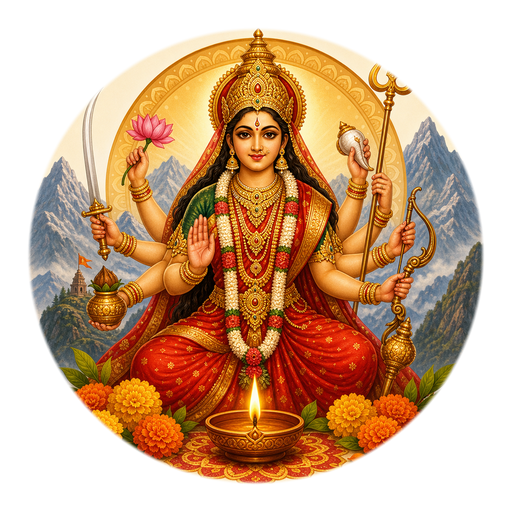
Ekvira Devi — Karla, Lonavala
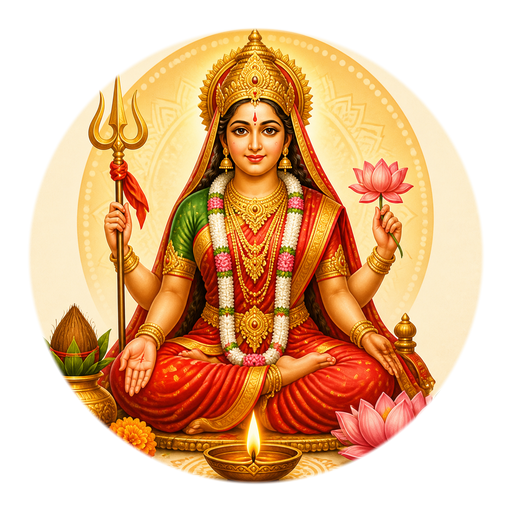
Ekvira Devi is an ancient temple on a hill at Karla, in Maval taluka of Pune district near Lonavala — standing right at the chaitya-hall entrance of the well-known Karla Buddhist caves. She is the principal kuldevi (family deity) of the Koli and Agri communities across Mumbai, Thane, Raigad, and the Konkan coast. Some traditions consider her a form of Parvati/Renuka — but Ekvira herself is not one of the Sadeteen Shaktipeeths, a distinction worth keeping clear. Her main annual festival is the Chaitra yatra/palkhi procession, with its main day falling on Chaitra Shukla Saptami — 25 March in 2026.
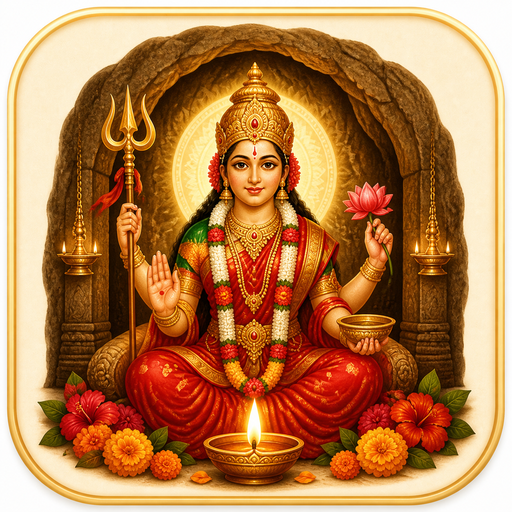
This year's dates (2026)
Deity and significance
Ekvira Devi is described as a form of Parvati, Yamai, and Renuka Mata. Some sources say she is regarded as Parashuram's mother, and that the name "Ekvira" comes from "Ek Vira" (one warrior son) — though this etymology comes from a single source and shouldn't be treated as settled.
She is the principal kuldevi of the Koli and Agri communities across Mumbai, Thane, Raigad, and the Konkan region — many families are said to hold that married life does not properly begin without first visiting her for darshan. The Chandraseniya Kayastha Prabhu (CKP) community is also said to share a long-standing connection with the Karla shrine — one source says a dharamshala belonging to this community once stood on the hill, used for weddings — but this detail comes from a single source and shouldn't be treated as settled. Other communities mentioned as worshippers include Daivadnya (goldsmiths), Mali, Kunbi, and some Brahmin sub-groups.
Shaktipeeth clarification: Ekvira Devi herself is not a Shaktipeeth. Some secondary sources mention her as being "among the Sadeteen Shaktipeeths," but this most likely comes from conflating Ekvira with Renuka — Renuka's actual Shaktipeeth is at Mahur, and no source gives Karla an independent Shaktipeeth status. The Sadeteen Shaktipeeths are Kolhapur, Tuljapur, and Mahur as the three full peeths, plus Saptashringi as the half-peeth — Ekvira is not on that list.
History and legend
The Karla Buddhist caves — India's largest and best-preserved chaitya hall — were carved in two distinct phases, roughly the 2nd century BCE to 2nd century CE, and again the 5th to 10th century CE, according to both the Government of India's official tourism portal and English Wikipedia. That same government portal notes the Ekvira temple and a nagarkhana (drum house) stand right at the chaitya hall's entrance. That dating, though, is for the caves — no source gives an independent founding date for the Hindu Ekvira temple itself, and the two shouldn't be conflated.
By tradition, the Pandavas came to the Karla hill during their exile; Ekvira Devi appeared to them and set a condition that they build a temple in a single night. The Pandavas met that condition — the temple is said to have stood complete by morning. She is said to have then blessed them so that no one would recognise them for the rest of their exile. One source itself calls this temple "a mystery for historians," since this episode appears across the Skanda Purana, the Mahabharata, the Ganesh Purana, and the Kali Purana with differing details.
Some sources say the temple has been maintained since the time of Chhatrapati Shivaji Maharaj and Sambhaji Maharaj, but this claim comes only from lower-reliability sources — no historical or academic source independently corroborates it. The year and agent of restoration also vary by source — some say Punyashlok Ahilyadevi Holkar restored the temple, while another source independently gives the year 1866; neither claim should be treated as settled.
Architecture and layout
The temple stands at Vehergaon/Karla, on a hill in the Sahyadri range, right beside the Karla Buddhist caves. It is said to have originally had three identical west-facing sanctums in a row; today only the middle and southern ones survive, with only the outline of the third still traceable. Sixteen small shrines to parivara-devatas (attendant deities) are also recorded around it, along with a maha-mandapa, a varsha-mandapa, and a gopura. An idol of Jogeshwari Devi is said to be worshipped in the same sanctum as, or alongside, Ekvira Devi — though the exact relationship between the two comes from a single source and shouldn't be treated as settled.
Reaching the temple requires climbing the hill — English Wikipedia and most English-language tourism sources put this at roughly 500 steps, while one Marathi source says 100 stone steps; either way, expect to climb several hundred.
One source mentions the deity's idol as being a swayambhu (self-manifested) stone — this is not independently corroborated.
Stone elephant sculptures and a nagarkhana are also recorded at the chaitya hall's entrance.
Main festivals and pilgrimage
| Festival | Tithi | 2026 date | In short | Link |
|---|---|---|---|---|
| Chaitra Yatra — main palkhi procession | Chaitra Shukla Saptami | 25 March (Wednesday) | The main palkhi day | 25 March day page |
| Shashthi — Kalbhairav palkhi departs | Chaitra Shukla Shashthi | approx. 24 March | Said to depart from Devghar village, estimated from the tithi pattern; confirm the exact date with the temple committee | — |
| Ashtami — man and telwan programme | Chaitra Shukla Ashtami | approx. 26 March | Estimated from the tithi pattern; confirm the exact date with the temple committee | — |
| Chaitra Navratri | Chaitra Shukla Pratipada-Navami | General festival | Not a separate Ekvira-specific festival, a general observance | Chaitra Navratri |
| Ashwin (Sharadiya) Navratri | Ashwin Shukla Pratipada-Navami | General festival | Not a separate Ekvira-specific festival, a general observance | Navratri |
The Chaitra yatra's main palkhi day always falls on Chaitra Shukla Saptami. A "Kathichi Yatra" is also said to set out from Devghar village roughly eight days after Saptami, but its exact date isn't settled — confirm with the temple committee.
Darshan and aarti timings
No official timetable is published, so the two sources below give conflicting timings — confirm with the temple committee before an actual visit. One source says the temple stays open continuously from 5 AM to 6 PM, with kakad aarti at 5:30 AM and abhishek at 6:30 AM; another says it opens in two blocks, 5:30 AM to noon and 4 PM to 8 PM. Darshan of the goddess is free — the neighbouring Karla caves, however, charge a separate entry fee (under archaeology-department rules, for the caves only, not the temple).
Rituals here
Javal (first tonsure): a child's first haircut before the goddess is a recorded practice here — common across many Devi temples. A panchamrut abhishek for the goddess on full-moon/new-moon days is also mentioned. A ban on liquor sale and consumption around Karla during the yatra period is recorded in one source.
The exact sequence of daily puja, abhishek, and mantras should be confirmed with the temple committee — no authoritative sequence is available.
How to reach
The nearest railway station is Malavli, about 3 kilometres away; Lonavala station is about 10 kilometres away. By road, access is via the Mumbai-Pune Expressway/National Highway 48 — about 10 kilometres from Lonavala, about 100 kilometres from Mumbai, and about 49-65 kilometres from Pune (sources vary slightly). Pune airport is about 60-65 kilometres away, and Mumbai airport about 95-97 kilometres. Parking is available at the base of the hill, and the final stretch must be climbed on foot via the steps.
Nearby places
- Karla Buddhist Caves — right beside the temple, India's largest chaitya hall.
- Bhaje Caves — another ancient Buddhist cave complex nearby.
- Lohagad-Visapur forts and Pavna Dam — popular spots in the same area.
- Valvan Lake viewpoint, Malavli waterfall, Tiger's Leap — other Lonavala-area attractions.
Traveller tips
Hundreds of steps must be climbed to reach the temple — comfortable footwear and enough water are worth carrying. Crowds are heavy during the Chaitra yatra and Navratri — one news report mentions roughly seven to eight lakh visitors a year. A ropeway project has been proposed to ease crowding (pending state government approval, at an estimated cost of about ₹36 crore) — but it has not been built yet and remains only at the proposal stage.
Temporary monsoon-season safety restrictions (on swimming, sitting under waterfalls, alcohol consumption) can be imposed in this area — such restrictions were in place during the 2025 monsoon, but shouldn't be assumed to recur identically every year; general caution during the monsoon is still worthwhile. Darshan of the goddess is free; a separate ticket is needed to visit the Karla caves — plan extra time if visiting both together.
Good to know
Crowds peak on Saptami day of the Chaitra yatra — plan for parking and climbing time in advance. Since the official trust's timetable isn't directly available, it's worth phoning ahead to confirm darshan timings before visiting. It's also worth remembering that Ekvira Devi is not a Shaktipeeth — she is a distinct, self-standing kuldevi of the Koli and Agri communities.
FAQ
- Whose kuldevi (family deity) is Ekvira Devi?
- Primarily of the Koli and Agri communities across Mumbai, Thane, Raigad, and the Konkan region; the Chandraseniya Kayastha Prabhu (CKP), Daivadnya, and some Kunbi/Mali sub-groups also hold her as their kuldevi.
- Is Ekvira Devi one of the Sadeteen Shaktipeeths?
- No. Some traditions consider her a form of Renuka Mata, but Renuka's actual Shaktipeeth is at Mahur — Ekvira-Karla is not itself on the Shaktipeeth list.
- When is Ekvira Devi's Chaitra yatra/palkhi procession?
- The main palkhi day is Chaitra Shukla Saptami — 25 March, a Wednesday, in 2026.
- What is the connection between the Karla caves and the Ekvira Devi temple?
- The Ekvira temple stands right at the entrance of Karla's ancient Buddhist chaitya hall; the caves date from roughly the 2nd century BCE, but the temple's own founding date is unknown.
- How many steps does the Ekvira Devi temple have?
- Sources vary between 100 and 500 — the exact count hasn't been verified; expect several hundred steps.
- Is there an entry fee at Ekvira Devi temple?
- Darshan of the goddess is free; the neighbouring Karla caves, however, charge a separate ticket.
- How do I reach Ekvira Devi temple — what's the nearest railway station?
- Malavli station is nearest (about 3 km); Lonavala station is also close (about 10 km). By road, it's easily reached via the Mumbai-Pune Expressway.
- Is there a ropeway at Ekvira Devi temple?
- Not currently — a ropeway project is proposed and pending state government approval, but it has not been built yet.