Mahur — Renuka Mata
Mahur (Mahurgad), a hill pilgrimage site in Nanded district — the Renuka Mata temple is one of Maharashtra's three-and-a-half Shaktipeeths, a Purna Peeth, along with Kolhapur and Tuljapur. The goddess Renuka is the wife of Rishi Jamadagni and mother of Parashuram; by legend, her son Parashuram beheaded her on his father's command, and she was later revived (two versions of this story are given below). The idol in the temple is in mukhavata (face-only) form — believed to be swayambhu, having risen from the ground, with no full body. Mahur's hill is a trikuta of three peaks — Renuka (Shakti), Datta Shikhar (the belief that Dattatreya was born here), and the Atri-Anasuya Shikhar — making this simultaneously a Shaktipeeth and a Datta kshetra. The main annual festival is the Sharadiya Navratra (Ghatasthapana on 11 October 2026), with its big yatra falling on Vijayadashami-Dussehra (20 October 2026).
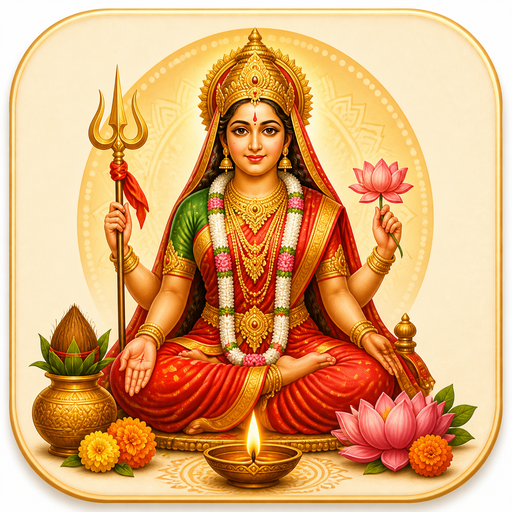
This year's dates (2026)
- Sunday; Ghatasthapana, Sharadiya Navratra begins — the panchang explicitly tags 'Mahur' on this day11 Oct
- Monday; Durgashtami — a general Navratra day, no Mahur-specific entry19 Oct
- Tuesday; Vijayadashami, Dussehra — Mahur's main annual yatra (corroborated by external sources)20 Oct
Deity & significance
Renuka — daughter of King Renu (some sources also call her the daughter of "Bhagavati"); married to Rishi Jamadagni; five sons (among them Parashuram, Vishnu's sixth incarnation) and one daughter (Anjana).
Shaktipeeth status: Mahur's Renuka is one of Maharashtra's three-and-a-half Shaktipeeths, a Purna Peeth — along with Kolhapur's Mahalakshmi and Tuljapur's Bhavani; Saptashrungi (Vani) is regarded as the Ardha Peeth.
Form of the goddess: some sources regard Renuka as a manifest form of Mahakali or Adishakti Parvati, while others address her directly as Jagadamba (mother of the whole world).
Name resemblance: some traditions and sources also know Renuka by the names Ekvira, Yamai, Yelluai, and Yellamma — mainly as a devi-form within South Indian and inter-regional devotional traditions. But these names belong to Karla's Ekvira, Aundh's Yamai, and Saundatti's Yellamma — temples that are geographically and administratively entirely separate from Mahur, and should not be conflated with it.
Mahur is also believed by devotees to be Dattatreya's birthplace — Atri Rishi and Anasuya Mata are believed to have lived here — making this site simultaneously a centre of both the Shakti and Datta worship traditions. (The claim to being Dattatreya's birthplace may differ by tradition at other sites too.)
History & legend (sthala-purana)
The underlying story appears in the Mahabharata, the Harivansha, and the Bhagavata Purana — this original Puranic story is in the public domain. By tradition, this story is told in different versions — details vary by source.
Renuka was an extremely devoted and austere wife of Rishi Jamadagni — her tapah-power was such that she could carry water from the river even in an unbaked clay pot, so the story goes. One day, seeing a gandharva king (Chitraratha) at the river, she was momentarily distracted in her mind — her tapah-power wavered, and the pot broke. Rishi Jamadagni intuitively knew of this; enraged, he ordered his sons to kill their mother. The other sons refused; Parashuram, however, accepted his father's command without question and beheaded his mother. Most sources describe Parashuram as the youngest son, while one Mahur-focused katha source describes him as the eldest — sources differ on this detail. Pleased by this obedience, Jamadagni offered Parashuram a boon — Parashuram asked for the revival of his mother and brothers, and she came back to life.
Afterward, King Sahasrarjuna/Kartavirya Arjuna is said to have seized Jamadagni's Kamadhenu and killed him — in revenge, Parashuram is believed to have annihilated the Kshatriyas twenty-one times over. This is a separate, later episode — its details are given on the Parashuram Jayanti page; it's mentioned here only for context.
Two different versions exist for why Mahur specifically is special — neither is treated as settled:
- By most sources: a divine voice (akashvani) told Parashuram, "Your mother will rise again from the earth to give you darshan, but do not look back." Out of curiosity, he looked back — and saw only Renuka's face rise from the earth. This is why only her face is worshipped here, and this place came to be called "Matapur" or "Matripura" (the mother's city), which is believed to have corrupted over time into "Mahur."
- By one, comparatively less-corroborated source: after Sahasrarjuna killed Jamadagni, Parashuram is said to have performed his father's last rites at Mahur's local "Ganga" tirtha, and installed the goddess's idol on this same hill in his mother's memory.
Which version is authoritative should be confirmed with the temple committee.
The present temple is said by most sources to have been built by a Yadava king of Devagiri approximately 800-900 years ago (roughly the 12th-13th century); the specific king's name, however, is not recorded anywhere.
Mahur's second hill is Datta Shikhar — Atri Rishi and Sati Anasuya are believed to have lived here, and devotees firmly believe Dattatreya was born here; the third hill is the Atri-Anasuya Shikhar. A 12th-century Datta devotee, Changdev Raul, is also recorded as having had a vision of Datta here (based on a single source).
Architecture & layout
The goddess's idol is in mukhavata (face-only) form — the full body is believed to lie underground. Two references give it as approximately 5 feet tall and 4 feet wide, though both may trace back to a single original source.
The idol is adorned with a silver crown or helmet, gold ornaments, and a pitambar/shalu.
Temple layout: divided into a sanctum and a sabha-mandap; the mandap has stone pillars and arches, the sanctum is cave-like, and one source notes a silver-covered entrance gate — this detail comes from a single source, with no independent corroboration. The same source also notes that the temple is not purely Hemadpanthi in style.
Trikuta structure: three peaks on one hill cluster — the Renuka temple, Datta Shikhar (the tallest, home to a full idol of Dattatreya — unlike many other Datta kshetras, which have only padukas; this is one of Mahur's distinctive features), and the Atri-Anasuya Shikhar.
About 200-250 steps lead up the hill to the temple; a doli or palanquin service is noted as available for those who cannot walk.
Festivals & yatra
The dates below are based on the panchang. Only 11 October carries an explicit "Mahur" entry in the panchang; the remaining Navratra tithis are general — though Mahur's own big yatra is independently corroborated by external sources as falling precisely within this same Navratra-Dussehra period.
| Festival | Tithi | 2026 date | In brief |
|---|---|---|---|
| Ghatasthapana, Navratrotsav begins (Mahur) | Ashwin Shukla Pratipada | 11 October (Sunday) | The panchang carries an explicit "Mahur" entry. For the general meaning, see Navratri. |
| Durgashtami | Ashwin Shukla Ashtami | 19 October (Monday) | A general Navratra day; no Mahur-specific entry. For the general meaning, see Durgashtami. |
| Vijayadashami, Dussehra — Mahur's main annual yatra | Ashwin Shukla Navami | 20 October (Tuesday) | Tithi from the panchang; the claim that this is "Mahur's biggest yatra of the year" comes from two independent external sources. For the general meaning, see Dussehra. |
| Chaitra Navratra (a Mahur festival) | Chaitra Shukla Pratipada to Navami | No date — no Mahur entry found in the panchang | External sources describe this festival, but the panchang carries no Mahur-specific entry for it. For general reference, see Chaitra Navratra. |
| Renuka Jayanti | Vaishakh Shukla Tritiya (claimed) | A date cannot be given | This claim rests on a single source, and coincidentally falls on the same tithi as Parashuram Jayanti — not treated as settled. |
Darshan & aarti timings
Timings vary across sources; one source (a Nanded district collector's notice) is from the COVID era (2021), so its pass/vaccination/age-limit rules should not be assumed to apply today.
- General darshan: most sources give 6 AM to 10 PM.
- Special Navratra timings (per one old district collector's notice, possibly specific to that year only): 5 AM to 10 PM.
- An online darshan-pass facility is available through one website — recorded as a channel recognised by the Nanded district administration, though the website itself couldn't be directly verified.
- No solid, independently corroborated detail on aarti timings was found — confirm with the temple committee or the district administration's official schedule for that year.
Multiple websites describe the temple's management, but none is confirmed as the official trust — for passes and timings, check the district administration's notice for that year.
Special rituals here
Navratra worship: nine days of special puja from Ghatasthapana; one source mentions a Saptashati- or Navchandi-type yagna — this is a single-source detail.
Vijayadashami-Dussehra: a palanquin procession for the goddess and a Simollanghan-type ritual (distributing Apta leaves) are mentioned in one source — not independently corroborated.
Tambul-vida specialty: one source mentions a local betel-leaf preparation (a mix of catechu, betel nut, lime, and nutmeg) from the Mahur area as a local specialty, with an effort underway to obtain a GI tag.
The exact sequence of daily puja, abhishek, and alankara, and their schedule, should be confirmed with the temple committee — an authoritative sequence wasn't found in this research.
Mantra & aarti
The most familiar bija mantra of devi worship — "Om Renukayai Namah" — meaning: salutations to the goddess Renuka. No separate Mahur-specific stotra or full aarti text is given here; for a general devi aarti, see Navratri Aarti.
How to reach
By road: state transport buses are available from Nagpur, Amravati, Akola, Nanded, Kinwat, Yavatmal, and Pusad; about 4 km from the Mahur bus stand to the temple, followed by steps.
By rail: the nearest station is Kinwat, about 50 km away (consistent across three sources); the major station is Nanded (South Central Railway).
By air: Nanded airport — sources give distances ranging from 100 to 130 km.
Approximate route from Mumbai: via Ahmednagar, Paithan, Jalna, Washim, and Pusad, about 717 km (single source).
Nearby places
- Datta Shikhar (the Dattatreya temple, with a full idol) and the Atri-Anasuya Shikhar (the Anasuya Mata temple) — the remaining two peaks of the same trikuta hill.
- The Parashuram temple and kund, the Jamadagni temple, the Mahakali temple, and the Devdeveshwar temple (a Shiv temple, believed to be Dattatreya's "resting place") — all in the same area.
- Mahurgad Fort (12th century) — the Hathi Darwaja gate, palace ruins; of Bahamani and Berar-era historical significance.
- Pandav Leni (ancient caves), Sarvatirth, and Matritirth (a lake, believed to be a cremation site) — single-source details.
- Narsobawadi (a Datta kshetra, Kolhapur district), Tuljapur Bhavani, and Saptashrungi — sibling sites within the three-and-a-half Shaktipeeth family (geographically distant, but a thematic connection).
Travel tips (good to know)
- Expect huge crowds during Navratra and the Dussehra yatra — plan ahead; crowd-management and pass arrangements are set annually by the district administration and temple committee — check that year's official notice before travelling.
- About 200-250 steps lead up the hill — senior citizens and those with physical limitations should inquire about the doli/palanquin service in advance.
- October to March is noted by one source as a relatively pleasant weather window — during the monsoon (heaviest rain in July-August), the hill path can be slippery, so take care.
FAQ
- Who is Renuka Devi of Mahur?
- The wife of Rishi Jamadagni and mother of Parashuram; one of Maharashtra's three-and-a-half Shaktipeeths, a Purna Peeth, is located here.
- Why did Parashuram behead Renuka Devi?
- By legend, on his father's command — Jamadagni, enraged, ordered it; Parashuram later asked for a boon to revive his mother. The details of the story vary by version.
- Why is Mahur considered Dattatreya's birthplace?
- Devotees believe Atri Rishi and Sati Anasuya lived here, and that Dattatreya was born here; the same hill holds Datta Shikhar and the Anasuya Shikhar. (Other traditions may hold different beliefs.)
- How do I reach Mahur? What's the nearest railway station?
- By road, state transport buses from Nanded, Nagpur, Amravati, and Kinwat; by rail, Kinwat (about 50 km) is the nearest station; by air, Nanded airport (about 100-130 km, sources vary).
- What are Maharashtra's three-and-a-half Shaktipeeths?
- Kolhapur (Mahalakshmi), Tuljapur (Bhavani), and Mahur (Renuka) are the full peeths; Saptashrungi (Vani) is regarded as the half peeth.
- Is Mahur's Renuka the same goddess as Saundatti's Yellamma?
- Many traditions regard Renuka and Yellamma as two forms/names of the same goddess, but Mahur (Maharashtra) and Saundatti (Karnataka) are two separate, independent temples — Mahur has only a face-form idol, while Saundatti has a full idol. The two shouldn't be confused as one.
- What are the darshan timings at the Mahur temple?
- Generally 6 AM to 10 PM; timings can change during Navratra — confirm with that year's official notice.
Related Info
 Navratri11 Oct
 Navratri Aarti — Ashwinshuddhapakshi Amba
- Chaitra Navratri (Vasant Navratri)19 Mar
 Dussehra / Vijayadashami20 Oct
- Durgashtami26 Jan
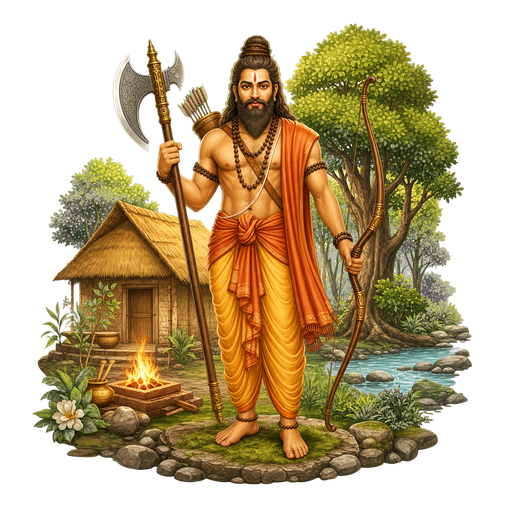 Parshuram Jayanti19 Apr
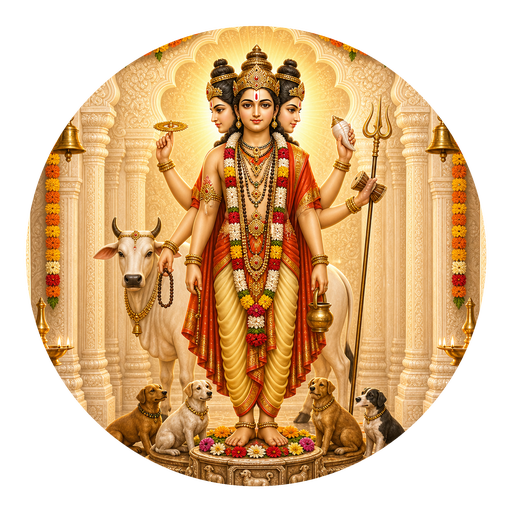 Datta Jayanti (Shri Dattatreya Jayanti)23 Dec
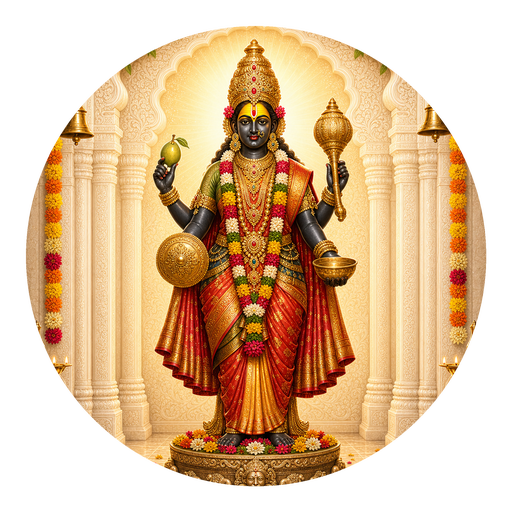 Kolhapur Mahalakshmi (Ambabai)11 Oct
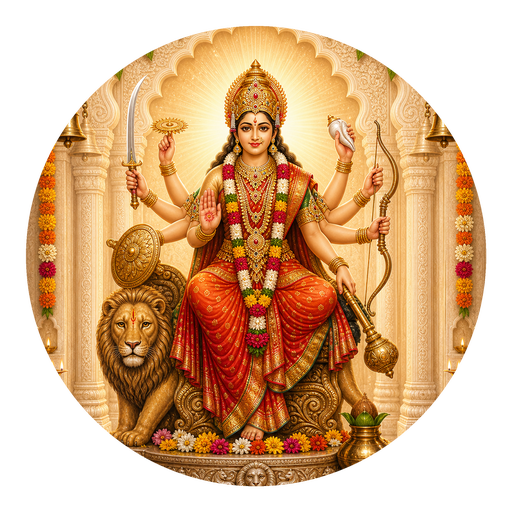 Tuljapur — Tuljabhavani3 Jan
 Saptashrungi Devi Temple, Vani26 Mar
- Narsobawadi (Narsobachi Wadi) Datta Temple29 Jul
 Ekvira Devi — Karla, Lonavala25 Mar