Saptashrungi Devi Temple, Vani
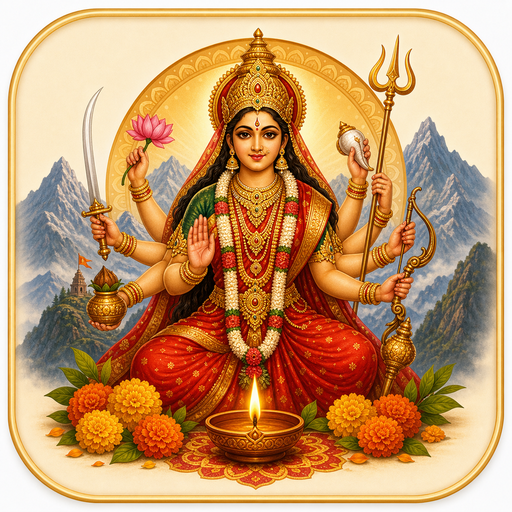
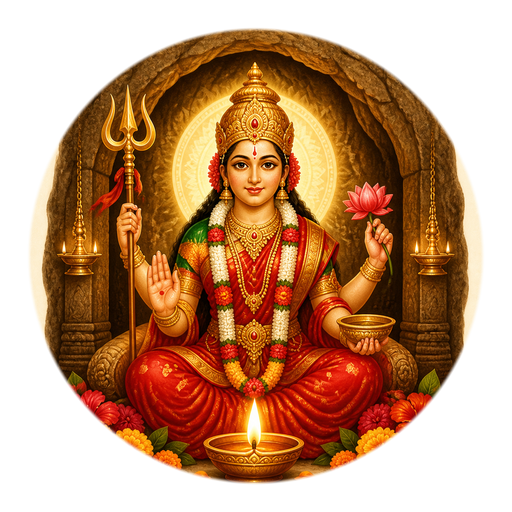
Saptashrungi Gad is a Devi shrine on a hill ringed by seven Sahyadri peaks, near the Vani/Nanduri villages in Kalwan taluka, Nashik district — one of Maharashtra's saade teen (three-and-a-half) Shaktipeeths (traditionally called the "ardha," or half, peeth, though the temple trust's own position holds it to be a full/adi Shaktipeeth — see below). The deity's idol is swayambhu, about 8 feet tall, with 18 arms — carved into a natural cave in the cliff-face and covered in sindoor. The main festival is Chaitrotsav, beginning on Ram Navami and reaching its peak on Chaitra Purnima, when lakhs of devotees raise a giant gudhi/flag atop the hill at midnight on the final day. In 2026, Chaitra Purnima/the yatra falls on 2 April. The Sharadiya Navratri festival also begins on Ghatasthapana day itself (11 October in 2026). About 500 steps (472 by some sources) or a ropeway lead up the hill.
This year's dates (2026)
- Chaitrotsav begins — the general Ram Navami date; the panchang carries no Vani-specific tag, but external sources say the Chaitrotsav starts here26 Mar
- Saptashrungidevi Yatra - Nanduri — the panchang directly tags this day; the culmination/main yatra day of Chaitrotsav2 Apr
- Saptashrungi Navratrotsav Prarambh - Saptashrunggad — the panchang directly tags this day; Ghatasthapana/the start of Sharadiya Navratri11 Oct
- Lalita Panchami — a general Navratri-pillar date; the panchang carries no Vani-specific tag15 Oct
- Durgashtami — a general Navratri-pillar date; the panchang carries no Vani-specific tag19 Oct
- Vijayadashami/Dussehra — a general Navratri-pillar date; the panchang carries no Vani-specific tag20 Oct
- Kojagiri Purnima — the panchang carries no Vani-specific tag; external sources say it is also observed at the fort25 Oct
Deity and significance
Form: Saptashrungi Devi is traditionally regarded as the combined form of Mahalakshmi (Kolhapur), Mahasaraswati (Tuljapur), and Mahakali (Mahur) — as well as an 18-arm Mahishasuramardini, each hand holding a different weapon gifted by Brahma, Vishnu, Mahesh, and other deities.
Place among the saade teen Shaktipeeths: in Maharashtra's folk tradition and the saade teen Shaktipeeth grouping, Saptashrungi is regarded as the "ardha" (half) peeth (Kolhapur, Tuljapur, and Mahur together making the full peeth, with Saptashrungi as the half). However, the official Shree Saptashrung Nivasini Devi Trust's own website holds this to be a full/adi Shaktipeeth.
Per the broader pan-India tradition of the 51 Shaktipeeths, Sati's right arm is believed to have fallen at this very spot.
Sage Markandeya and the Devi Mahatmya: on the hill opposite (Markandeya hill), sage Markandeya is believed to have performed tapasya and composed the Devi Mahatmya (Durga Saptashati) in this very area — a stretch still known by the name "Markandeya" today.
The hill area has several kundas (sacred pools) — per the Nashik district administration's official page, Kalikund, Suryakund, and Dattatreya Kund are the three prominent named ones; one source also mentions around 108 smaller kundas across the whole watershed area.
History and legend
The account below rests on sthal-purana and tradition — retold here in original words.
The devi is believed to have slain the demon Mahishasura, fighting with 18 arms bearing 18 weapons gifted by Brahma, Vishnu, Mahesh, and other deities. After the slaying, she is believed to have taken up residence on Saptashrungi Gad. A buffalo-shaped stone rock at the foot of the hill is regarded as a symbol of the slain Mahishasura.
Per the Shaktipeeth version, after Sati immolated herself in the sacrificial fire, a grief-stricken Shiva took up her body and began his tandava; Vishnu's chakra cut her body into pieces — her right arm is said to have fallen on Saptashrungi hill, establishing the Shaktipeeth here.
According to some traditions/texts, Lord Rama, Sita, and Lakshman once visited this hill area; while searching for the Sanjeevani herb for Lakshman, who had been struck unconscious by Indrajit's Shakti weapon, Hanuman is said to have carried off a portion of Mount Dronagiri — with one telling holding that this fragment is Saptashrungi itself. According to some traditions/texts, Chhatrapati Shivaji Maharaj also visited the devi here for darshan.
The roughly 500-step path up the hill is believed to have been built by Umabai Dabhade in 1710 CE. The Shree Saptashrung Nivasini Devi Trust was established in 1975. Between July and September 2022, as part of the idol's upkeep, around 2,000 kg of sindoor that had accumulated over the years was removed to reveal the idol's original swayambhu form, and a pranapratishtha ritual was held on 8 September 2022.
Architecture
Location and elevation: about 4,659 feet above sea level (some sources give an average peak elevation of around 4,500 feet) — a hill ringed by seven peaks, part of the Sahyadri range.
Temple structure: a two-storey temple built in front of a natural cave in the hillside; the cave itself is the sanctum — the garbhagriha is said to have three gates (Shaktidwar, Suryadwar, and Chandradwar), through which the devi's darshan is believed to take place.
Idol: carved in black stone, swayambhu, about 8 feet tall, with 18 arms (nine on each side); covered in sindoor; dressed in a fresh shalu/choli every day.
Access path: about 500 steps (472 by some sources) cut into the rock (1710 CE, Umabai Dabhade); a funicular ropeway has been available since 2018, with the ascent taking about 3 minutes.
Main festivals and yatra
Dates are taken from the panchang. Only Chaitra Purnima and Ghatasthapana carry a Saptashrungi/Vani-specific tag in the panchang — the remaining Navratri dates are general (the same dates apply to Kolhapur, Tuljapur, and Mahur too), and their observance at this hill rests only on external sources.
| Festival | Tithi | 2026 date | Note |
|---|---|---|---|
| Chaitrotsav begins (Ram Navami) | Chaitra Shukla Ashtami/Navami | 26 March | The general Ram Navami date; external sources say the Chaitrotsav begins here. See Ram Navami for the full story. |
| Chaitrotsav culmination/yatra (Chaitra Purnima) | Chaitra Shukla Purnima | 2 April | The panchang directly tags this as "Saptashrungidevi Yatra - Nanduri" — the hill's biggest yatra day, with lakhs of devotees. |
| Giant gudhi/flag-raising | Midnight on the eve of Chaitra Purnima | Night of 1 April/dawn of 2 April (approximate) | The exact clock time comes only from external sources, not the panchang — part of the yatra day above. |
| Gudi Padwa | Chaitra Shukla Pratipada | 19 March | External sources say it is also observed at the hill. See Gudi Padwa for more. |
| Sharadiya Navratri begins (Ghatasthapana) | Ashwin Shukla Pratipada | 11 October | The panchang directly tags this as "Saptashrungi Navratrotsav Prarambh - Saptashrunggad." See Navratri for the general context. |
| Lalita Panchami | Ashwin Shukla Panchami | 15 October | — |
| Durgashtami | Ashwin Shukla Ashtami | 19 October | — |
| Vijayadashami/Dussehra | Ashwin Shukla Navami | 20 October | — |
| Kojagiri Purnima | Ashwin Shukla Chaturdashi | 25 October | External sources say it is also observed at the hill. See Kojagiri Purnima for more. |
| Gokulashtami, Mahashivratri, Lakshmipujan | Various tithis | General dates available in the panchang | External sources say these are observed in a minor way at the hill. |
| Harihar Bhet | Tithi/date uncertain | Not found | Only a mention of the name is available; date/detail not available. |
Darshan and aarti timings
Timings from the official trust and one private information portal are nearly identical, differing only in the evening aarti time — confirm the current schedule with the official trust (ssndtonline.org) before treating any timing as final.
- Morning aarti (Kakad Aarti): 5:30 AM.
- Panchamrit mahapuja (abhishek and shringar): 7:00 to 9:00 AM.
- Mahanaivedya aarti: 12:00 PM.
- Evening aarti: 7:00 PM per the official trust; 6:00 PM per one private portal — confirm with the official trust where these differ.
- Mahaprasad: approximately 11:00 AM to 2:50 PM, and 7:00 to 9:30 PM.
Special rituals here
Chaitrotsav yatra: devotees from Khandesh (Dhule/Jalgaon/Nandurbar) and surrounding areas walk for four to eight days, carrying a flag/gudhi about 10 feet tall, and raise it atop the hill at midnight on the eve of Chaitra Purnima — the hill's biggest and most distinctive celebration.
Navas tradition: childless women are said to make vows (navas) to the devi during Chaitrotsav seeking children.
Special puja days: Tuesday, Friday, and the Ashtami-Navami-Chaturdashi tithis are considered especially important for puja.
The exact sequence and mantras for the daily abhishek/shringar and other special rituals should be confirmed with the temple trust — no standard, authoritative sequence is publicly documented.
How to reach
By road: from Nashik via State Highway 17 (connected to National Highway 3) — approximately 60-65 km (sources vary slightly).
By air: Ozar (Nashik) airport — about 24 km per one official source; some other sources give a much larger distance — verify before you travel. Mumbai International Airport is about 231 km.
By rail: Nashik Road railway station — approximately 70-75 km.
Locally: from the foothill villages of Vani/Nanduri, about 500 steps or the ropeway (funicular, about 3 minutes).
Nearby places
- Markandeya hill/fort — across the ravine, opposite the temple; believed to be connected to sage Markandeya's tapasya and the composition of the Devi Mahatmya.
- Dhodap Fort — the second-highest fort in the Sahyadris after Salher (about 1,472 metres), in the same hill range.
- Trimbakeshwar Jyotirlinga and Nashik city (Panchavati, the Kumbh Mela site) — part of the same Nashik-district pilgrimage circuit, but about 90 km away — best understood as a same-district circuit, not "nearby."
- The saade teen Shaktipeeth cluster (distant, but connected in narrative) — Kolhapur Mahalakshmi, Tuljapur Bhavani, Mahur Renuka.
Good to know before you go
- Expect enormous crowds during Chaitrotsav and Navratri — the climbing path is narrow and steep, with a history of accidents (e.g., a 2008 bus accident) — follow all safety instructions closely.
- The ropeway is a safer option for senior citizens and children; ticket prices and timings can change seasonally — check the official trust's website before you travel.
- Darshan queues, special-darshan passes, and accommodation (dharmashala/bhaktaniwas) can change per the temple trust's own announcements — verify before you travel.
FAQ
- Whose form is Saptashrungi Devi?
- She is traditionally regarded as the combined form of Mahalakshmi, Mahasaraswati, and Mahakali, and as an 18-arm Mahishasuramardini.
- Why is Saptashrungi called an "ardha" (half) Shaktipeeth?
- In the saade teen Shaktipeeth folk tradition, Saptashrungi is regarded as the half peeth, but the official temple trust itself holds it to be a full/adi Shaktipeeth — both views are current.
- What are the saade teen Shaktipeeths?
- Kolhapur Mahalakshmi, Tuljapur Bhavani, and Mahur Renuka (the full peeths), plus Saptashrungi Vani (the half, by tradition).
- How many steps are there at Saptashrungi Gad?
- About 500 (472 by some sources); believed to have been built by Umabai Dabhade in 1710 CE.
- Is there a ropeway at Saptashrungi Gad?
- Yes, since 2018; the ascent takes about 3 minutes. Ticket prices vary seasonally — check the official site before you travel.
- How many arms does the Saptashrungi Devi idol have, and why?
- Eighteen — each arm is believed to hold one of the 18 weapons gifted by various deities for the slaying of Mahishasura.
- When is the Saptashrungi Chaitrotsav?
- It begins on Ram Navami and reaches its peak on Chaitra Purnima; in 2026, Chaitra Purnima/the yatra falls on 2 April.
- How far is Vani from Nashik?
- About 60-65 km (sources vary slightly); it lies in Kalwan taluka.
Related Info
 Tuljapur — Tuljabhavani3 Jan
 Mahur — Renuka Mata11 Oct
 Kolhapur Mahalakshmi (Ambabai)11 Oct
 Trimbakeshwar14 Jan
 Navratri11 Oct
 Chaitra Navratri (Vasant Navratri)19 Mar
 Ram Navami26 Mar
 Gudi Padwa19 Mar
 Kojagiri Purnima (Sharad Purnima)25 Oct
 Gokulashtami / Krishna Janmashtami4 Sep
- Diwali / Lakshmi Pujan (Deepavali)6 Nov
 Maha Shivratri15 Feb
 Ekvira Devi — Karla, Lonavala25 Mar