Vajreshwari (Vajreshwari Yogini Devi)
Vajreshwari is a Devi shrine in Bhiwandi taluka, Thane district (some sources give "Palghar district" instead — see below), on the banks of the Tansa river. The original village was named Vadvali, later renamed Vajreshwari after the devi. It is about 75 km from Mumbai. Chimaji Appa, brother of Peshwa Bajirao I, is believed to have built this grand temple to fulfill a vow, after his victory over the Portuguese at Vasai fort (16 May 1739). The main yatra falls on Chaitra Krishna Amavasya — 17 April in 2026. Nearby, in the Ganeshpuri and Akloli area, are about 20 natural hot-water springs.
This year's dates (2026)
⚠️ Important note: the name "Vajreshwari" applies to at least four distinct shrines across India. This page covers only the Vajreshwari village in Bhiwandi taluka, Thane district (Chimaji Appa's temple, near Ganeshpuri) — it should not be confused with the sites at Ekrukhe (Ahmednagar district), Kangra (Himachal Pradesh, a Shaktipeeth), or Tambave (Solapur district).
Deity and significance
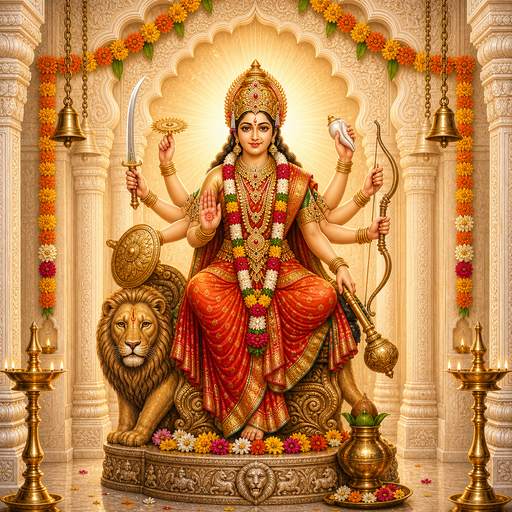
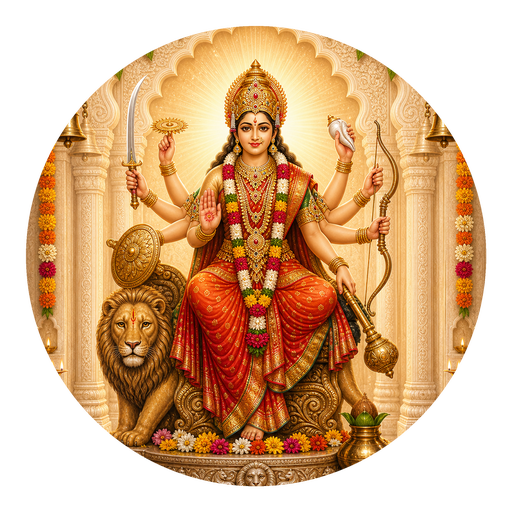
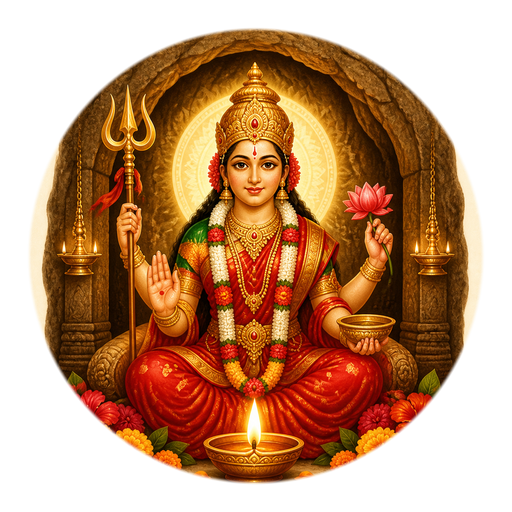
The devi Vajreshwari is also known as Vajrabai and Vajrayogini; she is regarded as a form of Parvati/Adi-Maya. The name is generally explained as meaning "she who holds/presides over the vajra" (Indra's thunderbolt weapon). The idol is saffron/sindoor-covered — holding a sword in the right hand and a mace in the left (one source also mentions a trishul).
A belief in an "awakened" shrine: devotees across the Mumbai-Thane region regard Vajreshwari as a jagrut (awakened) devi who fulfills vows — this is presented as a matter of belief, not an objective claim.
Vajreshwari is regarded, along with Mumbadevi and Mahalaxmi Mumbai, as one of the major Devi shrines of the Mumbai/Thane region. It is not, however, one of Maharashtra's saade teen Shaktipeeths (Kolhapur/Tuljapur/Mahur/Saptashringi) — it is a separate, independently significant Devi shrine.
The temple's management is known as "Shree Vajreshwari Yogini Devi," and hereditary trustees from the Giri Gosavi lineage are said in several places to oversee the temple. Verify current management, trustee details, and darshan timings locally before your visit.
A discrepancy in the idol list: besides Vajreshwari herself, the sanctum holds other subsidiary idols, but the exact list varies by source — most sources name Renuka, Saptashringi-Mahalakshmi, Kalika, and Parshuram, while the government Marathi Vishwakosh gives an entirely different list: Saraswati, Savitri, Lakshmi, and Bhargava, along with Ganesh, Vetal, and Kalbhairav.
History and legend (sthal-purana)
The administrative district: most sources (the government Marathi Vishwakosh, the Maharashtra Tourism Development Corporation) place Vajreshwari in Thane district, Bhiwandi taluka; some sources (including English Wikipedia) instead say "Palghar district." Bhiwandi taluka is recorded as having remained part of Thane district even after the 2014 Palghar split, so the "Thane district" claim appears more consistent.
The legend (a common core, with some details varying by version): sages in the Vadvali area were troubled by a demon (the name varies by source). The sage Vashishtha performed a yajna for protection. In this episode, Indra's vajra (weapon) proved decisive — most versions hold that Parvati/the devi absorbed the vajra into herself (swallowed it) and thereby slew the demon (one version reverses this — the devi is said to have manifested from the vajra itself). This act is believed to have given her the name "Vajreshwari" (the one who presides over the vajra). Some sources add that, at Lord Ram's request, the devi made Vajreshwari (Vadvali) her permanent residence — this detail has not been independently verified.
The historical founding (comparatively better established): the original temple stood at Gunj (about 8 km north of Vadvali); after the Portuguese destroyed it, it was relocated to Vadvali. Chimaji Appa, brother and general of Peshwa Bajirao I, is said to have made a vow to the devi while setting out on the Vasai campaign against the Portuguese; after conquering Vasai fort on 16 May 1739, he ordered the subedar, Shankar Keshav Phadke, to build a grand temple in celebration and fulfillment of his vow. The Nagarkhana is said to have been built by the Gaikwads, and the steps/tower by Nashik's financier Nanasaheb Chandavadkar. Most independent sources give the founding year as 1739; one or two secondary sources mention 1734/1737, but since these are inconsistent, 1739 is used here. The Giri Gosavi sect are said to have been the temple's hereditary trustees since 1739.
Architecture
The temple stands on a hill by the Tansa river (the hill's name varies slightly by source — "Mandagiri," "Mangalgiri," or "Mandakini"), facing east, with fort-like walls.
A Nagarkhana stands at the entrance, said to be modeled on Vasai fort. One source also mentions a 60-foot lighthouse-like tower.
52 stone steps lead to the main sanctum; one step is carved with a golden tortoise (Kurma). Most sources describe the sanctum as consisting of an assembly hall and one or two inner chambers.
The hill is believed to have formed through volcanic activity — the same geological origin said to explain the area's natural hot springs.
Main festivals and yatra
Dates are taken from the panchang — only the Chaitra Amavasya yatra carries a Vajreshwari-specific tag in the panchang; other traditional festivals are said to be observed here too, per external sources, but since the panchang carries no Vajreshwari-specific entry for them, their exact 2026 date is not given here — only a link to the relevant festival page.
| Festival | Tithi | 2026 date | Note |
|---|---|---|---|
| Chaitra Amavasya Yatra (the main fair) | Chaitra Krishna Amavasya | 17 April (Friday) | The year's biggest yatra; one source states it begins with a formal puja from Krishna Chaturdashi. |
| Navratri (Chaitra) | Chaitra Shukla Pratipada to Ram Navami | No Vajreshwari tag in the panchang | External sources say Chaitra Navratri is also observed here. See Chaitra Navratri for more. |
| Navratri (Sharadiya) | Ashwin Shukla Pratipada to Vijayadashami | No Vajreshwari tag in the panchang | See Navratri for more. |
| Kojagiri Purnima | Ashwin Shukla Purnima | No Vajreshwari tag in the panchang | Traditionally observed. See Kojagiri Purnima for more. |
| Shravan Shiv-puja | Throughout the month of Shravan | No specific date applies | Shiva worship is said to hold special significance here through Shravan. |
| Datta Jayanti, Hanuman Jayanti, Holi, Diwali | Various tithis | No Vajreshwari tag in the panchang | Traditional festivals, also observed here. See Datta Jayanti, Hanuman Jayanti, Holika Dahan, and Diwali for more. |
Darshan and aarti timings
The timings below rest on a single type of secondary source — they could not be independently verified on the temple trust's own website. Treat them as a rough framework, not exact timings — verify with the temple committee or local inquiry before you travel.
Darshan: generally daily from about 5:00 AM to 9:00 PM. Aarti: 5:00 AM, 11:15 AM, and 8:15 PM. One source notes especially large crowds every Tuesday.
Special rituals here
Chaitra Amavasya yatra rituals: one source states the yatra begins with a formal puja from Krishna Chaturdashi — a detailed sequence was not found.
Bathing in the hot springs: devotees often combine their darshan with a bath in the nearby (Akloli/Ganeshpuri) hot-water springs — a belief holds these waters help with skin conditions and arthritis; this is presented here as tradition/belief, not a medical claim.
The exact sequence of daily abhishek, adornment, and other special rituals, along with associated mantras, isn't publicly documented — verify with the temple trust.
How to reach
Location: Bhiwandi taluka, Thane district (some sources say Palghar), on the banks of the Tansa river.
By road: about 1 to 1.5 hours from the Mumbai-Thane region; connected by a road linking to the national highway, with regular buses from Thane and Vasai.
By rail: the nearest station varies by source — Virar (Western Railway, about 27.5 km) or Khadavli (Central Railway, about 31 km); one source gives about 30-31 km from Vasai Road station; and about 34-42 km from Thane station — check a live map or current train schedule before you travel.
By air: Mumbai International Airport, approximately 75 km away.
Nearby places
- Ganeshpuri — close to the Vajreshwari temple (about 1-2 km away); the hub of the area known for its hot-water springs.
- Akloli Kund — within Vajreshwari village itself, about 1 km from Ganeshpuri; about 10 hot springs on the left bank of the Tansa river (temperatures around 45-48°C), with sulphur-calcium-magnesium-rich water — believed to help with skin conditions and arthritis, by local tradition.
- Nityanand Mandir (Ganeshpuri Ashram) — the samadhi shrine of Swami Nityanand (from around the 1960s), about 2 km from Akloli Kund; a spiritual center associated with Swami Muktananda and the Siddha Yoga tradition — an entirely separate worship tradition from the Vajreshwari Devi temple, noted here only for its geographic proximity.
- Vasai Fort — historically linked to this temple's founding (Chimaji Appa's victory), though the actual distance is significant — mentioned here as a narratively connected site, not a "nearby" one.
Good to know before you go
- The date given here comes only from the panchang — the Chaitra Amavasya yatra falls on 17 April in 2026; if a web source shows a different Gregorian date, it may be referring to a different year's panchang.
- Expect special crowds during the Chaitra Amavasya yatra, Navratri, and on Tuesdays, per several sources — plan travel and accommodation in advance.
- Take care around the hot springs: the water runs fairly hot — extra caution is advisable for small children and senior citizens.
- Avoid the name mix-up: this is the Vajreshwari near Mumbai/Thane — the similarly-named shrines at Kangra (Himachal Pradesh), Tambave (Solapur), and Ekrukhe (Ahmednagar) are different places.
FAQ
- Where exactly is the Vajreshwari Devi temple?
- In Bhiwandi taluka, Thane district, on the banks of the Tansa river, about 75 km from Mumbai (some sources give the district as "Palghar" instead — verification needed).
- Why is the devi called Vajreshwari?
- Legend holds that she absorbed Indra's vajra (weapon) into herself and used it to slay a demon, giving her the name "Vajreshwari" — versions of this story vary in detail.
- What is the connection between the Vajreshwari temple and Chimaji Appa?
- Chimaji Appa is believed to have built this grand temple to fulfill a vow after his victory over the Portuguese at Vasai fort (16 May 1739).
- How far is Vajreshwari from Mumbai/Thane, and how do I reach it?
- About 75 km from Mumbai; the nearest railway station is Virar, Khadavli, or Vasai Road, depending on the source (distances vary, roughly 27-31 km).
- What is the connection between Vajreshwari and the Ganeshpuri hot springs?
- The Ganeshpuri/Akloli area is 1-2 km from the Vajreshwari temple, and holds about 10-20 natural hot springs.
- What are the darshan and aarti timings at the Vajreshwari temple?
- Roughly 5:00 AM to 9:00 PM for darshan, with aartis at 5:00 AM, 11:15 AM, and 8:15 PM — but confirm the exact timing with the temple committee.
- When is Vajreshwari's main yatra/fair?
- On Chaitra Krishna Amavasya; 17 April in 2026.
- Is Vajreshwari a Shaktipeeth?
- No source found calls Vajreshwari a formal (saade teen or 51) Shaktipeeth — it is an independent, regionally significant Devi shrine.
- Are Vajreshwari (Thane) and the Vajreshwari/Brajeshwari Devi at Kangra the same?
- No, they are entirely separate sites and traditions; the temple at Kangra (Himachal Pradesh) is a recognized Shaktipeeth.
- Which idols are in the Vajreshwari temple's sanctum?
- Besides Vajreshwari, the sanctum holds subsidiary idols, but the exact list varies by source — Renuka, Saptashringi-Mahalakshmi, Kalika, and Parshuram in some sources, versus Saraswati, Savitri, Lakshmi, and Bhargava plus Ganesh, Vetal, and Kalbhairav in others.
Related Info
 Navratri11 Oct
 Chaitra Navratri (Vasant Navratri)19 Mar
 Kojagiri Purnima (Sharad Purnima)25 Oct
 Datta Jayanti (Shri Dattatreya Jayanti)23 Dec
 Hanuman Jayanti2 Apr
 Holika Dahan / Holi2 Mar
- Diwali / Lakshmi Pujan (Deepavali)6 Nov
 Kolhapur Mahalakshmi (Ambabai)11 Oct
 Tuljapur — Tuljabhavani3 Jan
- Mahalakshmi Temple, Mumbai19 Mar
 Ekvira Devi — Karla, Lonavala25 Mar