Alandi Sant Dnyaneshwar Samadhi Mandir
Alandi (Pune district, on the Indrayani riverbank) is the Sanjeevan Samadhi site of Sant Dnyaneshwar Maharaj, the founding figure of the Warkari tradition — in 1296 CE, at the age of just 21, he took samadhi here. The Samadhi Temple stands within the grounds of the ancient Siddheshwar Shiv temple, and its signature feature is the Ajanvriksha — a tree believed to have grown from the staff he planted before taking samadhi. Every year, the Ashadhi Wari palkhi departs from this same Alandi towards Pandharpur (8 July in 2026), and the Sanjeevan Samadhi Sohala is observed in the month of Kartik (main day: Trayodashi). Dnyaneshwar Maharaj is regarded as the founding figure of Marathi devotional literature and the Warkari tradition because of the Dnyaneshwari — his verse commentary on the Bhagavad Gita, composed at Nevase around age 16. Below is his life story, the samadhi temple's history, its festivals, darshan timings, and travel details.
This year's dates (2026)
- Ashadhi Wari — palkhi prasthan (Alandi)8 Jul
- Kartiki yatra begins (Utpatti Ekadashi)4 Dec
- Sanjeevan Samadhi Sohala — the main day6 Dec
Deity & significance
Sant Dnyaneshwar Maharaj's Sanjeevan Samadhi is Alandi's principal object of worship — in the Warkari tradition he is reverently called "Mauli"; devotees believe he continues to reside there in a living, conscious form even after taking samadhi.
Within the same samadhi complex stands the ancient Siddheshwar Mahadev temple (a shivpindi) — this Shiv shrine predates Dnyaneshwar's samadhi, and the samadhi itself is believed to have been taken within this very complex.
The foundation of the Warkari tradition is believed to have been laid at Alandi itself — through the four sant siblings Nivruttinath, Dnyanadev, Sopandev, and Muktabai, and later through the line of Namdev-Eknath-Tukaram. The saying popular in Warkari circles — "Dnyanadeve rachila paya, Tuka zalase kalas" ("Dnyanadev laid the foundation, Tuka became the pinnacle") — is told in this same context.
Details of significance and belief can vary by household and local tradition.
History & legend (sthala-purana)
This story is recorded in at least two independent traditional versions. This entire story is legend/devotional tradition, not established history.
Birth and family: Dnyaneshwar Maharaj was born around 1275 CE at Apegaon (near Paithan, on the Godavari riverbank). His father was Vitthalpant Kulkarni, his mother Rukmini Bai. Among the four siblings, Nivruttinath was the eldest (and later Dnyaneshwar's guru), followed by Dnyaneshwar, Sopandev, and the youngest, Muktabai. After marriage, Vitthalpant had gone to Kashi and taken sannyasa; when his guru learned the truth, he was ordered back to householder life — as a result, the family is said to have faced roughly twelve years of ostracism from Brahmin society.
The Paithan shuddhipatra legend: at a dharma-sabha in Paithan, the siblings faced various tests for their purification. A well-known legend recounts that Dnyaneshwar placed his hand on the head of a beaten water-buffalo and made it recite Vedic mantras; moved by this miracle, the Brahmins of Paithan are said to have issued a shuddhipatra around 1288 CE, readmitting the siblings into society.
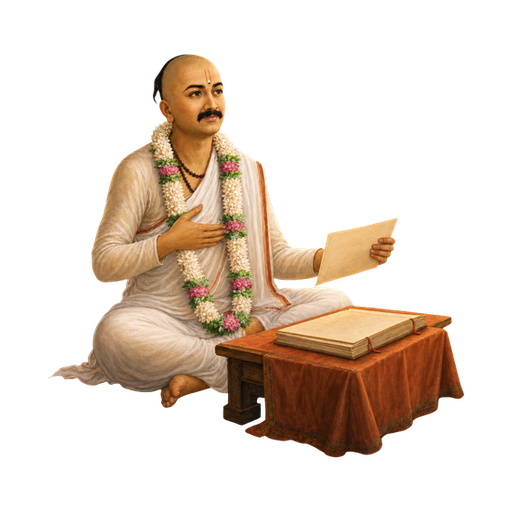
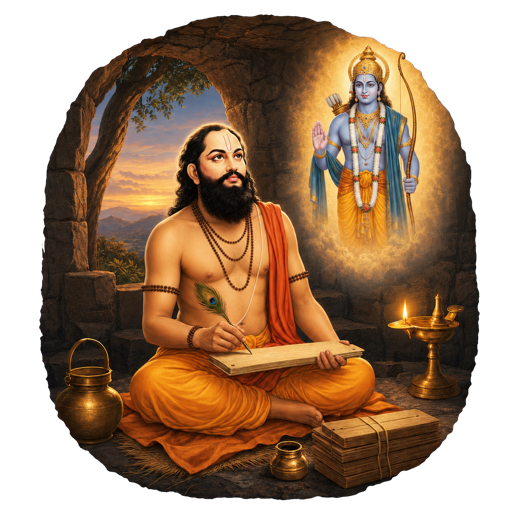
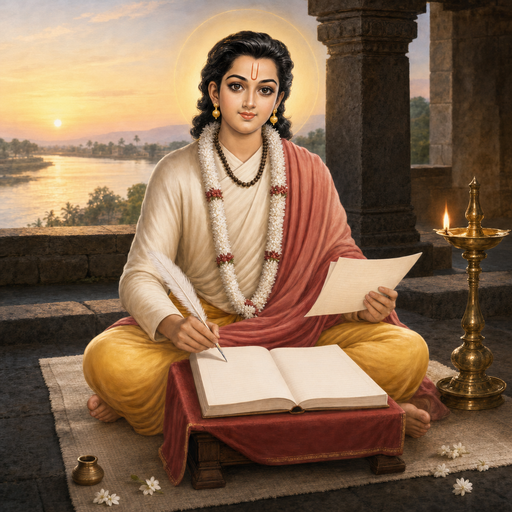
The Dnyaneshwari and other works: at Nevase (Ahmednagar district, on the Pravara riverbank), around age 15-16 (1290 CE), he composed a verse commentary in Marathi on the Bhagavad Gita — about 9,000 ovi verses across 18 chapters; Sacchidanand Baba is said to have been the scribe. After this, at the urging of his elder brother Nivruttinath, he composed the Amrutanubhav, an independent philosophical work. The Haripath is a collection of 28 abhangs celebrating the glory of chanting the divine name.
The Changdev Pasashti legend: the yogi Changdev — riding a tiger, holding a snake as a whip — came to Alandi to meet the Dnyaneshwar siblings; legend has it that the siblings made the very wall they were sitting on move to go and greet him. This encounter broke Changdev's pride, and he became a disciple; Dnyaneshwar composed the 65-verse "Changdev Pasashti" for him. Even today, "Dnyaneshwar's Wall" is shown to pilgrims a short distance from the Samadhi Temple in Alandi.
Sanjeevan Samadhi: in 1296 CE (Shaka 1218), on Kartik Krishna Trayodashi, at age 21, at Alandi on the Indrayani riverbank, within the grounds of the ancient Siddheshwar temple. The Ajanvriksha, believed to have grown from the staff he planted before taking samadhi, is said to still stand within the Samadhi Temple today. (By one tradition, roughly two hundred years later, Sant Eknath Maharaj — after a dream vision — is said to have travelled from Paithan, descended into the samadhi vault, and removed a root of the Ajanvriksha.)
Construction of the Samadhi Temple: in roughly the latter half of the 16th century (sources differ on the exact year), the Ambekar Deshpande family is believed to have built the temple over the samadhi. It was later expanded during the Maratha-Peshwa period; by one account, in 1778 Mahadji Shinde received the town from the Peshwa and patronised renovations for about two decades.
Architecture & layout
The Samadhi Temple stands on the bank of the Indrayani river; the complex includes the samadhi sanctum, the ancient Siddheshwar Shiv temple (a shivpindi), and the Ajanvriksha. The temple's silver mask (mukhavata) is carried in the palanquin during festival processions (the Nagar Pradakshina) — the procession begins from the Deulwada. In the town, a short distance from the Samadhi Temple, "Dnyaneshwar's Wall," associated with the Changdev legend, is shown to pilgrims as a site of pilgrimage. There are bathing ghats on the Indrayani riverbank as well.
Festivals & yatra
Alandi's own two most prominent annual occasions are the Ashadhi Wari palkhi departure and the Sanjeevan Samadhi Sohala in Kartik.
| Festival | Tithi | 2026 date | In brief |
|---|---|---|---|
| Ashadhi Wari — palkhi prasthan | Nija Jyeshtha Krishna Ashtami | 8 July (Revati nakshatra) | The Sansthan sends the palkhi off around 3-4 PM (sources vary slightly); it walks via Pune-Saswad-Jejuri-Wakhari, reaching Pandharpur around 24 July; Ashadhi Ekadashi is observed on 25 July. |
| Kartiki yatra begins | Kartik Krishna Ekadashi | 4 December (Hasta nakshatra) | The start of the Nagar Pradakshina and Indrayani bathing; recent years have recorded roughly five lakh devotees. |
| Sanjeevan Samadhi Sohala (main day) | Kartik Krishna Trayodashi | 6 December (Swati nakshatra) | The annual main observance of Dnyaneshwar Maharaj's samadhi; the silver mask is carried in the palanquin procession. |
Because 2026 has an Adhik Jyeshtha month (17 May to 15 June), the following Nija Jyeshtha month falls from 16 June to 14 July — which is why the palkhi-departure tithi is recorded this year in "Nija Jyeshtha" rather than "Ashadh." This name isn't an error; in a year without an Adhik masa, this same month name would be "Ashadh." All yatra dates and schedules should be confirmed with the Sansthan — the programme can change.
Darshan & aarti timings
The detailed schedule from the official Sansthan website is given priority below; other sources also quote a simpler "6 AM to 9 PM" figure. Timings can change — especially on Ramnavami, Krishnashtami, Narsimha Jayanti, Mahashivratri, and every Ekadashi, when a different schedule applies; confirm with the Sansthan before an actual visit.
- Kakad aarti: 4:00-4:15 AM.
- Pavaman puja and dugdhabhishek: 4:15-5:30 AM.
- Open for darshan: 5:30 AM-12:30 PM.
- Mahimna puja: 6:00-7:00 AM.
- Mahanaivedya (darshan closed): 12:30-1:00 PM.
- Poshakh (vastralankar): 3:00-3:30 PM.
- Evening bells: 7:00-7:30 PM.
- Dhoop-aarti: 8:00-9:00 PM.
One government-tourism reference gives "Kakad at 4 AM to Shej at 11 PM" instead. Entry is free.
Special rituals here
- Indrayani snan: the custom of bathing/purifying in the river before darshan.
- Mukhavata procession: during the Kartiki Sohala, Dnyaneshwar Maharaj's silver mask is carried in the palanquin for the Nagar Pradakshina, starting from the Deulwada.
- Special-day schedule changes: the main puja is suspended on Ramnavami, Krishnashtami, Narsimha Jayanti, Mahashivratri, and every Ekadashi.
Fasting/vrat details observed between Ashadhi and Kartiki are covered on the Ashadhi Ekadashi page — not repeated here.
How to reach
Location: Alandi (Alandi Devachi), Khed taluka, Pune district; on the Indrayani riverbank.
Distance from Pune: about 19-25 km (sources vary — about 19 km from the railway station, about 25 km from Swargate; roughly a 40-45 minute drive via Wadgaon).
Airport: Pune airport, about 16-25 km away (sources vary).
By road/bus: the Pune-Alandi road; PMPML and MSRTC buses run regularly.
Proximity to Dehu: Sant Tukaram Maharaj's Dehu is close to Alandi, and a combined "Dehu-Alandi" darshan trip is popular.
Nearby places
- The Siddheshwar temple and the Ajanvriksha — within the samadhi complex itself.
- Dnyaneshwar's Wall — associated with the Changdev legend, a short distance from the Samadhi Temple.
- The Muktabai temple — within Alandi town; said to house black-stone images of all four Dnyaneshwar siblings.
- Dehu — the Sant Tukaram Maharaj temple, nearby (a popular combined circuit).
- Sopandev's samadhi, Saswad — a major halt on the palkhi route; the younger brother Sopandev's samadhi is said to be here.
- Nivruttinath's samadhi, Trimbakeshwar — the samadhi of the eldest brother and guru, Nivruttinath; far from Alandi, in a different direction.
Travel tips (good to know)
- Expect extremely large crowds during yatra periods (the palkhi departure and the Kartiki Sohala) — Pune traffic police announce temporary diversions along the palkhi route (Dive Ghat, Saswad, Bopdev Ghat, Lonand, the Pune highway) — in 2026, recorded for 11-18 July — check local traffic advisories before travelling.
- Darshan is free; confirm details of any special queue/pass arrangement with the Sansthan.
- Visiting Dehu together is convenient given the short distance — one-day Pune-Dehu-Alandi trips are popular.
Mantra & aarti
Dnyaneshwar Maharaj's aarti — "Aarti Dnyanraja" (traditionally credited to Ramjanardani) — is sung after samadhi darshan and daily in the Warkari tradition; it praises Dnyaneshwar as radiant with supreme liberation (mahakaivalya) and an incarnation of Panduranga.
FAQ
- Why is Dnyaneshwar Maharaj's samadhi at Alandi?
- Sant Dnyaneshwar Maharaj took Sanjeevan Samadhi here in 1296 CE at the age of 21, on the Indrayani riverbank within the Siddheshwar temple complex — which is why Alandi is regarded as his samadhi site.
- What are the darshan timings at Alandi?
- Per the official Sansthan, from Kakad aarti at dawn (4:00 AM) to Dhoop-aarti at night (9:00 PM), with darshan closed during Mahanaivedya/Poshakh; confirm timings with the Sansthan.
- When did Sant Dnyaneshwar Maharaj take samadhi?
- In 1296 CE (Shaka 1218), on Kartik Krishna Trayodashi, at the age of 21.
- When does the palkhi depart from Alandi?
- Every year on Jyeshtha/Ashadh Krishna Ashtami (8 July in 2026); the palkhi travels on foot, reaching Pandharpur around 24 July, with Ashadhi Ekadashi observed on 25 July.
- How do I reach Alandi from Pune?
- About 19-25 km from Pune; reachable by road or PMPML bus in 40-45 minutes.
- What is the Ajanvriksha?
- A tree believed to have grown from the staff Dnyaneshwar Maharaj planted before taking Sanjeevan Samadhi — an object of devotion within the Samadhi Temple.
- What is the difference between Alandi and Dehu?
- Alandi is the samadhi site of Sant Dnyaneshwar Maharaj, while Dehu is that of Sant Tukaram Maharaj — the two are close to each other, and both Ashadhi Wari palkhis depart from these same two towns.
- What is the Dnyaneshwari?
- A verse commentary in Marathi on the Bhagavad Gita, composed by Dnyaneshwar Maharaj at Nevase around age 16 — regarded as one of the founding texts of Marathi devotional literature.