Shirdi Sai Baba
Sai Baba (c. ?–15 October 1918) was a sant/sadguru who resided in Shirdi (Ahilyanagar district, formerly Ahmednagar) for about 60 years — revered with equal faith by both Hindus and Muslims. He is believed to have come to Shirdi permanently around 1858, at roughly age 20. Nothing is known for certain about his birth date, birthplace, or parents. His teaching centered on "Shraddha" (faith) and "Saburi" (patience), and the universal principle behind his best-known saying, "Sabka Malik Ek" ("one God rules over all"). He gave the mosque he lived in a Hindu name, Dwarkamai. He died/took samadhi on 15 October 1918, which fell on Vijayadashami itself. Shirdi is known for darshan at the Samadhi Mandir and Dwarkamai, three major annual festivals (Ram Navami, Guru Purnima, and Vijayadashami/Punyatithi), its symbolism of Hindu-Muslim unity, and being among India's highest-footfall temples.
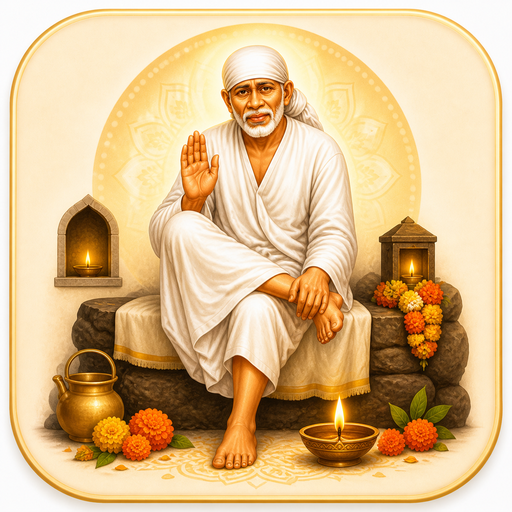
This year's dates (2026)
- Shri Ram Navami (with Urus) — per the Sai Baba Sansthan's own announcement, the 115th edition in 2026; the main day falls on a Thursday26 Mar
- Guru Purnima — a special festival honoring Sai Baba as sadguru; per the trust's announcement, held 28-30 July, with the main day on Wednesday29 Jul
- Vijayadashami/Dussehra = Sai Baba's Punyatithi (the samadhi day, 15 October 1918) — Shirdi's single biggest day of the year20 Oct
⚠️ Important note: Shirdi's Sai Baba (d. 1918) and Puttaparthi's (Andhra Pradesh) Sathya Sai Baba (1926-2011) are two entirely separate people and traditions. This page is only about Shirdi's Sai Baba.
Deity and significance
Sai Baba is not a traditional puranic deity — he is a historical sant/sadguru whom devotees regard as divine. Even during his lifetime (by the late 19th century), he had built a large following across both Hindu and Muslim communities.
A symbol of universal faith: he never confined himself to a single religion — he practiced and taught both Hindu and Islamic customs together, which is Shirdi's most distinctive feature.
The Dattatreya-avatar belief: some Hindu devotees, and followers of the Dattatreya tradition, regard Sai Baba as an avatar of Dattatreya; this belief is also mentioned in the Sai Satcharita. This is a devotional belief, not an objective historical fact.
British government records from around 1911-12 also describe him as a "sadhu, avatar, fakir" — meaning his popularity had already entered official records during his own lifetime.
Shirdi is regarded today as one of India's highest-footfall and highest-donation pilgrimage sites.
History and legend
His birth details are unknown: nothing is known for certain about his birth date, birthplace, or parents; Sai Baba himself remained silent on the subject. English-language sources generally estimate around 1838 (some place it between 1838 and 1842), while Marathi Wikipedia gives a different year, 1856 — there is no agreement here, so no single year is treated as settled. One theory suggests Pathri (in Marathwada) as a possible birthplace, but this too is unconfirmed.
He first appeared in Shirdi sometime between 1854 and 1857, as a sixteen-year-old young fakir (under a neem tree); he disappeared for a time and returned permanently around 1858, arriving with Chand Patil's wedding party. He is believed to have received the name "Sai" when Mhalsapati spontaneously greeted him with "Ya Sai" ("Welcome, Sai") as he alighted.
He lived first under the neem tree, then in a deserted mosque (to which he himself gave the Hindu name Dwarkamai) — residing in Shirdi for about 60 years in all. His disciples and close associates included Mhalsapati (his first devotee), Upasani Baba Maharaj (later the teacher of Meher Baba), Madhavrao Deshpande ("Shama"), Kakasaheb Dixit, and Das Ganu Maharaj (who took on the responsibility of kirtan from 1914).
The dhuni (a perpetually-burning sacred fire) and the udi (sacred ash) it produced became his distinctive form of prasad.
On 15 October 1918, which fell on Vijayadashami itself, he took mahasamadhi at around 2:30 in the afternoon; the Shree Saibaba Sansthan was formally established with court approval in 1921.
The Ram Navami-Urus unification story (the primary traditional source is the Sai Satcharita): in 1897, Gopalrao Gund, a circle inspector at Kopargaon, is said to have proposed holding an "urus" (fair) in celebration of a son born to him through Sai Baba's blessing; after consulting with Tatya Patil, Dada Kote Patil, and Madhavrao Deshpande, Sai Baba's permission was secured through Mhalsapati's mediation. In 1912, the devotee Krishnarao Jageshwar Bhishma (visiting with Dadasaheb Khaparde) is said to have proposed adding a Ram Navami festival onto the same Urus day, offering to perform the kirtan himself; Sai Baba granted permission. Per the text, Sai Baba's purpose was the unification of the two fairs — the Urus and Ram Navami — and, through it, of the Hindu and Muslim communities; attendance is said to have grown over the years from around 5,000-7,000 to about 75,000, without any communal trouble.
⚠️ A note of caution: Shirdi's Sai Baba (d. 1918) and Puttaparthi's Sathya Sai Baba (1926-2011) are two separate people and traditions — Sathya Sai Baba considered himself a reincarnation of Shirdi's Sai Baba, but the two represent different institutions and devotee communities. This page covers only Shirdi.
Architecture
Shirdi's premises span over 200 acres and hold five major sacred sites — all within roughly a 1 km radius of each other.
Samadhi Mandir (the main sanctum): originally begun around 1915 by the devotee Gopalrao Booty as construction for his own residence (wada); after the mahasamadhi of 1918, this same wada became Sai Baba's samadhi shrine. It has a marble samadhi and marble railing; a marble statue in a seated pose, sculpted in Italy, was installed on 7 October 1954.
Dwarkamai (the mosque): the old mosque where Sai Baba lived for over 60 years — he himself gave it this Hindu name. Its dhuni still burns continuously today, and it is the source of the udi prasad.
Chavadi: the village's old office building — from around 1909, Sai Baba slept here on alternate nights; this gave rise to the weekly Thursday-night palkhi procession between Dwarkamai and Chavadi (carrying his portrait, paduka, and satka), which continues to this day.
Gurusthan: the spot under the neem tree where Sai Baba first appeared in his youth; marble paduka were installed here in 1912, and a shivling is also present. By devotee belief, this is regarded as the samadhi site of Sai Baba's own guru.
Lendi Baug: a garden that Sai Baba himself maintained and watered; a Nanda Deep (an ever-burning lamp) stands between two trees he planted.
Other shrines: a Hanuman Mandir, small Ganesh/Shani/Mahadev shrines, a Narasimha temple, and Jain temples all stand within the same premises — a reflection of his all-embracing teaching.
Main festivals and yatra
Dates are taken from the panchang.
| Festival/yatra | Tithi | 2026 date | Nakshatra | Note |
|---|---|---|---|---|
| Shri Ram Navami (with Urus) | Chaitra Shukla Ashtami at sunrise, Navami after 11:48 AM (madhyahna-vyapini) | 26 March (Thursday) | Ardra | Per the Sansthan's own announcement, the 115th Ram Navami; 25 March brings an akhand parayan and palkhi, 26 March the Ram-birth kirtan and chariot procession, with the temple open overnight for darshan, and 27 March a dahihandi and conclusion. See Ram Navami for the general context. |
| Guru Purnima | Ashadh Shukla Purnima | 29 July (Wednesday) | Uttarashadha | Per the Sansthan's announcement, held 28-30 July; a special puja-kirtan-procession honoring Sai Baba as sadguru. See Guru Purnima for more. |
| Vijayadashami/Punyatithi (the samadhi day) | Ashwin Shukla Navami (until 12:49 PM), then Dashami | 20 October (Tuesday) | Shravana | Sai Baba's punyatithi (1918) — Shirdi's single biggest day of the year; a three-day festival with a palkhi procession and overnight parayan. See Dussehra for more. |
| Weekly Chavadi festival | Every Thursday | No fixed date | — | The Dwarkamai-Chavadi palkhi procession, around 9:15 PM; running since around 1909. |
The exact procession routes, timings, and crowd arrangements change year to year — verify with the temple committee before you travel.
Darshan and aarti timings
The official trust (sai.org.in) is the genuine authoritative source — even so, verify all darshan/aarti timings with the temple committee.
The temple opens around 4:30-4:45 AM; darshan generally begins after 6:00 AM; it stays open until around 11:15-11:30 PM at night.
Four principal aartis take place through the day: Kakad Aarti (dawn, around 4:30-5:15 AM), Madhyan Aarti (12:00 PM, consistent across sources), Dhoop Aarti (at sunset — varying by season between roughly 6:00 and 7:15 PM), and Shej Aarti (around 10:00-10:30 PM, the final aarti before the temple closes).
Online darshan/aarti registration is available on the official portal (online.sai.org.in) — both a free darshan pass (limited, advance registration) and a paid special-darshan option are offered; check online.sai.org.in for current passes and fees.
The schedule changes on festival days — for instance, on the main day of Ram Navami, the regular morning/evening aartis are suspended and the temple stays open overnight for darshan.
Special rituals here
Udi prasad: ash from the perpetually-burning dhuni at Dwarkamai is given to devotees as sacred prasad (udi) — a practice dating back to Sai Baba's own time.
Satyanarayan puja and abhishek — rituals performed regularly at the temple.
A continuous Sai Satcharita parayan — especially during festival periods (for instance, before Ram Navami), a collective akhand parayan is held.
Nav Guruwar Vrat (the nine-Thursday vow): a weekly vow popular among devotees — fasting, puja, and listening to or reading Sai Baba's story over nine consecutive Thursdays. Thursday is held to be especially dear to Sai Baba, which is why this vrat and the weekly Chavadi procession are linked. The exact practice varies somewhat by tradition and source, and no single sequence is treated as universally authoritative.
The "Eleven Assurances": a text popularly attributed to Sai Baba as eleven promises to his devotees — widely circulated in devotional literature, but the exact original Marathi wording and authorship remain unconfirmed. In general, devotees understand these assurances as promises of protection, relief from suffering, and continued guidance for those who turn to him in faith.
"Sabka Malik Ek" — Sai Baba's most famous saying; its meaning: there is only one God, who is not the exclusive property of any single religion or sect. Marathi Wikipedia also records the variant "Allah Malik" — both forms are in common use.
How to reach
By air: Shirdi Airport (Sai Nagar) is about 13-15 km from the temple — the nearest; Chhatrapati Sambhajinagar (Aurangabad) and Pune airports serve as alternatives.
By rail: Sainagar Shirdi station is about 3 km from the temple — the nearest; Kopargaon and Ahmednagar/Ahilyanagar are other nearby stations; Manmad Junction is a major railway junction useful for many trains arriving from farther states.
By road: regular Maharashtra State Transport (ST) bus services. Approximate distances — Nashik about 90 km, Chhatrapati Sambhajinagar (Aurangabad) about 106-109 km, Pune about 185 km, Mumbai about 240 km, and Shani Shingnapur about 69 km.
The district's name, formerly "Ahmednagar," has now officially changed to "Ahilyanagar" — both names remain in common search use.
Nearby places
- Shani Shingnapur — about 69 km — the well-known site of Shanidev; the most commonly combined single-day trip with a Shirdi visit.
- Trimbakeshwar/Nashik — about 90 km to over 130 km — the Trimbakeshwar Jyotirlinga; Nashik-Shirdi-Shani Shingnapur is a popular combined circuit.
- Chhatrapati Sambhajinagar (Aurangabad) — about 106-109 km — the gateway to Ellora (the Grishneshwar Jyotirlinga) and the Ajanta Caves.
- Manmad Junction — a major railway junction, an entry point for devotees arriving from farther states.
Good to know before you go
- Expect enormous crowds — lakhs of devotees — during all three major festivals, especially Punyatithi and Ram Navami; complete your online darshan registration (online.sai.org.in) in advance.
- Avoid unofficial booking agents/sites — several similarly-named portals exist, and some of them themselves state they are "not affiliated with the official trust." Only sai.org.in or online.sai.org.in is the official channel.
- Dress simply and modestly, as is customary at most temples; queues can take a long time.
- Combining the trip with Shani Shingnapur or Nashik-Trimbakeshwar makes travel planning more convenient.
FAQ
- Where exactly is the Shirdi Sai Baba temple?
- In Shirdi village, Ahilyanagar (formerly Ahmednagar) district, Maharashtra.
- When and where was Sai Baba born?
- Not known for certain; his birth date, birthplace, and parents remain unknown. An estimate of around 1838 (some sources say 1856) is found, along with an unconfirmed mention of Pathri as a possible birthplace — no single account should be treated as settled.
- Was Sai Baba Hindu or Muslim?
- He never confined himself to a single religion — he practiced and taught both Hindu and Muslim traditions; "Sabka Malik Ek" was his central principle.
- When did Sai Baba take samadhi in Shirdi?
- On 15 October 1918, which fell on Vijayadashami itself, at around 2:30 in the afternoon.
- What are Shirdi's main festivals?
- Ram Navami (Chaitra, with its own Urus-unification history), Guru Purnima (Ashadh), and Vijayadashami/Punyatithi (Ashwin — Sai Baba's samadhi day). In 2026, these fall on 26 March, 29 July, and 20 October respectively.
- What are the darshan and aarti timings at the Shirdi Sai Baba temple?
- The temple stays open from around 4:30 AM to around 11:15 PM; there are four main aartis — Kakad, Madhyan, Dhoop, and Shej. Check the exact timings with the temple/trust portal.
- How do I reach Shirdi?
- Shirdi Airport is about 13-15 km away; Sainagar Shirdi railway station is about 3 km away; by road, Nashik is about 90 km, Aurangabad about 109 km, and Pune about 185 km.
- Are Shirdi's Sai Baba and Puttaparthi's Sathya Sai Baba the same?
- No, they are entirely different people and traditions. Shirdi's Sai Baba (d. 1918) is the subject of this page; Sathya Sai Baba (1926-2011, Puttaparthi) is a separate, later person and institution.
- What does "Sabka Malik Ek" mean?
- There is only one God, who belongs to no single religion or sect — this was Sai Baba's central principle of universal faith.
- How is the Nav Guruwar Vrat (nine-Thursday vow) observed?
- It involves fasting, puja, and listening to or reading Sai Baba's story over nine consecutive Thursdays; the exact practice varies somewhat by tradition.
- What other places can I visit near Shirdi?
- Shani Shingnapur (about 69 km), Nashik/Trimbakeshwar, and Aurangabad (Ellora-Ajanta).
Related Info
 Ram Navami26 Mar
 Guru Purnima (Vyas Puja)29 Jul
- Dussehra / Vijayadashami20 Oct
 Shani Shingnapur9 Mar
 Trimbakeshwar14 Jan
 Pandharpur Vitthal-Rukmini Temple29 Jan
 Akkalkot Swami Samarth19 Feb
 Shegaon Gajanan Maharaj8 Feb
 Alandi Sant Dnyaneshwar Samadhi Mandir8 Jul
 Dehu — Sant Tukaram Maharaj5 Mar
 Paithan — Sant Eknath Maharaj Samadhi Mandir9 Mar
 Sajjangad — Samarth Ramdas Samadhi11 Feb