Kanifnath Madhi
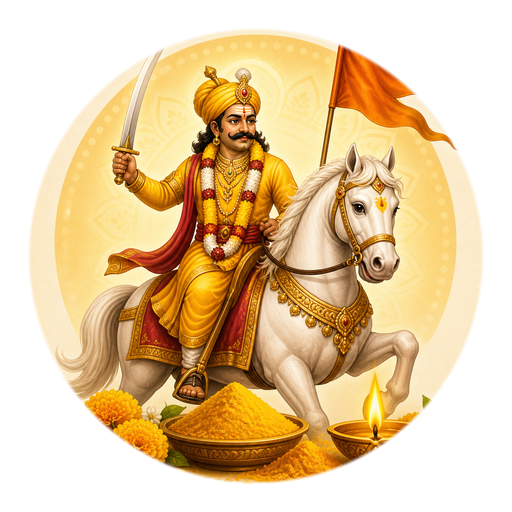
Kanifnath (popularly known as Kanhoba) is one of the Navnath — his sanjivan samadhi stands at Madhi village, Pathardi taluka, Ahilyanagar (formerly Ahmednagar) district. The main annual yatra falls on Phalgun Vadya Panchami (Rangpanchami) — 8 March in 2026 — a roughly 15-day fair believed to run from Holi through Gudi Padwa. It is regarded as one of the principal pilgrimage sites for Maharashtra's nomadic and de-notified communities (especially the Vaidu community); lakhs of devotees arrive from several states. By popular belief, Kanifnath was born in an elephant's ear in the Himalayas — the source, by tradition, of the name "Kanifnath."
This year's dates (2026)
- The main Kanifnath yatra day — the most crowded day of the 15-day fair8 Mar
- The closing day of the 15-day fair; according to the temple trust's website, it is recorded separately in the annual festival list, with a sandalwood-paste ritual19 Mar
- The second of that same website's three annual festivals (a birth-anniversary celebration)26 Mar
- The third of that same website's three annual festivals (with an abhishek)19 Apr
- The panchang records only a general 'utsav — Madhi, Nagar district' entry, with no Kanifnath name and no mention in the three festivals above — its exact nature is unclear27 Apr
Deity and significance
Kanifnath is regarded as one of the nine great yogis (Navnath) of the Shaiva Nath sampradaya. The commonly cited Marathi Navnath list runs: Jalandharnath, Machindranath, Gorakhnath, Gahininath, Kanifnath, Bhartrinath, Revannath, Nagnath, Charpatinath. One academic tradition gives a slightly different order — Matsyendranath, Gorakshanath, Jalandharnath, Kanifnath (fourth), Gahininath, Bhartrinath, Revannath, Charpatnath, Nagnath. The nine names are the same, only the order differs by tradition — both are recorded here, without treating either as the correct one.
Madhi is described as "the founding place of the Nath sampradaya and the Pandharpur of nomadic communities" — a special site of faith for nomadic and de-notified communities and the Vaidu community in particular, giving it a distinct social identity compared to many other major Maharashtra pilgrimage sites.
In popular Marathi tradition, Kanifnath's guru is not clearly named — he is simply placed in the Navnath list after Gorakhnath/Jalandharnath. However, a separate Vajrayana/Tibetan-siddha tradition names his principal guru as Jalandharnath, and describes his relationship with Gorakshanath inconsistently — in one account a rival who repeatedly loses to him, in another a close disciple. This Vajrayana identity differs from the Marathi devotional "Prabuddha Narayan" story; no source has conclusively established that both refer to the same person, so both traditions are recorded here separately, without treating either as definitive.
History and legend
By Marathi Nath-bhakti tradition, Kanifnath is regarded as an incarnation of one of the nine Narayanas known as Prabuddha Narayan — the Nath tradition's own belief holds that these nine Narayanas took birth in Nath form at Krishna's command. He is believed to have been born in an elephant's ear in the Himalayas — hence the name "Kanifnath" (kan + nath, "ear" + "lord"). Travelling south from the Himalayas while carrying out the work of the Nath order, he is said to have arrived at Madhi in Nagar district. At Madhi, he is said to have first meditated at the Apeshwar temple (by the riverbank), then in a cave, and to have taken sanjivan samadhi there on Phalgun Vadya Panchami (Rangpanchami) — meaning this samadhi is still regarded as spiritually "living" today.
A separate Vajrayana/Tibetan Charyapada-siddha tradition describes a figure under the same name — there, Kanifnath is known as Kanhupa/Kanhapa, the seventeenth of the 84 Mahasiddhas per the Chaturashiti-siddha-pravritti text, dating to the 10th century. He is said to have been born in Somapuri (Bengal, present-day Paharpur) into a Brahmin clerical family; educated at King Devapala's Somapuri vihara, with Jalandharnath as his principal guru, and is credited with composing Charyapada verses in Old Bengali. This is a distinct scholarly/Vajrayana-siddha identity — the Marathi devotional tradition makes no mention of Bengal, Somapuri, Charyapada, or Jalandharnath as guru; no source has conclusively established that both traditions describe the same person, so they are kept separate here rather than blended into one narrative.
On the temple's construction and expansion, three independent Marathi-language sources give a relatively consistent account — during a Mughal siege, Rani Yesubai is said to have made a vow that a temple would be built if her son, Shahu Maharaj, was freed; after his release, Maratha sardars are said to have built the entrance, the nagarkhana, and the sabhamandap, with water arrangements, and in 1743, Shahu Maharaj is said to have granted a charter establishing Vedic worship at the samadhi site. According to the temple trust's website, the current structure was built in the 17th century, which is consistent with this Maratha-era account. One English-language source gives a different, Nizam-era claim, though this second claim has little source support.
Architecture and layout
Around the main samadhi temple stands a complex including a sabhamandap, a meditation hall, a nagarkhana, a baradari, and a gadighar; a marble idol is also said to stand in the sanctum. The complex is said to include separate shrines to Vishnu, Hanuman, Machindranath, Vitthal-Rukmini, and Bhavani Mata. One source describes an underground meditation chamber with a Shivling, and a large shikhara topped with a trishul.
One source describes entry to the sanctum as being through a narrow, roughly one-foot-wide gap, for male devotees only, entered by sliding in. However, the statement that "on Rangpanchami, darshan is possible from within the sanctum, while on other days darshan is only from outside" is consistent across two sources.
Main festivals and pilgrimage
| Festival | Tithi | 2026 date | In short | Link |
|---|---|---|---|---|
| Kanifnath Yatra (Rangpanchami) | Phalgun Krishna Panchami | 8 March | Madhi's biggest day — the most crowded day of the 15-day fair, with lakhs of devotees | 8 March day page → Rangpanchami |
| Gudi Padwa (yatra closing) | Chaitra Shukla Pratipada | 19 March | The closing day of the 15-day fair; according to the temple trust's website, it is recorded separately in the festival list, with a sandalwood-paste ritual | 19 March day page → Gudi Padwa |
| Shri Ram Navami | Chaitra Shukla Ashtami/Navami | 26 March | The second of that same website's three annual festivals (a birth-anniversary celebration) | 26 March day page → Ram Navami |
| Akshaya Tritiya | Vaishakh Shukla Dwitiya/Tritiya | 19 April | The third of that same website's three annual festivals (with an abhishek) | 19 April day page → Akshaya Tritiya |
| Utsav (unclear) | Vaishakh Shukla Ekadashi (Mohini Ekadashi) | 27 April | The panchang records only "utsav — Madhi, Nagar district" — no Kanifnath name, and no mention in the list above; no crowd or yatra claim is made here | 27 April day page |
Beyond the five dates listed above, the panchang carries no other date under "Kanifnath" or "Madhi" — so no other date is assumed here. The panchang also carries one more entry under the same name (in Shravan month, at Moshi village in Pune district), but no independent source has confirmed a connection to Madhi — it is noted only as evidence that a local palkhi tradition for Kanifnath exists elsewhere too, not as part of Madhi's own festivities.
The yatra is traditionally said to begin with the Kaikadi community presenting an honorary "kathi" (staff) to the shikhara in the morning, and the Gopal community lighting the Holi bonfire in the evening; an oil/sandalwood anointing and a padukas-bathing ritual take place at the samadhi on Rangpanchami, after which local restrictions on farming, weddings, and new undertakings are said to apply in the village until Gudi Padwa. Exact year-by-year details and dates can vary.
Darshan and aarti timings
The temple trust's website does not clearly list daily darshan/aarti timings. The one rule that could be confirmed is that darshan from within the sanctum is possible on Rangpanchami, while on other days darshan is only from outside. A news report mentions a special window for direct entry into the samadhi sanctum a few days before Gudi Padwa — exact dates vary by year. Confirm the exact daily darshan/aarti timing directly with the temple committee.
Rituals here
On Rangpanchami, an oil-anointing and padukas-bathing ritual is said to take place at the samadhi. On Gudi Padwa, river water is brought for an abhishek at the samadhi, followed by a bath, a sandalwood-paste application, and a grand aarti. On Akshaya Tritiya, an abhishek ritual takes place, according to the temple trust's website. All these rituals are part of religious/local tradition, and their exact sequence, materials, and timing should be confirmed with the temple committee or priests.
How to reach
About 42 kilometres from Ahilyanagar city via Pathardi, according to two sources; other sources give a range of roughly 46.5 to 51 kilometres (the route or reference point may differ). About 12 kilometres from Pathardi town to Madhi. Regular state transport buses run here, with extra buses during the yatra. The nearest railway station is Ahilyanagar (Ahmednagar). The nearest airports are Chhatrapati Sambhajinagar (Aurangabad) and Pune; limited flights are available from Shirdi airport.
Nearby places
- Shri Machindranath Samadhi — about 6 kilometres from Madhi; one of the Navnath, a Nath-sampradaya connection.
- Vruddheshwar — about 12 kilometres from Madhi.
- Shirdi (Sai Baba) and Shani Shingnapur — other major pilgrimage sites in the same Ahilyanagar district.
- Pathardi — the taluka headquarters and Madhi's administrative centre, about 12 kilometres away.
Traveller tips
The Phalgun-Rangpanchami yatra draws immense crowds (in the lakhs) — traffic and parking controls, barricading, and police deployment are in place; arriving early and following local administration's instructions is best. Sanctum entry is limited on other days (darshan only from outside) — don't expect inner darshan except on Rangpanchami. During the March-April yatra period, keep the hot weather of Nagar district in mind and carry water and sun protection. The nearest large towns are Ahilyanagar and Shirdi, so plan travel in advance — local accommodation in this rural area can be limited.
Good to know
Two separate identity traditions exist for Kanifnath (Marathi Nath-bhakti and Vajrayana-siddha), along with two differing claims about the temple's construction. The district's official name is now Ahilyanagar (formerly Ahmednagar) — both names can be useful when searching. Since no confirmed official daily darshan timetable is available, it's worth phoning ahead before visiting.
FAQ
- When is the Kanifnath Madhi yatra in 2026?
- The main day is 8 March (Phalgun Vadya Panchami/Rangpanchami); the fair runs roughly 15 days from Holi through Gudi Padwa (19 March).
- Which district and taluka is Kanifnath Madhi in?
- Pathardi taluka, Ahilyanagar (formerly Ahmednagar) district.
- Who was Kanifnath? Which of the Navnath?
- One of the Navnath; by popular tradition, born in an elephant's ear in the Himalayas, and regarded as an incarnation of Prabuddha Narayan.
- Who was Kanifnath's guru?
- Not clearly named in Marathi tradition (he simply comes after Gorakhnath/Jalandharnath in the Navnath list); a separate Vajrayana tradition names Jalandharnath as his guru — the two traditions differ.
- How far is Madhi from Ahmednagar city?
- By road, roughly 42 to 51 kilometres (sources vary); about 12 km from Pathardi.
- How do I reach Madhi — by rail, road, or air?
- The nearest railway station is Ahilyanagar; nearest airports are Chhatrapati Sambhajinagar/Pune (limited flights from Shirdi); regular state transport buses run here.
- How long does the Kanifnath yatra last, and how many devotees attend?
- About 15 days (Holi to Gudi Padwa); devotee estimates vary by source, roughly five to twenty lakh.
- Who built the Kanifnath samadhi temple, and when?
- By Marathi-language sources, Maratha sardars expanded it in the 17th-18th century following Rani Yesubai/Shahu Maharaj's vow; a different claim also exists elsewhere.
- What's special about Rangpanchami at Madhi?
- An oil/sandalwood anointing and padukas-bathing ritual at the samadhi; on this day alone, darshan is possible from within the sanctum (on other days, only from outside).
- What other Navnath sites are near Madhi?
- Machindranath Samadhi (about 6 km), Vruddheshwar (about 12 km).
- What is Ahmednagar district's new name?
- Ahilyanagar — in honour of Punyashlok Ahilyabai Holkar; announced May 2023, with state cabinet approval in March 2024.