Mahalakshmi Temple, Mumbai
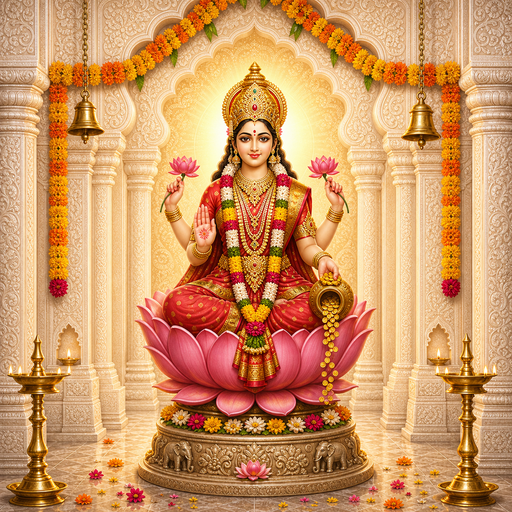
The Tridevi — Shri Mahalakshmi (at the centre), Shri Mahakali, and Shri Mahasaraswati — are worshipped at this temple in Mumbai's Mahalakshmi area, on Bhulabhai Desai Road near Breach Candy and Cumbala Hill, on a hill by the Arabian Sea. It's one of Mumbai's most-visited devi temples. This temple is not one of the three-and-a-half Shaktipeeths — that distinction belongs only to Kolhapur's Mahalakshmi (Ambabai) temple; the shared name causes confusion, but the two are entirely separate temples. By legend, three idols found through a dream-vision during the colonial-era Hornby Vellard project (which connected Mumbai's seven islands with a sea-wall) are enshrined here; the custom of sticking a coin to a wall to make a wish, sunrays reported to fall on the goddesses during both Navratris, and a no-VIP-darshan policy of equal treatment for all devotees are this temple's distinctive features.
This year's dates (2026)
- Thursday; Gudi Padwa — Chaitra Navratra begins, the Marathi new year19 Mar
- Monday; Shri Panchami, Lakshmi Panchami — Chaitra Navratra day five23 Mar
- Thursday; Shri Ram Navami — Chaitra Navratra concludes26 Mar
- Sunday; Akshaya Tritiya — noted as a major festival in the temple's own list19 Apr
- Sunday; Ghatasthapana, Sharadiya Navratra begins11 Oct
- Thursday; Lalita Panchami15 Oct
- Monday; Durgashtami19 Oct
- Tuesday; Vijayadashami, Dussehra20 Oct
- Sunday; Kojagiri, Sharad Purnima25 Oct
- Sunday; Shri Lakshmi-Kuber Pujan8 Nov
- Monday; Somvati Amavasya — popularly known as Diwali Lakshmi Pujan9 Nov
Deity & significance
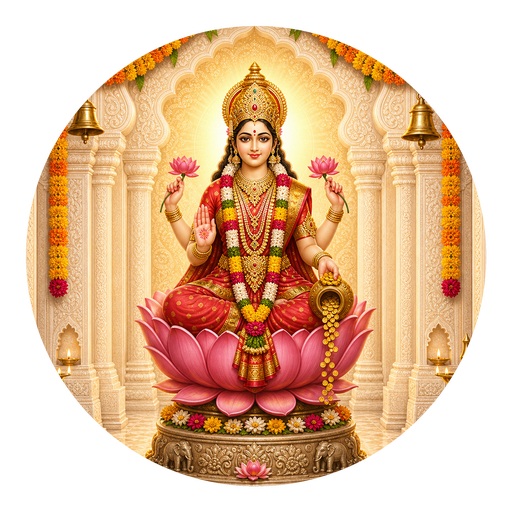
The temple is known by the name of its central deity, "Mahalakshmi," but its sanctum holds the Tridevi together — Mahakali (the power of creation and destruction), Mahalakshmi (wealth and prosperity), and Mahasaraswati (knowledge).
This temple is not a Shaktipeeth: Maharashtra's three-and-a-half Shaktipeeths — Kolhapur (Mahalakshmi/Ambabai), Tuljapur (Bhavani), Mahur (Renuka), and Saptashrungi (Vani) — do not include this Mumbai temple. Mumbai's temple is colonial-era (from the late 18th century) and has no documented connection to the Puranic Shaktipeeth tradition — the shared deity-name alone causes the confusion. Kolhapur's Mahalakshmi temple is the real Shaktipeeth — it and this temple are entirely different.
Besides the main Tridevi, the sanctum is recorded as also holding silver-covered wooden idols of Ganpati, Vitthal, and Rukmini, and a Lakshmi-Yantram (a symbol of wealth and prosperity). A silver lion sits in the sabha-mandap, facing the sanctum.
One cultural-historical note holds that Mumbai city was traditionally protected by two principal goddesses — Mahalakshmi and Mumbadevi.
The trust ("Shri Mahalakshmi Temple Charities") is recorded as running scholarships, free medical dispensaries (allopathic, ayurvedic, and homeopathic), and other charitable work.
History & legend
The temple's documented history goes back to the late 18th century — tied to Governor William Hornby's tenure (roughly 1771-1784) and his Hornby Vellard project (the sea-wall connecting Mumbai's seven islands), though the exact year (1761, 1771, or 1784) varies by source.
Many sources say the merchant Dhakji Dadaji (1760-1846) carried out a grand reconstruction or expansion in 1831; further renovations in the 1880s are also mentioned. (In some accounts this detail is absent — a heritage document states only that Ramji Shivji invested eighty thousand rupees to build the temple, without mentioning Dhakji Dadaji at all. The two accounts aren't necessarily contradictory — they may describe two different phases, the original temple versus a later grand reconstruction.)
Governor Hornby had assigned the land-reclamation (sea-wall) work between the Worli-Malabar creek to Ramji Shivji Prabhu (a Pathare Prabhu). Sea waves kept destroying the wall each time — the work stalled, and costs kept rising. One night, Prabhu is said to have dreamed of the goddess Mahalakshmi — she told him, "I lie at the bottom of the sea with my sisters; retrieve us, and your wall will be completed" — and also said the wall would only hold once the goddess had a home on the hill. With the help of local fishermen, three idols — Mahalakshmi, Mahakali, and Mahasaraswati — were found using nets. Construction is then said to have been completed without further obstruction. Hornby gifted Prabhu a plot on the hill; Prabhu is said to have built the temple there at his own expense of eighty thousand rupees.
A different version (in the same heritage document, citing an old history page from the temple itself) also states that, to protect them from foreign invaders, Hindu idols had an old practice of being submerged in the Worli creek — so these idols may have lain at the seabed for decades already. This adds a layer beyond simply being "found" through Ramji Shivji's dream — suggesting they had already been "placed" there.
The English Wikipedia article (otherwise detailed) states only that "Dhakji Dadaji built it in 1831" — it makes no mention of Ramji Shivji, the Hornby Vellard, or the dream-vision at all.
Architecture & layout
The temple stands on a hill north of Malabar Hill, on the Arabian Sea coast. The rear pathway towards the sea is currently (as of a 2023-era record) closed due to the Coastal Road project — confirm the current status before an actual visit.
Visitors walk from Bhulabhai Desai Road down a narrow lane lined with shops selling flowers and puja items.
A silver-covered lion sits at the centre of the sabha-mandap, facing the sanctum; the sanctum holds silver-covered wooden idols of Ganpati, Vitthal, and Rukmini, along with a Lakshmi-Yantram. All three goddesses sit on a partly silver-covered throne; the pillars in front of the throne are carved with decorative elephant and peacock motifs.
The temple's kalash (tower) is recorded by two sources as being about 15 metres tall. The architectural style is described as a blend of traditional Hindu temple style and colonial influences — carvings, domes, and spires.
At the rear stands a wall where devotees stick coins to make a wish — popular belief holds that if the coin sticks on the first attempt, the wish will come true; coins that don't stick fall into a grated shelf below.
Festivals & yatra
| Festival | Tithi | 2026 date | In brief |
|---|---|---|---|
| Gudi Padwa — Chaitra Navratra begins | Chaitra Shukla Pratipada | 19 March (Thursday) | For the general meaning, see Gudi Padwa and Chaitra Navratra. The temple's sunray phenomenon is reported to begin from this day. |
| Shri Panchami, Lakshmi Panchami (Chaitra Navratra day five) | Chaitra Shukla Panchami | 23 March (Monday) | A general calendar day, mentioned only for the shared "Mahalakshmi" name. |
| Shri Ram Navami — Chaitra Navratra concludes | Chaitra Shukla Ashtami (Navami follows later the same day) | 26 March (Thursday) | For the general meaning, see Ram Navami. |
| Akshaya Tritiya | Vaishakh Shukla Dwitiya (panchang shows Dwitiya despite the Tritiya name) | 19 April (Sunday) | For the general meaning, see Akshaya Tritiya. Noted in the temple's own festival list. |
| Ghatasthapana — Sharadiya Navratra begins | Ashwin Shukla Pratipada | 11 October (Sunday) | For the general meaning, see Navratri. Especially important here — the Sharadiya Navratra is this temple's busiest period; a three-three-three division of the nine days into Mahakali, Mahalakshmi, and Mahasaraswati (tamas, rajas, sattva) is recorded in the temple's own tradition. The sunray phenomenon is also reported during this period. |
| Lalita Panchami | Ashwin Shukla Panchami | 15 October (Thursday) | For the general meaning, see Lalita Panchami. |
| Durgashtami | Ashwin Shukla Ashtami | 19 October (Monday) | A general Navratra day. |
| Vijayadashami, Dussehra | Ashwin Shukla Navami | 20 October (Tuesday) | For the general meaning, see Dussehra. |
| Kojagiri, Sharad Purnima | Ashwin Shukla Chaturdashi | 25 October (Sunday) | For the general meaning, see Kojagiri Purnima. |
| Diwali Lakshmi Pujan | Ashwin Krishna Chaturdashi/Amavasya | 8 November to 9 November | For the general meaning, see Diwali. The temple holds a major Diwali and Annakut celebration (a naivedya of fifty-six dishes, reportedly with prasad for hundreds of devotees). |
| The month of Margashirsha | The whole month | (month-long, no specific date applies) | Large crowds, especially of women, are reported at the temple through Margashirsha. (Not directly connected to the home-based Margashirsha Thursday Mahalakshmi vrat — only a thematic resemblance, the same deity but a different tradition.) |
| Dwajasthambam anniversary/palkhi | Varies by source | Gudi Padwa or 17 June (source-dependent) | Some sources place it on Gudi Padwa, others say it falls every year on 17 June. |
Darshan & aarti timings
The timings below come from the official trust's website — but the schedule can change, so confirm current timings on the official website before an actual visit.
- Darshan hours: 6:00 AM to 10:00 PM daily — but darshan is closed during naivedya (11:45 AM to 12:20 PM).
- Morning aarti: 6:45 to 7:30 AM.
- Naivedya: 11:45 AM to 12:20 PM.
- Evening dhoop aarti: 6:15 to 6:40 PM.
- Evening aarti: 7:20 to 7:45 PM.
- Wait time: 15-45 minutes on a normal day; up to 2-3 hours during major festivals (Navratri, etc.).
- Priority darshan: a separate queue, with volunteer help, for senior citizens (65+) and persons with disabilities.
- Entry fee: free; there is no VIP darshan arrangement — all devotees are treated equally.
Special rituals here
Coin-wall vow: the custom of sticking a coin to the rear wall to make a wish — if the coin sticks on the first attempt, it's considered auspicious.
Puja services: services such as abhishek, archana, and special havan can be booked online or at the counter; donations qualify for an income-tax exemption under Section 80G (with PAN).
Navratri division: across the nine days, the first three are worshipped as Mahakali (tamas), the next three as Mahalakshmi (rajas), and the last three as Mahasaraswati (sattva) — recorded as this specific temple's own tradition, not a universal rule.
Sunrays: during both the Chaitra and Ashwin Navratras, the rays of the rising sun are reported to fall on the goddesses for a few minutes. (This isn't called "Kiranotsav" here — that is Kolhapur's distinct event with its own established name; only descriptive language is used for this Mumbai phenomenon.)
The exact sequence of daily puja and abhishek, and their mantras, should be confirmed with the temple committee.
Mantra & aarti
The most familiar bija mantra of devi worship — "Om Mahalakshmyai Namah" — meaning: salutations to the goddess Mahalakshmi. For the full aarti text, see Mahalakshmi Aarti.
How to reach
Address: Bhulabhai Desai Road, Mahalakshmi (West) and Breach Candy area, Mumbai 400 026.
By rail: Mahalakshmi railway station (Western Railway) is the nearest — about 1.2 km, per the official temple source; the Mumbai city district administration also gives "about 1 km" (broadly consistent).
By bus: BEST bus routes 63, 83, and 132 reach the temple, per official information.
By air: about 18-20 km from Chhatrapati Shivaji Maharaj International Airport (sources vary slightly).
Chhatrapati Shivaji Terminus (CST): about 7-9 km away (sources vary slightly).
By road: easily reached by taxi, autorickshaw, or private vehicle.
Nearby places
- Haji Ali Dargah — a very famous site in the immediate vicinity.
- Mahalakshmi Racecourse — a well-known nearby city landmark.
- Siddhivinayak Temple (Prabhadevi) — another very famous Mumbai temple, in a relatively nearby area.
- Vajreshwari — a sibling devi kshetra in the Mumbai-Thane area.
Travel tips (good to know)
- Crowds: expect large crowds on Fridays (the goddess's day), during both Navratris (Chaitra and Sharadiya), Diwali, and the month of Margashirsha — queues can run to 2-3 hours during festivals; visiting between 6 and 7 AM gives the calmest experience.
- Dress and conduct: for men, a dhoti-kurta or modest full-sleeved clothing is preferred; for women, a saree, salwar-kameez, or modest clothing covering shoulders and knees — shorts, sleeveless, and transparent clothing should be avoided. Footwear must be removed (a free deposit counter is available); leather items and large bags aren't allowed inside (a cloakroom is available).
- Mobile phones and photography: keep your phone on silent or vibrate; photography and videography are strictly prohibited inside the sanctum (allowed in the outer courtyard).
- The rear sea-facing pathway: closed for a period due to the Coastal Road project — confirm the current status before travelling.
- Avoid confusion: Mumbai's Mahalakshmi temple is entirely different from Kolhapur's Mahalakshmi (Ambabai) temple, which is one of the three-and-a-half Shaktipeeths. Also, the Chaitra Navratra (March) and the Sharadiya Navratra (September-October) are both important here, but are two separate occasions.
FAQ
- Where exactly is the Mahalakshmi temple in Mumbai?
- In the Mahalakshmi area, on Bhulabhai Desai Road, near Breach Candy and Cumbala Hill, on a hill by the Arabian Sea.
- Is Mumbai's Mahalakshmi the same as Kolhapur's Ambabai?
- No. The two are entirely separate temples that just happen to share the goddess's name ("Mahalakshmi"). Kolhapur's temple is one of the three-and-a-half Shaktipeeths, regarded as Puranic in origin; Mumbai's temple is comparatively recent — colonial-era, from the late 18th century.
- Is the Mahalakshmi Temple in Mumbai a Shaktipeeth?
- No. Maharashtra's three-and-a-half Shaktipeeths — Kolhapur, Tuljapur, Mahur, and Saptashrungi — do not include this Mumbai temple.
- What is the history of the Mahalakshmi Temple in Mumbai?
- By legend, during the Hornby Vellard (sea-wall) project, Ramji Shivji Prabhu is believed to have been shown in a dream by the goddess where to find idols in the sea; once found, construction was completed successfully and the temple was built. The merchant Dhakji Dadaji is also said to have later expanded the temple. The exact year varies by source.
- What are the darshan timings at the Mahalakshmi Temple?
- Roughly 6 AM to 10 PM, closed during naivedya (11:45 AM to 12:20 PM); but timings can change, so confirm on the official website.
- What is the coin-wall custom at the Mahalakshmi Temple?
- Devotees stick a coin to a rear wall to make a wish — popular belief holds that if it sticks on the first attempt, the wish will be granted.
- Why is the Mahalakshmi Temple so crowded during Navratri?
- This temple holds both the Chaitra and Sharadiya Navratras as especially significant — over nine days, Mahakali, Mahalakshmi, and Mahasaraswati are worshipped in sequence, drawing lakhs of devotees.
- How do I reach the Mahalakshmi Temple, and what's the nearest railway station?
- Mahalakshmi railway station (about 1-1.2 km away) is the nearest; from there, it's reachable on foot or by taxi/auto.
Related Info
 Kolhapur Mahalakshmi (Ambabai)11 Oct
 Siddhivinayak Temple, Prabhadevi, Mumbai6 Jan
 Vajreshwari (Vajreshwari Yogini Devi)17 Apr
 Navratri11 Oct
- Chaitra Navratri (Vasant Navratri)19 Mar
 Gudi Padwa19 Mar
 Ram Navami26 Mar
- Lalita Panchami15 Oct
 Kojagiri Purnima (Sharad Purnima)25 Oct
- Dussehra / Vijayadashami20 Oct
- Diwali / Lakshmi Pujan (Deepavali)6 Nov
- Akshaya Tritiya19 Apr
- Margashirsh Guruvar (Mahalakshmi vrat)10 Dec
- Mahalakshmi Aarti — Jay Devi Jay Devi Jay Mahalakshmi