Lenyadri Girijatmaj
Lenyadri's Shri Girijatmaj is a Ganpati set on a hill, inside a cave of an ancient Buddhist cave-complex, near Junnar in Pune district on the bank of the Kukadi river — and one of the Ashtavinayak (roughly the sixth in the scriptural order). It is the only Ashtavinayak that is on a hill and inside Buddhist caves; the whole shrine is carved out of a single rock hill, and you climb about 300+ steps to reach the cave. “Girijatmaj” means the son of Girija (Parvati) — by tradition it is believed that Parvati did penance for a son on this very hill. The shrine and caves are today a monument of national importance, protected by the Archaeological Survey of India (ASI).
This year's dates (2026)
- Shri Ganesh Chaturthi — start of Ganeshotsav; in the Lenyadri katha, Ganesh's birth-tithi14 Sep
- Shri Ganesh Jayanti, Vinayak Chaturthi (Maghi Ganesh Jayanti)22 Jan
- Angarki Sankashti Chaturthi (moonrise 21:20)6 Jan
- Angarki Sankashti Chaturthi (moonrise 22:19)5 May
- Angarki Sankashti Chaturthi (moonrise 20:13)29 Sep
Deity & significance
The Ganesh here is worshipped as Shri Girijatmaj. “Girija” is a name of Parvati (giri = mountain; she is the daughter of Himavan), and “atmaja” means son — so Girijatmaj = Parvati's son. In some places the name is also read as “born of / manifested from the mountain.” In this form Ganesh is worshipped as a child / son (balrup).
The hill and the caves — this is what sets it apart.
This is the only Ashtavinayak that is on a hill and within a Buddhist cave-complex. Unlike the other seven, there is no separate built temple here — instead there is a cave-structure carved into the rock. This is the kshetra's greatest draw.
Place in the Ashtavinayak.
Lenyadri is one of Maharashtra's eight principal Ganesh kshetras (the Ashtavinayak). In the scriptural order of the Ashtavinayak yatra, Lenyadri is taken to be roughly the sixth (Morgaon → Siddhatek → Pali → Mahad → Theur → Lenyadri → Ozar → Ranjangaon). This order can change with the actual travel route.
An internal katha link.
Lenyadri's birth-story is tied into the wider Ashtavinayak cycle — by tradition, some versions say the Ganesh born here later slew the demon Sindhu at Morgaon (Mayureshwar). This is a traditional narrative link.
In plain words: “The only Ganpati of the Ashtavinayak that sits on a hill and inside Buddhist caves is Lenyadri's Girijatmaj; ‘Girijatmaj’ means the son of Girija (Parvati).”
History & legend
The distinctive thing about Lenyadri is that you have to understand two separate layers here — one is the archaeological history (the caves, their age, the viharas and chaityagrihas, the inscriptions — independent and firm), and the other is the devotional legend (Parvati's penance, the birth of Ganesh — this is belief, and it comes in several versions). Both are set out separately below.
The archaeological history (firm).
The caves of Lenyadri were cut into the hill in the 1st to 3rd century CE (under Satavahana rule, in the Hinayana Buddhist phase). In the wider Junnar area there are about 200+ caves in four groups — Ganesh hill (Lenyadri), Shivneri, Tulja and Manmodi. The Lenyadri group has about 30 rock-cut excavations; of these, two are chaityagrihas and the rest are viharas (monks' cells). By the archaeological record, the main chaityagriha is taken to be an early example of a Hinayana chaityagriha.
These caves carry donative inscriptions dated to the 2nd century CE — one chaityagriha was the gift of Sulasadata of Kalyana, another the gift of Ananda; there are also records of water-cisterns donated by the goldsmith Saghaka and by two women, Lachhinika and Nadabalika. These inscriptions are solid archaeological evidence and are independent of the devotional katha.
Later on (the exact date unknown), the wall between two of the middle cells of one vihara-cave was broken through to merge them, and Ganesh worship began there — that is, an original Buddhist vihara was converted into a Hindu Ganesh shrine. On the cave-numbering, however, the sources differ: by the archaeological numbering the Ganesh shrine is in “Cave 7”, while in the pilgrimage tradition it is taken to be “the eighth cave (of 18).”
The sthala-purana / legend (devotional — belief).
The shared thread in the tradition is that Parvati (Girija) longed for a son, and did twelve years of hard penance and upasana on this very Lenyadri hill. Pleased, Ganesh granted her the boon of being born as her son, and on Bhadrapad Shukla Chaturthi (Ganesh Chaturthi) he appeared as her son — which is why the deity is “Girijatmaj” and the place is tied to the birth of Ganesh. The scriptural source of this katha is usually taken to be the Ganesh Purana; however, this Purana attribution varies from source to source.
Where the versions diverge (kept as they are).
On exactly how Ganesh came to be, the versions differ: in some, Ganesh is born as Parvati's son through the boon of her penance; in one version Parvati fashions Ganesh from the sandalwood paste she used at her bath; while a version in the Marathi sources says that “a devotee of Ganesh carved the murti behind the cave where Parvati had done penance” (that is, carved, not self-manifested).
A caution on the birthplace claim.
Lenyadri is called “the birthplace of Ganesh,” but there are other traditions of Ganesh's birth as well (for instance, from the scurf/dirt Parvati rubbed off her own body).
In short — the caves of Lenyadri were originally Buddhist viharas and chaityagrihas (Satavahana-era, 1st–3rd century CE); while by devotional tradition Parvati did penance on this hill and obtained Ganesh as her son. Keep these two layers distinct as you read them. The exact authoritative version and the Purana reference should be verified with the temple and an authoritative text.
Architecture
The cave-structure (the main feature).
The temple is a cave carved into the hill — taken to be the largest rock-cut excavation near Junnar, about 30 metres (roughly 98 feet) above the plains. The whole structure is carved from a single rock, and, following the original vihara layout, it has a large unpillared sabhamandap (hall) — this is the temple's most striking architectural feature.
Hall dimensions.
By some accounts the sabhamandap is roughly 57 × 51 feet (about 17.37 × 15.54 metres), unpillared, with about 20 cells (along both sides and the rear wall), and a pillared verandah with windows in front of the entrance. These dimensions differ slightly from source to source.
The murti.
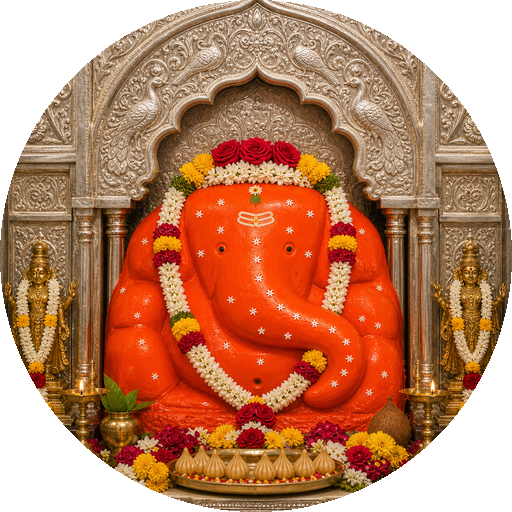
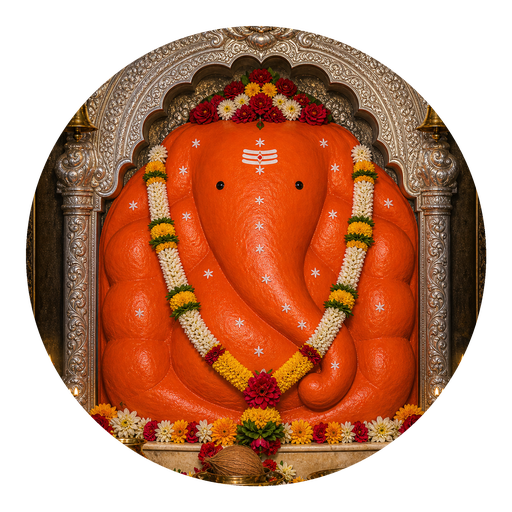
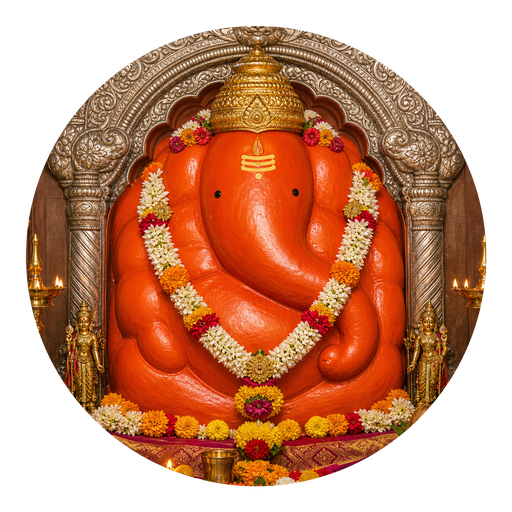
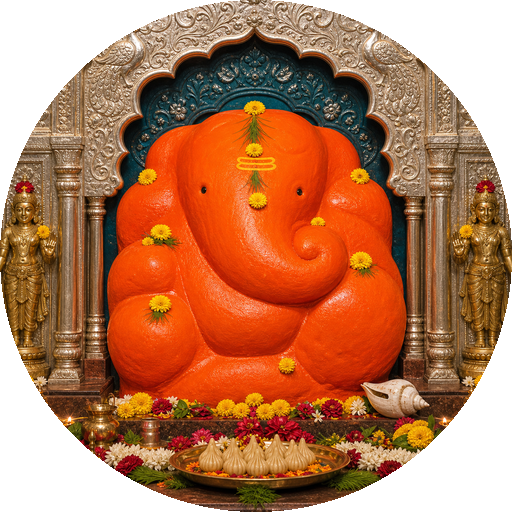
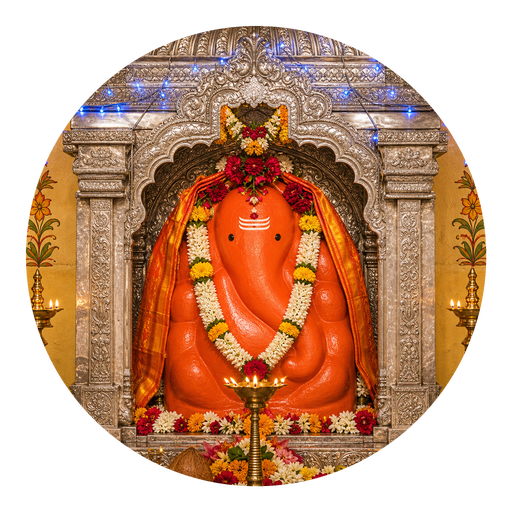
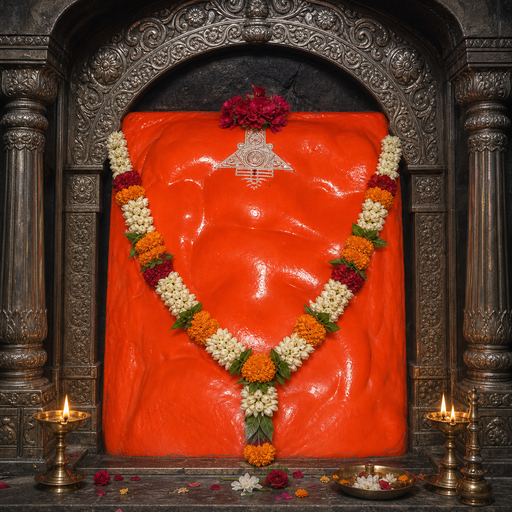
The Girijatmaj murti is carved into / manifested in the rear wall of the cave — most sources take it to be swayambhu (a self-manifested, natural rock form), while some say “a devotee carved it”; it is generally believed to be swayambhu. Its features are taken to be the least distinct among the Ashtavinayak murtis. On the orientation the sources are inconsistent: one place says “trunk to the left, east-facing, only one eye visible,” while it is also said that “by local tradition the temple faces south but the deity faces north — with his back to the worshipper.”
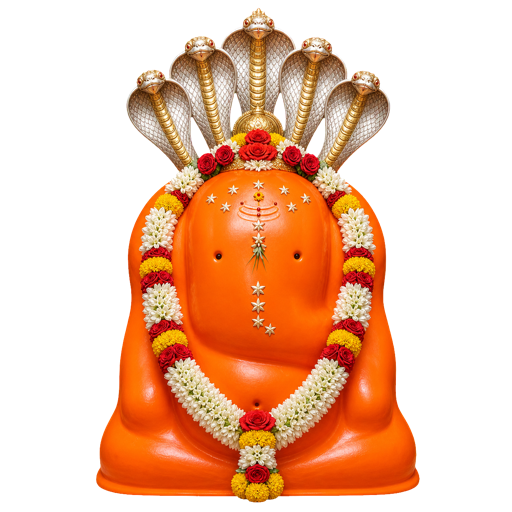
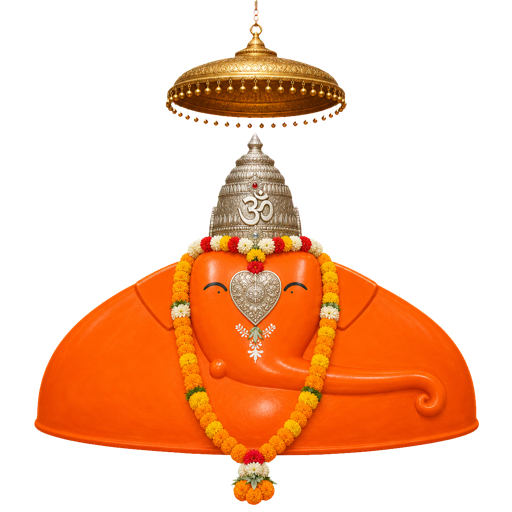
The murti is coated in shendur (vermilion); it is said that it earlier had a brass-and-wood armour (now removed). No authoritative record of the murti's exact dimensions was found (a single travel-blog mention of “about three and a half feet tall” is not authoritative).
The steps.
To reach the cave on the hill you climb stone steps. The exact number differs across sources — some say 283 (in eight flights), others 307; in total, about 300+ (roughly 283–307) steps, in several flights. These steps are traditionally taken to symbolise “the sensual pleasures overcome.”
Festivals & yatra
Each festival below is fixed by tithi; the Gregorian dates are taken as-is from this site's panchang records, and each date links to that day's panchang page. These are all general Ganesh tithis — their meaning and vidhi are covered on the relevant pages. The actual yatra programme should be verified with the temple and ASI (these can change).
| Festival / tithi | Tithi (rule) | This year's date | Occasion / page link |
|---|---|---|---|
| Shri Ganesh Chaturthi / Ganeshotsav | Bhadrapad Shukla Chaturthi (midday) | Mon, 14 Sep 2026 — nakshatra Chitra | Universal Ganeshotsav; in the Lenyadri katha this is taken to be Ganesh's birth-tithi → special importance. Details on the Ganesh Chaturthi page |
| Shri Ganesh Jayanti (Maghi), Vinayak Chaturthi | Magh Shukla Chaturthi | Thu, 22 Jan 2026 — nakshatra Shatataraka | Maghi Ganesh Jayanti; details on the Maghi Ganesh Jayanti page |
| Angarki Sankashti Chaturthi | Krishna Chaturthi + Tuesday | 6 Jan · 5 May · 29 Sep 2026 | Special crowds and specially auspicious at a Ganesh kshetra; see Sankashti Chaturthi |
| Monthly Sankashti / Vinayak Chaturthi | Krishna/Shukla Chaturthi (every month) | every month (about 24/year) | Darshan importance on every Chaturthi; look up each month's date on that day's panchang page. See Sankashti Chaturthi |
| Lenyadri-specific annual utsav / palkhi | tithi uncertain (not yet on record) | (date not found) | To be recorded only once a date is found; until then verify with the temple/ASI |
Note: Because the Lenyadri katha takes Ganesh Chaturthi (Bhadrapad) to be Ganesh's birth-tithi, this day is held to carry special importance and crowds here — but this is presented as a general Ganesh tithi, not as a Lenyadri-specific festival date. These dates fall differently each year because the identity is the tithi — the Gregorian date is only that year's detail.
Darshan & aarti timings
⚠️ The exact darshan and aarti timings could not be fixed from an authoritative source — no firm timing is given below.
Darshan and aarti timings are not officially published — verify with the temple/ASI before you travel.
Because of the hill climb, it is safer to finish darshan before sunset.
Special rituals
- The climb / the steps are themselves an experience. You climb about 300+ steps to the cave for darshan — these steps are traditionally taken to symbolise “the sensual pleasures overcome.”
- Worship in the cave. Ganesh worship is performed today in the original Buddhist vihara-cave — the daily puja/abhishek/aarti. The exact vidhi sequence, mantra and schedule should be verified with the temple/ASI priest arrangement (an authoritatively recorded sequence was not found). By some accounts the priests here are non-resident and from a particular family tradition; this arrangement too should be verified.
- ASI-monument etiquette. Because this is a protected archaeological monument, certain rules of conduct apply in the caves — not touching the carved parts or inscriptions, avoiding unauthorised dhoop/fire or rituals, and keeping the place clean. Keep the ASI rules in mind while performing any ritual.
Mantra & aarti
A simple jap-mantra for Ganpati: Om Gam Ganpataye Namah — meaning: salutations to Ganpati (this is Ganpati's bija-mantra).
The best-known aarti sung at Lenyadri and every Ganesh temple is Samarth Ramdas's “Sukhkarta Dukhharta.” It is sung morning and evening and at darshan. In meaning, it praises Ganpati as the giver of happiness and the remover of sorrow and obstacles (sukhkarta, dukhharta, varta vighnachi), describes his beautiful shendur-adorned form, and prays that he protect the devotee in every difficulty. Its recognizable opening line is “Sukhkarta Dukhharta, varta vighnachi…”.
How to reach
- Location: Lenyadri, Tal. Junnar, Dist. Pune — about 5 km from Junnar (on the northwest bank of the Kukadi river), up on a hill.
- By road: from Pune, by some accounts about 95–96 km (via Junnar) — the distance varies slightly by route. Pune–Junnar and Mumbai–Junnar state and private buses run; a local vehicle from Junnar takes you to Lenyadri.
- By rail: Junnar has no direct major railway station; by some accounts the nearest convenient station is Talegaon (about 85 km) — most of the journey is by road.
- By air: the nearest airport is Pune International Airport (about 100 km).
- The climb: since the temple is on a hill, you climb about 300+ steps to the cave (the figure differs across sources); allow enough time and be physically prepared.
⚠️ The exact distance, route and nearest railway station differ slightly across sources — verify on a map / an official source before you travel.
Nearby places
- Shivneri Fort (the birthplace of Chhatrapati Shivaji Maharaj) — by some accounts about 15 km from Lenyadri; being in the Junnar area, it is easy to add to the yatra. (Shivneri hill too has Buddhist caves — part of the same Junnar cave-group.) Check the distance on a map.
- Ozar (Vighneshwar) — the second Ashtavinayak near Junnar; Lenyadri–Ozar are easily paired in one trip.
- Other cave-groups around Junnar (Tulja, Manmodi) and forts — for light tourism and internal links. (Check distances on a map.)
Travel tips
- The climb: you climb about 300+ steps — carry plenty of water and comfortable footwear; take special care of older people, small children and anyone unwell, and it is safer to finish the climb and darshan before sunset.
- Watch for monkeys: the hill cave-area has monkeys about — don't leave food or prasad out in the open.
- Crowds: there are large crowds on Ganesh Chaturthi, Maghi Ganesh Jayanti and Angarki Sankashti — plan ahead.
- ASI monument: as this is a protected archaeological monument, do not touch the carved parts or inscriptions, avoid litter, and follow the ASI/photography rules.
- Timings change: darshan timings follow the official notice of the temple/ASI — verify before you travel.
Ashtavinayak — scriptural order & travel route
The scriptural (shastrokta) order of the eight Ashtavinayak kshetras is taken to be as below, with Lenyadri roughly sixth:
- Morgaon — Mayureshwar · Tal. Baramati, Dist. Pune
- Siddhatek — Siddhivinayak · Dist. Ahmednagar
- Pali — Ballaleshwar · Dist. Raigad
- Mahad — Varadvinayak · Dist. Raigad
- Theur — Chintamani · Tal. Haveli, Dist. Pune
- Lenyadri — Girijatmaj (this page) · Tal. Junnar, Dist. Pune
- Ozar — Vighneshwar · Dist. Pune
- Ranjangaon — Mahaganpati · Dist. Pune
On the actual journey, however, the order changes with distance and convenience. Being in the Junnar area, Lenyadri and Ozar are usually taken together. (The exact route can change depending on where you begin.)
Good to know
- Lenyadri's Girijatmaj is the only Ashtavinayak on a hill and inside Buddhist caves — the shrine is carved out of a single rock hill.
- Keep the archaeological history (the caves, 1st–3rd century CE, viharas and chaityagrihas, inscriptions) and the devotional legend (Parvati's penance, the birth of Ganesh) as two distinct layers.
- The step count, cave-numbering, hall dimensions, deity orientation and the versions of the katha differ from source to source — do not treat any single figure/version as final.
- Darshan/aarti timings and any Lenyadri-specific yatra dates should be verified with the temple/ASI.
- Do not use copyright photos/logos on the page, and make no “official association” claim.
FAQ
- Which is the Ashtavinayak Ganpati on a hill / in caves?
- Lenyadri's Girijatmaj — the only Ashtavinayak that is on a hill and inside a cave of a Buddhist cave-complex.
- What does the name “Girijatmaj” mean?
- “Girija” is a name of Parvati and “atmaja” means son — so Girijatmaj = Parvati's son.
- How many steps do you climb at Lenyadri?
- The figure differs across sources — about 300+ (roughly 283–307) steps, in several flights. Verify the exact count with the temple/ASI.
- Is Lenyadri the birthplace of Ganesh?
- By tradition it is believed that Parvati did penance here and obtained Ganesh as her son; but there are other traditions of Ganesh's birth too.
- How old are the Lenyadri caves and who built them?
- The caves are of the 1st to 3rd century CE (Satavahana-era, Hinayana Buddhist phase) and were originally Buddhist viharas and chaityagrihas; later, Ganesh worship began in one vihara-cave.
- Who runs the Lenyadri temple?
- The shrine and caves are a monument of national importance protected by the Archaeological Survey of India (ASI); there is no separate independent devasthan trust like at Morgaon/Theur. Verify the darshan arrangement with the ASI and the local priest arrangement.
- Which number is Lenyadri in the Ashtavinayak?
- In the scriptural order, roughly the sixth (Morgaon → Siddhatek → Pali → Mahad → Theur → Lenyadri → Ozar → Ranjangaon); the order can change with the actual travel route.