Ranjangaon Mahaganpati
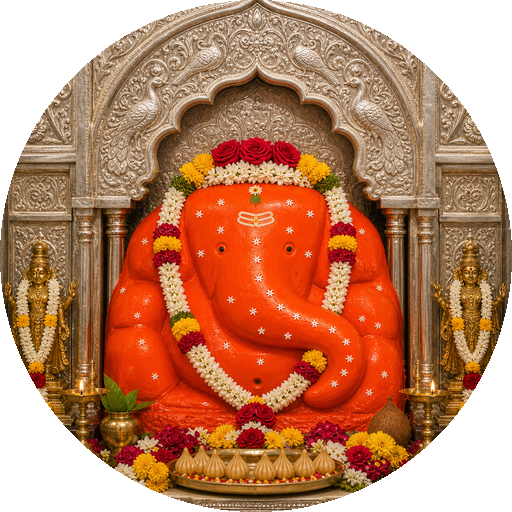
Ranjangaon's Mahaganpati is a living Ganesh kshetra (sacred site) on the Pune-Ahmednagar highway, about 50-52 km north-east of Pune — and one of the Ashtavinayak, Maharashtra's eight ancient Ganesh temples. In the scriptural yatra order it is generally reckoned the eighth (last) kshetra. As per the legend, Bhagwan Shiv worshipped Ganesh on this very spot before slaying the asura Tripurasura, and so the Mahaganpati temple rose here. The temple's standout feature is its sun-ray architecture — it is built east-facing in such a way that, at certain times, the sun's rays fall directly on the Ganesh murti. The garbhagriha (sanctum) is believed to have been built by Thorle Madhavrao Peshwa and the main sabhamandap by Sardar Kibe of Indore.
This year's dates (2026)
- Shri Ganesh Chaturthi — Ganeshotsav begins; Ranjangaon's Mukhdwar/Dwar yatra window (Bhadrapad Shukla 1-5) falls here (day-by-day schedule ownerVerify)14 Sep
- Shri Ganesh Jayanti, Vinayak Chaturthi (Maghi Ganesh Janmotsav)22 Jan
- Angarki Sankashti Chaturthi (Tuesday; moonrise 9.20 pm)6 Jan
- Angarki Sankashti Chaturthi (Tuesday; moonrise 10.19 pm)5 May
- Angarki Sankashti Chaturthi (Tuesday; moonrise 8.13 pm)29 Sep
Deity & significance
The Ganesh here is worshipped as Mahaganpati — Ganesh's great, grand and radiant form. The Ranjangaon Ganpati is held to be jagrut (awake) and powerful; devotees come here for the removal of obstacles and for wisdom and success in their work.
The murti (its distinct form).
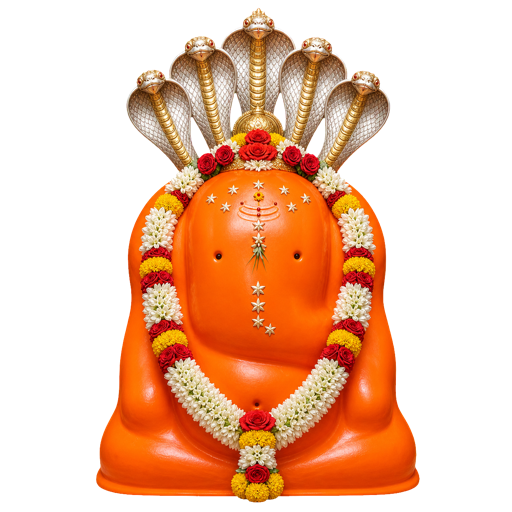
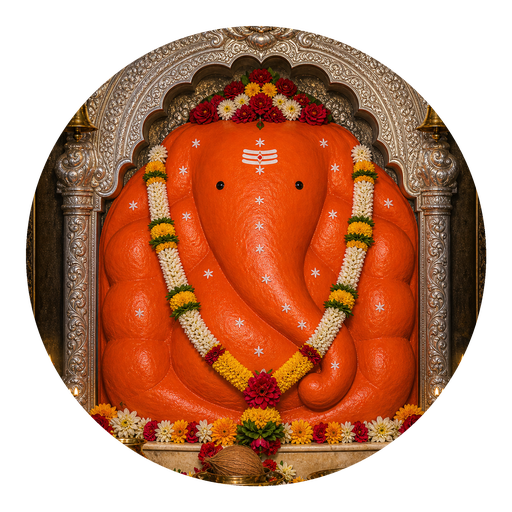
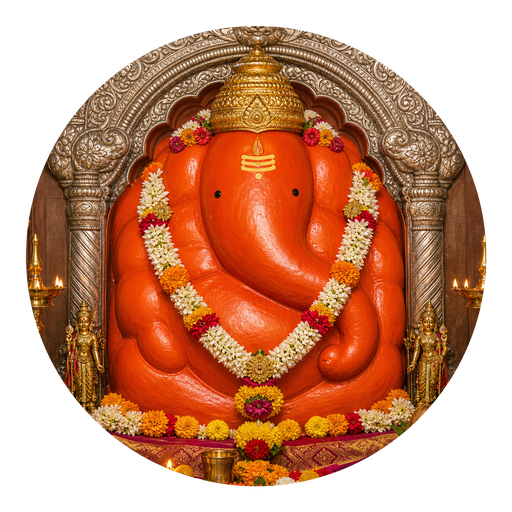
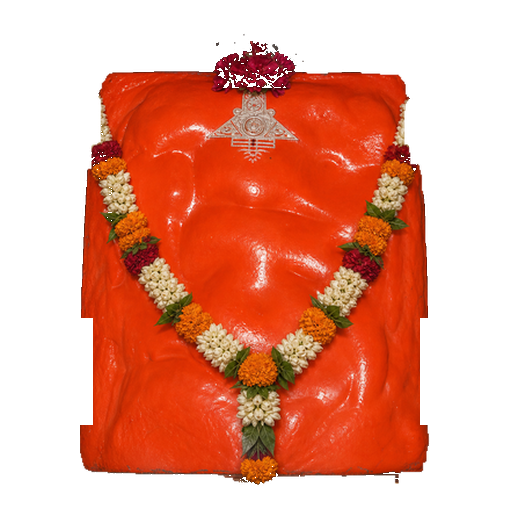
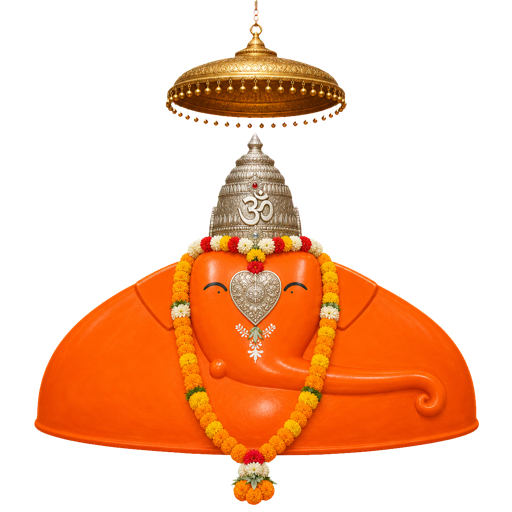
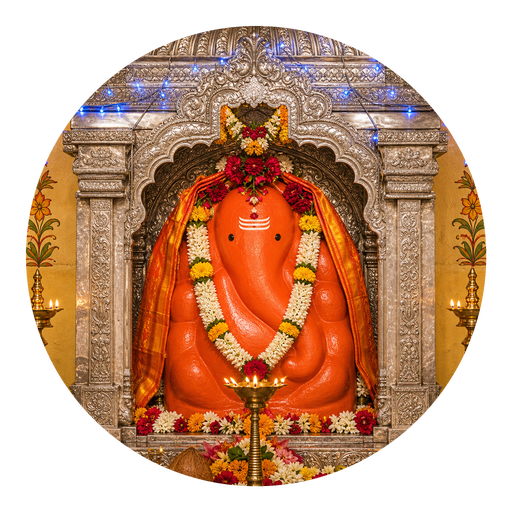
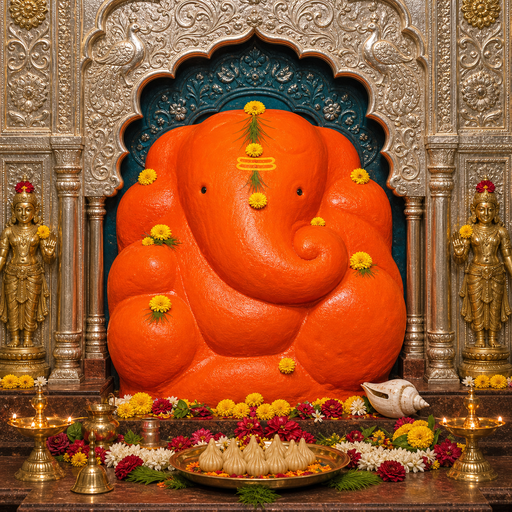
The worshipped murti has its trunk turned to the left (dava-sonda), is seated on a lotus (kamalasanstha), has a broad forehead, is flanked on both sides by Riddhi and Siddhi (personified powers), and faces east.
Mahotkat (the original idol) — folk belief vs a firm denial.
Many sources say that behind or below the visible murti lies a more ancient, grand idol called Mahotkat — said to have ten trunks and twenty arms — hidden in the basement (cellar); folk belief holds it was concealed for safety during the era of Islamic invasions. However, the temple administration / trustees deny that any such cellar idol exists. So this is best taken only as a mystery / folk belief, with neither side treated as established fact.
The Mahotkat idol is a matter of folk belief and the temple trustees deny it — keep both sides as they are; treat neither as final. Verify the actual facts with the temple trust.
Place in the Ashtavinayak.
Ranjangaon is one of Maharashtra's eight ancient Ganesh kshetras (the Ashtavinayak), in Pune district. In the scriptural yatra order it is generally taken to be the eighth (the last — after Ozar, before returning to Morgaon); however, in some geographic/convenience orderings a few sources count it as the fourth. Ranjangaon is a major Ashtavinayak kshetra — generally reckoned the eighth/last in the scriptural order; counted fourth in some geographic orderings.
The full Ashtavinayak yatra guide and the details of the other kshetras are on a separate page; the scriptural order and the practical travel route are both given at the end of this page.
About the name.
Some sources connect the village's name to the word-sense “mani = ranjan (a large pot)”; this is one etymological view — take it in the sense of “it is believed.”
History & legend
Construction history.
The garbhagriha (sanctum) of the present temple is believed to have been built or added by Thorle Madhavrao Peshwa; it is also recorded that he made a room in the basement to keep the idol. The main sabhamandap was built by Sardar Kibe of Indore, who later also carried out a renovation; the Shinde and Holkar houses too gave the kshetra substantial patronage. By tradition, Thorle Madhavrao Peshwa used to come here regularly for darshan. By some accounts the core of the temple is as old as the ninth-tenth century; even so, the present visible construction is mainly of the Peshwa era. The temple faces east, with a grand entrance and a nagarkhana (drum-house) above the gateway.
The sthala-purana (site legend).
The story of the Ranjangaon Mahaganpati kshetra is tied to Tripurasura, a mighty asura (demon). The thread shared by all versions runs like this —
An asura named Tripurasura won a boon and spread havoc across the three worlds, tormenting the gods. Bhagwan Shiv meant to destroy Tripurasura's three flying cities (“Tripura”), but success would not come. Then Shiv invoked and worshipped Ganesh on this very spot; by Ganesh's grace Shiv slew Tripurasura, and in gratitude he built the Mahaganpati temple here — hence the kshetra, so the story goes.
The exact form of Ganesh's help, however, differs across versions. In some versions, Shiv invokes Ganesh with a Ganesh-worship mantra and slays Tripurasura with the divine arrow he receives; in others, Ganesh himself takes the guise of a Brahmin and, by a stratagem, pierces Tripura's three flying cities to help defeat the asura. One version adds that Tripurasura had a boon (from Ganesh himself) that only Shiv could slay him. Another account says the village where Shiv established the deity was “Manipur” — today's Ranjangaon — and links the memory of this victory to “Tripuri Pournima” (Kartik Purnima).
The shared seed (Shiv → worship of Ganesh → slaying of Tripurasura → the Mahaganpati temple here) is one and the same; but the form of the help (mantra-and-arrow vs the Brahmin stratagem) differs across versions. No single version should be treated as final; verify the authoritative Marathi version with the temple trust / a standard text.
Architecture
- Facing: the temple faces east, with a grand entrance and a nagarkhana above the gateway.
- The sun-ray architecture (the standout feature). The temple is built so that at certain times — sources mention the dakshinayan/uttarayan and midday (madhyanha) periods — the sun's rays fall directly on the Ganesh murti in the sanctum. This shows the same ancient astronomical craft as the Kiranotsav at the Kolhapur Ambabai temple. However, unlike Kolhapur, no official source gives an exact Gregorian date or window. Sources say the sun's rays fall on the murti during the dakshinayan/midday period.
Sources say the sun's rays fall on the murti, but none gives an exact date-window — so no firm date is given here. Verify it with the temple trust and by astronomical calculation.
- Structural parts: the garbhagriha (sanctum) + the main sabhamandap; the garbhagriha by Madhavrao Peshwa and the sabhamandap by Sardar Kibe (see History above). The basement is the room Madhavrao made for the idol; it is here that the folk belief about the Mahotkat idol (and the trustees' denial) is set.
- The murti: left trunk, seated on a lotus, broad forehead, flanked by Riddhi and Siddhi, east-facing.
Festivals & yatra
Each festival below is fixed by tithi, and each date links to that day's panchang page. These are all general Ganesh tithis — their meaning and vidhi are covered on the respective pages. Ranjangaon's own distinctive practice is the Mukhdwar/Dwar yatra during the Bhadrapad Ganeshotsav (Bhadrapad Shukla Pratipada-Panchami) — its tithi-window coincides with Ganesh Chaturthi, so it is noted below; but the exact yatra dates and the day-by-day schedule change from year to year.
| Festival / yatra | Tithi (rule) | This year's date | Occasion |
|---|---|---|---|
| Shri Ganesh Chaturthi / Ganeshotsav + Ranjangaon Mukhdwar/Dwar yatra | Bhadrapad Shukla Chaturthi (madhyanha); yatra window Bhadrapad Shukla 1–5 | Mon, 14 Sep 2026 — nakshatra Chitra | Ganeshotsav begins; open-sanctum (muktadar) darshan up to the murti during the Bhadrapad window (day-by-day schedule via the temple trust) |
| Maghi Ganesh Jayanti / Vinayak Chaturthi | Magh Shukla Chaturthi | Thu, 22 Jan 2026 — nakshatra Shatataraka | Ganesh Janmotsav celebrated here with grandeur; special darshan |
| Angarki Sankashti Chaturthi | Krishna Chaturthi + Tuesday | 6 Jan · 5 May · 29 Sep 2026 | Rare and specially auspicious; large crowds |
| Tripuri Pournima (Kartik Purnima) | Kartik Purnima | (no Ranjangaon-specific record — date not stated here) | Some sources tie the memory of the Tripurasura victory to this kshetra; the exact temple-festival date/schedule via the temple trust |
| Sun-ray darshan (solar feature) | solar (dakshinayan/midday; not a tithi) | (window uncertain — no official source gives a Gregorian date) | Kolhapur Kiranotsav-like; check the exact date with the temple trust |
Monthly Sankashti Chaturthi (every Krishna Chaturthi) and Vinayak Chaturthi (every Shukla Chaturthi) also carry special importance for darshan at a Ganesh kshetra like Ranjangaon. These fall every month (about twenty-four a year). Look up each month's exact date on that day's panchang page and on the Sankashti Chaturthi page.
Note: These dates fall differently each year because the identity is the tithi — the Gregorian date is only that year's detail. The Mukhdwar/Dwar yatra is Ranjangaon's truly distinctive practice — during the Bhadrapad Ganeshotsav devotees can go right into the sanctum, up to the murti, for darshan. But these are general Ganesh tithis — their meaning and vidhi are covered on the Ganesh Chaturthi and Sankashti Chaturthi pages.
Darshan & aarti timings
The temple generally opens early in the morning and stays open for darshan until late at night; by one available record the timing appears to be roughly 5:30 AM to 10:00 PM. However, during festivals and the Mukhdwar yatra the open-sanctum (muktadar) darshan timings are different, and they vary across sources. So no firm timing is given here — verify the darshan and aarti timings against the temple trust's official schedule, especially on Ganesh Chaturthi, Maghi Ganesh Janmotsav and Angarki Sankashti.
Administration.
The kshetra is managed by the Shri Kshetra Ranjangaon Mahaganpati Devasthan Trust.
The trust's name is taken from available sources. Exact timings, contact and official information should be taken only from the temple's official sources. Do not treat any private booking portal as the “devasthan trust,” and make no “official association / endorsement” claim on the page.
Special rituals
- Mukhdwar/Dwar yatra — open-sanctum (muktadar) darshan (a special practice): during the Bhadrapad Ganeshotsav (Bhadrapad Shukla Pratipada-Panchami) devotees can go right into the sanctum, up to the murti, for darshan — this is not possible year-round; it is a Ranjangaon-specific practice. The exact rules and timings change from year to year and should be verified with the temple trust.
- Mantra connection: as per the site-legend Shiv invoked Ganesh here with a Ganesh-worship mantra, which is why Ganesh-upasana is specially associated with this place. (One source calls this a “Shadakshar mantra”; but exactly which Shadakshar text this is, the sources do not make clear — such an equation should not be treated as established.)
- Daily puja & vidhi: abhishek, puja, alankar and naivedya are the daily and festival rituals; however, their exact sequence, mantras and schedule were not found in an official source; they follow the temple's own custom — verify the exact sequence with the temple trust.
Mantra & aarti
A simple jap-mantra for Ganpati: Om Gam Ganpataye Namah — meaning: salutations to Ganpati (this is Ganesh's bija-mantra, seed-mantra).
The best-known aarti sung at Ranjangaon and every Ganesh temple — and across the Ashtavinayak yatra — is Samarth Ramdas's “Sukhkarta Dukhharta.” It is sung morning and evening and at darshan. In meaning, it praises Ganpati as the giver of happiness and the remover of sorrow and obstacles, describes his beautiful shendur-adorned form, and prays that he protect the devotee in every difficulty. Its recognizable opening line is “Sukhkarta Dukhharta, varta vighnachi…”.
How to reach
- By road: Ranjangaon is on the Pune-Ahmednagar highway, about 50-52 km from Pune (to the north-east); about 21 km from Shirur. About 223 km from Mumbai. State (ST) buses and private vehicles are easily available.
- By rail: the nearest station is Uruli — about 16 km (on the Pune-Daund line); the large junction is Pune.
- By air: Pune Airport is the most convenient (about 50-90 km by different sources — the distance varies).
⚠️ The exact distance, route and station differ slightly across sources (Pune ~50-52 km; airport ~50-90 km) — confirm on a map before travelling.
Nearby places
- Other Ashtavinayak (the yatra cluster): in the Pune region — Theur Chintamani, Morgaon Mayureshwar and Siddhatek Siddhivinayak, plus Ozar (Vighneshwar) and Lenyadri (Girijatmaj) — are the kshetras linked with Ranjangaon on the yatra route.
- Shirur and Pune city — travel bases; in Pune, the Dagadusheth Halwai Ganpati (a darshan option).
- Other local tirthas/temples in the area — for light tourism; check distances on a map.
Travel tips
- Crowds: the Bhadrapad Ganeshotsav (Mukhdwar yatra), Maghi Ganesh Janmotsav and Angarki Sankashti draw large crowds — darshan queues are long; plan ahead and take special care of elders and small children.
- Open-sanctum darshan: the Bhadrapad window offers direct sanctum darshan — but the timings and rules change per festival; verify with the temple trust before your visit.
- Dress/notices: keep to modest, sattvik dress and follow the temple's instructions and photography rules.
- Timings change: darshan timings and special darshan change as per the temple trust's official notice — verify before travelling.
Ashtavinayak — scriptural order & travel route
The scriptural (shastrokta) order of the eight Ashtavinayak kshetras is taken to be as below, with Ranjangaon eighth (last):
- Morgaon — Mayureshwar · Tal. Baramati, Dist. Pune
- Siddhatek — Siddhivinayak · Tal. Karjat, Dist. Ahmednagar
- Pali — Ballaleshwar · Dist. Raigad
- Mahad — Varadvinayak · Dist. Raigad
- Theur — Chintamani · Dist. Pune
- Lenyadri — Girijatmaj · Dist. Pune
- Ozar — Vighneshwar · Dist. Pune
- Ranjangaon — Mahaganpati (this page) · Tal. Shirur, Dist. Pune
Note: on the actual journey, however, the order changes with distance and convenience — which is why some sources place Ranjangaon at a different number (e.g. the fourth) from a travel-route point of view. Pilgrims setting out from Pune usually take Morgaon → Theur → Siddhatek → Ranjangaon → Ozar → Lenyadri → Mahad → Pali and close the yatra by returning to Morgaon. (The exact route changes depending on where you begin; see the ashtavinayak-ordinal note above.)
Good to know
- Ranjangaon's Mahaganpati is a major Ashtavinayak kshetra (generally reckoned the eighth/last in the scriptural order; counted fourth in some geographic orderings); in Pune district.
- The temple's sun-ray architecture is a special feature, but no official source gives an exact date-window — do not treat it as fixed.
- The Mahotkat (ten-trunk, cellar) idol is a folk belief and the temple trustees deny that claim — keep both sides as they are.
- The Tripurasura versions differ (mantra-and-arrow vs the Brahmin stratagem) — do not treat any single version as final.
- Darshan/aarti timings, yatra dates and official information should be verified with the temple trust / official sources.
- Avoid mixing up the dates: Bhadrapad Ganesh Chaturthi (Sep) ≠ Maghi Ganesh Janmotsav (Jan, Magh Shukla Chaturthi) ≠ the monthly Sankashti/Vinayak Chaturthi.
- Do not use copyright temple photos/logos on the page, and make no “official association” claim.
FAQ
- Where is the Ranjangaon Mahaganpati temple?
- On the Pune-Ahmednagar highway, at Ranjangaon (Tal. Shirur, Dist. Pune) — about 50-52 km north-east of Pune. It is one of the Ashtavinayak kshetras.
- How did Ranjangaon get the name Mahaganpati and its temple?
- As per the legend, Bhagwan Shiv worshipped Ganesh on this very spot before slaying Tripurasura, and after the victory built the Mahaganpati temple here in gratitude — hence the kshetra, so the story goes.
- What is the Ranjangaon Mahotkat idol — does it have ten trunks and twenty arms?
- By folk belief, behind/below the present murti lies an ancient idol called Mahotkat with ten trunks and twenty arms, hidden in the basement. However, the temple trustees deny that any such idol exists — so take it only as folk belief/mystery, not as established fact.
- When do the sun's rays fall on the idol at the Ranjangaon temple?
- Because the temple faces east, sources say the sun's rays fall directly on the murti in the dakshinayan/midday period; but no official source gives an exact date/window — verify it with the temple trust.
- Does the Ranjangaon murti have a left trunk or a right trunk?
- The worshipped murti has a left trunk, is seated on a lotus, has a broad forehead, is flanked by Riddhi and Siddhi, and faces east.
- Who built the Ranjangaon temple?
- The garbhagriha is believed to have been built by Thorle Madhavrao Peshwa and the main sabhamandap by Sardar Kibe of Indore; the Shinde-Holkar houses too gave patronage — the construction is mainly of the Peshwa era.
- How far is Ranjangaon from Pune and how do you reach it?
- About 50-52 km from Pune (on the Pune-Ahmednagar highway). By road via ST buses / private vehicles, by rail via the nearest station Uruli (~16 km) and the large junction Pune, and by air via Pune Airport. (Check the distance on a map.)
- What are the Ranjangaon Mahaganpati darshan timings?
- The temple is generally open from early morning to late night (by one record, roughly 5:30 AM to 10:00 PM); but timings change during festivals/yatra and reliable official timings are not available — verify them with the temple trust.