Mahad Varadvinayak
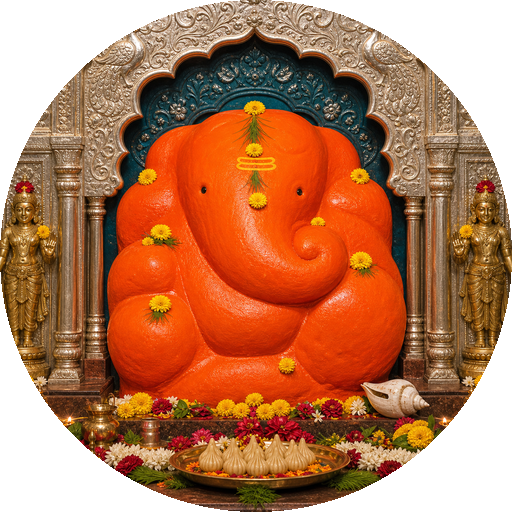
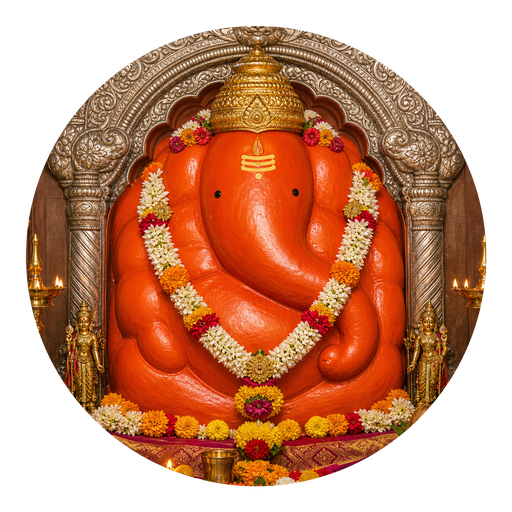
Mahad's Varadvinayak is a Ganesh kshetra (sacred site) in Raigad district, near Khopoli and Karjat, about four kilometres off the Pune–Mumbai highway — and one of the Ashtavinayak, Maharashtra's eight swayambhu (self-manifested) Ganesh temples. Its signature distinction is that this is said to be the only Ashtavinayak where devotees enter the garbhagriha (sanctum) directly and do their own darshan and puja (by some accounts until noon). The nandadeep (perpetual lamp) said to have burned continuously in the sanctum since 1892 is another well-known feature. ‘Varad’ means the giver of boons — as per the legend, the sage Gritsamada worshipped Ganesh in this very forest and gained a boon, which is why the deity here is ‘Varadvinayak.’ The present temple is believed to have been built by the Peshwa-era subhedar Ramji Mahadev Biwalkar in 1725.
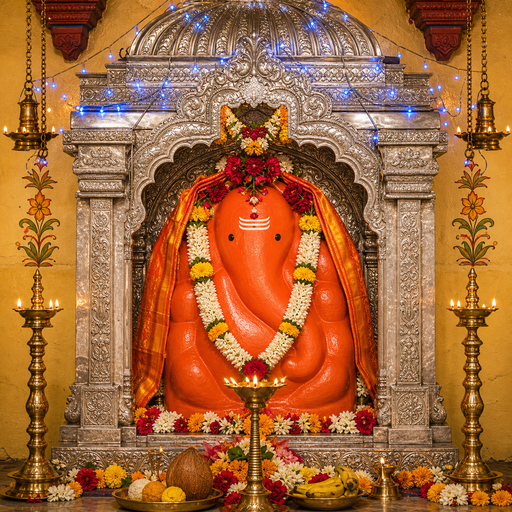
This year's dates (2026)
- Shri Ganesh Jayanti, Vinayak Chaturthi (Maghi) — Mahad's main crowd tithi22 Jan
- Shri Ganesh Chaturthi — Ganeshotsav begins (madhyanha chaturthi)14 Sep
- Anant Chaturdashi (Ganeshotsav conclusion / visarjan)25 Sep
- Angarki Sankashti Chaturthi (moonrise 9.20 pm)6 Jan
- Angarki Sankashti Chaturthi (moonrise 10.19 pm)5 May
- Angarki Sankashti Chaturthi (moonrise 8.13 pm)29 Sep
⚠️ Avoid a name mix-up: this is Mahad the village (Tal. Khalapur, near Khopoli–Karjat, north Raigad) — an Ashtavinayak kshetra. It is an entirely different place from Mahad town in south Raigad (Chavdar Tale, Dr. Ambedkar's satyagraha); check the address and map carefully.
Deity & significance
The Ganesh here is worshipped as Varadvinayak — “the Vinayak who grants a varad (boon, a wish fulfilled).” “Varad” means the giver of boons; devotees come here with devotion for the removal of obstacles, for wishes fulfilled and for success.
Entering the garbhagriha — the key distinction.
This is said to be the only Ashtavinayak temple where devotees have direct entry into the garbhagriha and can do their own darshan, touch and puja of Ganpati (by some accounts until noon). This is the exact opposite of Siddhatek, where a strict sovale (ritual purity) is kept because of the “awake” right-trunk Ganpati; here, by contrast, the devotee is said to be allowed to do the puja closely and personally.
This is a statement of temple custom — in the sense of “as per the temple's practice”; do not take it as a universal or final rule. Verify the exact rules and timing for entering the sanctum with the temple trust.
Place in the Ashtavinayak.
The pilgrimage to Maharashtra's eight swayambhu Ganesh kshetras is called the Ashtavinayak; Mahad is one of them and one of the Ashtavinayak kshetras in Raigad district. Sources differ on its number in the circuit — most Marathi sources call it roughly the fourth, while the Marathi Vishwakosh (encyclopaedia), going by the yatra route, calls it the “seventh”; a few sources say “third.”
The full Ashtavinayak yatra guide and the details of the other kshetras are on that page; the scriptural order and the practical travel route are both given at the end of this page.
History & legend
Construction history.
The present temple is believed to have been built or renovated by the Peshwa-era subhedar Ramji Mahadev Biwalkar in 1725. Biwalkar was the subhedar / sar-subedar of Kalyan and northern Konkan under the Peshwas Bajirao I and Balaji Bajirao. (By some accounts Biwalkar also settled the village of Mahad along with the temple; that detail appears in only one source, so it should not be treated as certain — the temple's building/renovation, however, is recorded in several places.)
The sthala-purana (site legend).
The story behind the name Varadvinayak is tied to the sage Gritsamada, and it has two distinct layers.
The shared thread.
As per one version, from an episode involving Mukunda, the wife of the sage Vachaknavi, and King Rukmangada — brought about by Indra's deceit — a son named Gritsamada was born. This Gritsamada later worshipped Ganesh intensely in this very forest (Bhadrakavana — present-day Mahad) and gained a boon (varad); hence the deity here is “Varadvinayak” and Gritsamada is held to be the founding proponent of the Ganapatya tradition. Gritsamada is regarded as the seer (rishi) of the well-known Rigvedic hymn “Gananam tva Ganapatim havamahe” (Rigveda 2.23.1), and this site-legend is linked to the tradition of the Ganesha Purana and the Mudgala Purana (where this region is called “Bhadraka / Madhaka”).
A difference in tradition (noted, not resolved).
Some versions add an earlier prologue to this story — the childless King Bhima of Koundinyapur met the sage Vishwamitra in the forest, and by japa of the “ekakshari Gajanana mantra” that the sage gave him, the son Rukmangada was born (leading into the Rukmangada story above). Other versions, however, leave out this Bhima/Vishwamitra prologue and begin directly from the Rukmangada part.
The Rukmangada–Mukunda part is a delicate episode — without treating any one version as final, the shared thread (Gritsamada → boon → “Varadvinayak” → founder of the Ganapatya tradition) is given in original words, with the Bhima/Vishwamitra prologue noted as “in some versions.” Although the underlying Puranic story and the Rigvedic hymn are in the public domain, the authoritative version of this site-legend should be verified with the temple trust or a standard text.
Architecture
- Style: The temple is relatively simple and kaularu (tiled-roof), with a fine dome, a golden kalash (finial) and a serpent carving on the finial, by some accounts.
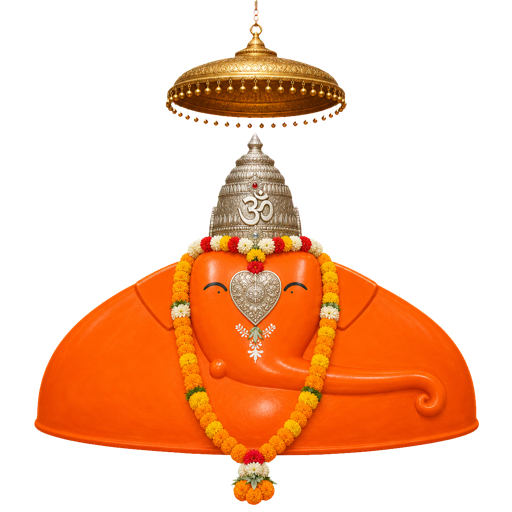
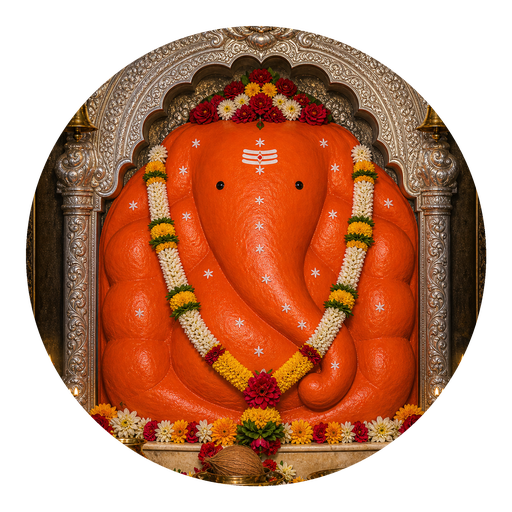
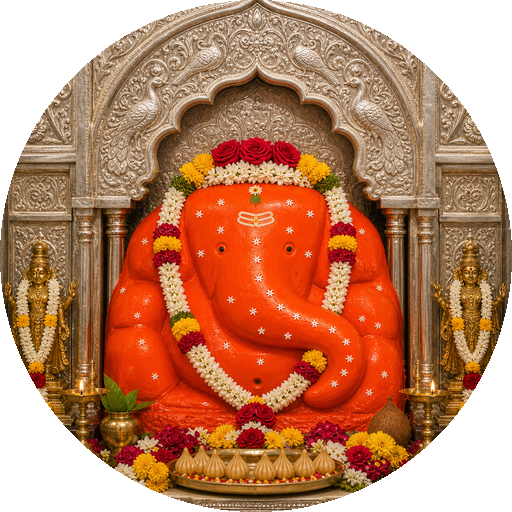
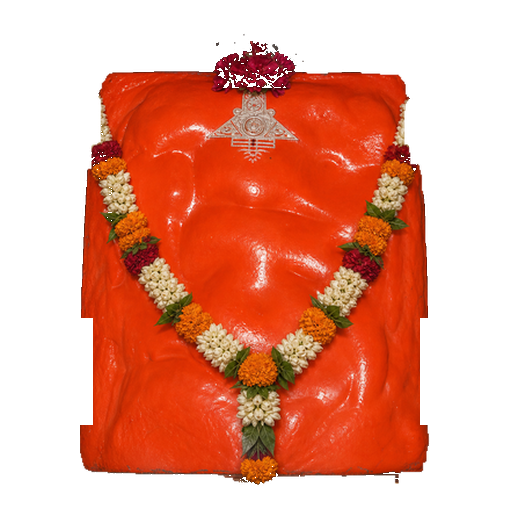
- The murti & trunk direction: The murti is swayambhu and taken to be east-facing. The temple is held to have two murtis — the outer, shendur-coated one with a left-turned trunk is the main darshan murti, while the inner white-marble murti has a right-turned trunk. The main, commonly-seen darshan murti is taken to be left-trunked; the right-trunked marble murti is noted as a point of distinction here. (The trunk direction differs across sources — some say “left,” while the Marathi Vishwakosh groups Mahad among the “right-trunked” ones; the two-murti account reconciles this contradiction.)
- Murti measurements: the murti's exact measurements should be verified with the temple trust.
- The sanctum & surrounding murtis: the garbhagriha is said to hold, along with the main Ganesh, the Navagraha deities, a mushaka (mouse) and a Shivalinga; there are four elephant murtis on the temple's four sides and a stone mahirap (arched frame).
- Surroundings: there is a water body / lake near the temple (where the murti is believed to have been found) and green surroundings.
- The akhand nandadeep: the nandadeep (perpetual lamp) said to have burned continuously in the sanctum since 1892 is a well-known feature of the temple.
Festivals & yatra
Each festival below is fixed by tithi; the Gregorian dates are taken as-is from this site's panchang records, and each date links to that day's panchang page. These are all general Ganesh tithis — their meaning and vidhi are covered on the respective pages. Both official sources (Maharashtra Tourism and the Raigad district site) name Magh Chaturthi as Mahad's special crowd tithi, which is why Maghi Ganesh Jayanti is listed first here.
| Festival / yatra | Tithi (rule) | This year's date | Occasion |
|---|---|---|---|
| Shri Ganesh Jayanti (Maghi) / Vinayak Chaturthi — Mahad's main crowd tithi | Magh Shukla Chaturthi | Thu, 22 Jan 2026 — nakshatra Shatataraka | Ganesh Jayanti; special crowds here |
| Shri Ganesh Chaturthi / Ganeshotsav | Bhadrapad Shukla Chaturthi (madhyanha) | Mon, 14 Sep 2026 — nakshatra Chitra | Ganeshotsav begins; large crowds at the kshetra |
| Anant Chaturdashi (Ganeshotsav conclusion / visarjan) | Bhadrapad Shukla Chaturdashi | Fri, 25 Sep 2026 — nakshatra Shatataraka | Ganeshotsav concludes; visarjan |
| Angarki Sankashti Chaturthi | Krishna Chaturthi + Tuesday | 6 Jan · 5 May · 29 Sep 2026 | Rare and specially auspicious; large crowds |
| Mahad-specific multi-day Maghotsav / Ganeshotsav (Shuddha Pratipada–Panchami) | Tithi start from the panchang; exact day-wise program uncertain | Tithi start = 22 Jan / 14 Sep 2026 | — |
Monthly Sankashti Chaturthi (every Krishna Chaturthi) and Vinayak Chaturthi (every Shukla Chaturthi) also carry special importance for darshan at a Ganesh kshetra like Mahad. These fall every month (about twenty-four a year), so they are not all listed here — look up each month's exact date on that day's panchang page and on the Sankashti Chaturthi page.
Note: These dates fall differently each year because the identity is the tithi — the Gregorian date is only that year's detail. Because devotees can enter the sanctum here, Maghi Ganesh Jayanti, the Bhadrapad Ganeshotsav and Angarki/Sankashti are said to draw special crowds; but these are general Ganesh tithis — their meaning and vidhi are covered on the Ganesh Chaturthi and Sankashti Chaturthi pages.
Darshan & aarti timings
Verify the darshan and aarti timings against the temple trust's official schedule, especially on Maghi Ganesh Jayanti, the Bhadrapad Ganeshotsav and Angarki Sankashti — timings on festival and Sankashti days differ from the usual schedule. (By some accounts devotees can do their own puja/aarti until noon and the daily puja is performed thrice a day — but this should not be taken as a firm schedule.)
Special rituals
- Entering the garbhagriha & self-puja (a special practice): this is said to be the only Ashtavinayak temple where devotees can go into the garbhagriha and do their own touch / abhishek / puja of Ganpati (by some accounts until noon). This is a statement of temple custom — do not take it as a universal rule; verify the exact rules and timing with the temple trust.
- Prasad belief: some believe a coconut prasad here is auspicious for the birth of sons — this is a folk belief, not a fixed rule.
- Daily puja & vidhi: abhishek, puja, alankar and naivedya are the daily and festival rituals; however, their exact sequence, mantras and schedule were not found in an official source, so they should be verified with the temple trust.
Mantra & aarti
A simple jap-mantra for Ganpati: Om Gam Ganpataye Namah — meaning: salutations to Ganpati (this is Ganesh's bija-mantra, seed-mantra).
The “ekakshari Gajanana mantra” referred to in the legend (said, in some versions, to have been given by Vishwamitra to King Bhima) — its full text is not given here; take it only as a reference within the story.
The best-known aarti sung at Mahad and every Ganesh temple is Samarth Ramdas's “Sukhkarta Dukhharta.” It is sung morning and evening and at darshan.
How to reach
⚠️ Avoid a name mix-up: this is Mahad (Tal. Khalapur, near Khopoli, north Raigad) — not Mahad town (south Raigad, Chavdar Tale). Directions and distances are given only with reference to north Raigad (Khopoli / Karjat / Pune–Mumbai highway).
- Location: Mahad, Tal. Khalapur, Dist. Raigad — near Khopoli–Karjat, about four kilometres off the Pune–Mumbai highway.
- By road: convenient by highway from both Pune and Mumbai; state (ST) buses and private vehicles. About 140 km from Pune, by some accounts.
- By rail/air: the nearest railway convenience is around Khopoli / Karjat; by air, Mumbai or Pune. (Check the exact nearest station and distance on a map.)
⚠️ The exact distance, nearest station and route differ slightly across sources — check a live map before travelling.
Nearby places
- The nearest Ashtavinayak kshetra in Raigad district — Pali Ballaleshwar (check the distance on a map).
- Khopoli and around (a highway base on the Pune–Mumbai road); the Lonavala / Karjat area — travel bases and light tourism (check distances on a map).
- Other Ashtavinayak — Siddhatek, Theur, Morgaon, Ozar, Lenyadri, Ranjangaon — the yatra cluster (check distances on a map).
(⚠️ Do not bring Mahad town / Chavdar Tale in here — it is a different place.)
Travel tips
- Entering the garbhagriha: devotees can go into the sanctum here and do their own puja (by some accounts until noon) — so plan the queue and timing at busy hours and follow the temple's instructions.
- Crowds: Maghi Ganesh Jayanti, the Bhadrapad Ganeshotsav and Angarki Sankashti draw large crowds — plan ahead; take special care of elders and small children.
- Timings change: darshan timings and special darshan change as per the temple trust's official notice — verify before travelling. Follow photography rules too.
- Dress/sattvikta: keep to modest, sattvik dress as per the temple's practice and follow the instructions.
Ashtavinayak — scriptural order & travel route
The scriptural (shastrokta) order of the eight Ashtavinayak kshetras is taken to be as below, with Mahad (Varadvinayak) fourth:
- Morgaon — Mayureshwar · Tal. Baramati, Dist. Pune
- Siddhatek — Siddhivinayak · Tal. Karjat, Dist. Ahmednagar
- Pali — Ballaleshwar · Dist. Raigad
- Mahad — Varadvinayak (this page) · Tal. Khalapur, Dist. Raigad
- Theur — Chintamani · Dist. Pune
- Lenyadri — Girijatmaj · Dist. Pune
- Ozar — Vighneshwar · Dist. Pune
- Ranjangaon — Mahaganpati · Dist. Pune
Note: on the actual journey, however, the order changes with distance and convenience — which is why some sources, such as the Marathi Vishwakosh, place Mahad at a different number (seventh) from a travel-route point of view. Pilgrims setting out from Pune are often said to take a route such as Morgaon → Theur → Siddhatek → Ranjangaon → Ozar → Lenyadri → Mahad → Pali, closing the yatra by returning to Morgaon — this is one commonly-cited route, not a fixed rule; the exact route changes depending on where you begin, as noted in the ordering discussion above.
Good to know
- Mahad's Varadvinayak is the Ashtavinayak kshetra with direct entry into the garbhagriha and self-puja (said to be the only one); the akhand nandadeep since 1892 and the swayambhu murti found in a lake (~1690) are its special features.
- The katha has two layers (the Gritsamada-boon thread + the Bhima/Vishwamitra prologue “in some versions”), and the Ashtavinayak order and the trunk direction differ across sources — do not treat any single version or figure as final.
- Darshan/aarti timings, the utsav program and the garbhagriha-entry rules should be verified with the temple trust.
- Avoid a name mix-up: Mahad (Ashtavinayak, Khalapur) ≠ Mahad town (Chavdar Tale, satyagraha).
- Avoid mixing up the dates: Maghi Ganesh Jayanti (Jan, Magh Shukla Chaturthi) ≠ Bhadrapad Ganesh Chaturthi (Sep) ≠ the monthly Sankashti/Vinayak Chaturthi.
FAQ
- Where is the Mahad Varadvinayak temple?
- In the village of Mahad (Tal. Khalapur, Dist. Raigad), near Khopoli–Karjat, about four kilometres off the Pune–Mumbai highway. It is one of the Ashtavinayak kshetras. (This is not Mahad town — Chavdar Tale.)
- Which is the Ashtavinayak you can enter?
- Mahad's Varadvinayak — said to be the only Ashtavinayak temple where devotees go into the garbhagriha and do their own darshan and puja (by some accounts until noon). This is the exact opposite of Siddhatek's strict sovale.
- How did the name Varadvinayak come about?
- “Varad” means the giver of boons; as per the legend, the sage Gritsamada worshipped Ganesh in this very forest (Bhadrakavana → Mahad) and gained a boon, hence the deity here is “Varadvinayak.”
- How was the Mahad Varadvinayak murti found in a lake?
- Tradition holds that this swayambhu murti was found in a nearby lake / water body around 1690.
- Who built the Mahad temple?
- The Peshwa-era subhedar Ramji Mahadev Biwalkar is believed to have built or renovated the temple in 1725.
- What number is Mahad Varadvinayak in the Ashtavinayak?
- The order changes with the yatra route — most Marathi sources reckon it roughly the fourth; the Marathi Vishwakosh says “seventh,” a few sources “third.” One should not fix a single number.
- Since when has the akhand nandadeep been burning?
- The lamp is believed to have burned continuously in the sanctum since 1892. (Verify the exact year with the temple trust.)
- What are the Mahad Varadvinayak darshan timings?
- Verify the exact darshan timings against the temple trust's official schedule — they change during festivals and Sankashti.
- How do you reach Mahad from Khopoli/Pune?
- About four kilometres off the Pune–Mumbai highway, near Khopoli; convenient by road (ST buses / private vehicles). About 140 km from Pune, by some accounts. (Check the distance on a map.)