Ozar Vighneshwar
Ozar's Shri Vighneshwar (Vighnahar) is one of the Ashtavinayak Ganpatis, in Junnar taluka of Pune district, on the bank of the Kukadi river near the Yedgaon dam — on the Pune–Nashik road, about 9 km north of Narayangaon and about 85 km from Pune. Its single most famous feature is that it is the only golden-dome (gold-plated shikhara) temple of the Ashtavinayak; by tradition, the Peshwa commander Chimaji Appa gilded the dome in gratitude after taking the fort of Vasai from the Portuguese. The deity's name ‘Vighneshwar / Vighnahar’ comes from the sthala-katha (place-legend) of the defeat of a demon named Vighnasura. On Kartik Poornima the temple's stone deepmalas (lamp-towers) are lit for a deepotsav.
This year's dates (2026)
- Tripurari (Kartik) Poornima — start-tithi of the Ozar-specific deepmala festival (verify with the temple trust)24 Nov
- Shri Ganesh Chaturthi — start of Ganeshotsav14 Sep
- Shri Ganesh Jayanti, Vinayak Chaturthi (Maghi Ganesh Jayanti)22 Jan
- Angarki Sankashti Chaturthi (moonrise 9.20 pm)6 Jan
- Angarki Sankashti Chaturthi (moonrise 10.19 pm)5 May
- Angarki Sankashti Chaturthi (moonrise 8.13 pm)29 Sep
Deity & significance
The Ganesh here is worshipped as Shri Vighneshwar — the Ganpati who removes vighna (obstacles), the reliever of difficulties. The very name ‘Vighnahar’ or ‘Vighnaharta’ is tied to the removal of obstacles, and the origin of the kshetra's name lies in the Vighnasura legend. Devotees come here to pray for the removal of obstacles, for buddhi (wisdom) and for prosperity.
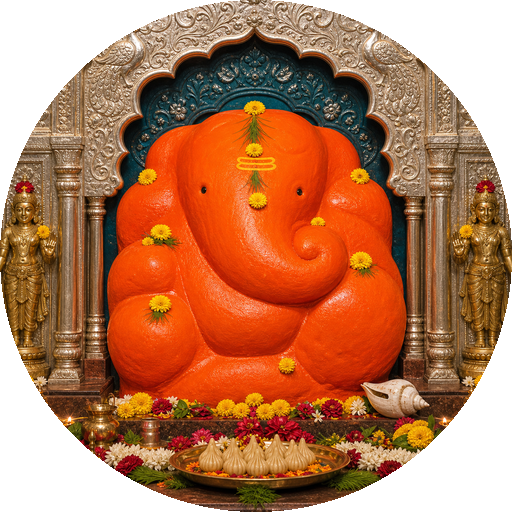
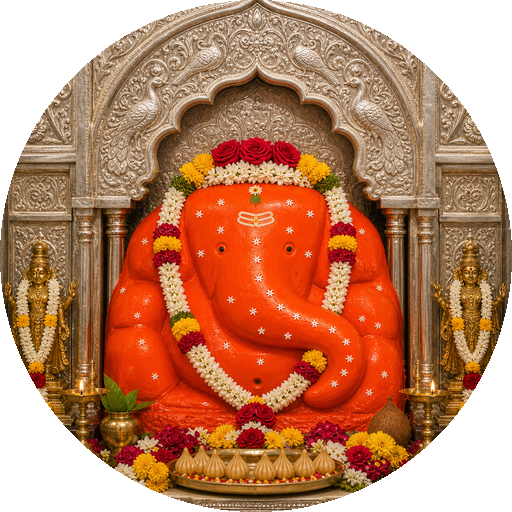
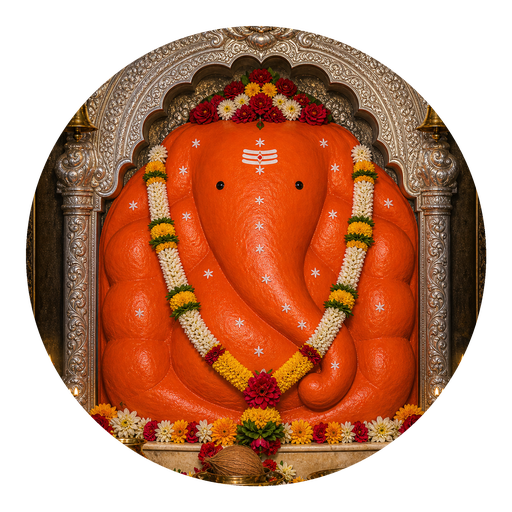
The murti's trunk turns to the left. By tradition a left-trunked murti is considered gentle and auspicious for household worship; but such meanings of the trunk's direction are mainly matters of folk belief and tradition and should not be taken as any universal rule.
Place in the Ashtavinayak
The pilgrimage to Maharashtra's eight swayambhu (self-manifested) Ganesh kshetras is called the Ashtavinayak, and Ozar is one of them. It is one of the five Ashtavinayak in Pune district (Morgaon, Theur, Lenyadri, Ozar, Ranjangaon). In the shastrokta (scriptural) yatra order, Ozar is taken to be the seventh Ganpati (…Lenyadri → Ozar → Ranjangaon → back to Morgaon). On the actual journey, however, convenience of route means pilgrims often visit Ozar in a different order — sometimes fifth — so no single number should be treated as final.
The Junnar area
Ozar and nearby Lenyadri (Girijatmaj) are both Ashtavinayak of the Junnar belt and very close to each other, and Shivneri fort (the birthplace of Chhatrapati Shivaji Maharaj) is in the same area — so Ozar and Lenyadri are easily taken together in one combined trip.
History & legend
The sthala-katha of Ozar's Vighneshwar is tied to Ganesh's defeat of a demon named Vighnasura. The core of the story is much the same across versions, though the details vary slightly.
The shared thread. Vighnasura was a demon who brought obstacles and disturbances into the world; he troubled sages and gods by obstructing yajnas and sacred works. At the prayer of the gods and sages, Ganesh defeated Vighnasura. The defeated demon surrendered and requested that wherever Ganesh is worshipped, his own name (the name of vighna) be joined too — and so Ganesh came to be known here as ‘Vighneshwar / Vighnahar.’ The katha carries the idea that ‘where Ganesh is remembered, obstacles do not remain.’
The fuller Puranic version. Some versions give more detail: King Abhinandana (of the city of Hemavati) performed a yajna but did not give Indra his due share/offering. The angered Indra commanded Kala to disrupt the yajna, and from this Vighnasura was born; he brought obstacles into yajnas and sacred works. In the end, at the request of the gods and sages, Ganesh defeated him, and at the surrendered demon's request he remained here as ‘Vighneshwar.’ This fuller version is not from a single source — it appears in several Puranas such as the Mudgala Purana (Skandha 7 — Vighnaraja), the Ganesha Purana and the Skanda Purana; but the exact name and the sub-legend details change from version to version, so they should not be treated as final.
Building history — the golden dome
Two things in Ozar's history should be kept apart. First — the golden dome: by tradition, Chimaji Appa — Peshwa Bajirao's younger brother and military commander — gilded the shikhara/dome here in gratitude after taking the fort of Vasai from the Portuguese (around 1739). This is what makes it the only golden-dome Ganpati of the Ashtavinayak. The second thing is separate — the temple's construction/renovation: by some accounts the present structure/renovation dates to about 1785, and later, in 1967, the Ganesh devotee Appa Shastri Joshi carried out a renovation. The golden dome (~1739) and the temple's construction/renovation (~1785 and 1967) are two separate events.
Architecture
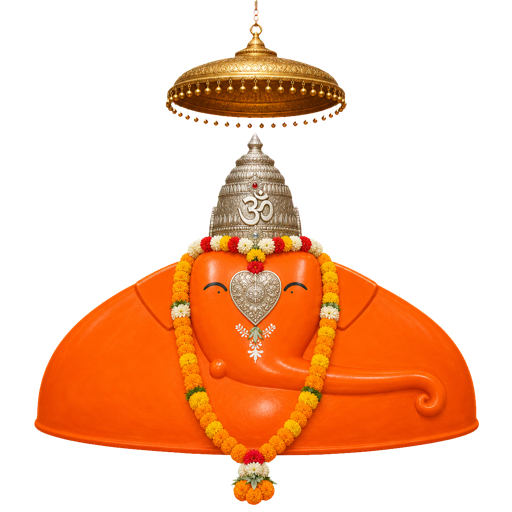
- The golden dome (the standout feature): the shikhara over the garbhagriha is covered in gold foil — the only gold-domed temple of the Ashtavinayak.
- The deepmala (the second feature): near the entrance stand two large stone deepmalas (lamp-towers); on Kartik Poornima they are lit with lamps. This is Ozar's distinctive visual occasion.
- Entrance and sabhamandap: a grand entrance with stone dwarapala (gate-guardian) sculptures on both sides; a handsome corridor of seven cusped arches and two halls/sabhamandaps (by some accounts roughly 20 ft and 10 ft in height). Inside, a white-marble mushika (Ganesh's mount) is recorded.
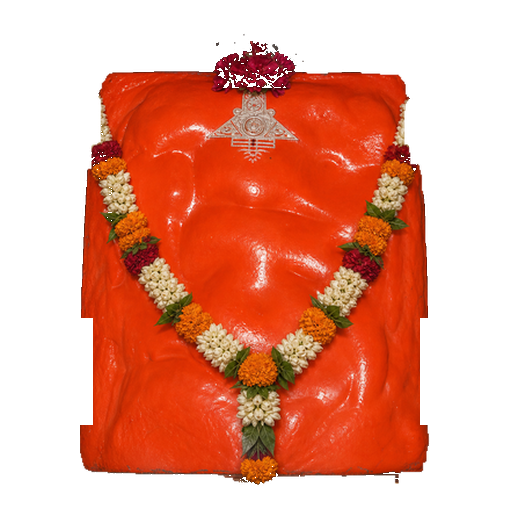
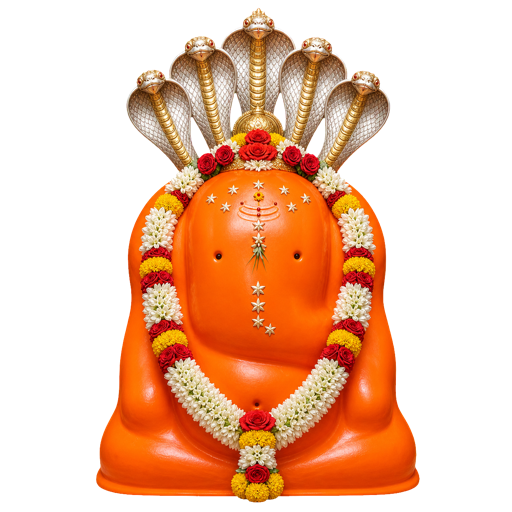
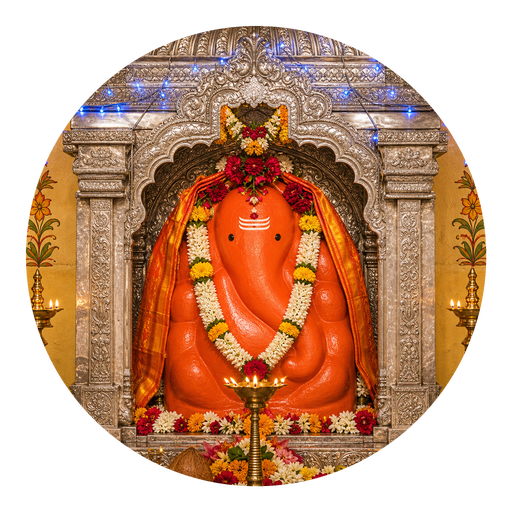
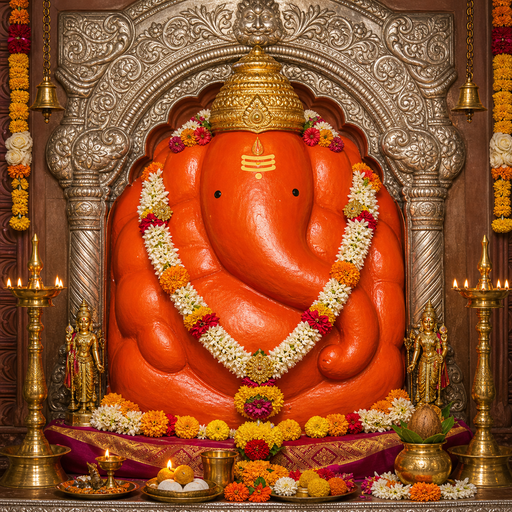
- The murti: Vighneshwar's murti is held to be a swayambhu (self-manifested) elephant-faced stone murti; by tradition it is east-facing and left-trunked, and coated in shendur (vermilion) and oil. Jewels are said to be set in the eyes (by some accounts emeralds, by others rubies) and diamonds on the forehead and at the navel; brass murtis of Riddhi-Siddhi flank it on both sides. The exact jewel details differ slightly across sources.
- The precinct: a fenced, spacious complex with a courtyard and a stone pradakshina (circumambulation) path on both sides. Because the temple is on the bank of the Kukadi river, some devotees bathe in the Kukadi.
Festivals & yatra
Each festival below is fixed by tithi; each date links to that day's panchang page. Ganesh Chaturthi, Maghi Ganesh Jayanti and Sankashti are general Ganesh tithis; the Kartik Poornima deepmala festival, however, is Ozar-specific. The actual yatra, palkhi/rath and the programme on the day should be verified with the temple trust (these can change).
| Festival / yatra | Tithi (rule) | This year's date | Occasion |
|---|---|---|---|
| Kartik Poornima Deepotsav (Ozar-specific deepmala event) | Kartik Shukla Poornima (Tripurari) | Tue, 24 Nov 2026 — nakshatra Krittika | panchang label: “Tripurari Poornima.” The stone deepmalas are lit for a deepotsav; the duration/exact vidhi → verify with the trust |
| Shri Ganesh Chaturthi / Ganeshotsav | Bhadrapad Shukla Chaturthi (midday) | Mon, 14 Sep 2026 — nakshatra Chitra | Universal Ganeshotsav; details on the Ganesh Chaturthi page |
| Shri Ganesh Jayanti (Maghi) / Vinayak Chaturthi | Magh Shukla Chaturthi | Thu, 22 Jan 2026 — nakshatra Shatataraka | Maghi Ganesh Jayanti; a general Ganesh tithi → linked to the Sankashti Chaturthi and Ganesh Chaturthi pages |
| Angarki Sankashti Chaturthi (Sankashti falling on a Tuesday) | Krishna Chaturthi + Tuesday | 6 Jan · 5 May · 29 Sep 2026 | Special crowds and specially auspicious at a Ganesh kshetra; see Sankashti Chaturthi |
| Monthly Sankashti / Vinayak Chaturthi | Krishna/Shukla Chaturthi (every month) | Every month (about 24/year — not all listed here) | Darshan importance on every Chaturthi; see Sankashti Chaturthi |
| Ozar's own annual palkhi/rath-yatra | Tithi uncertain (not yet on record) | (date not found) | Obtain the exact tithi/date from the temple trust |
Note: These dates fall differently each year because the identity is the tithi — the Gregorian date is only that year's detail. Look up each month's exact Sankashti and Vinayak Chaturthi dates on that day's panchang page.
Darshan & aarti timings
⚠️ The sources for the timings do not agree — the text below is a rough guide; take none of it as a firm official timing.
The available sources for Ozar Vighneshwar's darshan/aarti timings conflict with each other — one portal says the temple is open 5 am to 11 pm, while some yatra portals give 5 am to 10 pm; no official temple-trust-confirmed timing could be fixed. It is generally recorded that there is a kakad aarti in the early morning and a maha/shej aarti in the evening. Timings change during festivals and on Angarki, so verify the exact darshan/aarti timings with the temple trust before you visit.
Special rituals
- The Kartik Poornima deepmala lighting (a distinctive custom): on Kartik Poornima, both stone deepmalas here are lit with lamps and a deepotsav is observed over the following days. Some sources describe this as a roughly five-day festival, but the exact duration and the day-by-day vidhi are not consistently reported everywhere; verify them with the temple trust.
- Daily puja/abhishek/alankar and the special rituals follow the temple's own custom and can vary by place and season.
How to reach
- Location: Ozar, Tal. Junnar, Dist. Pune — on the bank of the Kukadi river, near the Yedgaon dam.
- By road: Ozar is on the Pune–Nashik highway, about 9 km north of Narayangaon and about 85 km from Pune. ST buses and private vehicles are available via Pune/Narayangaon/Junnar; on an Ashtavinayak yatra, Ozar can be taken together with Lenyadri.
- By rail/air: the most convenient big railway station and airport is Pune; from there it's roughly a 2-hour drive via Narayangaon. Check a live map for the exact route.
Nearby places
- Lenyadri Girijatmaj — the nearby Ashtavinayak of the Junnar belt (the only hill one); Ozar and Lenyadri are easily taken together.
- Shivneri fort (the birthplace of Chhatrapati Shivaji Maharaj) — near Junnar; easily added to the yatra.
- Ranjangaon Mahaganpati — the Ashtavinayak that follows Ozar in the scriptural order.
- The Kukadi river / Yedgaon dam — the temple surroundings; the area's scenery and bathing ghats. (Check distances on a map.)
Travel tips
- Planning a combined trip: since Ozar and Lenyadri are close, it is convenient to plan them together; Shivneri can be added too — keep enough time in hand.
- Crowds: expect large crowds on Ganesh Chaturthi, Maghi Ganesh Jayanti, Angarki Sankashti and the Kartik Poornima deepotsav — the darshan queues are long; go early and take care of elders and small children.
- The deepmala occasion: on Kartik Poornima, the evening is the right time for a deepmala darshan; verify the exact days/timing with the temple trust.
- Timings change: darshan timings and special darshan change on the temple trust's official notice; there is a source conflict on timings (10 pm vs 11 pm) — verify before you travel. Follow the photography rules.
Ashtavinayak — scriptural order & travel route
The scriptural (shastrokta) order of the eight Ashtavinayak kshetras is taken to be as below, with Ozar seventh:
- Morgaon — Mayureshwar · Tal. Baramati, Dist. Pune
- Siddhatek — Siddhivinayak · Dist. Ahmednagar (Ahilyanagar)
- Pali — Ballaleshwar · Dist. Raigad
- Mahad — Varadvinayak · Dist. Raigad
- Theur — Chintamani · Tal. Haveli, Dist. Pune
- Lenyadri — Girijatmaj · Dist. Pune
- Ozar — Vighneshwar (this page) · Tal. Junnar, Dist. Pune
- Ranjangaon — Mahaganpati · Dist. Pune
On the actual journey, however, the order changes with distance and convenience — pilgrims often visit Ozar in a different order, sometimes fifth (for instance, taking the Junnar-side Lenyadri–Ozar together from one side). The exact route depends on where you begin and on convenience; no single order should be treated as final.
Mantra & aarti
A simple jap-mantra for Ganpati: Om Gam Ganpataye Namah — meaning: a bow to Ganpati (a bija-mantra).
The best-known aarti sung at Ozar and every Ashtavinayak and Ganesh temple is Samarth Ramdas's “Sukhkarta Dukhharta.” It is sung morning and evening and at darshan. In meaning, it praises Ganpati as the giver of happiness and the remover of sorrow and obstacles (sukhkarta, dukhharta, varta vighnachi), describes his beautiful shendur-adorned form and jewelled crown, and prays that he protect the devotee in every difficulty. Its recognizable opening line is “Sukhkarta Dukhharta, varta vighnachi…”.
Good to know
- Ozar's Vighneshwar is the only golden-dome Ganpati of the Ashtavinayak (seventh in the scriptural order) — ‘Vighnahar’ from the Vighnasura legend.
- The golden dome (around 1739, after the Vasai victory) and the temple's construction/renovation (around 1785 / 1967) are two separate events.
- Bhadrapad Ganesh Chaturthi (Sep), Maghi Ganesh Jayanti (Jan), the monthly Sankashti/Vinayak Chaturthi, and the Kartik Poornima deepotsav (Nov) are four distinct occasions.
- Darshan/aarti timings, yatra dates, the Kartik deepotsav duration, the katha and the vidhi should be verified with the temple trust.
FAQ
- Where is the Ozar Vighneshwar temple?
- On the bank of the Kukadi river, at Ozar (Tal. Junnar, Dist. Pune); on the Pune–Nashik road, about 9 km north of Narayangaon and about 85 km from Pune. It is one of the Ashtavinayak kshetras.
- Which is the golden-dome Ganpati of the Ashtavinayak?
- Ozar's Vighneshwar — the only golden-dome (gold-plated shikhara) Ganpati of the Ashtavinayak; by tradition, Chimaji Appa gilded the dome after the victory at Vasai.
- How did Vighneshwar get the name “Vighnahar”?
- After Ganesh defeated Vighnasura (the obstacle-bringing demon), at the surrendered demon's request the word ‘vighna’ was joined before Ganesh's name — hence ‘Vighneshwar / Vighnahar.’ The fuller King-Abhinandana version appears in several Puranas.
- Who built Ozar's golden dome?
- By tradition, the Peshwa commander Chimaji Appa gilded the dome after taking the fort of Vasai from the Portuguese. The temple's construction/renovation is a separate stage — by some accounts about 1785, and a 1967 renovation by Appa Shastri Joshi.
- What is the murti like (trunk, direction, jewels)?
- The murti is held to be swayambhu; by tradition it is east-facing and left-trunked, coated in shendur. Jewels are said to be set in the eyes (emeralds/rubies — sources differ) and diamonds on the forehead and navel; Riddhi-Siddhi flank it. The exact jewel details differ slightly.
- Which number is Ozar in the Ashtavinayak?
- In the shastrokta order, the seventh; on the actual journey, though, the order changes by route, so no single number should be treated as final.
- What is special at Ozar on Kartik Poornima?
- Both stone deepmalas here are lit with lamps and a deepotsav is observed (this year, 24 November 2026). Some sources describe a roughly five-day festival; verify the exact duration and vidhi with the temple trust.
- How far is Ozar from Pune and how to reach?
- About 85 km; on the Pune–Nashik road, via Narayangaon (about 9 km). ST buses/private vehicles are available; Lenyadri and Shivneri are nearby. Verify the exact distance/station.