Theur Chintamani
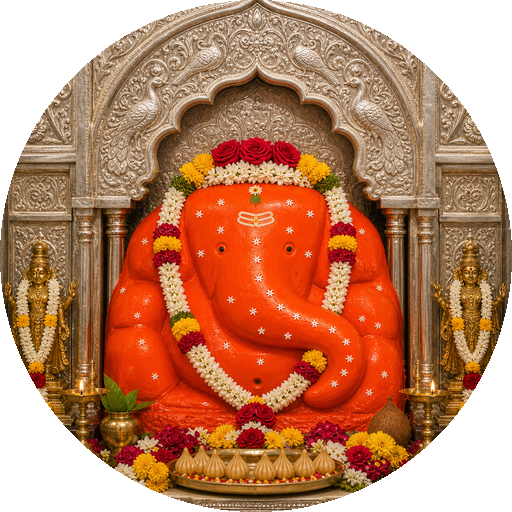
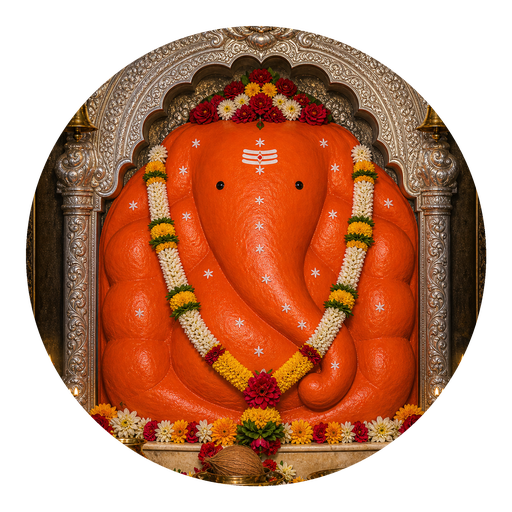
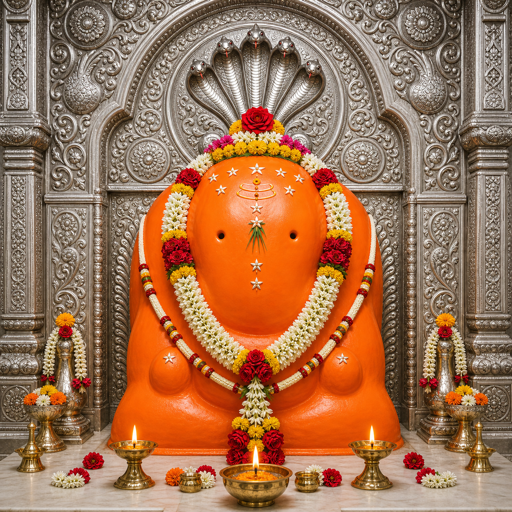
Theur's Chintamani is an ancient Ganesh kshetra in Haveli taluka of Pune district, near the sangam (confluence) of the Bhima and Mula-Mutha rivers — and the fifth Ganpati of the Ashtavinayak (in the scriptural order). “Chintamani” means the Ganpati who removes his devotees' worries (chinta) and gives the mind peace. The murti is swayambhu (self-manifested), east-facing, seated, and its trunk turns to the left. The kshetra's most cherished link is with history — it was the ishta-daivat (chosen deity) of Thorle Madhavrao Peshwa, who built a wooden sabhamandap here and passed away in the temple premises on 18 November 1772.
This year's dates (2026)
- Maghi Ganesh Jayanti / Vinayak Chaturthi — Theur's main annual utsav (verify with the temple trust)22 Jan
- Shri Ganesh Chaturthi / Ganesh Prakatotsav (Bhadrapad Shu. 1–7)14 Sep
- Angarki Sankashti Chaturthi (Tuesday) — special crowds6 Jan
- Angarki Sankashti Chaturthi (Tuesday)5 May
- Angarki Sankashti Chaturthi (Tuesday)29 Sep
- Sankashti Chaturthi (monthly — example; all Sankashti/Vinayaki Chaturthi draw crowds)5 Feb
Deity & significance
The Ganesh here is worshipped as Shri Chintamani Vinayak. “Chinta” means worry and “mani” means jewel — as per the legend, Ganesh recovered a lost, wish-fulfilling divine jewel named “Chintamani,” so the deity came to be known as “Chintamani”: the one who removes worry and gives the mind peace.
In the Ashtavinayak yatra, Theur is regarded as the kshetra of “chinta-haran” (the lifting of worry); devotees visit seeking peace of mind, buddhi (wisdom), and prosperity.
Place in the Ashtavinayak.
The pilgrimage to Maharashtra's eight swayambhu Ganesh kshetras is called the Ashtavinayak. In the shastrokta (scriptural) order, Theur's Chintamani is the fifth Ganpati (after Morgaon, Siddhatek, Pali and Mahad). Because Theur is a central stop near Pune on the Ashtavinayak yatra, most pilgrims take it right on the way. The full scriptural order and the practical travel route are given at the end of this page.
Theur is sometimes called “the largest/grandest of the Ashtavinayak”; that is a subjective view. It is a prasiddha (renowned) and bhavya (grand) kshetra.
History & legend
The story of Chintamani's appearance comes from the Mudgala Purana, and its core is much the same across versions.
The shared thread — Kapil Muni and Ganasura.
The sage Kapil Muni possessed a wish-fulfilling divine jewel named “Chintamani.” A powerful but greedy king named Ganasura came to the sage's ashram with his army. Enchanted by the feast and splendour the jewel produced, he asked for it, and when refused, seized it by force.
Kapil Muni invoked Ganesh. Ganesh defeated Ganasura in battle, recovered the jewel and returned it to the sage. Out of gratitude the sage offered the jewel back around Ganesh's neck — which is why the deity is called “Chintamani.” This is believed to have happened under a kadamba tree, so the place is also called “Kadambanagar / Kadambapur.”
Where the versions diverge.
In some versions Ganasura is the son of King Abhijit and Queen Gunavati; a boon from Shiva makes him invincible. In this version Ganesh's shakti creates a thousand-armed warrior who destroys the army, while Ganesh himself severs Ganasura's head.
A second version — Brahma / Indra.
In some versions Brahma performed penance here and made his restless mind still (sthavara) — hence the kshetra is called “Sthavara Kshetra.” In another, Indra worshipped Ganesh under a kadamba tree to be freed from the curse of sage Gautam — hence the name “Kadambanagar.” Both sub-legends exist in the tradition.
The historical layer — the Peshwa era.
Thorle Madhavrao Peshwa (reigned 1761–1772) was a devout follower of Chintamani; he would come for darshan before and after campaigns. He carried out the jirnoddhar (renovation) of the temple and built a teakwood sabhamandap in front.
When he fell ill with tuberculosis (from June 1770), Madhavrao spent his last days at this very kshetra and passed away in the temple premises on 18 November 1772, aged only 27; his wife Ramabai committed sati on his pyre. This history gives Theur a distinct emotional significance.
Chimaji Appa is said to have offered here a large European bell captured from the Portuguese during the Vasai campaign, which is said to still hang in the temple courtyard.
Architecture
The temple is built in the Peshwa-era architectural style. Its structure has a wooden mandap + stone sabhamandap + garbhagriha (sanctum), and the wooden sabhamandap was built by Madhavrao Peshwa. There is a recorded black-stone water fountain inside.
The murti.
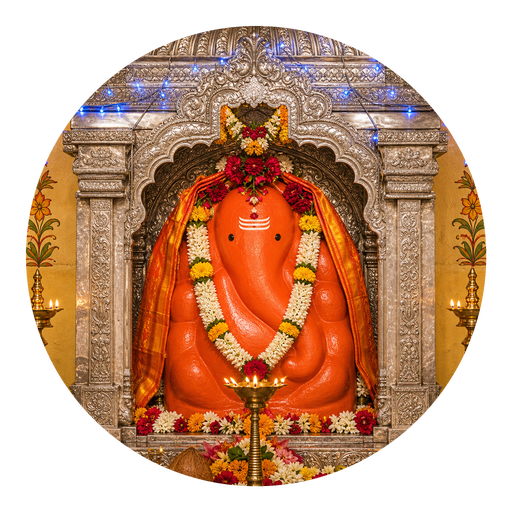
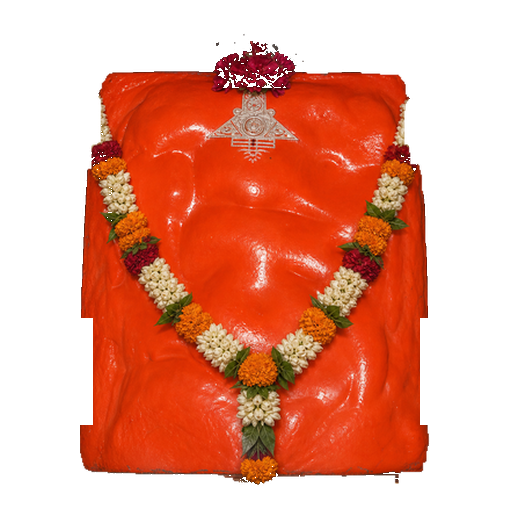
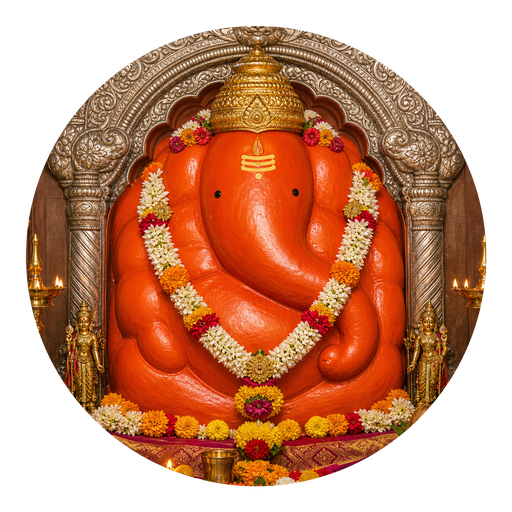
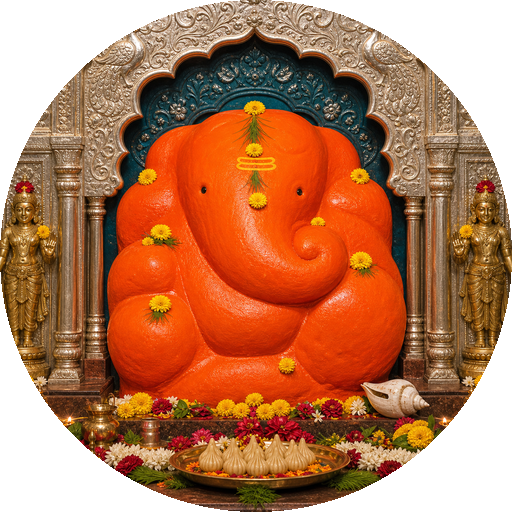
The Chintamani murti is believed to be swayambhu (self-manifested). Its trunk turns to the left, it is east-facing and seated, and jewels (diamonds/rubies) are set in its eyes; the murti is coated in shendur (vermilion). The main entrance faces north.
Other shrines in the complex.
Besides the main sanctum, the complex is said to have shrines of Vishnu-Lakshmi, Mahadev and a Dakshinamukhi Maruti (Hanuman), along with other Ganesh murtis.
Festivals & yatra
Each festival below is fixed by tithi; the Gregorian dates are taken as-is from this site's panchang records, and each date links to that day's panchang page. The actual yatra, rath/palkhi and the programme on the day should be verified with the temple trust (these can change).
| Festival / yatra | Tithi (rule) | This year's date | Occasion |
|---|---|---|---|
| Maghi Ganesh Jayanti / Maghotsav (Theur's main annual utsav) | Magh Shukla Chaturthi | Thu, 22 Jan 2026 — nakshatra Shatataraka | panchang label: “Shri Ganesh Jayanti, Vinayak Chaturthi.” Day-by-day programme/rath procession → verify with the trust |
| Ganesh Prakatotsav / Ganesh Chaturthi (Bhadrapad Shu. 1–7; Chaturthi = the main day) | Bhadrapad Shukla Chaturthi | Mon, 14 Sep 2026 — nakshatra Chitra | Universal Ganeshotsav; details on the Ganesh Chaturthi page |
| Angarki Sankashti Chaturthi (Sankashti falling on a Tuesday) | Krishna Chaturthi + Tuesday | 6 Jan · 5 May · 29 Sep 2026 | Special crowds and specially auspicious at a Ganesh kshetra |
| Monthly Sankashti / Vinayaki Chaturthi | Krishna/Shukla Chaturthi (every month) | e.g. Sankashti 5 Feb 2026 — nakshatra Uttara Phalguni | Darshan crowds on every Chaturthi; see Sankashti Chaturthi |
| Rama-Madhav Punyotsav (death anniversary of Madhavrao & Ramabai) | Kartik (tithi — to be verified) | exact Kartik tithi to be verified with the trust | A history-linked memorial observance |
Monthly Sankashti Chaturthi (every Krishna Chaturthi) and Vinayaki Chaturthi (every Shukla Chaturthi) also carry special importance for darshan at a Ganesh kshetra like Theur. Look up each month's exact date on that day's panchang page.
A note on Rama-Madhav Punyotsav: the death anniversary of Madhavrao and Ramabai is tied to Theur. While Madhavrao's date of death, 18 November 1772, is fixed in the historical sources, exactly which Kartik tithi the temple's punyotsav falls on is ambiguous in the sources; verify the exact tithi and this year's date with the temple trust.
Note: These dates fall differently each year because the identity is the tithi — the Gregorian date is only that year's detail. The main utsavs are Maghi Ganesh Jayanti on Magh Chaturthi and Ganesh Chaturthi on Bhadrapad Chaturthi.
Darshan & aarti timings
⚠️ The sources for the timings do not agree — the figures below are a rough guide; take none of them as a firm official timing.
The available sources for Theur Chintamani's darshan/aarti timings conflict with each other:
- One informational source says the temple is open roughly from early morning to night.
- Another source says darshan is 6 am–1 pm and 2 pm–10 pm; on Angarki, 4 am–11 pm; Maha-aarti at 7:30 am, Madhyan (noon) aarti at 12 pm, Shej-aarti at 10 pm.
None of these could be fixed as an official, temple-trust-confirmed timing. Timings change during festivals and on Angarki, so verify with the temple trust before you travel.
Special rituals
- There is a historical mention that Madhavrao Peshwa performed a milk abhishek (abhishek with milk) of Chintamani.
- There is a mention of a dwar-yatra in the months of Bhadrapad and Magh, a yatra that visits nearby sites; its exact vidhi and route should be verified with the official trust.
No puja vidhi/abhishek is presented as “universal”; it follows the temple's own custom and can vary by place and season.
How to reach
- Location: Theur, Tal. Haveli, Dist. Pune — near the sangam of the Bhima and Mula-Mutha rivers.
- By road: from Pune, about 22–27 km (via Hadapsar / Loni Kalbhor, depending on route). A private vehicle/taxi from Pune city is convenient.
- By rail/air: the nearest big city, railway station and airport is Pune.
- Management/address (to be verified): available sources say the management is with the Chinchwad Devasthan Trust and that there is a bhakta niwas (guest house) in the complex (contact: Manager, Shri Chintamani Mandir, Theur, Tal. Haveli, Dist. Pune, PIN 412110). Confirm it with the official trust.
Nearby places
- The sangam of the Mula-Mutha and Bhima rivers — right by Theur; tied to the kshetra's sanctity.
- The sibling Ashtavinayak kshetras around Pune — Morgaon Mayureshwar, Siddhatek Siddhivinayak, Ranjangaon Mahaganpati, Ozar Vighneshwar and Lenyadri Girijatmaj — are the usual nearby/next stops after Theur.
- Pune city — Dagdusheth Halwai Ganpati and other darshan sites. (Check distances on a map.)
Travel tips
- Expect very large crowds on Angarki Sankashti, Maghi Ganesh Jayanti and the Bhadrapad Ganeshotsav — the darshan queues are long; go early and keep time in hand.
- Darshan/aarti timings and the special Angarki timings change — confirm with the temple trust before you set out.
- A bhakta niwas is said to be available in the complex (management to be verified) — enquire ahead for a stay.
- Since Theur is a central Ashtavinayak kshetra near Pune, a combined day-trip from Pune covering Morgaon/Theur/Ranjangaon works well.
Ashtavinayak — scriptural order & travel route
The scriptural (shastrokta) order of the eight Ashtavinayak kshetras is taken to be as below, with Theur fifth:
- Morgaon — Mayureshwar · Tal. Baramati, Dist. Pune
- Siddhatek — Siddhivinayak · Dist. Ahmednagar
- Pali — Ballaleshwar · Dist. Raigad
- Mahad — Varadvinayak · Dist. Raigad
- Theur — Chintamani (this page) · Tal. Haveli, Dist. Pune
- Lenyadri — Girijatmaj · Dist. Pune
- Ozar — Vighneshwar · Dist. Pune
- Ranjangaon — Mahaganpati · Dist. Pune
On the actual journey, however, the order changes with distance, convenience, and where you start. Pilgrims setting out from Pune typically cover Theur → Morgaon → Siddhatek → Ranjangaon in one day; those coming from Mumbai plan Pali → Mahad → Lenyadri → Ozar as a separate leg. See the Ashtavinayak hub page for the fuller day-by-day plan.
Mantra & aarti
A simple jap-mantra for Ganpati: Om Gam Ganpataye Namah
The best-known aarti sung at Theur and every Ganesh temple is Samarth Ramdas's “Sukhkarta Dukhharta.” It is sung morning and evening and at darshan. In meaning, it praises Ganpati as the giver of happiness and the remover of sorrow and obstacles (sukhkarta, dukhharta, varta vighnachi), describes his beautiful shendur-adorned form, and prays that he protect the devotee in every difficulty. Its recognizable opening line is “Sukhkarta Dukhharta, varta vighnachi…”.
Good to know
- Theur's Chintamani is the fifth Ganpati of the Ashtavinayak (in the scriptural order) — the kshetra of “chinta-haran.”
- The versions of the katha (who gave the jewel, Ganasura's parents, the Brahma/Indra sub-legend) differ; do not treat any single version as final.
- Darshan/aarti timings, the yatra programme, special rituals and the managing trust should be verified with the temple trust.
FAQ
- Which number is Theur's Ganpati in the Ashtavinayak?
- In the shastrokta order, the fifth — Shri Chintamani.
- How did the name “Chintamani” come about?
- Ganesh recovered Kapil Muni's seized Chintamani jewel; the grateful sage offered it back around Ganesh's neck → hence “Chintamani,” the Ganpati who removes worry (chinta).
- What are the Theur Chintamani temple's darshan timings?
- The sources differ; roughly early morning to night. Verify the exact timing with the temple trust (timings change during festivals/Angarki).
- How many kilometres is Theur from Pune?
- About 22–27 km, depending on route; Tal. Haveli, Dist. Pune.
- What is Madhavrao Peshwa's connection with Theur?
- Chintamani was his ishta-daivat; he renovated the temple and built the wooden sabhamandap, and he passed away in the temple premises on 18 November 1772; his wife Ramabai committed sati.
- When is Theur's biggest yatra?
- The main annual utsav is Maghi Ganesh Jayanti (Magh Shu. 4 → 22 January this year, 2026) and the Bhadrapad Ganeshotsav; verify the exact utsav programme with the trust.
- Does the Theur murti have a left or right trunk?
- A left-turning trunk — the murti is swayambhu, east-facing and seated.