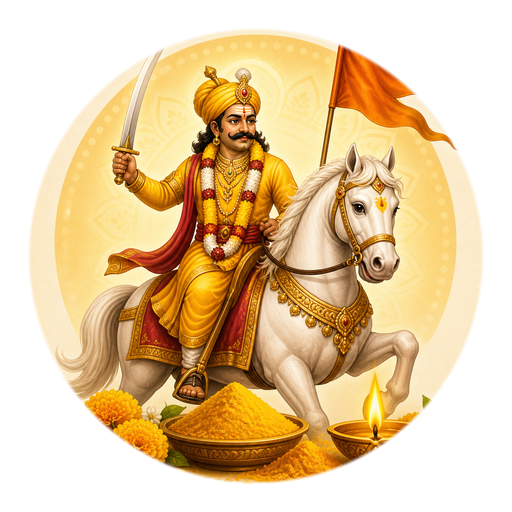
Morgaon Mayureshwar
Morgaon's Mayureshwar (Moreshwar) is an ancient Ganesh kshetra on the banks of the Karha river in Baramati taluka, Pune district — and the first Ganpati of the Ashtavinayak yatra. By tradition the Ashtavinayak circuit begins and ends here; the yatra is not considered complete until you return to Morgaon. As per the legend, Ganesh took the Mayureshwar form riding a mor (peacock, Sanskrit mayura) and slew the daitya (demon) Sindhu here, which gives the deity its name. The temple looks like a fort — a tall black-stone wall with turrets at its four corners — and is today managed by the Chinchwad Devasthan Trust.
This year's dates (2026)
- Maghi Ganesh Jayanti / Vinayak Chaturthi — Mayureshwar prakatya tithi (per trust katha); palkhi from Chinchwad22 Jan
- Shri Ganesh Chaturthi — the biggest utsav; palkhi from Chinchwad14 Sep
- Vijayadashami / Dasara — jatra at the temple20 Oct
- Angarki Sankashti Chaturthi (Tuesday) — specially auspicious6 Jan
- Angarki Sankashti Chaturthi (Tuesday)5 May
- Angarki Sankashti Chaturthi (Tuesday)29 Sep
- Somvati Amavasya — jatra at the temple16 Feb
- Somvati Amavasya — jatra at the temple15 Jun
- Somvati Amavasya — jatra at the temple13 Jul
- Somvati Amavasya — jatra at the temple9 Nov
Deity & significance
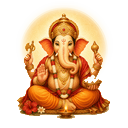
The Ganesh here is worshipped as Mayureshwar / Moreshwar — “the one mounted on a peacock.” The name comes from Sanskrit mayura and Marathi mor (peacock).
The Ganesh Purana and Mudgala Purana treat Morgaon (called Mayurapuri) as a supreme Ganesh kshetra; the Mudgala Purana is said to devote about twenty-two chapters to Morgaon's mahatmya. Morgaon is regarded as the adipeeth (foremost seat) of the Ganapatya sampradaya — the tradition that reveres Ganesh as Parabrahma. Its sanctity is spoken of alongside that of Kashi.
Place in the Ashtavinayak.
The pilgrimage to Maharashtra's eight swayambhu (self-manifested) Ganesh kshetras is called the Ashtavinayak, and it begins and ends at Morgaon — that is this kshetra's chief distinction. Put simply, the first Ganpati of the Ashtavinayak is Morgaon's Mayureshwar.
The full Ashtavinayak yatra guide and details of the other seven kshetras are on a separate page; the scriptural order and the practical travel route are both covered further below.
History & legend
The story of Mayureshwar's appearance comes from the Ganesh Purana, and its core is much the same across versions; the details, however, vary.
The shared thread.
In the Treta Yuga a powerful daitya named Sindhu (Sindhurasura) tormented the gods and the earth. Wearied by him, the gods invoked Ganesh. Ganesh took the Mayureshwar avatar, rode a mor (peacock), slew Sindhu in battle and restored peace. From the peacock mount he is called “Mayureshwar,” and from the peacocks that lived there the village came to be called “Morgaon.”
Where the versions diverge.
In the Ganesh Purana version, Sindhu is the son of King Chakrapani of Mithila and Ugra; unable to bear the heat of a conception born of a surya-mantra, Ugra released the embryo into the sea, hence the name “Sindhu.” A boon from Surya gave him a vessel of amrit (nectar). In this version Ganesh first cuts the commander Kamalasura into three and then splits open Sindhu's amrit-laden body to kill him; here Mayureshwar is described as shadbhuja (six-armed) and white-complexioned.
In some versions — notably the Chinchwad Devasthan Trust's — there are two daityas, Sindhu and Kamalasura; goddess Parvati performs tapascharya for Ganesh in a hill cave, a peacock is created from the womb of Viniti (wife of Kashyapa), and riding it Ganesh slays both; the pancha-devas then install the Mayureshwar murti on Bhadrapad Shukla Chaturthi and give Ganesh the name “Mayureshwar.” In yet other versions it says only that “Ganesh, riding the peacock, struck Sindhu at the navel and killed him.”
The peacock's origin also shifts by version — in one from an egg fallen from a mango tree, in another from Viniti's womb, in another only “mounted on a peacock.”
Moraya Gosavi and Chinchwad.
The great Ganesh devotee Moraya Gosavi is said to have a close bond with Morgaon. By one account he worshipped at Morgaon and later moved to Chinchwad, founding a Ganesh temple there; by a Marathi folk account, after his father Vamanbhat Shaligram did penance at Morgaon, Mayureshwar himself was born as their son. Both accounts exist in the tradition; it is not right to fix one as true. His exact period is also uncertain — placed roughly between the 13th and 17th centuries.
Later, in the 18th century, the Peshwas gave the kshetra patronage and grants. Scholars differ on the temple's exact historicity, so the precise date of construction cannot be stated with certainty.
Architecture
Seen from afar, the temple looks like a fort. Its most striking features are a tall black (basalt) stone wall — by some accounts about fifty feet high — and turrets (minars) at its four corners, which show a Bahamani/Islamic architectural influence. By some accounts these turrets were added in the Mughal era for protection against raids.
The temple has four gates, one facing each direction. As per the English Wikipedia, these four gates are taken to symbolise the four yugas and the four purusharthas (dharma, artha, kama, moksha). The main entrance faces north and the inner courtyard has two deepmalas (lamp-towers), per the English Wikipedia.
The murti.
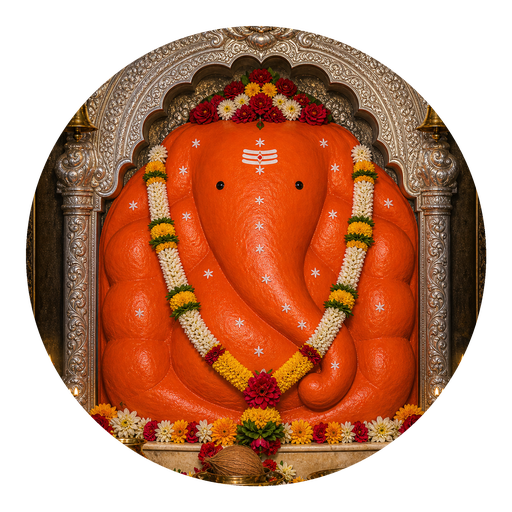
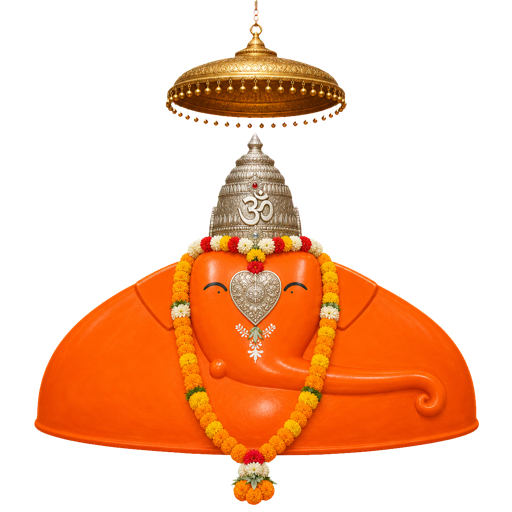
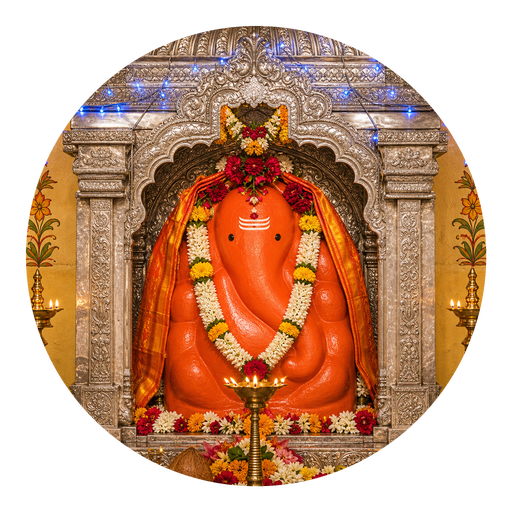
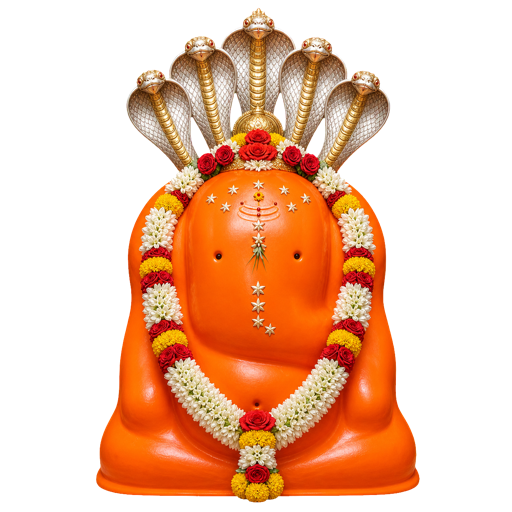
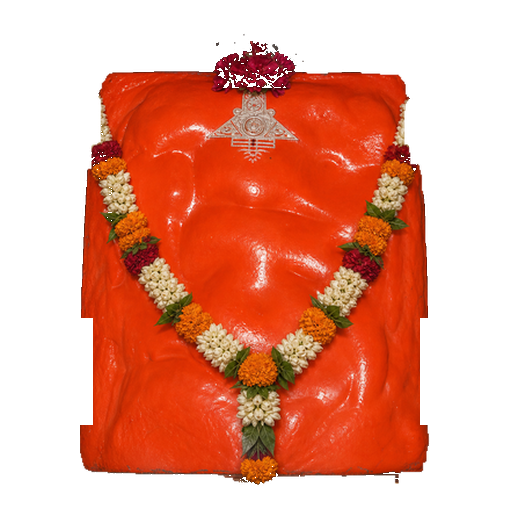
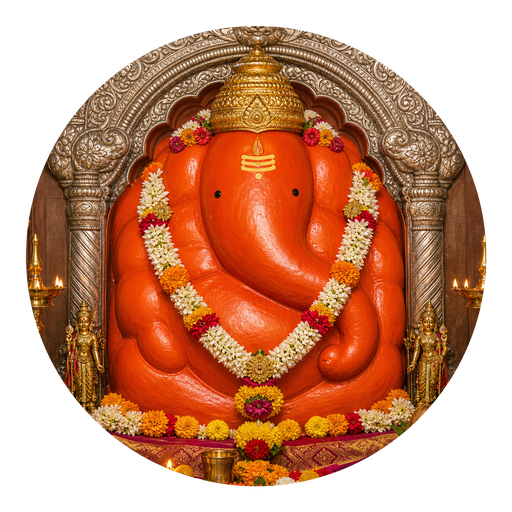
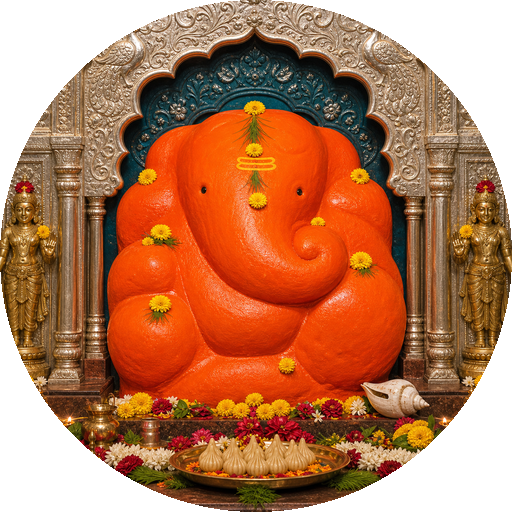
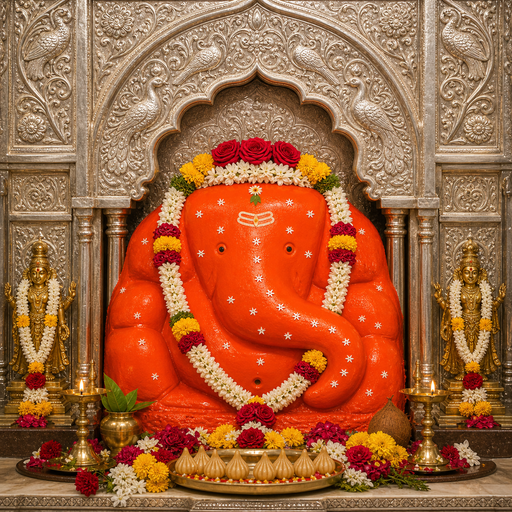
Per the English Wikipedia, the Mayureshwar murti is believed to be swayambhu (self-manifested). Its trunk turns to the left, diamonds are set in its eyes and navel, and a serpent's hood shelters its head; Riddhi-Siddhi (Siddhi-Buddhi) stand at its sides. The present murti is described as four-armed; note, however, that the Puranic Mayureshwar is described as six-armed and white-complexioned, so the Puranic form and the actual murti differ. It is recorded that the shendur (vermilion) layer on the murti sheds roughly once a century. In front of the temple stand a stone peacock and a mushak (mouse) about six feet high.
The unusual Nandi.
It is rare for Nandi, Shiva's mount, to sit before a Ganesh temple — and this is one of Morgaon's special features. The legend about it varies: in some versions the Nandi was being taken to a nearby Shiva temple when the cart's wheel broke and it stayed here; in others the Nandi itself insisted on remaining. The mushak and the Nandi are regarded as the temple's dwar-rakshaks (gate-guardians).
Festivals & yatra
Each festival below is fixed by tithi; the Gregorian dates are taken as-is from this site's panchang records, and each date links to that day's panchang page. The actual yatra, palkhi departure and the programme on the day should be verified with the temple trust (these can change).
| Festival / yatra | Tithi (rule) | This year's date | Occasion |
|---|---|---|---|
| Shri Ganesh Chaturthi (the biggest) | Bhadrapad Shukla Chaturthi | Mon, 14 Sep 2026 — nakshatra Chitra | Palkhi from Chinchwad; utsav runs about a month |
| Maghi Ganesh Jayanti / Vinayak Chaturthi | Magh Shukla Chaturthi | Thu, 22 Jan 2026 — nakshatra Shatataraka | Mayureshwar prakatya tithi (per trust katha); palkhi from Chinchwad |
| Vijayadashami / Dasara | Ashwin Shukla Navami | Tue, 20 Oct 2026 — nakshatra Shravan | Jatra at the temple |
| Angarki Sankashti Chaturthi | Krishna Chaturthi + Tuesday | 6 Jan · 5 May · 29 Sep 2026 | Specially auspicious at a Ganesh kshetra; large crowds |
| Somvati Amavasya | Amavasya + Monday | 16 Feb · 15 Jun · 13 Jul · 9 Nov 2026 | Jatra at the temple |
Monthly Sankashti Chaturthi (every Krishna Chaturthi) and Vinayak Chaturthi (every Shukla Chaturthi) also carry special importance for darshan at a Ganesh kshetra like Morgaon. Look up each month's exact date on that day's panchang page.
Note: These dates fall differently each year because the identity is the tithi — the Gregorian date is only that year's detail. The main utsavs on Bhadrapad and Magh Chaturthi are Ganesh Chaturthi and Maghi Ganesh Jayanti.
Darshan & aarti timings
The daily aarti timings below are based on the official Chinchwad Devasthan Trust (Morgaon) information. These times can change by season and during festivals, so verify with the temple trust before you set out.
| Aarti / puja | Time (approx.) |
|---|---|
| Kakad aarti | 5:00 am |
| Panchopachar puja / dhup-aarti | 7:00 am |
| Mahapuja / mahanaivedya | 12:00 noon |
| Maha-aarti / mantrapushpa | 8:30 pm |
| Shej-aarti | 10:30 pm |
By some accounts the main puja is recorded at 7 am, 12 noon and 8 pm — so minor differences are possible; give priority to the official trust timings. A mahaprasad (meal) is said to be available near the temple roughly between 12 noon and 2 pm; confirm this too with the trust.
Special rituals
On Bhadrapad and Magh Chaturthi, a palkhi comes to Morgaon from the Mangalmurti temple at Chinchwad — regarded as the most distinctive event here. Besides this, abhishek, mahapuja, mahanaivedya and maha-aarti are the daily and festival rituals. The exact vidhi, mantras and palkhi programme vary by place and season, so verify them with the official trust.
How to reach
- Location: Morgaon, Tal. Baramati, Dist. Pune, PIN 412304 — on the banks of the Karha river, in the middle of the village.
- By road: from Pune, by some accounts about 55 km (via Pune–Solapur) or about 64 km (via Hadapsar–Saswad–Jejuri) — the distance varies by route. Pune–Baramati state buses run regularly.
- By rail: the nearest station is Jejuri (about 17 km); taxis/autos are available from there.
- By air: Pune International Airport (about 80 km).
- Official management/address: Chinchwad Devasthan Trust, Morgaon, Tal. Baramati, Dist. Pune 412304 (head office at Chinchwad, Pune). Phone/email may change — confirm with the official trust.
Nearby places
- Jejuri Khandoba (about 17 km) — the famous kshetra of Martand Bhairav/Khandoba, right on the way to Morgaon.
- The next stops in the Ashtavinayak — Siddhatek Siddhivinayak and Theur Chintamani — are the usual route after Morgaon.
- Baramati town (about 20–25 km around) — for food and stay. (Check distances on a map.)
Travel tips
- Expect very large crowds on Angarki Sankashti, Ganesh Chaturthi and Maghi Ganesh Jayanti — plan early darshan and stay in advance.
- The trust's bhakta niwas (guest house) is said to be available at Morgaon; enquire ahead.
- Darshan/aarti timings and the palkhi programme change by season — confirm with the official trust before travelling.
- Since Mayureshwar is the first kshetra of the Ashtavinayak, if you are doing the whole circuit the tradition is to start from Morgaon and return to Morgaon at the end.
Ashtavinayak — scriptural order & travel route
The scriptural (shastrokta) order of the eight Ashtavinayak kshetras is taken to be as below, with Morgaon first:
- Morgaon — Mayureshwar (this page) · Tal. Baramati, Dist. Pune
- Siddhatek — Siddhivinayak · Dist. Ahmednagar
- Pali — Ballaleshwar · Dist. Raigad
- Mahad — Varadvinayak · Dist. Raigad
- Theur — Chintamani · Dist. Pune
- Lenyadri — Girijatmaj · Dist. Pune
- Ozar — Vighneshwar · Dist. Pune
- Ranjangaon — Mahaganpati · Dist. Pune
On the actual journey, however, the order changes with distance and convenience; pilgrims setting out from Pune usually take Morgaon → Theur → Siddhatek → Ranjangaon → Ozar → Lenyadri → Mahad → Pali and close the yatra by returning to Morgaon. (The exact route can change depending on where you begin.)
Mantra & aarti
A simple jap-mantra for Ganpati: Om Gam Ganpataye Namah
The best-known aarti sung at Morgaon and every Ganesh temple is Samarth Ramdas's “Sukhkarta Dukhharta.” It is sung morning and evening and at the palkhi/darshan. In meaning, it praises Ganpati as the giver of happiness and the remover of sorrow and obstacles (sukhkarta, dukhharta, varta vighnachi), describes his beautiful shendur-adorned form, and prays that he protect the devotee in every difficulty. Its recognizable opening line is “Sukhkarta Dukhharta, varta vighnachi…”.
Good to know
- Mayureshwar is the first and last kshetra of the Ashtavinayak — the yatra starts and ends here.
- The murti's number of arms and the peacock's origin differ by version; do not treat any single version as final.
- Darshan/aarti timings, yatra/palkhi dates and special rituals should be verified with the temple trust.
FAQ
- Which is the first Ganpati of the Ashtavinayak?
- Morgaon's Mayureshwar. By tradition the Ashtavinayak yatra begins and ends here.
- Where is the Morgaon Mayureshwar temple?
- In Baramati taluka of Pune district, on the banks of the Karha river. By some accounts about 55–64 km from Pune (depending on route).
- How did the names ‘Mayureshwar’ / ‘Morgaon’ come about?
- As per the legend, Ganesh mounted a mor (peacock, mayura) and slew the daitya Sindhu → hence “Mayureshwar”; and from the peacocks that lived there the village became “Morgaon.”
- Why is there a Nandi at the Morgaon temple?
- By legend the Nandi stayed here while being taken to a nearby Shiva temple (in one version the cart's wheel broke, in another the Nandi insisted). A Nandi before a Ganesh temple is considered rare.
- Why does the Ashtavinayak yatra begin from Morgaon?
- By tradition Morgaon is the start and the conclusion of the circuit; the yatra is held incomplete until you return to Morgaon.
- What are the Morgaon Mayureshwar darshan timings?
- Per the official trust, roughly from the kakad aarti around 5:00 am to the shej-aarti at 10:30 pm. The exact times change by season — verify with the temple trust.
- How do you get to Morgaon from Pune?
- By road about 55–64 km (via Saswad–Jejuri or via Solapur); the nearest railway station is Jejuri (about 17 km). Pune–Baramati state buses run regularly.