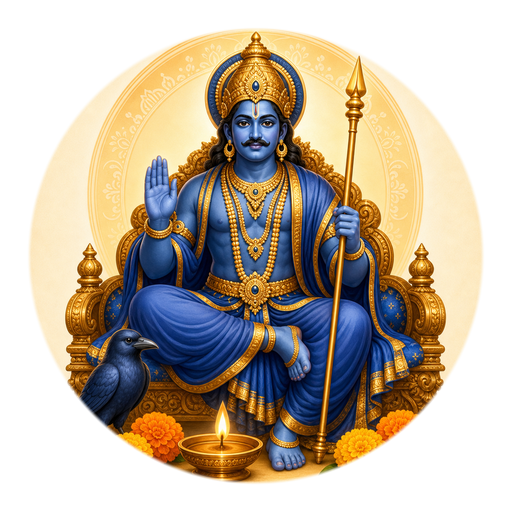
Shravani Shanivar (Ashwattha Maruti / Narasimha)
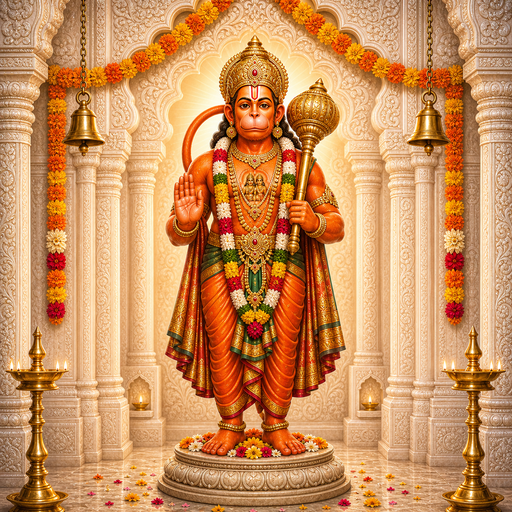
Shravani Shanivar is the joint worship of Maruti — under the ashwattha (peepal) tree — and Lord Narasimha (Vishnu's fourth avatar), observed on every Saturday of the month of Shravan; both pujas are performed the same day and regarded as complementary to each other. In 2026, there are four Shravani Saturdays — 15 August, 22 August, 29 August, and 5 September. This tradition is especially prevalent in Maharashtra and parts of Gujarat.
This year's dates (2026)
- The first Shravani Saturday — 2026 coincidence: Independence Day15 Aug
- The second Shravani Saturday — the only day of the year the panchang carries a direct 'Ashwattha Maruti Pujan' label22 Aug
- The third Shravani Saturday — 2026 coincidence: National Sports Day29 Aug
- The fourth (last) Shravani Saturday — 2026 coincidence: Dahi Handi/Gopalkala5 Sep
⚠️ Worth knowing: the "Sampat Shanivarchi Katha" on Marathi Wikisource is a story about Shani Dev, not Maruti — it belongs to the separate, general Shanivar Vrat page.
Deity and significance
The greatness of the ashwattha (peepal) tree: the peepal is regarded as the "tree of all deities" — believed to house Brahma at its roots, Vishnu in its trunk, and Shiva at its crown. In the Bhagavad Gita, Krishna says "Ashwatthah sarva-vrikshanam" (among trees, I am the ashwattha — Gita 10.26) — so worshipping the peepal is regarded as worshipping Vishnu. The root-trunk-crown detail (Brahma-Vishnu-Shiva), however, comes not from the Gita but from a separate, popular ashwattha-vandana verse.
The Saturday-Maruti connection: Saturday is regarded as Maruti's day — by one popular legend, Maruti freed Shani Dev from Ravana's captivity, and a grateful Shani promised that he wouldn't trouble devotees who worship Maruti with devotion on Saturdays. This is why Saturday worship of Maruti is considered especially significant for those experiencing sade-sati or other Shani-related hardship — this is a matter of belief, not a guarantee. The fuller, multi-version account of this relationship is on the Shanivar Vrat page.
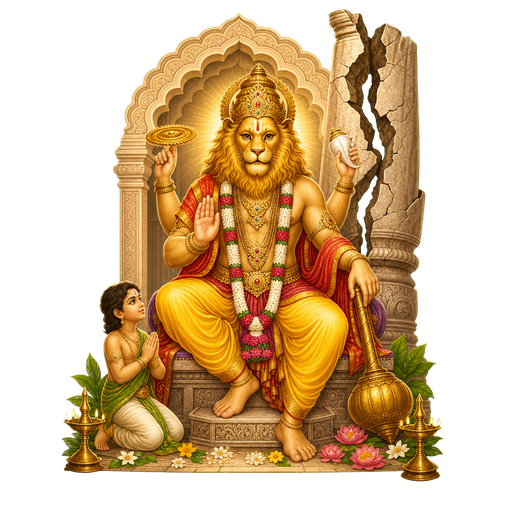
The purpose of Narasimha worship: this weekly puja is performed in remembrance of the Narasimha avatar that Vishnu took to protect Prahlad — not for wealth or progeny, but as an act of remembrance and gratitude. The full avatar story is given in detail on the Narasimha Jayanti page.
Shravani Shanivar is part of Shravan's weekly cycle of vrats — alongside Monday (Shivamuth), Tuesday (Mangala Gauri), Thursday (Brihaspati), Friday (Jivati), and Sunday (Aditya Ranubai).
The vrat katha
Two stories are associated with this puja.
The main vrat katha — the Ashwattha Mahatmya (Dhananjay and Kubera): there was a Vishnu-devotee Brahmin named Dhananjay. To test his devotion, Vishnu made him poor, and even his relatives abandoned him. One cold day, while gathering firewood, Dhananjay accidentally broke a branch of a peepal tree. Vishnu then appeared and said, "The wounds you dealt the peepal in breaking that branch are as if dealt to my own body" — since the peepal is regarded as a form of Vishnu himself. Hearing this, Dhananjay was overcome with remorse. Pleased by his devotion and repentance, Vishnu instructed him to worship the ashwattha daily; in time, through Kubera's grace, Dhananjay's poverty lifted and he became wealthy.
A second, complementary story — the tale of Maruti on Saturday: in a Brahmin household, the mother-in-law and father-in-law went out for darshan every day, while the daughter-in-law kept house and ate whatever food was left over. On four consecutive Saturdays of Shravan, an unfamiliar boy came asking her for an oil bath and a meal — each time, she bathed him with what little oil she had and fed him her own share. On the fourth Saturday, the boy asked for rice, scattered it throughout the house, and vanished. The household was transformed into one of wealth from then on — it was revealed that the boy had in fact been Maruti himself, and this was the fruit of the daughter-in-law's selfless service.
The exact wording of both stories varies slightly by source.
Who should observe it
Devotees of Maruti and worshippers of Narasimha — men and women, of all ages. Those experiencing sade-sati or other Shani-related hardship are particularly believed to observe special worship on this day. Some families also perform Narasimha worship for the protection of young children. Regional and family variations exist — this isn't presented as a universal obligation.
Puja vidhi
Ashwattha Maruti Pujan:
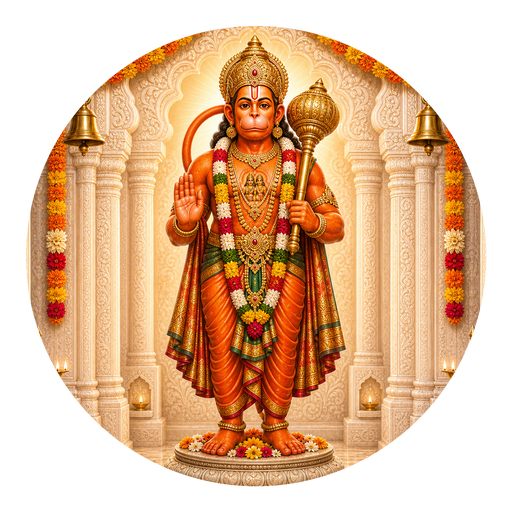
- Bathe early in the morning and, if possible, visit an ashwattha (peepal) tree. If a Maruti idol sits beneath the peepal, worship both together; otherwise, worship them separately.
- Offer milk with bel leaves at the root of the peepal.
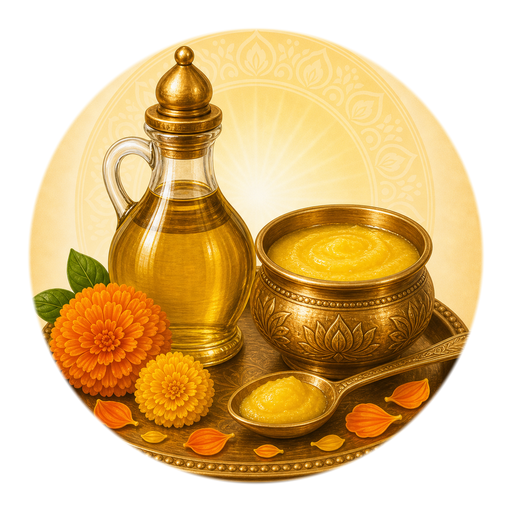
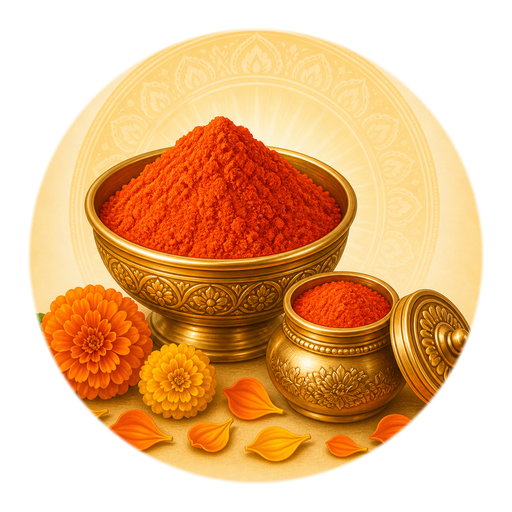
- Offer Maruti oil, vermilion, and a garland of rui (swallow-wort) leaves.
- Circumambulate the tree — typically three or five times; sources don't agree on a fixed number.
- Recite the Hanuman Chalisa or the Bhimrupi Maharudra stotra, followed by the aarti and prasad.
This is a recurring weekly observance — a fixed closing ritual (udyapan) or multi-year commitment, of the kind found for Shivamuth or the Mahalakshmi vrat, isn't usually part of it.
Narasimha Pujan:
- Draw an image of Narasimha on a wall or pillar, or use a ready-made image.
- Sprinkle sesame oil or ghee as a purification (proksham).
- Offer turmeric, sandalwood paste, and red and blue/yellow flowers.
- Offer kunjar vegetable curry and rice khichadi as naivedya.
- The purpose is remembrance of the avatar taken to protect Prahlad — not a pursuit of wealth or children.
The exact sequence, the number of circumambulations, and other details can vary by region and family. Some specifics (an exact mantra count, a particular circumambulation sequence) reflect a particular local or community tradition in some places — not a universal or the only method.
Puja materials
- An ashwattha tree or a Maruti idol/image; milk and bel leaves (for the root offering); oil, vermilion, and a rui-leaf garland.
- For Narasimha: an image or picture, sesame oil or ghee, turmeric, sandalwood paste, red and blue/yellow flowers, kunjar vegetable curry and rice khichadi (naivedya).
- Turmeric, unbroken rice, incense and a lamp, aarti materials.
(This list can vary by region and family.)
 Bel leaves
 Oil/ghee
 Vermilion (shendur)
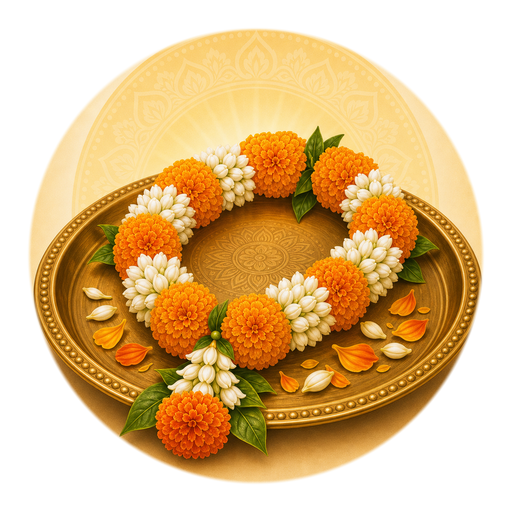 Rui-leaf garland
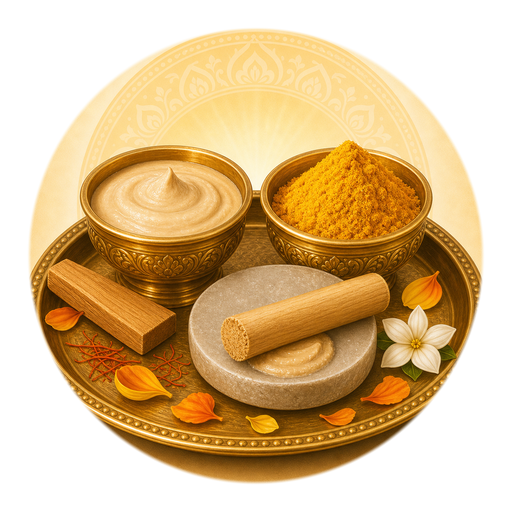 Sandalwood paste
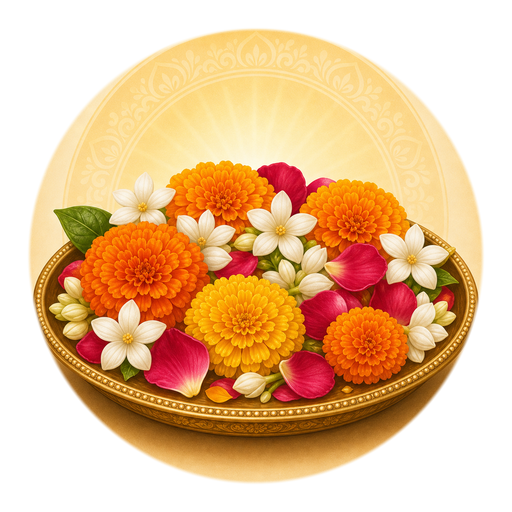 Red and blue/yellow flowers
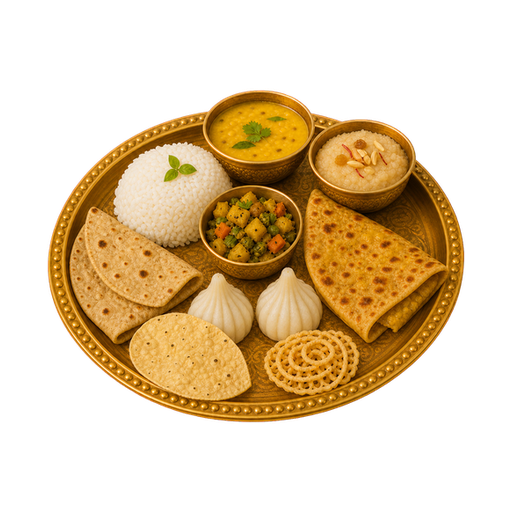 Kunjar curry-khichadi naivedya
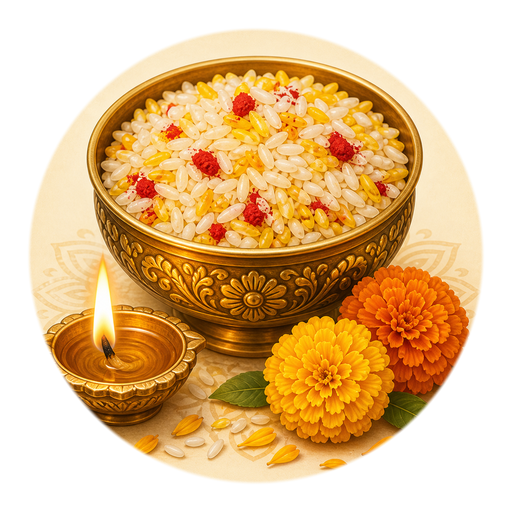 Unbroken rice (akshata)
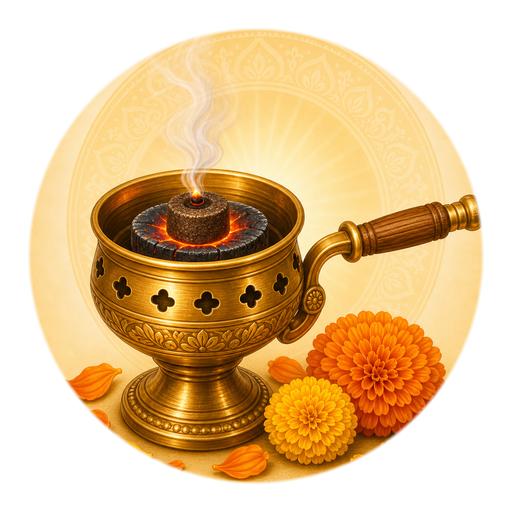 Incense
 Lamp
LampFasting and dietary rules
This day is regarded mainly as a puja observance; a strict, single-meal fast of the kind kept for Shivamuth isn't the usual part of it. In some households, the general Shanivar Vrat's fasting rules (avoiding oil and salt, for instance) are also kept on this day. How strict the fast is can be decided by family and tradition; take an exemption based on your health.
Mantra and stotras
- The ashwattha bija mantra (a salutation to the peepal tree): "Om Ashwatthaya Namah", as well as "Om Urdhvamukhaya Namah" and "Om Vanaspataye Namah".
- The Bhimrupi Maharudra stotra (Samarth Ramdas) and the Hanuman Chalisa (Tulsidas): the full Maruti stotra "Satrane Uddane" is given on the Mangalvar Vrat (Hanuman) page.
- The Narasimha nama-mantra (a salutation to Narasimha): "Om Narasimhaya Namah" — full detail is on the Narasimha Jayanti page.
- The ashwattha-vandana verse (root-trunk-crown = Brahma-Vishnu-Shiva): the opening line — "Mulato brahma-rupaya…" — this is not a Gita verse, but a separate, popular one.
Regional customs
Being part of Shravan's weekly cycle of vrats is itself the distinctly Maharashtrian identity of Shravani Shanivar — this context rarely appears in pan-Indian calendars. This tradition is recorded as especially prevalent in Maharashtra and parts of Gujarat. In some places, women tie a thread around the tree before the puja (similar to a Vat Purnima custom).
Some places hold a large public Ashwattha Maruti Pujan event, particularly on the last Shravani Saturday — this is a local/community-specific practice, not a universal one.
Worth distinguishing: the Shanivar Vrat is a separate, general page — it covers Shani-Maruti worship on any Saturday of the year, is fasting-centred, and isn't bound to Shravan. Shravani Shanivar is centred specifically on Ashwattha Maruti and Narasimha worship during the Saturdays of Shravan, puja-centred.
2026 Shravani Saturdays — dates
| # | Date | Tithi | Nakshatra | The panchang's main label that day |
|---|---|---|---|---|
| 1 | 15 August | Shravan Shukla Tritiya | Uttara Phalguni | Independence Day |
| 2 | 22 August | Shravan Shukla Dashami | Jyeshtha | Ashwattha Maruti Pujan |
| 3 | 29 August | Shravan Krishna Pratipada | Purva Bhadrapada | National Sports Day |
| 4 | 5 September | Shravan Krishna Navami | Mrig | Dahi Handi/Gopalkala |
The panchang carries a direct "Ashwattha Maruti Pujan" label only on 22 August; on the other three Saturdays, a national holiday or another festival takes the main label instead. All four Saturdays fall within the scope of this observance because they fall within the span of the Shravan month, and external sources consistently describe the puja as observed on "every Saturday of Shravan."
Good to know for 2026
- The first Saturday (15 August) coincides with Independence Day; the third (29 August) with National Sports Day; the fourth and last (5 September) with Dahi Handi/Gopalkala. These are this year's coincidences — they change annually and aren't part of the observance's own definition.
- Temples where a Maruti idol sits beneath a peepal tree can see larger-than-usual crowds on Saturdays, especially at sites holding large public events on the last Saturday — check locally before visiting.
- A strict fast doesn't suit everyone — those with diabetes, who are pregnant, or elderly should take an exemption on medical advice.
FAQ
- What is Shravani Shanivar?
- The joint worship of Maruti — beneath the ashwattha (peepal) tree — and Lord Narasimha, observed on every Saturday of the month of Shravan.
- Why are Maruti and the peepal tree worshipped on Shravan Saturdays?
- Saturday is regarded as Maruti's day; the peepal is regarded as the tree of all deities (Brahma-Vishnu-Shiva). Where a Maruti idol sits beneath a peepal tree, both are worshipped together.
- How many Shravani Saturdays fall in 2026, and when?
- Four — 15, 22, 29 August, and 5 September 2026.
- How is Ashwattha Maruti Pujan performed?
- Milk and bel leaves are offered at the peepal's root, oil, vermilion, and a rui-leaf garland are offered to Maruti, and circumambulation and a stotra reading follow.
- How is Narasimha worship performed on Shravani Shanivar?
- An image of Narasimha is drawn on a wall or pillar, sesame oil or ghee is sprinkled as purification, turmeric and flowers are offered, and kunjar vegetable curry with rice khichadi is given as naivedya — in remembrance of the rescue of Prahlad.
- What benefit is Ashwattha Maruti Pujan believed to bring?
- Freedom from illness and relief from Shani's sade-sati are believed to follow — this is a matter of belief, not a guarantee.
- Why is Shani Dev believed to be pleased by Hanuman worship on Saturday?
- By legend, Maruti freed Shani from Ravana's captivity; a grateful Shani promised not to trouble Maruti's devotees.
- What's the difference between Shravani Shanivar and the general Shanivar Vrat?
- The general Shanivar Vrat is observed on any Saturday of the year to seek relief from Shani's influence, and is fasting-centred. Shravani Shanivar is centred specifically on Ashwattha Maruti and Narasimha worship during the Saturdays of Shravan, and is puja-centred — the two are separate pages.