Dagdusheth Halwai Ganpati, Pune
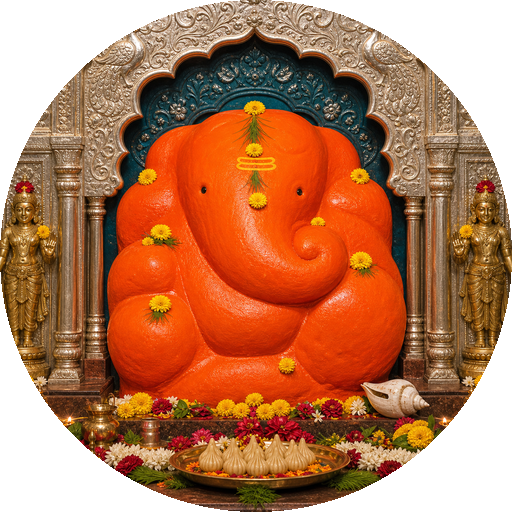
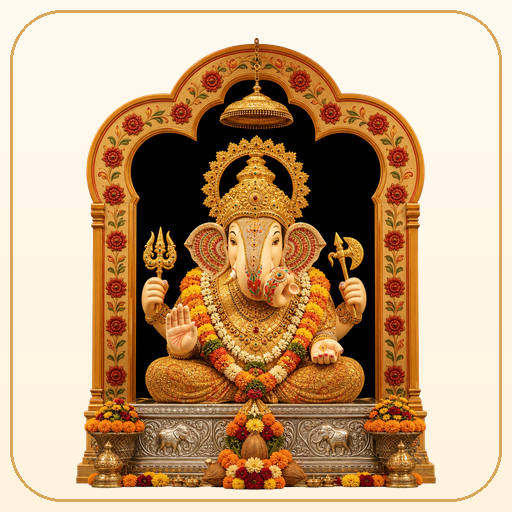
Shri Ganesh — a temple in Pune's Budhwar Peth area, at Ganpati Chowk. It's one of Maharashtra's most famous and most-visited Ganesh temples; lakhs of devotees visit daily during Ganeshotsav. Its signature feature is an elaborate decoration theme that changes every year (replicas of famous temples) and a grand visarjan procession on Anant Chaturdashi. The temple is not one of the Ashtavinayak, nor is it Pune's first sarvajanik (public) Ganpati — that credit goes to the Bhausaheb Rangari Ganpati (1892). The temple takes its name from the sweets merchant Dagdusheth Halwai; its founding, around 1893, is tied to Lokmanya Tilak's public Ganeshotsav movement, though the exact story differs across sources. Full details follow below.
This year's dates (2026)
- Monday; Shri Ganesh Chaturthi — Ganeshotsav begins, the public decoration opens14 Sep
- Friday; Anant Chaturdashi — Dagdusheth Ganpati's grand visarjan procession25 Sep
- Thursday; Shri Ganesh Jayanti, Vinayak Chaturthi (Maghi)22 Jan
- Tuesday; Angarki Sankashti Chaturthi6 Jan
- Tuesday; Angarki Sankashti Chaturthi5 May
- Tuesday; Angarki Sankashti Chaturthi29 Sep
- Sunday; Akshaya Tritiya — Dagdusheth Ganpati's Amba Mahotsav19 Apr
Deity & significance
The name "Dagdusheth Halwai Ganpati" comes from its founder's name. Some sources also give the idol the popular nickname "Navasacha Ganpati" (the Ganpati who fulfils vows/wishes) — but this same nickname is commonly used for Mumbai's Lalbaugcha Raja, a separate public Ganeshotsav mandal; the two are entirely different, unrelated institutions, and shouldn't be confused.
By one source, the idol is about 2.2 metres tall and 1 metre wide; the idol's original stone/metal type and the direction of its trunk can't be stated with certainty.
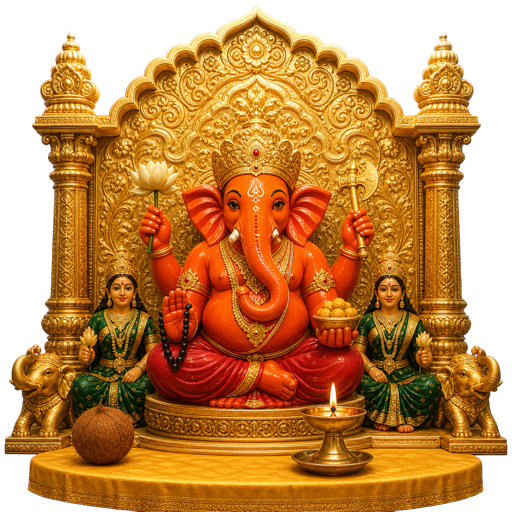
Every year during Ganeshotsav, the idol is adorned with crores of rupees' worth of special jewellery and ornaments; the exact amount/weight varies hugely by year and by source.
The temple is managed by the Shreemant Dagdusheth Halwai Sarvajanik Ganpati Trust — in 1952, this responsibility was formally handed to Tatyasaheb Godse and colleagues. The trust is also active in social work — education, microfinance, elderly care, and rehabilitation services.
Dagdusheth Ganpati is not one of the eight temples of the Ashtavinayak pilgrimage — those are all rural/historic sites across the Pune, Ahmednagar, and Raigad districts; the real Ashtavinayak temple near Pune is Ranjangaon Mahaganpati. Dagdusheth is an urban temple that rose to fame in the modern era through the public Ganeshotsav movement.
Dagdusheth Ganpati is also not Pune's, or India's, first sarvajanik (public) Ganpati — that credit generally goes to the Ganpati established by Bhausaheb Rangari in 1892, regarded as India's first public Ganeshotsav. Dagdusheth Halwai took part in the early meetings of that same movement (at Bhau Rangari Wada, alongside Lokmanya Tilak, Annasaheb Patwardhan, and Balasaheb Natu), and his own Ganpati began the very next year (around 1893). Over time, for social and cultural reasons, Dagdusheth's Ganpati became the most famous and the wealthiest — but the "first" credit still belongs to Bhausaheb Rangari.
History & legend
Dagdusheth Halwai was a well-known sweets merchant and nagarsheth (city elder) of Pune, active in the latter half of the 19th century, during the plague era. Guru Madhavnath Maharaj's role is considered important across most versions. The temple is tied to Lokmanya Tilak's public Ganeshotsav movement (around 1893 — Tilak's strategy of building a cultural-religious platform to work around the British-era ban on public political gatherings). At least four different versions of the founding story are in circulation — they differ from each other in the details.
By the most widespread popular/travel-source version — Dagdusheth and his wife Lakshmibai are said to have lost their only son to the plague; on their guru's advice, they installed a Ganesh idol in the son's memory.
By the official trust's own, more detailed version — Dagdusheth was a co-founder of the 1893 public movement; the first idol was made by a sculptor. This version then says that in 1896, the plague killed both the son and Dagdusheth himself. On Guru Madhavnath Maharaj's advice, the widow had a Datta temple and a second Ganesh idol built in Dagdusheth's own memory.
A different version has no death story at all — Ganesh is said to have appeared to Dagdusheth in a dream, directing him to install an idol in the city and start an annual festival, so that plague-stricken Puneites would find support.
Yet another version (from an established Marathi daily) includes the son's plague death and Guru Madhavnath Maharaj's comfort and advice, but gives the founding year as 1896 (instead of 1893 in the other versions) and firmly claims that Lokmanya Tilak himself performed the consecration with his own hands.
Most independent sources corroborate 1893 as the founding year more strongly; 1896 appears in only one source. The date "19 February 1893" is also questionable — Tilak's first public Ganeshotsav is traditionally tied to Ganesh Chaturthi in the month of Bhadrapad (September), not February (the month of Magh). A firm year or date can't be stated with certainty; most sources point to around 1893.
Sources also differ on who sculpted the original (1893) idol — one source gives one name, another gives a different name entirely.
A comparatively more consistent chapter is the 1968 idol-renewal story — about 75 years after the founding, the original idol's arm broke; a new idol was made by a sculptor (whose name also varies across sources); it was consecrated on 27 August 1968, during a solar-eclipse muhurat, along with a Ganesh yantra; the old, damaged idol is kept at the trust's childcare centre today.
Architecture & layout
The temple's original structure is over a hundred years old; marble Jay-Vijay sentinel statues stand at the entrance. The structure is relatively simple and open, so the idol can be viewed even from outside.
The temple's main architectural feature is its annual decoration — during Ganeshotsav, the entire pandal is dressed up around one theme each year, usually a grand replica of a famous temple in India. For instance, one year saw a replica of the Ram Mandir at Ayodhya, while another year featured a grand replica of Kerala's Padmanabhaswamy Temple (built by hundreds of artisans over several months). As of July 2026, the theme for the coming year had not yet been announced.
A specially decorated chariot is built every year for the idol's immersion — one such chariot was named "Umangmalaj," inspired by the Jatoli Shiv Temple in Himachal Pradesh, depicting Shiv's matted locks, trishul, damru, and rudraksha.
By one mention, a replica of this temple was also built in Phuket, Thailand.
Festivals & yatra
Most of Dagdusheth Ganpati's festivals coincide with general Ganesh tithis — the general meaning of those tithis isn't repeated here; links to the relevant pages are given instead. The focus here is on what happens specifically at this temple.
| Festival | Tithi | 2026 date | In brief |
|---|---|---|---|
| Shri Ganesh Chaturthi — Ganeshotsav begins | Bhadrapad Shukla Chaturthi | 14 September (Monday) | For the general meaning of this tithi, see Ganesh Chaturthi. Temple-specific: the grand public decoration opens on this day, and round-the-clock darshan begins. |
| Anant Chaturdashi — visarjan procession | Bhadrapad Shukla Chaturdashi | 25 September (Friday) | For the general meaning of this tithi, see Anant Chaturdashi. Temple-specific: one of Pune's largest and most-talked-about visarjan processions — a special chariot, dhol-tasha-lezim troupes, and lakhs of devotees. |
| Home Ganesh visarjan (Gauri visarjan) | Bhadrapad Shukla Ashtami | 19 September (Saturday) | A public-mandal Ganpati like Dagdusheth's is not immersed on this day — it stays until Anant Chaturdashi (ten days); this is only the general date for home Ganpatis, noted here to avoid confusion. |
| Angarki Sankashti Chaturthi (three times) | Krishna Chaturthi + Tuesday | 6 January, 5 May, 29 September (all Tuesdays) | For the general meaning of this tithi, see Sankashti Chaturthi. The temple's own festival list also mentions a special "Grape Festival" tied to Sankashti — which specific Sankashti isn't clear. |
| Shri Ganesh Jayanti (Maghi), Vinayak Chaturthi | Magh Shukla Chaturthi | 22 January (Thursday) | For the general meaning of this tithi, see Maghi Ganesh Jayanti. |
| Amba Mahotsav (Mango Festival) | Akshaya Tritiya | 19 April (Sunday) | For the general meaning of this tithi, see Akshaya Tritiya. Temple-specific: a decoration of thousands of mangoes, a swarabhishek, a Brahmanaspati Sukta abhishek, and a Ganesh yaga; prasad is distributed to hospitals, old-age homes, and institutions for the differently-abled — a popular, well-corroborated temple-specific festival. |
| Other minor temple festivals | various tithis | (confirm the exact date with the temple committee) | Sunflower Festival, Mogra Festival, Vallabhesh Mangalam, Shardesh Mangalam (both on Akshaya Tritiya), Sheshatmaj Ganesh Jayanti, Coconut Festival (30 April, Vaishakh Purnima), Atirudra Mahayag and Chaturmas pravachan-kirtan, Tripurari Purnima, Dahi Handi, a Gudi Padwa-to-Ram Navami music festival (single-source mention as a "foundation day" observance). |
Darshan & aarti timings
The schedule below comes from the official trust's website — but schedules can change, so confirm the current timing on the official website before an actual visit.
- Darshan: 5:30 AM to 11:00 PM (with brief gaps during some rituals).
- Abhishek and shringar: 6:00 to 7:15 AM.
- Suprabhatam aarti: 7:30 to 7:45 AM.
- Naivedyam aarti: 1:30 to 2:00 PM.
- Madhyana aarti: 3:00 to 3:15 PM.
- Mahamangal aarti: 8:00 to 9:00 PM.
- Shejarti: 10:30 to 10:45 PM.
- The temple stays open round the clock during Ganeshotsav.
Special rituals here
- Online seva: darshan/puja booking, a daily mahaabhishek, and donations can all be registered through the online e-seva portal.
- Amba Mahotsav rituals (Akshaya Tritiya): begins at dawn with a swarabhishek; a Brahmanaspati Sukta abhishek and a Ganesh yaga; a decoration of thousands of mangoes and prasad distribution.
- Annual decoration-making: hundreds of artisans work on the pandal and the decoration for months beforehand — this is a distinctive yearly feature, though the theme and details change each year.
- Visarjan ritual: a grand chariot procession for the idol takes place on Anant Chaturdashi — the exact start and end time varies every year, so no single year's timing should be treated as a permanent rule.
- The exact scriptural sequence of daily puja, abhishek, and alankara, and its mantras, should be confirmed with the temple committee — a detailed, authoritative sequence wasn't found in this research.
Mantra & aarti
The best-known bija mantra of Ganpati worship — "Om Gam Ganapataye Namah" — meaning: salutations to Ganpati. No separate Dagdusheth-specific stotra or full aarti text is given here; for a general Ganpati aarti, see the Datta/Ganesh puja-vidhi pillar reference.
How to reach
Address: Ganpati Bhavan, 250, Budhwar Peth (Chhatrapati Shivaji Maharaj Road/Ganpati Chowk), Pune, Maharashtra 411002.
By rail: the nearest major station is Pune Junction — roughly 2-3 km away (estimates vary slightly by source); check the exact distance on a live map.
By road: about a 15-minute taxi/auto ride from Pune station; several PMPML bus routes are noted by one travel source as stopping near Budhwar Peth — confirm the exact route numbers with the temple committee or through local inquiry.
Nearby places
- Shaniwar Wada — the Peshwas' historic fort and mansion, in the immediate vicinity.
- Tulshibaug and Laxmi Road — a nearby, well-known shopping area.
- Ranjangaon Mahaganpati — the real Ashtavinayak temple near Pune, outside the city.
- Bhimashankar — a Jyotirlinga in Pune district, comparatively far but within the same district.
- Ganpatipule — another famous Ganesh kshetra on the Konkan coast, far away but notable as a sibling Ganpati site.
Travel tips (good to know)
- Expect huge crowds during the ten days of Ganeshotsav (especially the first and last day — Anant Chaturdashi) and on Angarki Sankashti; the temple stays open round the clock during Ganeshotsav — consider an early visit or booking darshan online.
- Long queues form outside the pandal to view the decoration during Ganeshotsav, especially in the evening and at night — since the decoration changes every year, it helps to check the theme in advance.
- Don't confuse Dagdusheth Ganpati with any Ashtavinayak temple (especially Ranjangaon Mahaganpati), and remember it isn't Pune's or India's first sarvajanik Ganpati either (that credit belongs to Bhausaheb Rangari) — keep both points in mind.
- A public-mandal Ganpati like Dagdusheth's is immersed on Anant Chaturdashi; home Ganpatis have a separate, fifth-day immersion (Gauri visarjan) — don't confuse these two different dates.
FAQ
- Where exactly is the Dagdusheth Halwai Ganpati temple in Pune?
- In the Budhwar Peth area, at Ganpati Chowk on Shivaji Maharaj Road, Pune 411002.
- Is Dagdusheth Ganpati Pune's first sarvajanik (public) Ganpati?
- No. That credit generally goes to the Bhausaheb Rangari Ganpati (1892); Dagdusheth (around 1893) came a year later, and went on to become the most famous.
- Who founded Dagdusheth Ganpati, and when?
- It's named after the sweets merchant Dagdusheth Halwai, founded around 1893, tied to Lokmanya Tilak's public Ganeshotsav movement — but the exact story and year differ across sources.
- Is Dagdusheth Ganpati one of the Ashtavinayak?
- No. The Ashtavinayak is a pilgrimage of eight temples — Morgaon, Theur, Siddhatek, Ranjangaon, Ozar, Lenyadri, Pali, and Mahad; the real Ashtavinayak temple near Pune is Ranjangaon Mahaganpati.
- What are the darshan timings at Dagdusheth Ganpati?
- Generally 5:30 AM to 11:00 PM; round the clock during Ganeshotsav — but timings can change, so confirm on the official website.
- When and how does Dagdusheth Ganpati's visarjan procession take place?
- On Anant Chaturdashi, in a specially decorated chariot; lakhs of devotees and dhol-tasha-lezim troupes take part — the exact timing changes every year.
- How is Dagdusheth Ganpati's annual decoration theme decided?
- Each year during Ganeshotsav, the pandal is decorated around one theme, usually a grand replica of a famous Indian temple — the coming year's theme is generally announced close to the festival itself.
- What is the Amba Mahotsav at Dagdusheth Ganpati temple?
- A special temple festival held on Akshaya Tritiya — a decoration of thousands of mangoes, special abhisheka rituals, and prasad distribution to hospitals and orphanages.
- How do I reach Dagdusheth Ganpati temple, and what's the nearest station?
- Pune Junction is the nearest major station; from there, it's reachable by taxi, auto, or bus. Confirm the exact distance and the alternate-station claim with the temple committee.