Bhimashankar
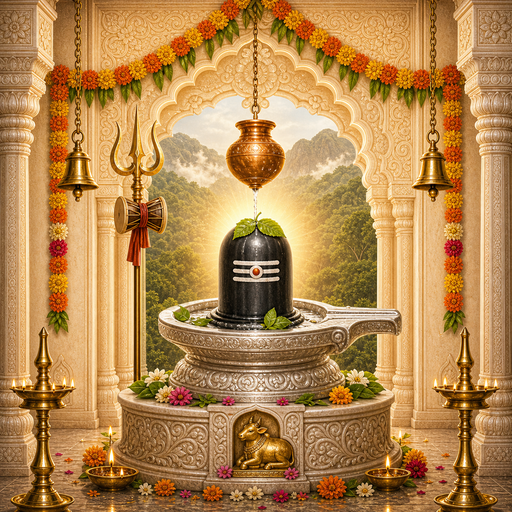
Bhimashankar is a Shiv temple in Khed taluka of Pune district, set in the Sahyadri (Western Ghats) — one of the twelve Jyotirlingas (traditionally the sixth). It stands at about 934 m in dense forest. The sacred Bhima river rises here, and downstream it becomes the “Chandrabhaga” at Pandharpur. The temple lies inside the Bhimashankar Wildlife Sanctuary — home of the Shekru (Indian giant squirrel), Maharashtra's state animal. On Shravan Somvar and Mahashivratri, huge crowds of devotees pour in. This is one of the five Shiv Jyotirlingas in Maharashtra.
This year's dates (2026)
- Mahashivratri (general festival; the Jyotirlinga's biggest day)15 Feb
- First Shravan Somvar (peak crowds); Nagpanchami falls the same day17 Aug
- Second Shravan Somvar24 Aug
- Third Shravan Somvar; Sankashti Chaturthi falls the same day31 Aug
- Fourth (last) Shravan Somvar7 Sep
- Vijayadashami / Dasara (general festival; the trust holds a palkhi/mahaarti)20 Oct
- Tripurari Pournima (general festival; the trust holds a palkhi/mahaarti)24 Nov
Deity & significance
Bhimashankar is one of the twelve Jyotirlingas — a Jyotirlinga being a swayambhu (self-manifested) form of Shiv's light. It is one of the five Jyotirlingas that devotees in Maharashtra revere and visit most; the others are Trimbakeshwar, Grishneshwar, Aundha Nagnath and Parli Vaijnath.
Note: in the shastrokta Dvadasha-Jyotirlinga list, the count firmly placed in Maharashtra is three; the identifications of Aundha Nagnath as Nageshwar and Parli Vaijnath as Vaidyanath are disputed. In popular devotion, however, all five are worshipped as Maharashtra's Jyotirlingas.
The river source — Bhimashankar's distinctive feature.
Bhimashankar is not only a Shiv kshetra (holy seat) but also the source of the Bhima (Bhimarathi) river. This same Bhima flows on to the feet of Vitthal at Pandharpur under the name “Chandrabhaga,” and finally joins the Krishna river. That makes Bhimashankar a rare place linking two traditions — the Shaiva (devotees of Shiv) and the Varkari (devotees of Vitthal). By legend, after the battle with the demon Bhima, the river is believed to have formed from Shiv's perspiration (gharma).
Nature and tirtha together.
Because a dense evergreen Sahyadri forest, a wildlife sanctuary and a Jyotirlinga all meet in one place, this spot draws not only devotees but also nature lovers and trekkers in large numbers.
History & legend
Temple history.
The sanctum of the temple dates to the 13th century, carved in black stone. Later, in the 18th century, Nana Phadnavis is said to have improved or built the sabhamandap (assembly hall) and the shikhara, and to have built a well in the precinct. The temple's architecture is Nagara (north Indian) style, with similarities to the Hemadpanti style; the pillars and door-frames carry carvings of divine and human figures.
Chimaji Appa's bell.
Chimaji Appa, brother of Bajirao I, offered here one of the Portuguese bells brought back after he defeated the Portuguese at Vasai (Bassein) fort (1739). The bell bears 1729 as its casting year and Christian imagery (a cross / Mary–Jesus). (“The bell was brought in 1729” is a common mix-up — 1729 is only the year it was cast; it was actually brought here after the Vasai victory, that is, after 1739.)
The sthala-purana (legend).
Bhimashankar's original story comes from the “Koti Rudra Samhita” in the Shiva Purana — Chapter 20 (“the greatness of the Bhimeshvara Jyotirlinga”) and Chapter 21 (“the origin of the Bhimeshvara Jyotirlinga”). It is an ancient text, and the story is retold in many secondary sources too. In brief —
There was a mighty demon named Bhima, believed to be the son of Kumbhakarna (his mother was Karkati). After Rama had killed Kumbhakarna, the grown Bhima resolved to take revenge on Rama. Through severe penance to Brahma he won a boon of enormous power, and drunk on that power he began to torment gods and humans alike.
Bhima then imprisoned a devout Shiv-bhakta king and tried to force him to give up his worship of Shiv. The king firmly refused — “I shall never forsake Shiv.” Enraged, Bhima raised his sword against the very Shivling the king was worshipping. At that instant Shiv appeared as Bhimeshvara — “I am Bhimeshvara; I have revealed myself to protect my devotee” — and with a single Hum sound destroyed Bhima and his army. At the request of the gods and sages, Shiv stayed on there forever as the Bhimashankar Jyotirlinga; and from the perspiration of that battle, the Bhima river is believed to have formed.
(In some versions the name of this Shiv-bhakta king is “Kamarupeshwar” — the king of the Kamarupa land; in some modern retellings the name is given as “Sudakshina.” Likewise, some versions connect the story to the Tripurasura episode — in that battle Kamalaja Devi (a form of Parvati) aids Shiv; her temple stands about 500 m from the main temple. The heart of the story — Shiv appearing to protect his devotee — is the same everywhere.)
Note — a place dispute: because the Koti Rudra Samhita mentions “Kamarupa / Dakini,” a claim was made (in 2023) that the sixth Jyotirlinga is in Assam (Kamarupa). However, this Bhimashankar in the Pune-Sahyadri is the widely accepted sixth Jyotirlinga.
Architecture
- The sanctum (13th century), black stone; above it, the Nana Phadnavis-era sabhamandap and Nagara-style shikhara. It has similarities to the Hemadpanti style, with carved pillars and doors.
- Chimaji Appa's Portuguese bell stands in front of the temple — Roman/Christian in style, a historic memento of the Vasai victory.
- Mokshakund tirtha (a sacred bathing tank behind the temple), the Kamalaja Devi temple (~500 m), a Nandi and other tanks in the precinct.
- Gupt Bhimashankar: a “hidden” Shivling shaped by water beneath a waterfall in the forest near the temple — believed to be linked to the source-stream of the Bhima river.
Festivals & yatra
The tithi is the real anchor of the date; the dates below come from each year's panchang (this site's 2026 panchang data) and shift automatically the next year. Each row links to that day's page.
| Festival / yatra | Tithi | This year's date (2026) | Nakshatra | Type / more |
|---|---|---|---|---|
| Mahashivratri | Magh Krishna Trayodashi | 15 Feb 2026 | Uttarashadha | The Jyotirlinga's biggest day — see the full Mahashivratri page. The trust holds a palkhi/mahaarti. |
| First Shravan Somvar | Shravan Shukla Panchami | 17 Aug 2026 | Chitra | Peak crowds of all Shravan — see the full Shravan Somvar page. Nagpanchami falls the same day. |
| Second Shravan Somvar | Shravan Shukla Dwadashi | 24 Aug 2026 | Purvashadha | The second Monday of Shravan. |
| Third Shravan Somvar | Shravan Krishna Tritiya | 31 Aug 2026 | Revati | The third Monday. Sankashti Chaturthi falls the same day. |
| Fourth (last) Shravan Somvar | Shravan Krishna Ekadashi | 7 Sep 2026 | Punarvasu | The last Monday of Shravan. |
| Vijayadashami / Dasara | Ashwin Shukla Dashami | 20 Oct 2026 | Shravan | A general festival; the trust holds a palkhi/mahaarti. |
| Tripurari Pournima | Kartik Shukla Pournima | 24 Nov 2026 | Krittika | Deepotsav — see the full Tripurari Pournima page. The trust holds a palkhi/mahaarti. |
- Shravan Somvar — Bhimashankar's speciality. Through the whole month of Shravan (this year, amanta: 13 August → 11 September 2026) the temple sees a flood of devotees; on all four Mondays the queues grow very long. The shivamuth, the significance of the four Mondays and the fasting details are on the Shravan Somvar page.
- Nagpanchami (17 August) and Sankashti Chaturthi (31 August), which happen to fall on those dates, are separate general festivals; they are noted here to help you plan for the queues. Bhimashankar's main yatra, however, is Shravan + Mahashivratri.
Darshan & aarti timings
According to the official Shree Kshetra Bhimashankar Trust schedule page, the temple opens at about 5.00 AM and closes at about 9.30 PM. The main blocks through the day are given roughly as: 5.00–5.30 AM worship · 5.30 AM–12.00 PM darshan and abhishekam · 12.00–12.20 PM naivedya · 12.20–2.45 PM darshan and abhishekam · 2.45–3.20 PM worship · 3.20–7.30 PM dev-darshan · 7.30–8.00 PM worship · 8.00–9.30 PM dev-darshan. All times change on festival and special days.
Online darshan pass. By a Trust notice, from 15 June only online pass holders get darshan (via an online pass system). This policy and date can change from year to year, so check the current rule with the official Trust before you travel.
On festival days (Shravan / Mahashivratri / Tripurari Pournima) the trust holds a mahapuja, mahaarti and palkhi.
Before you travel, check the darshan and aarti timings, the pass rule and the queue arrangement with the temple committee (mandir samiti).
Special rituals here
- Abhishek / Rudrabhishek: a panchamrut and Rudrabhishek over the Jyotirlinga is regarded as the chief ritual here; you register for it at the trust counter. Check the exact rules, fees and timing with the trust.
- Mokshakund bath and the customs before darshan are described as per local tradition.
(This is religious guidance — do not take it as a universal rule. If you wish to perform the rituals, do so per your own local and family tradition, under the guidance of authorised priests.)
How to reach
- By road: roughly ~100–125 km from Pune via the Sahyadri ghat road. There is a direct road to the temple via Pune / Manchar / Ghodegaon. Check the exact distance and route on a map before you travel.
- By rail / trek route: from the Mumbai side you can trek on foot from Karjat/Neral → Khandas (the base village) — two main routes: Shidi Ghat (a ladder route, steep and adventurous) and Ganesh Ghat (longer but relatively easy).
- By bus / private vehicle: buses and private vehicles run directly to the temple from Pune and Manchar. (Check the exact bus times and availability.)
Nearby places
- Gupt Bhimashankar — a Shivling shaped by water beneath a waterfall.
- Nagphani point — a sweeping Sahyadri viewpoint.
- Hanuman Tal — a lake on the plateau.
- Kamalaja Devi temple — about 500 m from the main temple.
- Mokshakund tirtha — the sacred tank behind the temple.
- Bhorgiri — a nearby fort and village.
- Bhimashankar Wildlife Sanctuary — habitat of the Shekru (Indian giant squirrel, the state animal).
(Check the exact distances, access and timings for nearby places with locals / the forest department.)
Travel tips
- Crowds are huge in Shravan and on Mahashivratri — if possible, get an online darshan pass in advance and arrive early. Check the exact crowd, queue, parking and palkhi arrangement before you travel.
- In the monsoon the Sahyadri turns lush and the waterfalls flow full — but the Shidi Ghat trek becomes slippery and dangerous; plan with proper footwear, a local guide and an eye on the weather.
- Follow the sanctuary rules — this is habitat for the Shekru and wildlife; avoid litter and noise, and respect the forest department's rules.
- Given the cold, mist and remote road, avoid travelling at night; arrange fuel and food in advance.
Mantra & aarti
Shiv jap-mantra: Om Namah Shivaya. This is Shiv's five-syllable (panchakshari) root mantra — “salutations to Shiv.” At a Shiv kshetra like Bhimashankar, this is the mantra people repeat in jap.
Shankar aarti — “Lavthavati Vikrala” (by Samarth Ramdas). It is traditionally sung after the puja in Shiv temples. Its meaning: Shiv is fearsome yet innocent, camphor-fair (karpur-gaura), radiant beside Parvati, and the one who drank the halahal poison of the churning of the ocean to become Neelkanth (the blue-throated one).
FAQ
- Which group of Jyotirlingas is Bhimashankar part of?
- It is one of the twelve Jyotirlingas (traditionally the sixth), and also one of the five Jyotirlingas that devotees visit in Maharashtra.
- How far is Bhimashankar from Pune?
- About ~100–125 km by road (the Sahyadri ghat); the figure varies a little by source. (Check the exact distance before you travel.)
- Where does the Bhima river rise?
- At Bhimashankar itself; downstream the same river becomes the “Chandrabhaga” at Pandharpur and finally joins the Krishna.
- What is the Bhimashankar legend? Who was the demon Bhima?
- Bhima is believed to be the son of Kumbhakarna; when the boon-drunk Bhima tormented a Shiv-bhakta king, Shiv appeared as Bhimeshvara and destroyed him. (The king's name is given as Kamarupeshwar or Sudakshina, depending on the version.)
- What are Bhimashankar's darshan timings?
- The temple is open roughly from about 5 AM to about 9.30 PM; the exact aarti times and the pass rule change on festival days — check with the temple committee.
- How big are the crowds at Bhimashankar on Shravan Somvar?
- Huge; the queues stay long through all of Shravan — plan ahead, and an online pass is advisable.
- What is Gupt Bhimashankar?
- A Shivling shaped by water beneath a waterfall in the forest near the temple; it is believed to be linked to the source-stream of the Bhima.
- What is a Shekru, and where is it found?
- The Shekru is the Indian giant squirrel — Maharashtra's state animal; it is found in the Bhimashankar Wildlife Sanctuary.
Related Info
 Maha Shivratri15 Feb
- Shravani Somvar17 Aug
 Trimbakeshwar14 Jan
 Pandharpur Vitthal-Rukmini Temple29 Jan
 Jyotirlinga15 Feb
 Grishneshwar15 Feb
 Aundha Nagnath15 Feb
 Parli Vaijnath13 Feb
- Deoghar Baidyanath Dham15 Feb
- Dwarka Nageshwar15 Feb
- Kashi Vishwanath (Varanasi, Uttar Pradesh)15 Feb
- Kedarnath15 Feb
- Mahakaleshwar (Ujjain, Madhya Pradesh)15 Feb
- Mallikarjuna Jyotirlinga (Srisailam)15 Feb
- Omkareshwar (Madhya Pradesh)25 Jan
- Rameshwaram (Tamil Nadu)15 Feb
- Somnath15 Feb