Trimbakeshwar
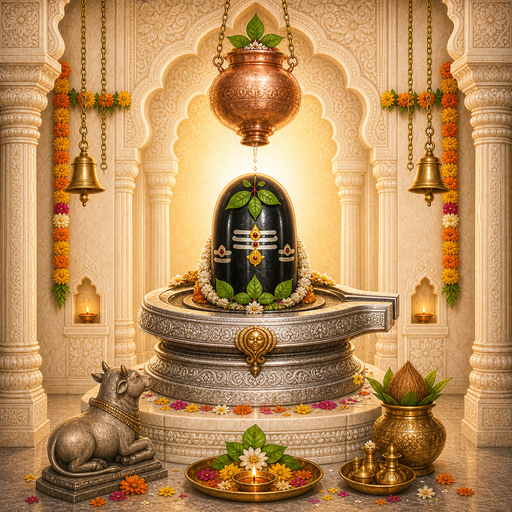
Trimbakeshwar is a Shiv temple in the town of Trimbak, Nashik district — one of the twelve Jyotirlingas. It sits about 28 km from Nashik, at the foot of the Brahmagiri hill. The Shivling here is believed to have three faces — Brahma, Vishnu and Mahesh (Shiv) — which is its distinctive feature. The sacred Godavari (Gautami) river is believed to rise here, on Brahmagiri and at the Kushavarta kund. Besides Jyotirlinga darshan, it is one of India’s foremost places for the Narayan Nagbali, Kalsarp Shanti and Tripindi Shraddha rituals.
This year's dates (2026)
- Sant Nivruttinath yatra — Trimbakeshwar (on Shattila Ekadashi / Makar Sankranti)14 Jan
- Sant Nivruttinath yatra — Trimbakeshwar10 Jul
- Sant Nivruttinath punyatithi — Trimbakeshwar11 Jul
- Mahashivratri (a general Shaiva festival)15 Feb
- Tripurari Pournima (a general festival)24 Nov
Deity & significance
Trimbakeshwar is one of the twelve Jyotirlingas — a Jyotirlinga being a swayambhu (self-manifested) form of Shiv’s light. It is one of the five Jyotirlingas that devotees in Maharashtra revere and visit most; the others are Bhimashankar, Grishneshwar, Aundha Nagnath and Parli Vaijnath.
Note: in the shastrokta Dvadasha-Jyotirlinga list, the count firmly placed in Maharashtra is three; the identifications of Aundha Nagnath as Nageshwar and Parli Vaijnath as Vaidyanath are disputed. In popular devotion, however, all five are worshipped as Maharashtra’s Jyotirlingas.
The meaning of the name is one of Trimbakeshwar’s lovely features. “Tryambak” = tri-ambak = “the three-eyed one” — itself a name of Shiv. The same name appears in the famous Mahamrityunjaya mantra (“Om Tryambakam Yajamahe…”); that mantra, from the Rigveda (7.59), is addressed to Tryambaka-Rudra-Shiv. So Trimbakeshwar is regarded as the original kshetra (holy seat) of this “Tryambak” form.
Because a Jyotirlinga, a river source, a sant’s samadhi and a Kumbh tirtha all come together in one place, Trimbakeshwar holds a special importance.
History & legend
Temple history. The present grand temple was built by the Peshwa Balaji Bajirao (Nanasaheb Peshwa) on the site of an older temple. According to the official Devsthan Trust, the temple’s grand opening was on Friday, 16 February 1756 — on Mahashivratri. By some accounts construction began around 1755 and took roughly three decades to complete at a cost of about 16 lakh. The temple is built in black basalt stone, in the Hemadpanti style.
The sthala-purana (legend). The original legend of Trimbakeshwar and the birth of the Godavari comes from the “Gautami Mahatmya” in the Brahma Purana, and it is retold in many places. In brief —
On the Brahmagiri hill, Rishi Gautam lived in penance with his wife Ahilya. Once a terrible drought struck, and Gautam, by the power of his tapas, grew grain and fed the people around him, saving many lives.
Later, near Gautam’s ashram, a cow died in an accident, and unknowingly the sin of go-hatya (cow-slaying) fell upon Gautam. To wash away that sin, Gautam did severe penance to Shiv and prayed, “Bring the sacred Ganga forth here.” Pleased, Shiv made the Ganga appear on Brahmagiri as the Gautami (Godavari); and she became the “Ganga of the South” — the Godavari river. Shiv himself is believed to have stayed there in the form of the Trimbakeshwar Jyotirlinga.
In some versions the detail of the cow’s death is told differently — in some it is a maya-cow incident, in others the doing of other rishis. Likewise, some accounts name the river “Gautami” and others directly “Godavari.” The heart of the story is the same everywhere.
Architecture
- The three-faced Jyotirlinga: the linga in the sanctum is believed to show three small faces — Brahma, Vishnu and Mahesh — a rare feature in India. Over the ages the linga is also said to have worn down.
- Hemadpanti style, black basalt stone; carved arches and a shikhara are the temple’s striking features.
- Kushavarta kund: a sacred tank in the temple precinct, regarded as the “source / sangam” point of the Godavari. It is the main place for bathing and various rituals.
- Brahmagiri hill: the hill behind the temple, believed to be the true source of the Godavari and the tapobhumi of Gautam. Devotees do the Brahmagiri pradakshina and trek here.
Festivals & yatra
The tithi is the real anchor of the date; the dates below come from each year’s panchang (this site’s 2026 panchang data) and shift automatically the next year. Each row links to that day’s page.
| Festival / yatra | Tithi | This year’s date (2026) | Nakshatra | Type / more |
|---|---|---|---|---|
| Mahashivratri | Magh Krishna Trayodashi | 15 Feb 2026 | Uttara Ashadha | The Jyotirlinga’s biggest day — see the full Mahashivratri page. |
| Sant Nivruttinath yatra (Paush) | Paush Krishna Ekadashi | 14 Jan 2026 | Anuradha | On Shattila Ekadashi / Makar Sankranti; a temple-specific yatra. |
| Sant Nivruttinath yatra (Jyeshtha) | Nija Jyeshtha Krishna Dashami/Ekadashi | 10 Jul 2026 | Bharani | Temple-specific yatra (verify the date). |
| Sant Nivruttinath punyatithi | Nija Jyeshtha Krishna Dwadashi | 11 Jul 2026 | Krittika | Lakhs of Varkaris gather (verify the date). |
| Tripurari Pournima | Kartik Shukla Purnima | 24 Nov 2026 | Krittika | Deepotsav; see the full Tripurari Pournima page. |
- Who was Sant Nivruttinath? — he was the elder brother and guru of Dnyaneshwar, a saint of the Nath / Varkari tradition. His samadhi is at Trimbakeshwar — which is why a great yatra is held here.
- Simhastha Kumbh Mela: when Guru (Jupiter) enters Simha (Leo), once in 12 years, the Nashik-Trimbakeshwar Simhastha Kumbh Mela is held; Kushavarta is one of its chief bathing tirthas. By some guide-site accounts the next dhwajarohan is around 31 October 2026 and the main shahi snans fall in 2027 (about 2 August, 31 August, 11 September), with the mela running to 24 July 2028. These dates are unofficial and should be verified with the official administration / Maharashtra Tourism.
Darshan & aarti timings
The official Devsthan Trust’s daily-programme page lists the main puja windows roughly as: morning puja (Brahma) about 7:00–8:30 AM, mid-day puja (Mahadev) about 10:45 AM–12:30 PM, and an evening Vishnu puja. The exact kakad and shej aarti times, like all timings here, change on festival and special days — check with the temple committee.
Before you travel, check the darshan and aarti timings and the queue arrangement with the temple committee (mandir samiti).
Special rituals here
Trimbakeshwar is regarded as one of India’s foremost places for the Narayan Nagbali, Kalsarp Shanti and Tripindi Shraddha rituals. Devotees are said to perform these here to address pitrudosh, nagdosh or the kalsarp yoga. A Kushavarta bath and an upvas (fast) are prescribed before the rituals; some of them run over more than one day.
This is astrological and religious guidance — do not take it as a universal rule. If you wish to perform these rituals, do so per your own local and family tradition, under the guidance of authorised priests.
How to reach
- By road: Trimbak is about 28 km from Nashik (Trimbak road); buses and taxis from Nashik are easy to find.
- By rail: the nearest major station is Nashik Road; from there take a bus or taxi to Trimbak. (Check the exact distance and connectivity before you travel.)
- By air: the nearest airports are Nashik (Ozar) and then Mumbai. (Check availability and distance.)
Nearby places
- Brahmagiri hill — the Godavari source, with a pradakshina and trek.
- Kushavarta kund — the sacred bathing tirtha, right by the temple.
- Sant Nivruttinath samadhi mandir — in Trimbak town.
- Nashik — Panchavati, Ramkund, Kalaram temple.
- Anjaneri — believed to be the birthplace of Hanuman.
Travel tips
- Early-morning darshan means comparatively smaller crowds. On festival days, through Shravan, and during the Kumbh, crowds are huge — plan your timing accordingly.
- There may be traditional rules for entering the sanctum (for example, men entering in a sovale) → check with the temple committee.
- In the monsoon the Brahmagiri trek gets slippery; wear proper footwear. If you are coming for the rituals, reaching the day before is convenient.
Mantra & aarti
Mahamrityunjaya mantra (jap-mantra):
The mantra is addressed to Tryambaka (Shiv): “We worship the three-eyed one, the fragrant, the nourisher; as a ripe cucumber is freed from its stem, free us from the bondage of death — but not from immortality.” Trimbakeshwar’s very name is tied to this mantra.
Shankar aarti — “Lavthavati Vikrala” (by Samarth Ramdas). It is traditionally sung after the puja in Shiv temples. Its meaning: Shiv is fearsome yet innocent, camphor-fair (karpur-gaura), radiant beside Parvati, and the one who drank the halahal poison of the churning of the ocean to become Neelkanth (the blue-throated one).
FAQ
- Which Jyotirlingas is Trimbakeshwar one of?
- It is one of the twelve Jyotirlingas, and also one of the five Jyotirlingas that devotees visit in Maharashtra.
- How far is Trimbakeshwar from Nashik?
- About 28 km, at the foot of the Brahmagiri hill. (Check the exact distance before you travel.)
- Why does the Shivling have three faces?
- They are taken as symbols of Brahma, Vishnu and Mahesh — the distinctive feature of Trimbakeshwar.
- Where does the Godavari river rise?
- The Godavari is believed to rise at the Brahmagiri hill and the Kushavarta kund near Trimbakeshwar.
- Where is the Narayan Nagbali puja performed?
- Trimbakeshwar is regarded as a foremost place for it; check the exact rules and eligibility with local priests.
- What are Trimbakeshwar’s darshan timings?
- The main pujas are morning, mid-day and evening; the exact darshan and kakad/shej aarti times change on festival days — check with the temple committee.
- When is the Nashik Simhastha Kumbh Mela?
- Once in 12 years, when Guru (Jupiter) enters Simha (Leo); the next main period is around 2027. Verify the exact dates with the official administration.
Related Info
 Maha Shivratri15 Feb
 Bhimashankar15 Feb
 Grishneshwar15 Feb
 Aundha Nagnath15 Feb
 Parli Vaijnath13 Feb
 Deoghar Baidyanath Dham15 Feb
- Dwarka Nageshwar15 Feb
- Jyotirlinga15 Feb
- Kashi Vishwanath (Varanasi, Uttar Pradesh)15 Feb
- Kedarnath15 Feb
- Mahakaleshwar (Ujjain, Madhya Pradesh)15 Feb
- Mallikarjuna Jyotirlinga (Srisailam)15 Feb
- Omkareshwar (Madhya Pradesh)25 Jan
- Rameshwaram (Tamil Nadu)15 Feb
- Somnath15 Feb
 Anjaneri (Nashik — Hanuman Janmasthan)2 Apr