Guruvar Vrat (Datta)
Thursday is regarded as dedicated to Dattatreya (Dattaguru) — in Maharashtra's Datta-sampradaya tradition, this day is considered especially suited to chanting, a Gurucharitra reading, and a visit to a Datta temple. At the same time, pan-Indian astrological tradition regards Thursday mainly as the day of the guru-deity Brihaspati (the planet Jupiter) — both accounts are genuine, and there is no single, undisputed answer. This vrat isn't bound to a tithi or a masa — it applies on every Thursday of the year (53 Thursdays in all in 2026).
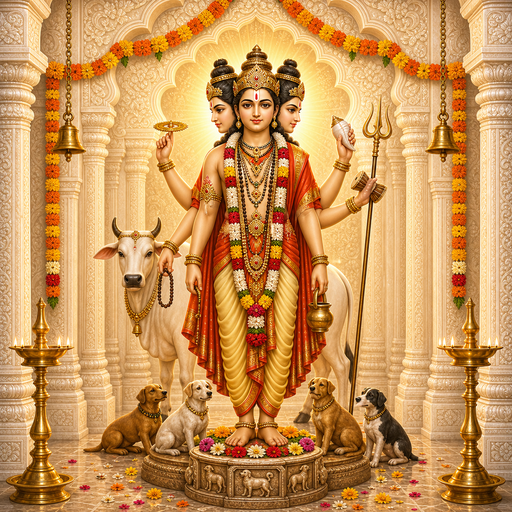
⚠️ Looking for a Shravan or Margashirsh Thursday specifically? This page covers every Thursday of the year in general. The Shravan Thursdays and the Margashirsh Thursdays (Mahalakshmi Vrat) have their own, more specific pages — see the comparison table below.
Deity and significance
Guruvar literally means "the guru's day." In astrology this is linked to the planet Jupiter/the guru-deity Brihaspati, while Dattatreya himself is regarded as the original guru (Adiguru) and the embodiment of guruship — per the story of the twenty-four teachers found in nature, covered in detail on the Datta Jayanti page. The chain of reasoning — "Thursday is the day of guruship, and Datta is the embodiment of guruship, so Thursday belongs to Datta too" — appears consistently across several sources.
This understanding also carries corroboration from multiple sources. The English Wikipedia article on Dattatreya states plainly in its infobox: "Day: Thursday." At the Shri Datta Mandir in Pune, the Datta idol and footwear-relics are carried in a palanquin procession every Thursday night at around 11:15 — this is not merely a matter of belief, but an actual, regularly observed temple practice. The idea is old in Marathi literature too — Sane Guruji's 1946 work "Aapan Sare Bhau" includes a line of dialogue: "What day is it today?" "It's Thursday." "Dattaguru's day; put a garland on the picture."
It's worth keeping in mind that most pan-Indian astrological sources regard Thursday mainly as the day of Brihaspati (the guru-deity — knowledge, wisdom, marriage significations) and Vishnu — this account is equally genuine. The Brihaspati-centred puja vidhi and general vrat katha for this are already covered in detail on the Shravani Guruvar page; here it's only noted, not repeated. In some traditions and regions Thursday belongs to Dattaguru, and in others mainly to Brihaspati-Vishnu — both are true, and neither is presented as "more correct" than the other.
The vrat katha
No separate, Datta-specific katha for the Thursday vrat was found — and this isn't merely an "we couldn't find one" gap. The complete list of traditional Aatpat-nagar-style weekday stories on Marathi Wikisource (around thirty-one entries, including Monday, Mangalagaur, Friday, and Saturday) has no separate entry for a "Thursday's story." So this absence appears to be present in the traditional story-collection itself.
What does turn up under the name "Thursday's story" in the sources researched is a general Brihaspativar vrat katha — one that makes no mention of Dattatreya at all. Its core: a family disrespects the guru/Brihaspati or avoids charitable giving, which brings ruin and misfortune; after observing the Thursday vrat properly, prosperity returns by grace. This story is noted here as belonging to the general Brihaspati tradition, not as a Datta story.
Instead, Datta-centred Thursday worship appears to rest on regular recitation rather than on a katha — a Gurucharitra reading, chanting of the Dattamala mantra, and the "Digambara Digambara" invocation are all given special importance on Thursdays (details in the mantra section below). If a household or regional tradition has its own Datta-Thursday story, it can be given priority over this account.
Who should observe it
- Anyone, by faith — both men and women; particularly Datta devotees and families of the Datta-sampradaya, for whom Datta is a family or personally worshipped deity.
- Those facing obstacles related to learning, education, or career, or seeking the guru's grace — in the pan-Indian Brihaspati tradition, this vrat is also suggested for knowledge, wealth, marriage, and children; this is a matter of astrological belief, not a guarantee.
- Practitioners of Gurucharitra reading or Dattamala mantra sadhana give particular importance to Thursday — it's considered a favourable day for mantra siddhi.
Puja vidhi
The sequence below is researched and general — details can vary by household and region. This page's emphasis is on Datta-centred worship; the Brihaspati-graha-shanti-centred vidhi (yellow clothes, chana dal, and so on) is already covered in detail on the Shravani Guruvar page.
- Bathe early in the morning and wear clean clothes if possible.
- Worship an idol, image, or the footwear-relics (paduka) of Dattatreya — offering sandalwood paste, flowers, unbroken rice, incense, a lamp, and camphor.
- Chanting: recite "Digambara Digambara Shripadavallabha Digambara" or the guru mantra "Om Draam Dattatreyaya Namah."
- Read from the Gurucharitra or the Dattamala mantra/Datta Bavani — daily or especially on Thursday; Thursday is considered an auspicious day to first attain siddhi of the Dattamala mantra (108 recitations).
- Sing the aarti (the traditional Datta aarti given below); offer naivedya and distribute prasad.
- Visit a Datta temple for darshan if possible — some Datta temples (e.g., in Pune) hold a special palanquin procession on Thursday nights.
- Udyapan (closing ritual): unlike the fixed weekly count found for Solah Somvar or the Tuesday vrat's numbered-week traditions, no fixed, Datta-specific "observe this many Thursdays, then close the vrat" tradition was found. The general Brihaspati vrat has a rule of "seven consecutive Thursdays starting from a Thursday under Anuradha nakshatra," but even that doesn't specify a clear closing ritual — if a household Datta tradition has a different rule, follow that instead.
The exact vidhi, direction, materials, and closing rule can vary by region and family tradition — this shouldn't be taken as the one correct procedure.
Puja materials
- An idol, image, or the footwear-relics (paduka) of Dattatreya.
- Sandalwood paste, flowers, unbroken rice, incense, a lamp (oil or ghee), and camphor.
- A Gurucharitra text or a Dattamala mantra/Datta Bavani booklet, for reading.
- Simple sattvic prasad for naivedya — no specific Datta-Thursday dish was found in sources; chana dal, jaggery, and bananas belong to the Brihaspati tradition, and no claim is made here that they're Datta-specific.
(This list can vary by region and family.)
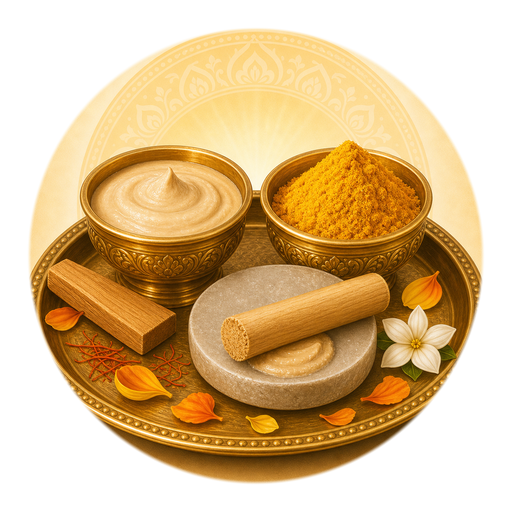 Sandalwood paste
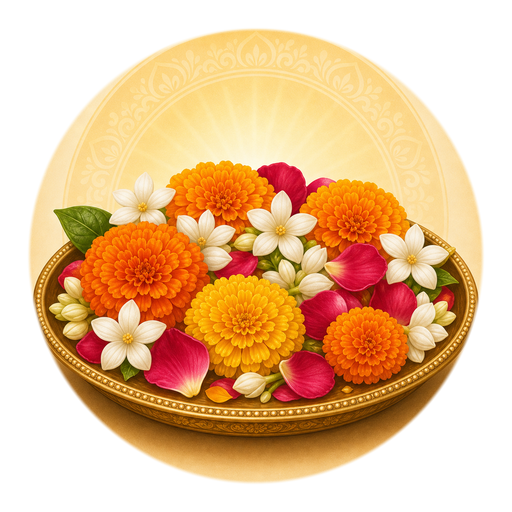 Flowers
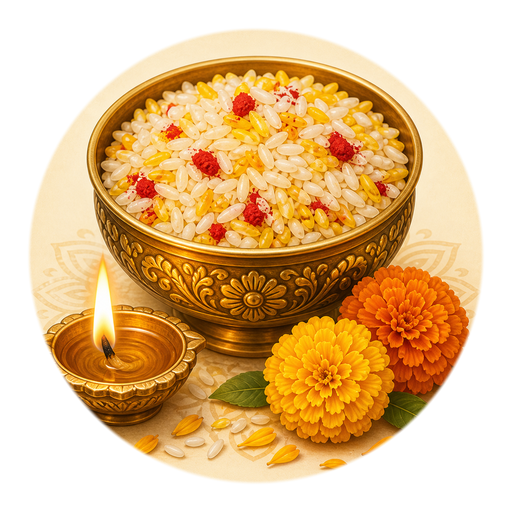 Akshata
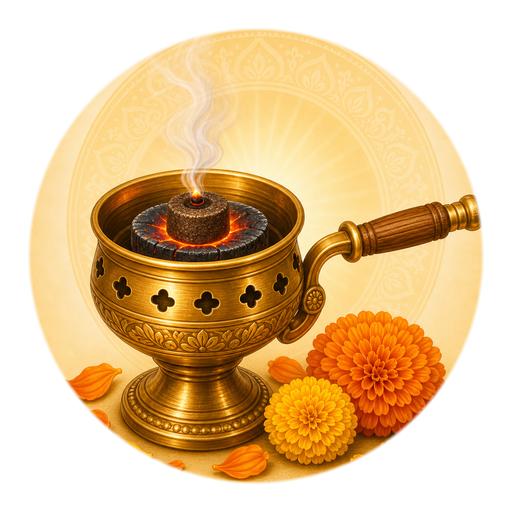 Incense
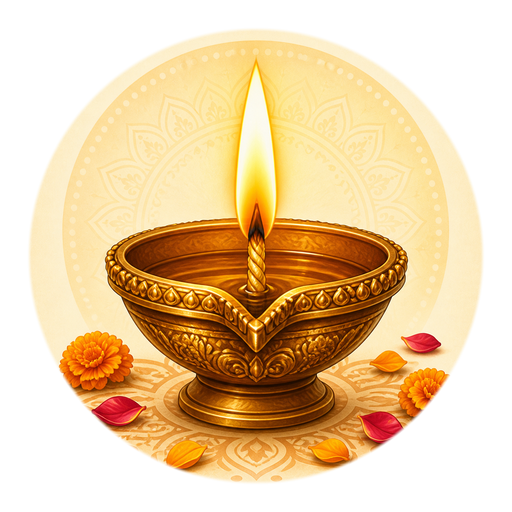 Lamp
Lamp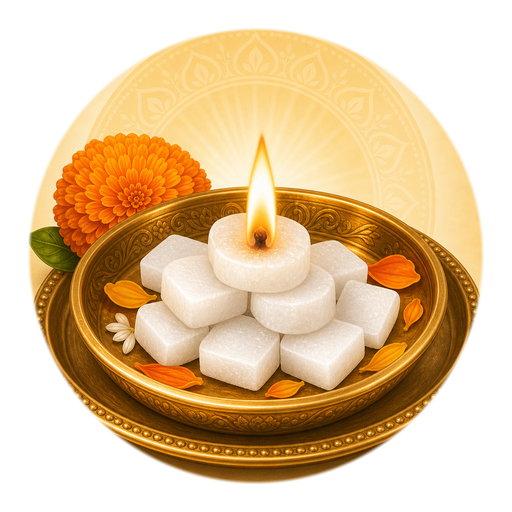 Camphor
 Gurucharitra / pothi
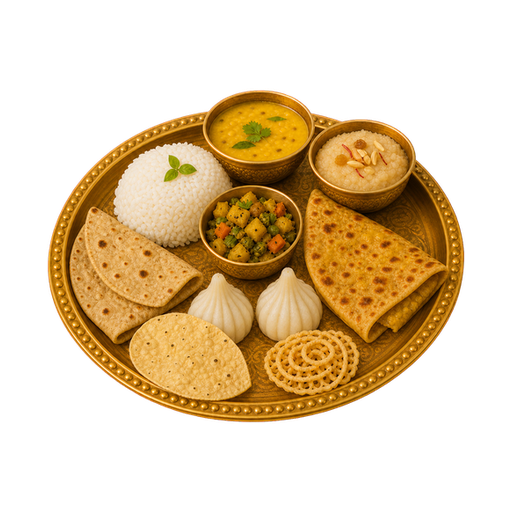 Naivedya (sattvic prasad)
Fasting and dietary rules
Many devotees fast or eat a single meal on Thursday — a general weekday-vrat practice consistent with other weekday pages. One specific, clearly sourced rule was found for Dattamala mantra practitioners and regular Datta worshippers: meat and alcohol are avoided on every Thursday of the year (as well as every full moon, Datta Jayanti, Guru Purnima, and the nine days of the Chaitra and Ashwin Navratris) — which shows that within Datta worship tradition, every Thursday is treated as a regularly observed, significant day, not a claim invented for this page alone.
A strict waterless or single-meal fast doesn't suit everyone — take an exemption based on your health.
Mantras and aarti
- Guru mantra: "Om Draam Dattatreyaya Namah" — a bija mantra of salutation to Dattaguru; a single round (mala) is often chanted before a reading or recitation.
- Naam-ghosh: "Digambara Digambara Shripadavallabha Digambara" — a popular invocation recalling Datta and his incarnations. The composition sounds traditional, but its exact age and author aren't established, so only the meaning and opening line are given here.
- Dattamala mantra: begins "Om Namo Bhagavate Dattatreyaya…" — a 108-recitation stotra; Thursday is considered a particularly favourable day to first attain siddhi of this mantra. Since the author and age aren't established, only the meaning and opening line are given here; the full text awaits a rights review.
- Datta Bavani: tradition holds that it's recited daily or on Thursdays, but this is a 1935 composition by a known author (Sant Rang Avadhoot Maharaj of Nareshwar) — originally in Gujarati, and regarded as under copyright. So only the meaning, when it's recited, and its name are given here, not the full text.
- Aarti — Triguṇātmaka Traimūrti Datta (Eka Janardani/Eknath): this composition is centuries old and regarded as public domain; the full aarti (romanized) is given below, along with its meaning — the Devanagari original is on the Marathi (mr) version of this page.
The aarti opens with "Triguṇātmaka traimūrti Datta hā jāṇā…" ("Know this triple-natured, three-formed Datta…") and its refrain is "Jaya deva jaya deva jaya Shrigurudattā" ("Victory to you, Shrigurudatta"). Its four verses describe Datta as the embodied form of the three gunas (the Brahma-Vishnu-Mahesh trinity), beyond words and thought, describe a devotee's full surrender before him, and close by naming the poet, Eka Janardani (Eknath). The meaning centres on surrender to Datta as the one guru beyond form, and on the grace that follows genuine devotion.
Regional customs
Maharashtra's Datta-sampradaya tradition treats Thursday as Dattaguru's day and gives it a distinct, Datta-centred emphasis — the daily worship at the Datta kshetras of Gangapur, Narsobawadi, and Audumbar, as well as the weekly Thursday palanquin tradition at urban Datta temples such as the one in Pune, are examples of this. Swami Samarth is regarded as an incarnation of Datta, so Thursday also carries significance at his shrines.
The site has three other pages connected to Thursday — the difference is set out clearly here to avoid confusion:
| Page | Scope (2026) | Primary deity | Character |
|---|---|---|---|
| This page — Guruvar Vrat (Datta) | Year-round, every Thursday (53 in all) | Dattatreya (with the Brihaspati account noted alongside) | Daily worship — chanting, Gurucharitra, Dattamala; no separate katha |
| Shravani Guruvar | Only the Thursdays in Shravan (5) | Brihaspati/Jupiter | Detailed puja vidhi and the general Brihaspativar katha |
| Margashirsh Guruvar — Mahalakshmi Vrat | Only the Thursdays in Margashirsh (4) | Mahalakshmi | A women's ghat-installation vrat |
| Datta Jayanti | Once a year (Margashirsh Purnima) | Dattatreya | A birth-tithi festival, the Anasuya-Trimurti story |
Guru Purnima (Ashadh Purnima) is another festival of the guru principle — its emphasis is mainly on worship of Vyasa, and it's also observed within the Datta tradition, but with a different deity emphasis. To understand what a "vaar" (weekday) itself means in the panchang, see vaar; the tithi and nakshatra for a specific Thursday can be found on today's panchang or on that day's own page.
Good to know
- It's true that Thursday is regarded as Dattatreya's day, but some sources and traditions describe it mainly as Brihaspati's/Vishnu's day instead — if you come across that account elsewhere, it isn't a contradiction; both accounts are genuine.
- Datta temples (Audumbar, Narsobawadi, Gangapur, as well as urban Datta temples) can see larger-than-usual crowds on Thursdays and on the full moon — it helps to plan your visit time in advance.
- A strict waterless or single-meal fast doesn't suit everyone — those with diabetes, who are pregnant, or elderly should take an exemption on medical advice.
FAQ
- What is the Guruvar Vrat and who is it dedicated to?
- An observance kept on every Thursday of the year. In Maharashtra it's regarded as dedicated to Dattatreya (Dattaguru), while pan-Indian tradition regards it mainly as the day of the guru-deity Brihaspati/Vishnu.
- Why is Thursday regarded as Dattatreya's day?
- Guruvar means "the guru's day"; Dattatreya himself is regarded as the original guru and the embodiment of guruship, so this chain of reasoning appears consistently across several sources. No firm claim that Datta was born on a Thursday was found — this connection is one of tradition and worship belief.
- Which deity does Thursday belong to — Datta or Brihaspati?
- Both. In some traditions, especially Maharashtra's Datta-sampradaya, Thursday belongs to Dattaguru; in pan-Indian astrological tradition, it belongs mainly to the guru-deity Brihaspati (and Vishnu). There is no single, undisputed answer.
- Who should observe the Guruvar Vrat?
- Anyone, by faith — particularly Datta devotees, families of the Datta-sampradaya, and those seeking help with learning or education.
- How is the Guruvar Vrat puja performed?
- After bathing, worship of the Datta idol or paduka, chanting ("Digambara Digambara" or "Om Draam Dattatreyaya Namah"), a Gurucharitra or Dattamala reading, the aarti, and prasad — with a Datta temple visit if possible. The exact vidhi can vary by region.
- What should be eaten or avoided while fasting on Thursday?
- Many keep a single-meal fast; Dattamala practitioners avoid meat and alcohol every Thursday. No specific Datta-Thursday dish list was found.
- What's the difference between the Guruvar Vrat and Margashirsh Guruvar (Mahalakshmi Vrat)?
- Margashirsh Guruvar is observed only on the four Thursdays of the Margashirsh month, is Mahalakshmi-centred, and is a women's ghat-installation vrat. This page applies on every Thursday of the year, is Datta-centred, and can be observed by anyone.
- What's the difference between the Guruvar Vrat and Shravani Guruvar?
- Shravani Guruvar is observed only on the Thursdays within the month of Shravan (five this year) and emphasises a Brihaspati-centred puja vidhi. This page applies year-round with a Datta-centred emphasis.
- What is the Dattamala mantra, and why is it chanted specifically on Thursday?
- A 108-recitation stotra beginning with "Om Namo Bhagavate Dattatreyaya." Thursday is considered an auspicious day to first attain siddhi of this mantra. The full text and rules should be verified against regional tradition.
Related Info
 Shravani Guruvar13 Aug
 Margashirsh Guruvar (Mahalakshmi vrat)10 Dec
- Datta Jayanti (Shri Dattatreya Jayanti)23 Dec
 Guru Purnima (Vyas Puja)29 Jul
- Gangapur Datta (Shri Narasimha Saraswati)2 Feb
- Narsobawadi (Narsobachi Wadi) Datta Temple29 Jul
- Audumbar Datta (Shri Narasimha Saraswati)2 Feb
 Akkalkot Swami Samarth19 Feb
 Somvar Vrat / Solah Somvar Vrat17 Aug
 Mangalvar Vrat (Hanuman)
 Shanivar Vrat
 Santoshi Mata Vrat
- Vaibhav Lakshmi Vrat