Deoghar Baidyanath Dham
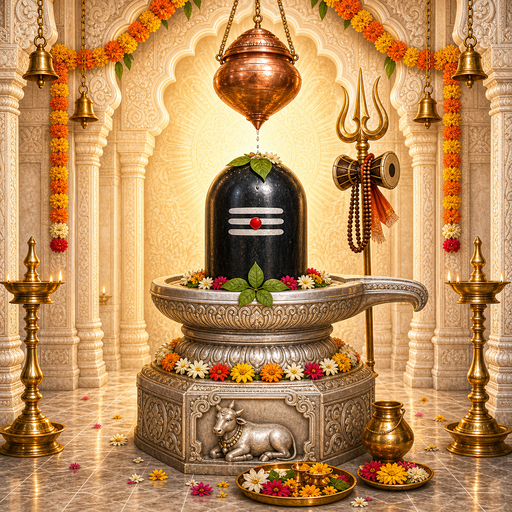
Deoghar Baidyanath Dham is an ancient Shiva temple in the town of Deoghar, Jharkhand — one of the twelve Jyotirlingas, holding the fifth position (Vaidyanath) in the widely-used Dwadash Jyotirlinga stotra recension. It's called the "Kamna Linga" because devotees' wishes are believed to be fulfilled here, and since the Jay Durga Shakti Peeth (Sati's heart) sits right in front of the main temple, it's venerated in both the Shaiva and Shakta traditions. Parli Vaijnath in Maharashtra also considers itself this same Vaidyanath Jyotirlinga — both traditions lay claim to the same "slot," and this is a longstanding, unresolved dispute.
This year's dates (2026)
Deity and significance
Deoghar Baidyanath is considered one of the twelve Jyotirlingas — a Jyotirlinga being Shiva's self-manifested form of light. In the widely-used Dwadash Jyotirlinga stotra sequence, it holds the fifth (Vaidyanath) position; the Maharashtrian tradition gives that same position to Parli Vaijnath.
Both "Baidyanath" and "Vaidyanath" spellings are used for Deoghar. The "Baijnath" temple in Kangra, Himachal Pradesh, however, is a separate temple — a third historical claimant, not to be confused with this one.
It's believed that wishes sincerely made here are fulfilled, which is why this linga is called the "Kamna Linga."
Right in front of the main Baidyanath temple stands the Jay Durga Shakti Peeth — Sati's heart is believed to have fallen here, which is why it's also called the Hriday Peeth/Hardapeeth; Shakti is worshipped here as "Jaydurga" and Bhairav as "Baidyanath/Abhiru." Among the twelve Jyotirlingas, this is one of the few sites holding this dual (Shaiva and Shakta) significance.
The dispute and the difference in lists: the widely-used Dwadash Jyotirlinga list mostly links Vaidyanath to Deoghar; the Maharashtrian tradition, however, considers Parli to be Vaidyanath; Himachal's Baijnath (Kangra) is a third historical claimant. One recension of the stotra reads "purvottare... chitabhumau... girijasametam" (in the northeast, on cremation-ground land, together with Girija) — which is linked to Deoghar's own cremation-ground legend; another recension reads directly "paralyam vaidyanatham." This is a difference across different manuscript recensions — no one is "wrong" here. This is a longstanding, unresolved dispute — both traditions are presented here with equal respect; the Government of India has not officially notified either temple as the Jyotirlinga.
The legend
The temple's existence is traced back to the 8th-century Gupta emperor Adityasena Gupta; scholars infer that a major Shiva temple recorded by the 7th-century Chinese traveler Hiuen Tsang may refer to this same shrine — this isn't a settled fact. The present temple's construction is credited to Raja Puran Mal, though the exact year varies by source (1596 or 1650). In 1788, East India Company officials oversaw the temple's collection administration for a time, before full control was handed back to the head priest, according to historical accounts.
Three separate legend-threads are tied to Deoghar.
Ravana performed severe penance on Mount Kailash and asked Shiva for a special linga (the "Kamna Linga"), intending to carry it to Lanka and become invincible. The gods grew anxious; Vishnu, in the guise of a cowherd boy (named "Baiju Gadariya" in some versions), tricked Ravana into setting the linga down on the ground — once set down, it became permanently rooted at that spot. Ravana tried to pull it up, which is believed to have caused slight damage to the linga (a mark said to be from his thumb pressing on it). This Atmalinga legend is also, scripturally, considered Parli's own founding story — this same shared legend is one reason behind the dispute over Vaidyanath's identity, so this story isn't used here as evidence that "Deoghar is the real Vaidyanath."
In a separate, distinct episode, Ravana offered nine of his own heads to Shiva as fire-offerings during his penance; just as he was about to cut off the tenth, Shiva appeared, stopped him, and restored/healed all nine heads. It's said that this act of healing is what gave this linga the name "Vaidyanath/Baidyanath" (vaidya = physician). This same "Vaidyanath" name-origin is told on the Parli Vaijnath page through a completely different story (the churning of the ocean — with the nectar and Dhanvantari hidden within the linga) — the same name at both places, but with entirely different founding stories; the two aren't merged or cross-applied here.
After Sati's self-immolation, Shiva carried her body and performed the tandava; wherever parts of her body fell, Shakti Peeths came into being — Sati's heart is said to have fallen at Deoghar, making this the Hriday Peeth, a third, separate legend told about this site.
Architecture
The main Baidyanath temple is built in the Nagara style, with a pyramid-shaped shikhara about 72 feet (22m) tall; it faces east, and some consider its shape reminiscent of a blooming lotus. Along with the main Baidyanath sanctum, the complex holds 21 other smaller temples (dedicated to Parvati, Ganesh, Kalbhairav, and others) — 22 temples in all. The main jyotirlinga is said to be about 5 inches in diameter. The shikhara bears three gold vessels donated by the Maharaja of Gidhaur, a trident-shaped emblem (Panchshul), and an eight-petaled lotus jewel.
Right in front of the main temple stands the Parvati (Jay Durga Shakti Peeth) temple; the two shikharas are joined by a red silk thread — devotees offer this thread, and volunteers climb the shikhara to tie it. This is considered a symbol of the union of Shiva and Parvati/Shakti — like the knot tied during the Saptapadi in a wedding, which is why it's called the "Gathbandhan."
Major festivals and pilgrimage
| Festival | Tithi | Date (2026) | Nakshatra | Note |
|---|---|---|---|---|
| Mahashivratri | Magh Krishna Trayodashi | 15 February | Uttarashadha | The biggest Shaiva festival of the year across all twelve Jyotirlingas |
Deoghar's own biggest and most distinctive identity, though, is the Shravani Mela — a barefoot Kanwar pilgrimage of about 105-109 km from Sultanganj (the Ajgaibinath temple) in Bihar to Deoghar, spanning the entire month of Shravan; it's described as one of the largest religious pilgrimages in the world. Millions of kanwariyas make this journey chanting "Bol Bam," bathing in the Shivganga before entering the temple.
An important difference: in the Jharkhand/Bihar region, the month of Shravan is counted by the purnimanta system (the new month begins right after the previous month's full moon) — so the Shravani Mela generally begins soon after Guru Purnima. Maharashtra, however, uses the amanta system (the month begins from Shukla Pratipada) — which puts the exact dates of "Shravan" in the two regions about two weeks apart. One independently-cited source suggests the Shravani Mela may begin around 30 July in 2026; check the local Jharkhand panchang for exact dates. Maharashtra's Shravani Somvar is conceptually related but the dates don't line up directly — don't confuse the two.
As part of the Shravani Mela itself, devotees also visit the nearby Basukinath temple (see "Nearby places" below).
A mention was found, on a government cultural portal, of a cultural event called "Baidyanath Mahotsav" held around Mahashivratri at Deoghar, but its actual details couldn't be verified. Raksha Bandhan, Janmashtami, and Guru Purnima are listed on the temple's own festival calendar, but these are general pan-Hindu festivals — no evidence was found of Deoghar-specific pilgrimage crowds tied to them.
There's also a mention that the temple's havan kund opens only once a year, tied to Navratri — the details aren't clearly documented.
Darshan and aarti timings
General darshan hours (roughly matching across two independent sources): about 4:00 AM to 2:00 PM in the morning, and about 6:00 PM to 8:00 PM in the evening. One source gives more detail: doors open at 4:00 AM, with Kancha Jal (the water ritual) at 4:10 AM, closing at 2:00 PM; doors open again at 6:00 PM, with Shringar Puja at 6:10 PM, closing at 8:00 PM. During the Shravani Mela, darshan queues and hours are likely to change substantially (round-the-clock darshan may be arranged) — no current, independent source was found on this.
One source notes that the temple is administered by a government-linked committee — chaired by the district collector, established by law. This comes from a single source; the actual darshan/aarti timings and any fees should be confirmed directly with the temple's management committee, especially during the Shravani Mela.
Rituals here
At dawn, devotees first perform an abhishek with pure water ("Kancha Jal"); during the Shravani Mela, kanwariyas perform the jalabhishek with Ganga water they've carried from Sultanganj — this is the Mela's core ritual. In the evening, the deity's Shringar Puja is performed. The main ritual at a Jyotirlinga is an abhishek/Rudrabhishek — this is religious guidance, not a universal or medical claim; it should be done according to local/temple tradition and under the guidance of authorized priests. Removing footwear and wearing modest, clean clothing is expected here as at any major Hindu temple.
The Tarak Mantra and other worship details here follow the general Shaiva tradition — the exact mantra wording can vary by tradition; confirm it with a knowledgeable local priest.
Getting there
By air: Deoghar Airport (DGH) is about 9 km from the temple — with direct flight connections to Delhi, Mumbai, Bengaluru, and Kolkata. Alternatives: Patna, Bodhgaya airports.
By rail: Jasidih Junction (about 7 km, on the Howrah-Delhi main line, with premium trains including Vande Bharat/Rajdhani), Deoghar Junction (about 3 km), Baidyanathdham Junction (about 2 km, limited services).
By road: about 243 km from Ranchi, the state capital; about 10 km from the Baghmara interstate bus stand.
Travelling from Maharashtra: direct flight/rail connections exist, but the distance (to Jharkhand) is substantial — check the exact route and travel time before your trip.
Nearby places
Basukinath Dham — about 44-46 km from Deoghar; paired with Deoghar in the popular belief that "the Deoghar pilgrimage is incomplete without Basukinath," forming the "Do Dham Yatra" — kanwariyas especially visit both during the Shravani Mela.
Naulakha Mandir, Tapovan Hill, Nandan Pahar/Trikuta Parvat (ropeway), Pagla Baba Ashram, Ramakrishna Mission Vidyapith — other sightseeing and spiritual spots in Deoghar town.
**Parli Vaijnath (Maharashtra)** — the Maharashtrian claimant to the Vaidyanath Jyotirlinga; not geographically close, but mentioned here for the dispute/comparison.
Traveller tips
The Shravani Mela draws millions of kanwariyas over the month, so crowds are immense — both the Bihar and Jharkhand administrations deploy traffic police, barricading, CCTV, and first-aid centers, but plan ahead for crowds and traffic all the same.
The best season is October to March — cool and pleasant (roughly 10-25°C), ideal for an unhurried darshan. April-June summers can cross 40°C. Shravan (July-August) is spiritually special but very crowded and humid.
If time allows, Deoghar and Basukinath can be planned together as the "Do Dham Yatra" (about 1-1.5 hours of travel). For those coming from Maharashtra, the distance is substantial, so air travel is more convenient; visiting outside the Shravani Mela period means smaller crowds and an easier darshan.
Good to know
- Understand the Parli-versus-Deoghar dispute neutrally — both traditions deserve respect; the Government of India has not officially notified either temple as the Jyotirlinga.
- The Shravani Mela's dates differ from Maharashtra's own Shravan — Jharkhand/Bihar use the purnimanta reckoning, so it begins roughly two weeks earlier.
- Confirm darshan/aarti timings and any special Shravani Mela arrangements directly with the temple's management committee — these change substantially, especially during the Mela.
- Keep the long travel distance from Maharashtra in mind — air travel is more convenient, so plan well ahead.
FAQ
- Which of the Jyotirlingas is Deoghar Baidyanath?
- One of the twelve Jyotirlingas; it holds the fifth (Vaidyanath) position in the widely-used stotra sequence.
- Where is Deoghar Baidyanath Dham? Which state is it in?
- In Deoghar district, Jharkhand (Santhal Parganas division).
- Why is it called Baidyanath / Vaidyanath?
- Deoghar's own legend holds that Ravana offered nine heads to Shiva, and Shiva healed them; this act of healing is believed to have given rise to the name "Vaidyanath" (vaidya = physician). (Parli's name-origin story is entirely different — the churning of the ocean.)
- Parli Vaijnath or Deoghar Baidyanath — which is the real Vaidyanath Jyotirlinga?
- This is genuinely disputed and unresolved — the widely-used list mostly leans toward Deoghar, while the Maharashtrian tradition holds Parli to be Vaidyanath. Both are traditions worth respecting.
- Is Deoghar Baidyanath also a Shakti Peeth?
- Yes, it's believed to be — Sati's heart is said to have fallen here, giving it the name Hriday Peeth; the Jay Durga Shakti Peeth sits right in front of the main temple.
- What is Deoghar's Shravani Mela? How far is Sultanganj from Deoghar?
- A barefoot Kanwar pilgrimage of about 105-109 km from Sultanganj (Bihar) to Deoghar, spanning the entire month of Shravan — considered one of the largest religious pilgrimages in the world.
- What are the darshan timings at Deoghar Baidyanath?
- Roughly 4 AM to 2 PM in the morning, and 6 PM to 8 PM in the evening; these change during the Shravani Mela — confirm with the temple's management committee.
- What is the Basukinath temple near Deoghar? Can both be visited together?
- Basukinath is about 44-46 km from Deoghar; both are visited together as the "Do Dham Yatra," especially during the Shravani Mela.
- How do I reach Deoghar? What's the nearest airport/railway station?
- Deoghar Airport (about 9 km, connected to Delhi/Mumbai/Bengaluru/Kolkata); Jasidih Junction (about 7 km, on the main rail line); about 243 km by road from Ranchi.
- What's the best time to visit Deoghar Baidyanath?
- October to March, for cool weather ideal for a general darshan; Shravan month is spiritually special but very crowded.
Related Info
 Trimbakeshwar14 Jan
 Bhimashankar15 Feb
 Grishneshwar15 Feb
 Aundha Nagnath15 Feb
 Parli Vaijnath13 Feb
 Somnath15 Feb
- Mallikarjuna Jyotirlinga (Srisailam)15 Feb
- Mahakaleshwar (Ujjain, Madhya Pradesh)15 Feb
- Omkareshwar (Madhya Pradesh)25 Jan
- Kedarnath15 Feb
- Kashi Vishwanath (Varanasi, Uttar Pradesh)15 Feb
- Rameshwaram (Tamil Nadu)15 Feb
- Dwarka Nageshwar15 Feb
 Maha Shivratri15 Feb
- Shravani Somvar17 Aug