Omkareshwar (Madhya Pradesh)
Omkareshwar is the fourth of the twelve Jyotirlingas — on Mandhata island in the Narmada river, in Khandwa district, Madhya Pradesh. The Narmada splits into two channels here, and the island formed between them is believed to resemble the shape of the sacred syllable "Om." The island holds Omkareshwar, while the south bank holds the equally-regarded Mamleshwar (anciently called Amareshwar). Tradition holds that Adi Shankaracharya met his guru, Govinda Bhagavatpada, here. A separate, unrelated "Omkareshwar Temple" on the Mutha river in Pune shouldn't be confused with this site.
This year's dates (2026)
- Narmada Jayanti — web sources say celebrations are held at Omkareshwar's ghats25 Jan
- Mahashivratri — the biggest day of the year across all Jyotirlingas15 Feb
- First Shravani Monday — the start of Sawan's peak crowd season17 Aug
- Second Shravani Monday24 Aug
- Third Shravani Monday31 Aug
- Fourth (last) Shravani Monday7 Sep
- Kartik Mela / Panchkroshi Yatra begins — starting at Gomukh Ghat20 Nov
- Tripurari Purnima — the Panchkroshi Yatra concludes with a circumambulation of Omkar Parvat24 Nov
Deity and significance
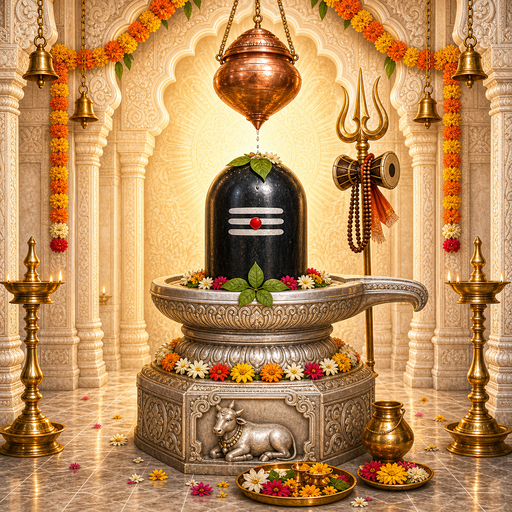
Lord Shiv — fourth in the traditional hymn order of the twelve Jyotirlingas, after Somnath, Mallikarjuna, and Mahakaleshwar. The linga in the sanctum is regarded as a roundish black stone, with a white stone beside it regarded as a symbol of Parvati; the complex also holds a Ganapati shrine.
Both Shivlings — Omkareshwar on the island and Mamleshwar on the south bank — are held in equal regard, with tradition holding that Shiv manifested in two forms on either bank of the Narmada. Even so, this isn't counted as two separate Jyotirlingas — both are regarded as two forms of the same fourth position on the list of twelve. Some sources describe this as "two independent, equally-ranked forms," while others frame it as "one Jyotirlinga expressed across two temples" — the exact wording varies by source.
This is the second Jyotirlinga in Madhya Pradesh — about 140-143 km from Mahakaleshwar (Ujjain); combining both in one trip is common.
History and legend
The temple standing today is believed to have been originally built by the Paramara kings of Malwa in the 11th century. In the 18th century, it was renovated — begun by Holkar queen Gautama Bai Holkar and completed by her daughter-in-law Ahilyabai Holkar — the same Holkar-era reconstruction thread seen at Trimbakeshwar and Grishneshwar.
By some accounts, the temple suffered damage and looting during medieval invasions (beginning with Mahmud of Ghazni), though it was never completely destroyed. Since independence in 1947, the temple's management has rested with the Archaeological Survey of India (ASI) and the Khandwa district administration.
Local tradition tells two origin legends, traditionally connected to the island's two Shivlings (Omkareshwar and Mamleshwar).
In the first version, sage Narada tells Mount Vindhya that Mount Meru is greater; feeling challenged, Vindhya performs severe penance to please Shiv — fashioning a Shivling out of sacred clay and worshipping it for about six months. Pleased, Shiv appears and grants Vindhya a boon; but with the gods and sages alarmed by Vindhya's unchecked growth, Shiv agreed to reside there permanently, in the form of the Omkareshwar Jyotirlinga.
In the second version, King Mandhata of the Ikshvaku dynasty (regarded as an ancestor of Lord Ram) performs long penance here; pleased by his austerity, Shiv manifests as a radiant Jyotirlinga. It's also said that a clay impression naturally took the shape of "Om," which is how the island came to be called "Omkareshwar." The two legends belong to different devotees (a mountain-deity versus a human king), and sources take no firm position on which is "original" and which came later — both are presented here as parallel traditions.
A well-established tradition holds that Adi Shankaracharya travelled from Kaladi in Kerala to meet his guru, Govinda Bhagavatpada, who was in deep meditation in a cave on the Narmada's banks. One telling adds that when the Narmada suddenly flooded, Shankaracharya placed his kamandalu in front of the rising water to protect his guru. When the guru asked, "Who are you?", Shankaracharya's immediate verse-form answer — the Nirvana Shatakam, also called the Atma Shatakam — is linked to this same episode, by that account. The cave is still open for darshan today, not far from the Omkareshwar bus stand, on Mandhata island.
Architecture and layout
The temple follows the Nagara (North Indian) architectural style, with a tall shikhara built up in stone tiers. The main temple is regarded as five storeys — Omkareshwar on the ground floor, with Mahakaleshwar, Siddhnath, Gupteshwar, and a flag-bearing deity on the floors above, in that order. The assembly hall stands about 14 feet tall on 60 pillars.
The Mamleshwar temple (anciently called Amareshwar) stands on the Narmada's south bank, facing the island. The Gauri Somnath temple — a three-storeyed, peacock-shaped structure — is on the island itself. The Govinda Bhagavatpada cave (the "Shankaracharya cave") is a short distance from the main temple.
The Narmada splits into two channels here — the narrower, deeper southern channel is the Narmada itself, while the wider, shallower northern channel is locally called "Kaveri." This is not the famous Kaveri river of South India — the shared name is coincidental.
A hanging bridge roughly 270 feet long spans the Narmada; the island is reached by bridge or boat. Just upstream stands the Omkareshwar Dam, built 2003-2007 (520 MW of hydroelectric capacity, irrigating roughly 132,500 hectares) — the dam takes its name from the temple.
Main festivals and pilgrimage
| Festival | Date (2026) | Connection |
|---|---|---|
| Narmada Jayanti | 25 January | Abhishek-aarti at Omkareshwar's ghats |
| Mahashivratri | 15 February | The biggest day of the year across all Jyotirlingas |
| Shravani Monday (4) | 17, 24, 31 August & 7 September | Sawan's peak crowd season |
| Kartik Mela / Panchkroshi Yatra begins | 20 November | Starting at Gomukh Ghat |
| Tripurari Purnima + yatra concludes | 24 November | Circumambulation of Omkar Parvat and collective darshan; estimated at more than a lakh devotees |
Darshan and aarti timings
According to one temple-affiliated website, the general schedule runs: Mangala Aarti 4:30-5 AM, Mangala darshan 5 AM-12:20 PM, midday darshan roughly 1-4 PM, evening Shringar darshan 4:30-9:30 PM, Shayan Aarti-darshan 9:30-10:30 PM. Darshan is closed before 5 AM and after 10:30 PM. Timings change during festivals and special occasions.
Confirm darshan and aarti timings with the temple administration or ASI before an actual visit.
Rituals here
Rudrabhishek and the general Jyotirlinga puja are regarded as the main rituals here, as at the other Jyotirlingas. By some accounts, the day's three worship sessions are conducted by three different groups (a trust, the Scindia family, and the Holkar family), with a golden palanquin procession of a three-faced idol every Monday. The temple website states that a Shighra Darshan (fast-track) ticketed service exists — confirm the exact process and fees before an actual visit.
How to reach
By road, roughly 77-87 km from Indore and 70-75 km from Khandwa. The nearest major railway station is Khandwa Junction (about 77 km) or Mhow; Indore Junction is also an option. The nearest airport is Indore's Devi Ahilyabai Holkar Airport, roughly 84-87 km away. Combining this with the Mahakaleshwar Jyotirlinga at Ujjain (roughly 140-143 km) is a common itinerary.
Nearby places
- Mamleshwar Temple, Gauri Somnath Temple, Govinda Bhagavatpada Cave — on or near the island.
- Omkareshwar Dam — upstream of the temple on the Narmada.
- Maheshwar (Ahilyabai Holkar's fort and ghat) — about 66-69 km away.
- **Mahakaleshwar, Ujjain** — about 140-143 km away.
- Indore city — about 77-87 km away.
Traveller tips
- Expect the heaviest crowds during Sawan (Shravan) and Mahashivratri — MP Tourism calls Sawan the year's peak season.
- Expect very heavy crowds during the Kartik Mela (November, Panchkroshi Yatra) — plan ahead.
- Reaching the island requires a bridge or boat — river levels can rise in the monsoon, changing routes and timings.
- October to March is generally considered the best time to visit.
Good to know
- The "Omkareshwar Temple" on the Mutha river in Pune is a separate, unrelated temple — this Jyotirlinga is in Khandwa district, Madhya Pradesh; don't confuse the two.
- Omkareshwar and Mamleshwar are both regarded as equally significant — don't treat one as secondary to the other.
- Routes onto the island and darshan timings can change by season — confirm before your actual visit.
FAQ
- Which state is the Omkareshwar temple in?
- Madhya Pradesh, Khandwa district, on Mandhata island in the Narmada river — not in Maharashtra.
- How far is Omkareshwar from Indore?
- Roughly 77 to 87 km.
- Which of the twelve Jyotirlingas is Omkareshwar?
- Fourth in the traditional hymn order.
- What's the difference between Omkareshwar and Mamleshwar?
- Both are regarded as equally significant Shivlings — Omkareshwar on the island, Mamleshwar (anciently called Amareshwar) on the south bank; tradition holds Shiv manifested in two forms on either bank of the Narmada.
- Why does the Omkareshwar island resemble the shape of Om?
- The island formed where the Narmada splits into two channels is believed to naturally resemble the shape of the sacred syllable "Om."
- What is Adi Shankaracharya's connection to Omkareshwar?
- Tradition holds he met his guru, Govinda Bhagavatpada, here; the cave is still open for darshan today.
- What are the darshan timings at Omkareshwar?
- Roughly 5 AM to 10:30 PM, with closures during certain aarti/bhog periods — confirm exact timings with the temple administration.
- Is the Omkareshwar temple in Pune the same as the Omkareshwar Jyotirlinga in Madhya Pradesh?
- No, they are two separate, unrelated temples.
Related Info
 Maha Shivratri15 Feb
- Shravani Somvar17 Aug
- Tripurari Pournima24 Nov
 Mahakaleshwar (Ujjain, Madhya Pradesh)15 Feb
 Trimbakeshwar14 Jan
 Bhimashankar15 Feb
 Grishneshwar15 Feb
 Aundha Nagnath15 Feb
 Parli Vaijnath13 Feb
- Deoghar Baidyanath Dham15 Feb
- Dwarka Nageshwar15 Feb
- Mallikarjuna Jyotirlinga (Srisailam)15 Feb
- Kedarnath15 Feb
- Kashi Vishwanath (Varanasi, Uttar Pradesh)15 Feb
- Rameshwaram (Tamil Nadu)15 Feb
- Somnath15 Feb