Kedarnath
Kedarnath is one of the twelve Jyotirlingas, in Rudraprayag district, Uttarakhand, in the Garhwal Himalayas on the Mandakini river, at about 3,580 metres — the highest-altitude Jyotirlinga. Unlike other Jyotirlingas, this temple isn't open year-round — it opens around Akshaya Tritiya and closes on Bhau Beej, with the deity moved to Ukhimath for winter. What sets this site apart is being part of the Char Dham, Panch Kedar, and dvadash-Jyotirlinga pilgrimage lists all at once, and having survived and been rebuilt after the devastating 2013 floods.
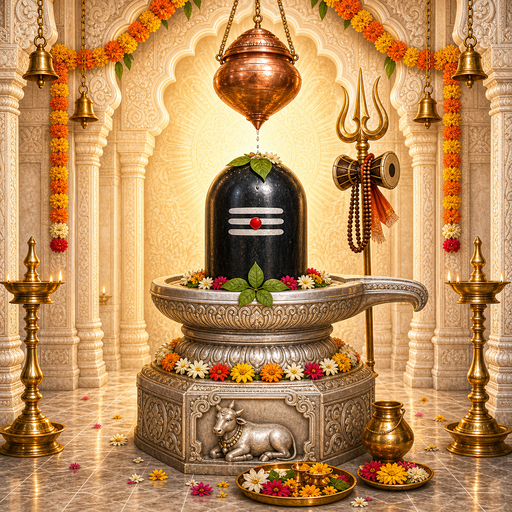
This year's dates (2026)
- The traditional tithi reference for the kapaat (doors) opening — the actual announced date for 2026 is 22 April (see the note below)19 Apr
- Mahashivratri — the Kedarnath temple is closed for winter on this day; the observance takes place at Ukhimath instead15 Feb
- First Shravani Monday (during the yatra season)17 Aug
- Second Shravani Monday24 Aug
- Third Shravani Monday31 Aug
- Fourth (last) Shravani Monday7 Sep
- Bhau Beej/Yama Dwitiya — the kapaat closing day, marking the end of the yatra season with the Shiv Samadhi Poojan11 Nov
Deity and significance
Kedarnath is one of the twelve Jyotirlingas — a Jyotirlinga being a self-manifested form of light representing Shiv. In one traditional hymn order, Kedarnath is placed eleventh; Jyotirlinga numbering varies by tradition.
Kedarnath is regarded as the highest-altitude Jyotirlinga — the other eleven sit much closer to sea level. It's a confluence of three major pilgrimage lists — the twelve Jyotirlingas, the Chota Char Dham (Yamunotri-Gangotri-Kedarnath-Badrinath), and the Panch Kedar (with Kedarnath regarded as the principal, first temple) — no Jyotirlinga in Maharashtra combines all three.
History and legend
The temple standing today is believed to have been built or revived by Adi Shankaracharya around the 8th century — two independent sources agree on this. By the 12th century it was already an established pilgrimage site. The temple is built of large grey stone slabs, about 80 feet tall, with a sanctum and mandap — in the North Indian Himalayan architectural style.
Behind the temple stands a samadhi shrine of Adi Shankaracharya, and local tradition holds that he took samadhi at this very spot. However, a second tradition (associated with the Kanchi Kamakoti Peetham) claims he died in Kanchipuram — Wikipedia itself calls the Kedarnath memorial "purported," meaning this isn't settled fact.
There are two distinct layers of story here, which shouldn't be conflated. The Jyotirlinga's original mythological origin, per the Shiv Purana, goes like this: Vishnu's Nara-Narayana forms undertake severe penance at Badrikashram in the Himalayas; pleased by their devotion, Shiv manifests, and at their request he stays on permanently at Kedar in the form of the Jyotirlinga. This is the same devotee-centred mythological origin story told for every other Jyotirlinga.
A separate, more popular local legend concerns the Pandavas — after the Mahabharata war, seeking penance for the sins of killing kin and Brahmins, the Pandavas go looking for Shiv at Kailash. Shiv, angry with them, hides by taking the form of an animal — most popular retellings (including Wikipedia's) say a bull or Nandi, while one older English translation of the Shiv Purana uses the word "buffalo" for the same episode directly.
Bhima recognises the animal and grabs its tail and hind legs; the animal plunges into the ground, and its body is said to have appeared in five separate places — the hump at Kedarnath, the arms at Tungnath, the face at Rudranath, the navel-belly at Madhyamaheshwar, and the matted hair at Kalpeshwar. The Pandavas built temples at all five — this is the Panch Kedar tradition. Wikipedia explicitly notes that Kedarnath isn't directly named in the Mahabharata text itself — meaning the Pandava story comes from later local tradition, not the original epic.
Architecture and layout
The Shivling is triangular in shape and self-manifested; the base's circumference and height are both about 3.6 metres. The mandap holds idols of the five Pandavas, Krishna, Nandi, and Virbhadra.
During the 2013 floods, a large boulder lodged behind the temple — now worshipped as the "Bhim Shila" — is credited with protecting the temple from the floodwaters. Teams from the Archaeological Survey of India and IIT Madras concluded the structure remained structurally sound.
A cloudburst and landslide on 16-17 June 2013 caused the Chorabari Tal to breach, sending a huge volume of water into the Mandakini river. According to Uttarakhand government figures, roughly 5,700 to over 6,000 people were reported missing or presumed dead in the disaster — an independent fact-check found that the widely circulated figure of "25,000 deaths" was incorrect, with the official figure being considerably lower. Reconstruction work led by the Nehru Institute of Mountaineering allowed the yatra to resume the very next year.
Since 2017, the central government has undertaken a large-scale redevelopment plan for Kedarpuri, with several projects built in phases — figures are updated periodically, so check the official portal for the latest.
Main festivals and pilgrimage
Unlike other Jyotirlingas, the Kedarnath temple isn't open year-round — it's seasonal. So the real "main occasion" here is the start and end of the yatra season itself.
| Occasion | Date (2026) | Connection |
|---|---|---|
| Kapaat opening (yatra begins) | Akshaya Tritiya, tithi anchor 19 April; actual announced date 22 April | Temple-specific, an extremely high-demand occasion |
| Mahashivratri | 15 February | The Kedarnath temple itself is closed on this day — the observance takes place at Ukhimath's Omkareshwar temple, where the next season's kapaat date is also announced |
| Shravani Monday (4) | 17, 24, 31 August & 7 September | During the active yatra season |
| Kapaat closing (yatra ends) | Bhau Beej/Yama Dwitiya, 11 November | "Shiv Samadhi Poojan" — a symbolic farewell to the deity for winter; the idol is carried in a palanquin to Ukhimath |
The exact annual date for the kapaat opening is decided and announced each year at Mahashivratri in Ukhimath by the temple committee (BKTC) based on panchang calculations — it doesn't always line up exactly with Akshaya Tritiya (for 2026, the announced date was 22 April versus Akshaya Tritiya's 19 April, a three-day gap). So never assume "it opens on this same date every year" — check the official announcement before your actual trip.
Darshan and aarti timings
Travel-guide sources give a general pattern: morning abhishek-puja roughly 4-6:30 AM, general darshan from about 6 AM, closed roughly 3-5 PM (shringar time, viewing from a distance only), evening aarti roughly 6-8:30 PM (summer season). There's no fixed Shayan Aarti time — it happens once the queue clears. General darshan is free; special darshan with Rudrabhishek (late at night, roughly 1-4 AM) is available separately, for a fee.
Timings change by season and crowd levels — confirm current timings with the temple committee (BKTC, badrinath-kedarnath.gov.in) before your trip. The temple is managed by the BKTC under the Shri Badrinath-Kedarnath Temples Act, 1939.
Rituals here
Currently, biometric registration is reported to be in use for the Char Dham yatra — the exact process, required documents, and pass format can change season to season or year to year, so confirm the current requirement on the official BKTC portal before travelling.
Special pujas such as Mahabhishek, Rudrabhishek, Laghurudrabhishek, and Shodashopachar can reportedly be booked online through the temple trust's portal. On the last day of the yatra season (Bhau Beej), the "Shiv Samadhi Poojan" is performed — this shouldn't be confused with Adi Shankaracharya's samadhi shrine; the two are distinct.
How to reach
From Gauri Kund (the last motorable point), it's roughly a 16-18 km trek on foot — pony or palanquin (doli) options are also available. Shuttle helicopter services run from Phata, Sersi, and Guptkashi, though bookings and fares change often.
The nearest railway station is Rishikesh (roughly 223-230 km), followed by a road journey. The nearest airport is Dehradun (Jolly Grant), roughly 239 km away, with direct flights from Delhi, Mumbai, and other major cities. All distances vary by a few kilometres across sources.
Nearby places
- The other four Panch Kedar temples — Tungnath, Rudranath, Madhyamaheshwar, and Kalpeshwar — are linked to the same Pandava legend.
- The other three of the Chota Char Dham — Badrinath, Gangotri, and Yamunotri; the traditional pilgrimage order runs from Kedarnath to Badrinath.
- Ukhimath — the winter seat, at the Omkareshwar temple; the deity resides here for six months, and the kapaat date is announced here too.
- Gauri Kund, Sonprayag, Guptkashi, and Rudraprayag are the main stops along the pilgrimage route.
Traveller tips
- Complete Char Dham registration in advance — you can't proceed past checkpoints without the biometric/QR pass.
- At about 3,580 metres, expect cold temperatures and thin air — carry appropriate clothing, necessary medication, and consider a medical check-up before travelling.
- The temple is closed outside the season (November to April) and the area is snowbound — since the exact opening/closing dates change every year, confirm them on the official portal.
- Expect very heavy crowds in May-June and during Shravan — booking early for registration and accommodation is helpful.
- Timings, fees, and registration rules can change — confirm with the official BKTC portal before travelling.
Good to know
- Remember that the Kedarnath temple itself is closed on Mahashivratri — the observance happens at Ukhimath, so don't confuse the two.
- The kapaat opening date is announced afresh every year — don't assume any single fixed date applies permanently.
- Since this temple sits at the intersection of the Char Dham, Panch Kedar, and dvadash-Jyotirlinga pilgrimage lists, it helps to plan travel with all three in mind.
FAQ
- Which state is the Kedarnath temple in?
- Uttarakhand, in Rudraprayag district, in the Garhwal Himalayas, at about 3,580 metres above sea level.
- Which numbered Jyotirlinga is Kedarnath?
- One of the twelve Jyotirlingas; eleventh in one traditional hymn order, though Jyotirlinga numbering can vary by tradition. It's also regarded as the highest-altitude Jyotirlinga.
- What is Kedarnath's story? What's the Pandavas' connection?
- Per the Shiv Purana, the original Jyotirlinga arose from the penance of Nara-Narayana; per popular local legend, after the Mahabharata war the Pandavas sought out Shiv for penance, and Shiv hid in the form of an animal whose body appeared in five places (the Panch Kedar). Kedarnath isn't directly named in the Mahabharata text.
- When does the Kedarnath temple open and close in 2026?
- The announced opening date for 2026 is 22 April (close to Akshaya Tritiya on 19 April); the closing date is Bhau Beej, 11 November. The exact opening date is announced afresh each year at Mahashivratri.
- How do I reach Kedarnath? What's the distance from Gauri Kund?
- Roughly a 16-18 km trek from Gauri Kund (pony/palanquin options available); or by helicopter from Phata/Sersi/Guptkashi. The nearest railway station is Rishikesh, and the nearest airport is Dehradun-Jolly Grant.
- Why is the Kedarnath temple closed in winter? Where does the deity go?
- Due to extreme cold and snowfall, the temple is closed from November to April; the idol is carried in a palanquin to the Omkareshwar temple at Ukhimath, where it's worshipped for the six winter months.
- Is Mahashivratri observed at Kedarnath?
- Not at the temple itself — it's closed that day. The Mahashivratri observance and the announcement of the next season's kapaat date both take place at Ukhimath.
- Is Adi Shankaracharya's samadhi at Kedarnath?
- A samadhi shrine of his stands behind the temple, and local tradition holds he took samadhi there — but this is disputed, with a second tradition pointing to Kanchipuram.
- What happened to the Kedarnath temple in the 2013 floods?
- The temple itself was protected by a large boulder (the "Bhim Shila"); ASI and IIT Madras teams confirmed the structure remained sound. The surrounding area, however, saw thousands reported missing or dead.
- What is Panch Kedar?
- Five temples — Kedarnath, Tungnath, Rudranath, Madhyamaheshwar, and Kalpeshwar — representing, per the Pandava legend, five parts of Shiv's body. Kedarnath is regarded as the principal, first temple.
Related Info
 Maha Shivratri15 Feb
- Shravani Somvar17 Aug
 Adi Shankaracharya Jayanti21 Apr
 Trimbakeshwar14 Jan
 Bhimashankar15 Feb
 Grishneshwar15 Feb
 Aundha Nagnath15 Feb
 Parli Vaijnath13 Feb
 Deoghar Baidyanath Dham15 Feb
- Dwarka Nageshwar15 Feb
- Kashi Vishwanath (Varanasi, Uttar Pradesh)15 Feb
- Mahakaleshwar (Ujjain, Madhya Pradesh)15 Feb
- Mallikarjuna Jyotirlinga (Srisailam)15 Feb
- Omkareshwar (Madhya Pradesh)25 Jan
- Rameshwaram (Tamil Nadu)15 Feb
- Somnath15 Feb