Somnath
Somnath is the first of the twelve Jyotirlingas — on Gujarat's Saurashtra coast, at Prabhas Patan (near Veraval) in Gir Somnath district, on the shore of the Arabian Sea. The Dvadash Jyotirlinga Stotram itself opens with the line "Saurashtre Somanatham cha." Legend holds that the Moon worshipped Shiv here to gain partial relief from a curse from Daksha — this is where the name "Somnath" comes from, and it's said to explain the waxing and waning of the moon (the very basis of tithi reckoning in the panchang). The temple has been destroyed and rebuilt many times over history; the grand structure standing today was raised in 1951 at the initiative of Sardar Vallabhbhai Patel.
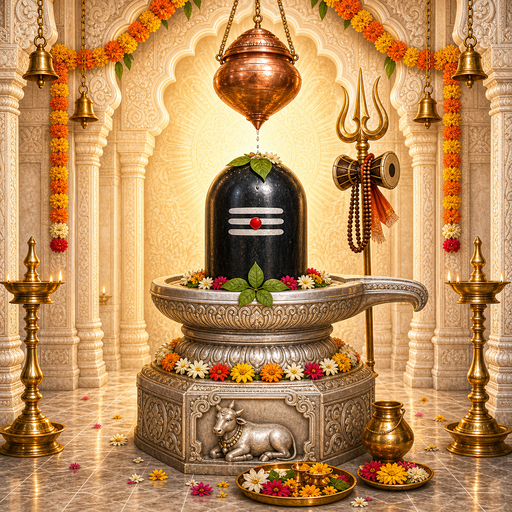
This year's dates (2026)
- Mahashivratri — the biggest day of the year across all Jyotirlingas; Somnath offers a special Parthiveshwar Puja option15 Feb
- First Shravani Monday — part of the trust's month-long \17 Aug
- Kartik Purnima — Somnath's own multi-day \24 Nov
Deity and significance
Somnath is regarded as the first of the twelve Jyotirlingas — it holds first position both in the Jnanasamhita of the Shiv Purana (the oldest known list of Jyotirlingas) and in the Dvadash Jyotirlinga Stotram attributed to Adi Shankaracharya.
"Som" means moon, and "Nath" means lord or protector — so "Somnath" means "protector of the moon." The site's ancient name, "Prabhas" (splendour/radiance), and the name "Someshwar," both come from this same legend.
Legend holds that it was here Shiv gave the Moon a boon — that he would wane, part by part, over one fortnight, and wax again over the next — connecting the concept of the moon's phases, which underlies the Shukla-Krishna paksha and tithi reckoning, directly to this site. The Prabhas area (Triveni Sangam) is regarded as especially auspicious for Pitru-Tarpan and Shraddha rites, particularly in the months of Chaitra, Bhadrapad, and Kartik — it's also known as a moksha tirtha.
History and legend
The exact founding year of the original temple is uncertain and conflicting across sources — some place it anywhere from the early first millennium CE to the 9th century, while one source gives a directly conflicting "649 BCE." Around the 10th century (before 997 CE), the Chalukya/Solanki king Mularaja is believed to have built a stone temple.
The temple was destroyed and rebuilt several times afterward — the famous 1026 CE raid by Mahmud of Ghazni; reconstruction between 1143-1172 (particularly 1169) under Chalukya king Kumarapala; destruction in 1297/99 by Ulugh Khan, a general of Alauddin Khilji; reconstruction between 1308-1351 under Chudasama king Mahipala I and his son Khengara; destruction in 1394/95 by Zafar Khan; desecration in 1451 by Mahmud Begada; and destruction in 1665 and 1706 on the orders of Mughal emperor Aurangzeb. Later, in the late 18th century (c. 1783-86), Ahilyabai Holkar is also recorded as having built a separate, smaller temple near the original site. At least five to six major destruction-reconstruction phases are documented in total; popular retellings sometimes cite a larger combined figure. Historian Romila Thapar has also observed that the exact figure for Mahmud of Ghazni's plunder may be a recurring or exaggerated claim within contemporary Muslim chroniclers' records.
Sardar Vallabhbhai Patel resolved to rebuild the temple after seeing its ruins in November 1947; Mahatma Gandhi supported the effort but set a condition — that construction be funded by public subscription, not the state. The Somnath Trust, led by K.M. Munshi, began construction in October 1950 after clearing the old ruins; the actual building work was carried out by Gujarat's traditional Sompura community of temple masons. On 11 May 1951, India's first President, Dr. Rajendra Prasad, performed the installation ceremony. Some discussion did take place at the time around the President's attendance at the inauguration, though he attended as planned on the scheduled day regardless.
The temple is managed by the Shree Somnath Trust — its leadership changes over time as an administrative matter.
The local legend of the Moon and Daksha is told as follows in the sthala-purana — Prajapati Daksha married his 27 daughters (regarded as symbolic of the 27 nakshatras) to the Moon. The Moon grew especially fond of one wife (Rohini, in most versions) and neglected the others. The neglected wives complained to Daksha; Daksha counselled the Moon, but the Moon didn't listen. The enraged Daksha cursed the Moon — his radiance began to fade. The Moon undertook intense worship of Shiv in the Prabhas area. Pleased, Shiv didn't fully lift the curse but modified it — the Moon would wane, part by part, over one fortnight, and wax again over the next. The grateful Moon established Shiv at that very site as the Jyotirlinga named "Somnath."
Some versions describe the curse specifically as "consumption" (a named ailment), while others describe it only as a general "fading of radiance." The duration and method of the worship also vary by version — some say a six-month ritual, others ten million recitations of the mantra, and one version says it was actually the wives, not the Moon himself, who performed the chanting. Wikipedia's etymological note differs slightly too — there, the Moon is said to have bathed in the Saraswati river to regain his radiance, and this is said to be the origin of the name "Prabhas."
Architecture and layout
The present temple's style is given different names across sources — some popular sources call it the "Chalukya/Kailash Mahameru Prasad style," while Wikipedia calls it the "Maru-Gurjara style" — these are likely different names for the same broad temple-architecture tradition of the Gujarat-Rajasthan region. The shikhara's height is also reported differently — some sources give roughly 155 feet total, while others give about 49 feet for the shikhara above the sanctum plus a separate flagpole.
The flag atop the temple is changed three times a day — this tradition is consistently recorded across several independent tourism sources. Construction involved Gujarat's traditional community of Sompura temple masons. The temple stands directly on the Arabian Sea coast; photography, mobile phones, and cameras are strictly barred inside the sanctum.
An ancient pillar — the Baan Stambh (arrow pillar) — stands on the temple's sea-facing side, bearing a Sanskrit inscription popularly interpreted as meaning: "from this point, there is no landmass in a straight line across the sea all the way to the South Pole (Antarctica)." This claim is repeated across countless tourism sources as a popular belief among pilgrims, not an established scientific fact.
Main festivals and pilgrimage
| Festival | Date (2026) | Connection |
|---|---|---|
| Mahashivratri | 15 February | The biggest day of the year across all Jyotirlingas; Somnath offers a special "Parthiveshwar Puja" option via the trust |
| Somnath Sthapana/Pran-Pratishtha Divas | 11 May | The annual anniversary of the 11 May 1951 installation ceremony — temple-specific, not tithi-tagged in the panchang (a solar/Gregorian date) |
| Shravani Monday (4) | 17, 24, 31 August & 7 September | Part of the trust's month-long "Shravan Mahotsav"; the Mondays themselves are a general festival |
| Tripurari Purnima — the "Kartik Purnima Mela" | 24 November | Somnath's own multi-day fair, with extended darshan hours |
Somnath's Sthapana Divas (11 May) is a solar-calendar date, not tied to a tithi — the panchang shows this date only as "National Technology Day"; its recognition as Somnath's anniversary comes from the temple trust's own yearly observance.
Details such as the exact year the Kartik Purnima Mela began, and the exact name of its venue, aren't firmly established — the multi-day fair itself takes place in November, with extended darshan hours.
Darshan and aarti timings
According to official trust information, darshan runs from 6 AM to 10 PM; aarti takes place at 7 AM, 12 noon, and 7 PM. The "Jai Somnath" sound-and-light show runs from 8 to 9 PM (it may be paused during the monsoon) — one tourism source gives the show time as 7:45 PM instead, so confirm the actual time before your visit.
Photography, mobile phones, cameras, and smartwatches are strictly barred inside the sanctum — free locker facilities are available. Modest dress is expected for entry (mini-skirts or disrespectful attire aren't allowed); smoking is also strictly prohibited. All timings can change during festivals and special occasions (for instance, extended into late night during the Kartik Purnima Mela) — confirm with the official website or temple committee before an actual visit.
Rituals here
Rudrabhishek and havan/yagna (in a separate yagnashala) can be booked; special puja options (such as "Parthiveshwar Puja") are offered by the trust on Mahashivratri. The Prabhas area and Triveni Sangam are regarded as especially sacred for Pitru-Tarpan and Shraddha rites — particularly in the months of Chaitra, Bhadrapad, and Kartik; it's also mentioned as a moksha tirtha. Confirm exact rules, fees, and eligibility directly with the temple trust.
How to reach
Somnath railway station is close to the temple; Veraval station is also nearby (about 7 km by road). By road, it's roughly 82 km from Junagadh and about 410 km from Ahmedabad. The nearest airport is Keshod (about 50 km, with limited flights) or Diu (about 60-85 km, figures vary by source) — Diu is generally considered more convenient for travellers. Confirm exact distances and flight frequency before your actual trip.
Nearby places
- Triveni Sangam — the ghat where the Saraswati, Hiran, and Kapila rivers meet the Arabian Sea; known for bathing, boating, and lamp-floating.
- Bhalka Tirtha (about 4 km away) — where, per the Mahabharata/Bhagavata Purana, a hunter's arrow wounded Krishna.
- Golok Dham/Dehotsarg Tirth (about 2 km away, on the Hiran river) — where Krishna is believed to have departed his body; Krishna's footprints and the Baldev cave are here.
- Gir National Park (the only natural habitat of Asiatic lions) and Diu — popular nearby destinations.
Traveller tips
- Mobiles and cameras aren't allowed inside the sanctum — use the free locker facility; learn the rules in advance to avoid wasted time in the queue.
- Expect very heavy crowds during the Kartik Purnima Mela — darshan hours are extended late into the night during this period, so plan ahead.
- Modest dress is expected.
- Triveni Sangam, Bhalka Tirtha, and Golok Dham are all within a few kilometres of each other, making them easy to visit in a single day.
Good to know
- Somnath holds the first position among the twelve Jyotirlingas, per the Dvadash Jyotirlinga Stotram.
- The temple's construction history is one of repeated destruction and rebuilding across centuries — at least five to six major phases are documented.
- The Baan Stambh's geographic claim is a matter of popular belief, not an independently proven scientific fact.
FAQ
- Which of the Jyotirlingas is Somnath?
- The first of the twelve Jyotirlingas.
- Where is the Somnath temple?
- On Gujarat's Saurashtra coast, at Prabhas Patan (near Veraval), in Gir Somnath district.
- What does the name "Somnath" mean?
- "Som" (moon) and "Nath" (lord/protector) — protector of the moon; the name comes from the Moon-Daksha legend.
- How many times has the Somnath temple been destroyed?
- At least five to six major destruction-reconstruction phases are documented in history (the most famous being 1026 CE, Mahmud of Ghazni).
- Who built the present Somnath temple?
- The Somnath Trust (led by K.M. Munshi), at the initiative of Sardar Vallabhbhai Patel, between 1950-51; President Rajendra Prasad performed the installation ceremony on 11 May 1951.
- What is the Baan Stambh?
- An ancient pillar on the temple's sea-facing side; its inscription is popularly interpreted as meaning "there's no land in a straight line from here to Antarctica."
- What is the distance between Somnath and Dwarka?
- Roughly 200+ km depending on the route — check a live map before you go; both are regarded as part of Gujarat's Saurashtra coastal pilgrimage circuit.
- What are the darshan timings at Somnath?
- Roughly 6 AM to 10 PM; aarti at 7 AM, 12 noon, and 7 PM — confirm with the temple trust before an actual visit.
- What is Bhalka Tirtha, near Somnath?
- A site about 4 km away where, per legend, a hunter's arrow wounded Krishna — a tirtha associated with Krishna's departure from his body.
- Which is the nearest airport to Somnath?
- Keshod (about 50 km, limited flights) or Diu (about 60-85 km) — confirm exact details before your actual trip.
Related Info
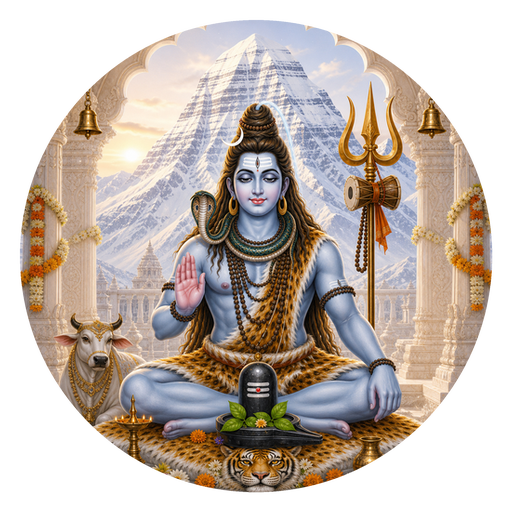 Maha Shivratri15 Feb
- Shravani Somvar17 Aug
- Tripurari Pournima24 Nov
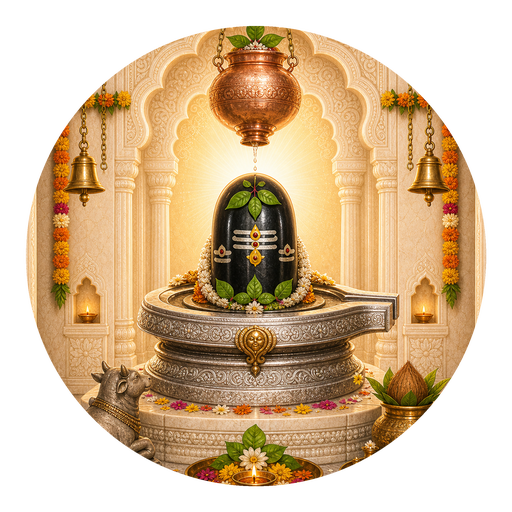 Trimbakeshwar14 Jan
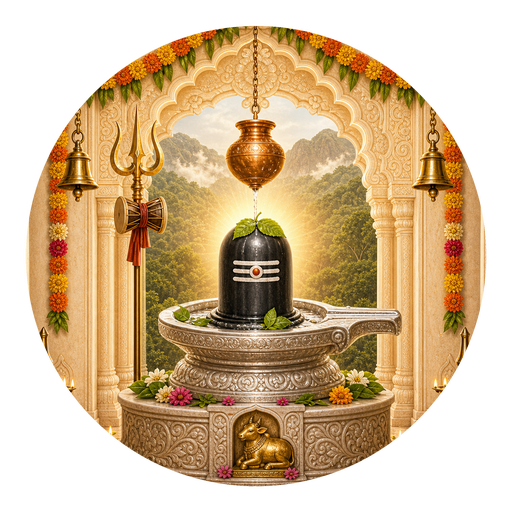 Bhimashankar15 Feb
 Grishneshwar15 Feb
 Aundha Nagnath15 Feb
 Parli Vaijnath13 Feb
 Deoghar Baidyanath Dham15 Feb
- Dwarka Nageshwar15 Feb
- Mallikarjuna Jyotirlinga (Srisailam)15 Feb
- Mahakaleshwar (Ujjain, Madhya Pradesh)15 Feb
- Kedarnath15 Feb
- Kashi Vishwanath (Varanasi, Uttar Pradesh)15 Feb
- Omkareshwar (Madhya Pradesh)25 Jan
- Rameshwaram (Tamil Nadu)15 Feb