Mahakaleshwar (Ujjain, Madhya Pradesh)
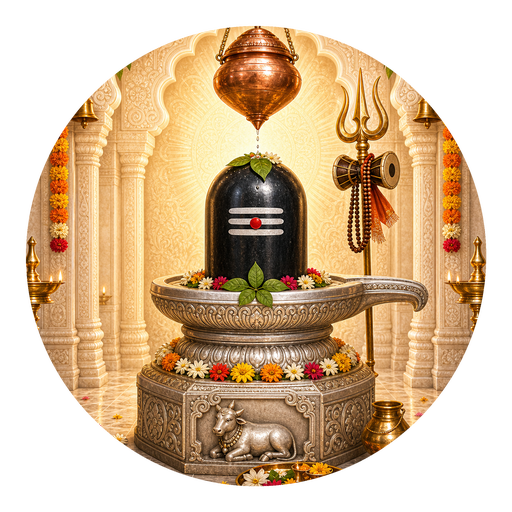
Mahakaleshwar is the third of the twelve Jyotirlingas, on the banks of the sacred Shipra river in Ujjain, Madhya Pradesh — the Shivling is regarded as self-manifested. It's the only south-facing temple among the twelve Jyotirlingas. The temple is known for its pre-dawn (currently around 4 AM, timing subject to change) Bhasma Aarti, the Nagchandreshwar shrine above the sanctum (open for darshan only on Nag Panchami), and the weekly "Sawari" palanquin procession through Shravan. After Iltutmish's destruction of the earlier temple, the one standing today was rebuilt in the 18th century by the diwan of Ranoji Shinde, a general of Peshwa Bajirao I — an important historical link for Marathi devotees.
This year's dates (2026)
- Mahashivratri — the temple's biggest day of the year, an all-night fair and worship15 Feb
- Monday — Nag Panchami (the Nagchandreshwar shrine opens for the year on this one day); also the first Monday Sawari17 Aug
- Monday — second Sawari24 Aug
- Monday — third Sawari31 Aug
- Monday — fourth and last Sawari, likely the \7 Sep
Deity and significance
The deity is Lord Shiv — as the Mahakaleshwar Jyotirlinga, self-manifested (a source of power in its own right, not consecrated by mantra like some others). In the traditional hymn order of the twelve Jyotirlingas, it's placed third, after Somnath and Mallikarjuna.
"Mahakal" combines "maha" (great) and "kal" (time/death) — Shiv in the form of "Lord of Time itself." Ujjain was historically regarded as the reference point of Indian timekeeping — ancient Indian astronomy is said to have run its "prime meridian" through Ujjain, the Surya Siddhanta refers to Avanti (Ujjain's ancient name) in this role, and the astronomer Varahamihira worked here — making the name "Lord of Time" especially fitting.
Being the only south-facing image among the twelve Jyotirlingas is another distinctive feature of Mahakaleshwar — regarded as significant within the tantric Shaiva tradition; the doctrinal explanation for this varies by tradition.
Ujjain has been referenced in Sanskrit literature since Kalidasa's time — his poem "Meghaduta" is believed to mention Ujjain and the Shipra river, though the exact verse isn't firmly established.
History and legend
The temple was destroyed by Iltutmish (Delhi Sultanate) in 1234-35 CE; one source also mentions attacks by Jalaluddin Khilji and Alauddin Khilji.
In the 18th century, once the Malwa region was freed from Mughal control, this jagir passed to Ranoji Shinde (founder of the Gwalior/Scindia dynasty), a general under Peshwa Bajirao I. His diwan rebuilt the present temple in the fourth decade of the 18th century (roughly 1736-39 CE) — the influence of Maratha architectural style is clearly visible. The diwan's exact name varies by source — likely the same individual with a surname recorded differently across sources; no single name is stated as settled here.
According to local legend, the story goes as follows — King Chandrasen of Ujjain was a devotee of Shiv; a cowherd boy, Shrikhar, deeply wished to worship Shiv alongside the king, but the guards drove him away to the banks of the Shipra river. Even there, he continued devotedly worshipping a clay Shivling. Neighbouring kings Ripudaman and Sinhaditya, aided by the demon Dushan (who had received a boon of invisibility from Brahma), attacked Ujjain and began plundering and destroying it. Moved by the unwavering devotion of both King Chandrasen and the boy Shrikhar, Shiv himself manifested in the fierce form of "Mahakal" and slew Dushan. At the devotees' request, Shiv stayed on permanently there in the form of the Jyotirlinga — and from then on, the townspeople have worshipped him as "Mahakal," the Lord of Time.
Architecture and layout
The temple has a five-storey structure with one underground sanctum — the main Mahakaleshwar linga sits in the underground sanctum; the floor above holds Omkareshwar Mahadev; and the third floor holds Nagchandreshwar, which opens for general darshan only on Nag Panchami each year. Around the sanctum are Ganesh (west), Parvati (north), Kartikeya (east), and a south-facing Nandi. The underground sanctum is lit by brass lamps.
The Mahakal Lok Corridor, built in 2022, is the temple's biggest modern transformation — Prime Minister Modi inaugurated its first phase on 11 October 2022. The corridor is about 900 metres long; the first phase cost roughly ₹351 crore (the total project roughly ₹856 crore), and the temple precinct was expanded about sevenfold. The corridor features more than a hundred sandstone pillars carved with trishul motifs and Shiv imagery, fountains, and more than fifty murals depicting Shiv Purana stories. These figures may be updated as the project progresses.
Main festivals and pilgrimage
| Festival | Date (2026) | Connection |
|---|---|---|
| Mahashivratri | 15 February | The temple's biggest day of the year — an all-night fair and worship |
| Nag Panchami (Nagchandreshwar special) | 17 August, Monday | The Nagchandreshwar shrine opens for darshan on this one day of the year; also the first Monday Sawari |
| Sawari (2nd) | 24 August, Monday | The weekly palanquin procession — from Mahakal Chauraha to Ram Ghat, with a bath in the Shipra |
| Sawari (3rd) | 31 August, Monday | Same route and form |
| Sawari (4th/last) | 7 September, Monday | Most sources say the grandest "Shahi Sawari" takes place on the last Monday of Shravan — the exact date and form is announced by the temple committee each year |
Some sources say the Sawari series can extend into the first Monday or two of Bhadrapad beyond Shravan's four Mondays (up to six in some years) — but the exact 2026 dates for this extension haven't been independently extracted or verified from the panchang, so nothing is stated firmly here.
The next Ujjain Simhastha Kumbh Mela is expected in 2028 — some guide sources put it at roughly 27 March to 27 May, with the main Shahi Snan (royal bathing) dates in April and May in the Shipra river. These dates haven't been independently verified against a primary government announcement.
Darshan and aarti timings
Bhasma Aarti: per the official Madhya Pradesh tourism source, currently begins daily at around 4 AM (lasting about an hour) — the temple claims this to be the only Shivling in the world where this aarti is performed every day. Advance online registration is currently the norm, and registering at least a month ahead is recommended especially during Shravan, Mahashivratri, and holidays; devotees are advised to arrive an hour before the scheduled time — the exact timing, registration process, and rules can change, so confirm the current status on the official portal before travelling.
The ash used for the Bhasma Aarti was historically drawn from cremation-ground ash; today, ash prepared regularly from cow dung is used instead — this change is explicitly documented by an official Madhya Pradesh tourism source.
Confirm the exact schedule and fees for the other daily aartis (morning/afternoon/night) with the temple committee or official website.
Rituals here
The Bhasma Aarti's ritual sequence runs roughly as follows — milk/water abhishek, offerings of curd-honey-sandalwood, adornment with bel leaves and flowers, a mask adornment, draping with cloth, and then the bhasma pouch is passed over the Shivling — followed by aarti with conch and bell, and chants of "Om Namah Shivaya"/"Har Har Mahadev."
The Nagchandreshwar shrine opens for general darshan only once a year, on Nag Panchami — on every other day, this third-floor sanctum remains closed.
The Sawari (the weekly Shravan procession) sets out every Monday evening (starting around 4 PM) — the Mahakal idol, dressed in grand attire, is carried in a silver palanquin in procession. The general route runs Mahakal Chauraha, Gudri Chauraha, Bakshi Bazaar, Kaharwadi, and finally Ram Ghat, where the idol is bathed in the Shipra river. The idol is dressed in a different form each Monday (such as Chandramouleshwar, among others) — the exact list varies year to year. All this ritual detail can change per the temple's own notices.
How to reach
The nearest airport is Indore (Devi Ahilyabai Holkar Airport) — from there, Ujjain city/temple is about 53-58 km by road, roughly a 75-minute to 1.5-hour drive (longer by bus depending on traffic) — most distant pilgrims, including those from Mumbai and Pune, travel this way.
The nearest railway station is Ujjain Junction (Western Railway) — right in the city centre, about 2 km from the temple. Direct trains from Mumbai include the Avantika Express (roughly 10.5 hours); from Pune, connections run via Indore (roughly 15 hours including the connection); from Nashik, roughly 13.5 hours via a changing route. Train numbers and schedules can change, so verify before travelling.
By road, Mumbai-Ujjain is about 637 km; Nashik-Ujjain about 471 km. Indore to Ujjain has a good national-highway connection.
Nearby places
- Omkareshwar Jyotirlinga — the second Jyotirlinga in Madhya Pradesh, about 140 km from Ujjain; many devotees combine an Ujjain-Omkareshwar trip in one journey.
- Indore — the nearest large city and airport, often used as a stopover.
- The Shipra river ghats (Ram Ghat and others) — where the Sawari's bathing ritual and general bathing/darshan take place.
Traveller tips
- Advance online registration for the Bhasma Aarti is mandatory — walk-in access on the day is unlikely; register well ahead during Shravan and Mahashivratri.
- Nagchandreshwar darshan is possible only on Nag Panchami — expect very heavy crowds on this one day, so plan your timing.
- On Sawari days (Shravan Monday evenings), traffic on the main route may be diverted — check locally.
- The temple precinct is very crowded during Mahashivratri and Shravan — early-morning darshan tends to be more comfortable.
- Indore is the convenient gateway for devotees travelling from Mumbai, Pune, and Nashik (both by air and rail) — an Ujjain-Omkareshwar combined trip is also possible.
Good to know
- The Nagchandreshwar shrine opens only once a year, on Nag Panchami — darshan isn't possible on any other day.
- Walk-in access to the Bhasma Aarti without registration is unlikely — plan your trip in advance.
- The temple itself was rebuilt by the diwan of Ranoji Shinde, a Maratha general, giving it a direct historical link to Maharashtra.
FAQ
- Which state and river is Mahakaleshwar on?
- In the city of Ujjain, Madhya Pradesh, on the banks of the Shipra river.
- Which of the twelve Jyotirlingas is Mahakaleshwar?
- Third in the traditional hymn order, after Somnath and Mallikarjuna.
- What is the Bhasma Aarti, and when does it happen?
- A special aarti currently performed daily around 4 AM, in which sacred ash is offered to the Shivling — advance registration is currently required, but timing and rules can change, so confirm with the official portal before travelling.
- Why does Mahakaleshwar face south?
- It's the only south-facing image among the twelve Jyotirlingas — regarded as significant within the tantric Shaiva tradition.
- Why does the Nagchandreshwar temple open only once a year?
- This third-floor shrine is traditionally kept open for darshan only on Nag Panchami; it stays closed on every other day.
- When is the next Ujjain Simhastha Kumbh Mela?
- Several guide sources place it in 2028 (roughly 27 March to 27 May) — verify against the official announcement.
- What is the Mahakal Lok Corridor?
- A grand temple-entrance corridor built in 2022 — featuring more than a hundred pillars and more than fifty Shiv Purana murals; the temple precinct was expanded about sevenfold.
- What is the Mahakal Sawari?
- A palanquin procession that sets out every Shravan Monday; the last Monday's procession is regarded as the grandest, the "Shahi Sawari."
- Who rebuilt the Mahakaleshwar temple?
- After Iltutmish's destruction of the earlier structure, the diwan of Ranoji Shinde, a Maratha general, rebuilt it in the 18th century.
Related Info
 Maha Shivratri15 Feb
 Nag Panchami17 Aug
 Trimbakeshwar14 Jan
 Bhimashankar15 Feb
 Grishneshwar15 Feb
 Aundha Nagnath15 Feb
 Parli Vaijnath13 Feb
 Deoghar Baidyanath Dham15 Feb
- Dwarka Nageshwar15 Feb
- Kashi Vishwanath (Varanasi, Uttar Pradesh)15 Feb
- Kedarnath15 Feb
- Mallikarjuna Jyotirlinga (Srisailam)15 Feb
- Omkareshwar (Madhya Pradesh)25 Jan
- Rameshwaram (Tamil Nadu)15 Feb
- Somnath15 Feb