Dwarka Nageshwar
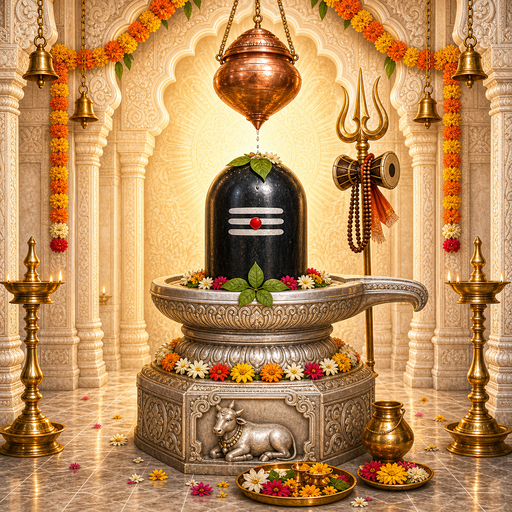
Dwarka Nageshwar is an ancient Shiva temple in the Devbhumi Dwarka district of Gujarat — the Nageshwar (Nagesh) Jyotirlinga, one of the twelve Jyotirlingas, at the ancient site of Darukavan. The Shivling sits in an underground sanctum, while a roughly 25-meter-tall seated Shiva statue in the temple grounds is visible from a distance. This site near Dwarka is currently the most widely recognized as the Nageshwar Jyotirlinga, though Aundha Nagnath in Maharashtra and Jageshwar in Uttarakhand are also claimants with their own traditions.
This year's dates (2026)
- Mahashivratri — the biggest day of the year across all Jyotirlingas15 Feb
- The first Shravan Monday — of general Shaiva significance, not Nageshwar-specific17 Aug
- Tripurari/Kartik Purnima — a general Shaiva festival24 Nov
Deity and significance
Nageshwar is considered one of the twelve Jyotirlingas — Shiva's self-manifested form of light. The site near Dwarka is currently the most widely recognized location for this name.
"Naga" (serpent) + "Ishwar" (lord) = "lord of serpents." According to the Shiva Purana, praying here is believed to protect against poison and snakebite, as well as worldly temptation — this is a religious belief, not a medical claim.
Numbering — two different traditions: in the canonical Dwadash Jyotirlinga stotra sequence (between Rameshwar and Kashi Vishwanath), Nageshwar holds the eighth position; according to the Shiva Purana's Supriya legend (and many devotional sources), it's considered the tenth. These come from two different counting systems (the stotra's sequence versus the Puranic legend's sequence) — neither is wrong or right, both traditions are recorded here.
The identity dispute: while the site near Dwarka is currently the most widely recognized, it isn't undisputed — Aundha Nagnath (Hingoli, Maharashtra) and Jageshwar (Almora, Uttarakhand) are also claimants to the Nagesh name, each with its own tradition behind it. Mainstream scholarship places Darukavan near Dwarka, while Aundha's claim rests on a reading of the stotra's southward ("yamye") direction, attributed to Adi Shankaracharya; Aundha's ancient name is recorded as "Sadanga." No claim is declared false here — both traditions are presented with equal respect.
The legend
The exact year the present temple was built isn't settled — some private tourism sources say it was built in 1750 by Naval Rai (a minister under Safdar Jung), but this claim is repeated nearly verbatim across many private pages, and no government or Wikipedia source corroborates it.
Several sources say the temple's present form largely comes from a 1996 renovation — begun by Gulshan Kumar, founder of T-Series, and completed by his family after his assassination in 1997; the total cost was around ₹1.25 crore, funded by the Gulshan Kumar Charitable Trust; a new devotee hall and outer towers were added, while the sanctum was kept at its original, below-ground spot. Gulshan Kumar's devotion to Shiva and his large-scale temple philanthropy (including the Vaishno Devi langar service) are independently well-documented, but no government or Wikipedia source itself confirms the Nageshwar renovation claim.
Archaeological excavations at this site are said, in two independent government sources, to have found five earlier cities.
Two separate, independently well-sourced legends are told here.
A demon named Daruka used to imprison Shiva devotees in Darukavan. A merchant devotee named Supriya was among those imprisoned; even in captivity, he taught his fellow prisoners to chant "Om Namah Shivaya." Pleased, Shiva appeared and destroyed the demon, and came to reside there in the form of the Nagesh (Nageshwar) Jyotirlinga. In one version, Daruka's wife, also named Daruka, is mentioned separately — granted by Parvati the power to move the entire forest, which she used to shelter the remaining demons.
A separate Puranic legend tells of sages called the Balakhilyas, who performed long penance to Shiva in Darukavan. To test their devotion, Shiva appeared as a naked ascetic wearing nothing but serpents. The sages' wives were drawn to him; the outraged sages cursed the ascetic, causing his linga to fall and shaking the entire universe. Brahma and Vishnu intervened and brought about a reconciliation between Shiva and the sages; Shiva took back the linga, but promised to remain permanently at Darukavan in the form of a Jyotirlinga. These are two separate legends — not merged into one.
Architecture
The main Shivling sits in an underground sanctum. The temple grounds hold a roughly 25-meter-tall (some sources say about 80 feet) seated, meditative Shiva statue — with a garden and pond, visible as a landmark from a distance. The difference in figures may come from meter-to-feet conversion and different measurement points; they shouldn't be taken as contradictory.
Two independent government sources say the temple's design follows Vaastu Shastra, based on the Sayanam (reclining) posture of the human body. The temple is also noted to be built in a distinctive red structure.
One government source describes the Shivling as carved from sacred "Dwarka Shila" stone, adorned with small chakras, in the shape of a Teen Mukhi Rudraksha — this specific detail wasn't found in other major sources, so it's presented as a mild claim rather than a settled fact.
Archaeological excavations are said to have found five earlier cities at this same site — consistent with the broader discussion of Dwarka's own "ancient submerged city," though this isn't presented here as an undisputed scientific fact.
Major festivals and pilgrimage
| Festival | Tithi | Date (2026) | Nakshatra | Note |
|---|---|---|---|---|
| Mahashivratri | Magh Krishna Trayodashi | 15 February | Uttarashadha | The biggest day of the year across all Jyotirlingas; Nageshwar too is said to keep extended/overnight darshan hours on this day |
| First Shravani Somvar | Shravan Shukla Panchami | 17 August | Chitra | The month of Shravan and Mondays are considered special for Shiva worship; not documented as a Nageshwar-specific gathering |
| Tripurari/Kartik Purnima | Kartik Shukla Purnima | 24 November | Krittika | A general Shaiva festival — no Nageshwar-specific fair, unlike Somnath's, was sourced here |
No Nageshwar-specific fair (like Somnath's multi-day "Kartik Purnima Mela") is established here. All three festivals above are of general Shaiva significance — sources consistently note that crowds increase during these periods, but that isn't evidence of a Nageshwar-specific event.
Krishna Janmashtami and the Char Dham pilgrimage are occasions tied to the nearby Dwarkadhish temple (a Krishna temple, a separate site) — not Nageshwar, so they aren't recorded separately here.
Darshan and aarti timings
No official temple trust website is available — the "Nageshwar"-named websites are either private or of unclear affiliation (one explicitly states in its own footer that it isn't affiliated with any temple or trust, and, confusingly, its content is actually built around Aundha Nagnath). The timings below are third-party estimates from private tourism websites.
Most sources agree: morning darshan roughly 6:00 AM to 12:30 PM, the temple closed in between, and evening darshan roughly 5:00 PM to 9:30 PM. One source, however, gives a different window — 5:30 AM to 9:00 PM without a break — and this source's reliability is unclear. On Mahashivratri, the temple is said to stay open for extended, near round-the-clock hours.
General darshan is free; abhishek is said to cost roughly ₹101 to ₹750, and an aarti thali ₹150 to ₹300, across several pages — confirm the exact rates and services before your visit. Photography is said to be prohibited in the sanctum and main complex by several tourism sources (permitted in the outer garden/statue area). Confirm darshan/aarti timings, fees, and photography rules directly with the temple management, especially around Mahashivratri and Shravan.
Rituals here
Abhishek (with water or milk) is the main ritual here; some paid service options are listed on tourism portals. For abhishek/puja, men are said to be expected to wear a dhoti/lungi (provided free at the temple) and women a saree — this hasn't been confirmed by any official trust source.
This is the same religious belief about protection from poison and snakebite noted above under "Deity and significance," not a medical claim.
Getting there
By road: about 15-18 km from Dwarka city (government source: about 16 km); situated on the route toward Bet Dwarka.
By rail: the nearest station is Dwarka (roughly the same distance, then by road).
By air: the nearest airport is given differently by different sources — Porbandar (about 107 km) or Jamnagar (about 126-130 km); both are notable options.
Major cities: about 440 km from Ahmedabad; about 230-250 km from Somnath toward Dwarka/Nageshwar (varies by route). Check a live map before you go.
Nearby places
Gopi Talav — on the route from Dwarka to Nageshwar/Bet Dwarka, about 20 km from Dwarka; known for Gopi Chandan (a yellow sacred soil), tied to the Krishna-Gopi legend.
Bet Dwarka — beyond Nageshwar (about 20-25 km, plus a boat crossing), an island pilgrimage site associated with Krishna.
Rukmini Devi Temple — about 2 km from Dwarka town (not from Nageshwar — a distinct location).
Dwarkadhish Temple (one of the Char Dham) — in Dwarka town, a separate temple dedicated to Krishna; Nageshwar (Shiva) and Dwarkadhish (Krishna) shouldn't be taken as the same.
**Somnath Jyotirlinga** — about 230-250 km from Dwarka, the other Jyotirlinga on Gujarat's Saurashtra coastal pilgrimage route.
Traveller tips
Mahashivratri and the month of Shravan bring immense crowds — darshan can typically take 30-60 minutes, so plan ahead. Photography is said to be prohibited in the main sanctum/complex by many sources — check mobile/camera rules beforehand.
Simple, modest clothing is enough for general darshan; abhishek/puja may involve dhoti/saree expectations — ask at the temple. November to February is a relatively comfortable season for weather; summers can be hot and humid along the Saurashtra coast. If planning a combined Dwarka-Somnath trip, check the distance and time beforehand.
Good to know
- Understand the Nageshwar identity dispute neutrally — Dwarka is currently the most widely recognized, but Aundha Nagnath and Jageshwar are also traditions worth respecting; no claim is "false" here.
- Don't confuse Nageshwar with Dwarkadhish — Nageshwar is the Shiva Jyotirlinga, Dwarkadhish is a separate Krishna temple.
- Confirm darshan/aarti timings and fees directly with the temple management — no official trust source is available; the timings below are third-party estimates.
- Distance from Dwarka to Nageshwar and airport choice vary by source — verify with a map before travelling.
FAQ
- Where is the Nageshwar Jyotirlinga?
- In the Devbhumi Dwarka district of Gujarat, on the route connecting Dwarka city and Bet Dwarka, about 15-18 km from Dwarka.
- Which Jyotirlinga number is Nageshwar?
- Eighth in the stotra sequence; tenth in the Shiva Purana's legend sequence — both traditions are current.
- How far is Nageshwar from Dwarka?
- About 15-18 km by road (slight variance by source; the government source gives about 16 km).
- What is the legend of the Nageshwar Jyotirlinga?
- Mainly the story of the demon Daruka and the devotee Supriya (Shiva Purana); some government sources also tell a separate legend of the Balakhilya sages (Vamana Purana).
- How tall is the Shiva statue at the Nageshwar temple?
- About 25 meters (roughly 80 feet), a seated Shiva statue in the temple grounds.
- Which is the real Nageshwar Jyotirlinga — Dwarka or Aundha Nagnath?
- The site near Dwarka is currently the most widely recognized, but Aundha Nagnath (Maharashtra) and Jageshwar (Almora) are also claimants with their own traditions — scholars disagree on this.
- What are the darshan timings at Nageshwar?
- Roughly 6 AM to 12:30 PM, and 5 PM to 9:30 PM; since no official temple trust source was found, confirm the exact timings with the temple management.
- Who built the Nageshwar temple, and who renovated it?
- The original construction history isn't firmly settled; the present form mostly comes from a 1996 renovation, in which T-Series founder Gulshan Kumar is said, by several sources, to have played a major role (unconfirmed by any government source).
- Are Nageshwar and Dwarkadhish the same temple?
- No, these are two separate temples — Nageshwar is the Shiva Jyotirlinga, Dwarkadhish is the Krishna temple (one of the Char Dham), both within the Dwarka area.
Related Info
 Jyotirlinga15 Feb
 Trimbakeshwar14 Jan
 Bhimashankar15 Feb
 Grishneshwar15 Feb
 Aundha Nagnath15 Feb
 Parli Vaijnath13 Feb
- Somnath15 Feb
- Mallikarjuna Jyotirlinga (Srisailam)15 Feb
- Mahakaleshwar (Ujjain, Madhya Pradesh)15 Feb
- Omkareshwar (Madhya Pradesh)25 Jan
- Kedarnath15 Feb
- Kashi Vishwanath (Varanasi, Uttar Pradesh)15 Feb
- Rameshwaram (Tamil Nadu)15 Feb
- Deoghar Baidyanath Dham15 Feb
 Maha Shivratri15 Feb
- Shravani Somvar17 Aug
- Tripurari Pournima24 Nov