Parli Vaijnath
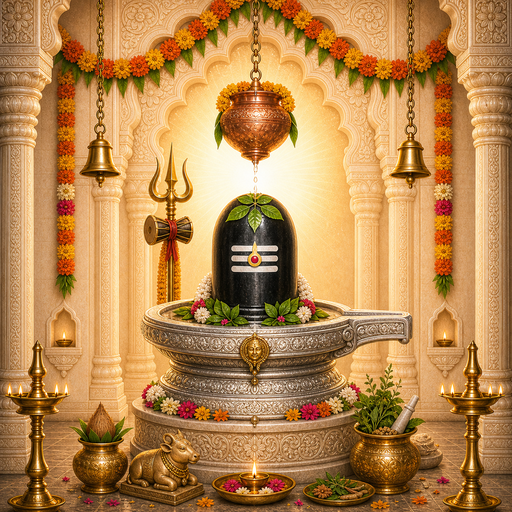
Parli Vaijnath is an ancient Shiv temple at Parli in Beed district — the Shri Vaidyanath (Vaijnath) Jyotirlinga, regarded as one of the twelve Jyotirlingas. In Maharashtra's tradition it is counted as the fifth Jyotirlinga. Two things make it distinctive: the Amrit and the divine physician Dhanvantari from the samudra manthan (the churning of the ocean) are said to be hidden in this very Shivling, which is why it is called Vaidyanath (‘the divine physician’); and here devotees can take sparsh darshan — actually touching the Shivling — which is rare among the twelve Jyotirlingas. Its Mahashivratri yatra is Parli's largest fair, drawing lakhs of devotees.
This year's dates (2026)
- Vijaya Ekadashi — a general Ekadashi vrat; no Parli-specific yatra is mentioned in official sources13 Feb
- Mahashivratri — Parli's biggest annual yatra (a general Shaiva festival)15 Feb
- Tripurari Pournima / Vaikunth Chaturdashi — a general Shaiva festival24 Nov
Deity & significance
Parli Vaijnath is regarded as one of the twelve Jyotirlingas — a Jyotirlinga being a swayambhu (self-manifested) form of Shiv's light. It is also one of the five Jyotirlingas that devotees in Maharashtra revere and visit most; the others are Trimbakeshwar, Bhimashankar, Grishneshwar and Aundha Nagnath. All five of Maharashtra's Jyotirlingas are introduced together on the Jyotirlinga hub page.
Why the name “Vaidyanath” (a health-and-healing connection).
Vaidya means a physician or healer. As the story goes, when the samudra manthan brought forth the Amrit (nectar) and the divine physician Dhanvantari, Lord Vishnu hid both of them within this very Shivling to keep them from the demons. Because both the Amrit and the physician are said to dwell in this linga, it came to be known as Vaidyanath — and it is also called Amriteshwar. This is why the place is regarded as a seat of health and healing.
Sparsh darshan (its most special feature).
Among the twelve Jyotirlingas, Parli is one of the rare places where devotees can actually touch the Shivling for darshan and abhishek. Devotees hold a belief that sparsh darshan removes their troubles. This is given here strictly as a belief (shraddha); no medical or universal claim that it “cures disease” is made on this page.
The number, and the Vaidyanath listing-difference (informational).
By Maharashtra's tradition and the state tourism listing, Parli is regarded as the fifth Jyotirlinga (Vaidyanath). However, which linga the “Vaidyanath” of the Dvadasha-Jyotirlinga stotra actually refers to is a matter of listing-difference: the canonical list is most often associated with Baidyanath Dham, Deoghar (Jharkhand), while Parli (Maharashtra) and Baijnath (Himachal) are the other claimants. Parli's fifth-Jyotirlinga identity is thus Maharashtra's tradition, not a settled canonical claim (the same listing difference noted on the Jyotirlinga hub).
“Anokhi Kashi” (a local tradition).
By local tradition it is held that among the twelve Jyotirlingas, Shiv and Parvati dwell together only at Parli, and so Parli is called an “Anokhi Kashi” (a unique Kashi).
History & legend
Temple history.
The temple is regarded as Yadava-era (roughly the 12th–13th century), built in the Hemadpanti style. Later, Rani Ahilyabai (Ahilyadevi) Holkar is believed to have renovated it in 1706 CE (as with many Jyotirlingas). (The exact construction date before that renovation is unclear.)
The sthala-purana (legend).
A few legends are told around the name and the linga of Parli Vaijnath. What follows retells those legends faithfully.
(1) Samudra manthan — the Amrit and Dhanvantari (the origin of the name Vaidyanath). When the gods and demons churned the ocean (samudra manthan) for the Amrit, fourteen jewels emerged; among them were the Amrit and the divine physician Dhanvantari. As the demons rushed in to seize the Amrit, Lord Vishnu hid both the Amrit and Dhanvantari within this very Shivling. Because both the nectar and the physician dwell in this linga, it came to be known as Vaidyanath (Amriteshwar); and it is from this that the place draws its association with health and healing.
(2) Ravana and the atmalinga. By this account, Ravana obtained a linga (the atmalinga) from Shiv through severe penance; while carrying it towards Lanka, Vishnu took the form of a boy and set the linga down on the ground, where it took root. When Ravana tried to uproot it, the top of the linga is said to have chipped slightly. However, this Ravana / atmalinga story is classically regarded as the origin-legend of Deoghar (Baidyanath) as well; the Parli tradition also tells it — which is itself one reason for the Vaidyanath listing-difference. So this story is not used here as proof that Parli is “the true Vaidyanath.”
(3) Markandeya and Satyavan–Savitri. Parli Vaijnath is also linked with the sage Markandeya and with the Satyavan–Savitri legend. The exact episodes of these local legends are not clear in the sources.
Architecture
- Hemadpanti style: the temple is built in the Hemadpanti style and is said to be about 75–80 feet high.
- The brass-plated east door: the main entrance is on the east and is a brass-plated door.
- A touch-accessible sanctum (its special feature): the sabhamandap (hall) and garbhagriha (sanctum) are laid out so that devotees can reach the Shivling itself and take sparsh darshan / do abhishek — rare among the twelve Jyotirlingas.
- A hilltop setting: the temple stands on the Naganarayana hill; the surrounding area is said to have forest rich in medicinal herbs (tied to the health-and-healing theme).
Festivals & yatra
The tithi is the real anchor of the date; the dates below come from each year's panchang (this site's 2026 panchang data) and shift automatically the next year. Each row links to that day's page.
Mahashivratri is Parli's main annual yatra, and Shravani Somvar also draws large crowds. Vijaya Ekadashi is a general vrat, with no special yatra at Parli.
| Festival / yatra | Tithi | This year's date (2026) | Nakshatra | Type / more |
|---|---|---|---|---|
| Vijaya Ekadashi | Magh Krishna Ekadashi | 13 Feb 2026 | Mula | A general Ekadashi vrat; there is no special yatra at Parli for this day. |
| Mahashivratri (annual yatra) | Magh Krishna Trayodashi | 15 Feb 2026 | Uttara Ashadha | Parli's biggest yatra — “one of the biggest fairs in Maharashtra,” with lakhs of devotees. See the full Mahashivratri page. |
| Tripurari Pournima / Vaikunth Chaturdashi | Kartik Shukla Pournima | 24 Nov 2026 | Krittika | A general Shaiva festival — listed in the temple's festival calendar as the “Vaikunth Chaturdashi–Tripurari Hari-Har bhet.” |
- Shravani Somvar (a crowd day, no fixed date): on every Monday of Shravan, Parli Vaijnath draws lakhs of devotees (a Parli-specific source). Since the Shravan Mondays are anchored to the masa, their dates are kept on the Shravani Somvar page; here it is only noted that there is a special crowd and a special darshan pass on Shravani Somvar. Verify the exact arrangement with the temple committee.
- Other festivals in the temple list: Gudi Padwa / Chaitra Padva, Vijayadashami (a procession), Diwali and Makar Sankranti are also celebrated at Parli; these are general festivals whose full details live on their own pages — no Parli-specific crowd claim is made here.
- Mahashivratri yatra details: the exact arrangements — palkhi/procession, queue and special pass, and crowd management — could not be officially confirmed, so nothing is stated here.
Darshan & aarti timings
Some websites describe themselves as connected with the Parli Vaijnath devasthan and offer online booking or donation. No private booking portal is presented here as the “official trust” — confirm with the official devasthan trust yourself before you book or donate.
For rough reference only (not official): sources say the temple opens around 5:00 AM and closes around 9:00–9:30 PM; sparsh darshan and abhishek run in set morning and midday windows (for example, roughly 5:00–8:00 AM and 12:00–3:00 PM); the morning and evening aarti times too differ from source to source.
Before you travel, check the darshan, aarti and sparsh-darshan timings and the queue arrangement with the temple committee (mandir samiti). Times and arrangements change on festival days (Mahashivratri, Shravan).
Special rituals here
- Rudrabhishek / Mahamrityunjay jap: the main rite on a Jyotirlinga is the abhishek; because of Parli's Vaidyanath (health) identity, devotees perform rites such as abhishek / rudrabhishek and the Mahamrityunjay jap with a wish for good health. This is religious/devotional guidance — it should not be taken as a medical or universal claim; understand it as “per your own local and family tradition, under the guidance of authorised priests.”
- Sparsh abhishek and a dress custom: devotees are said to be able to do the abhishek themselves with water/milk/panchamrut. Male devotees are asked not to wear a garment above the waist during the abhishek — verify this with the temple committee before you go.
The exact rules, fees, eligibility and sparsh-darshan norms should be verified with the temple committee itself.
How to reach
- By air: the nearest airport is Chhatrapati Sambhajinagar (Aurangabad) — about 225 km (a government source). Nanded airport is also a regional option.
- By rail: the Parli Vaijnath railway station is in the town itself, connected to Mumbai / Pune / Hyderabad / Nagpur / Latur.
- By road: Maharashtra State Transport (MSRTC) buses are available; there are road links from Latur / Nanded / Beed / Ambajogai. The exact road distances could not be independently confirmed → check on a map / with locals.
- A Marathwada travel-combo: Parli Vaijnath ↔ Aundha Nagnath Jyotirlinga, about 119 km — it is convenient to take darshan of both of Marathwada's Jyotirlingas together.
Nearby places
- Aundha Nagnath Jyotirlinga (Hingoli, Marathwada) — Marathwada's other Jyotirlinga; convenient as a travel-combo with Parli.
- Ambajogai (the Yogeshwari Devi temple, near Parli), Latur and Nanded are the nearest major places. (Check exact distance and entry locally.)
Travel tips
- Mahashivratri and Shravani Somvar bring huge crowds — take darshan early in the morning, and check the special-pass / queue arrangement beforehand.
- Sparsh darshan: since you can actually touch the linga here, it can take time when it is crowded; if you want to do your own abhishek, carry water/milk/panchamrut (rules per the temple committee).
- Marathwada is hot — in summer, guard against the heat and carry water; October–February is the pleasant season to travel. Planning a combined darshan trip with Aundha Nagnath is convenient.
Mantra & aarti
Shiv jap-mantra:
Om Namah Shivaya.
This panchakshari (five-syllable) mantra is addressed to Shiv and is chanted daily in Shiv temples. Devotees also say it during Jyotirlinga darshan and abhishek.
Shankar aarti — “Lavthavati Vikrala” (by Samarth Ramdas). It is traditionally sung after the puja in Shiv temples. Its meaning: Shiv is fearsome yet innocent (bhola), camphor-fair (karpur-gaura), radiant beside Parvati, and the one who drank the halahal poison of the churning of the ocean to become Neelkanth (the blue-throated one). The opening line is “Lavthavati vikrala brahmandi mala…”
FAQ
- Which Jyotirlinga is Parli Vaijnath?
- It is regarded as one of the twelve Jyotirlingas; in Maharashtra's tradition it is counted as the fifth (Vaidyanath). (The canonical list most often places “Vaidyanath” at Deoghar — a listing-difference.)
- Why the name Vaidyanath? Why is Parli famous for health?
- Because the Amrit and the divine physician Dhanvantari from the samudra manthan are said to be hidden in this very Shivling, the linga is called “Vaidyanath” (vaidya = physician); so it is regarded as a seat of health. (This is its devotional significance — not a medical claim.)
- Can you take darshan by touching the Shivling?
- Yes; sparsh darshan is possible at Parli — rare among the twelve Jyotirlingas. Devotees hold a belief that sparsh darshan removes their troubles. (Check the exact rules with the temple committee.)
- Who built the temple / who renovated it?
- The temple is regarded as Yadava-era (Hemadpanti); it is believed to have been renovated in 1706 CE by Ahilyabai Holkar.
- What is the samudra-manthan and Ravana legend?
- That Vishnu hid the Amrit and Dhanvantari of the churning of the ocean inside this linga; and that when Ravana carried off the atmalinga, Vishnu set it fast on the ground and its top chipped. (The Ravana story is classically regarded as Deoghar's too.)
- When is the yatra? How big is the Mahashivratri crowd?
- Mahashivratri brings Parli's biggest yatra (lakhs of devotees; one of the biggest fairs in Maharashtra); Shravani Somvar too brings large crowds.
- What are Parli Vaijnath's darshan timings?
- Sources say roughly 5:00 AM to about 9:00–9:30 PM, with abhishek in set windows; but check the exact timings with the temple committee (no official time is given on this page).
- How far is Parli from Beed / Latur / Nanded?
- The Parli Vaijnath railway station is in the town itself; the nearest airport, Chhatrapati Sambhajinagar, is about 225 km. The exact road distances should be verified.
- Parli or Deoghar's Vaidyanath — which is the real one?
- This is a listing-difference; Maharashtra's tradition holds Parli to be Vaidyanath, while the canonical list is most often associated with Deoghar (Jharkhand). (No firm claim is made here.)
- Can you take darshan of Parli and Aundha Nagnath together?
- Yes; since both are Jyotirlingas in Marathwada (about 119 km apart), a combined darshan trip (travel-combo) is convenient.
Related Info
 Maha Shivratri15 Feb
 Aundha Nagnath15 Feb
 Grishneshwar15 Feb
 Bhimashankar15 Feb
 Trimbakeshwar14 Jan
 Jyotirlinga15 Feb
- Kashi Vishwanath (Varanasi, Uttar Pradesh)15 Feb
- Kedarnath15 Feb
- Mahakaleshwar (Ujjain, Madhya Pradesh)15 Feb
- Mallikarjuna Jyotirlinga (Srisailam)15 Feb
- Omkareshwar (Madhya Pradesh)25 Jan
- Rameshwaram (Tamil Nadu)15 Feb
- Somnath15 Feb
- Deoghar Baidyanath Dham15 Feb
- Dwarka Nageshwar15 Feb