Grishneshwar
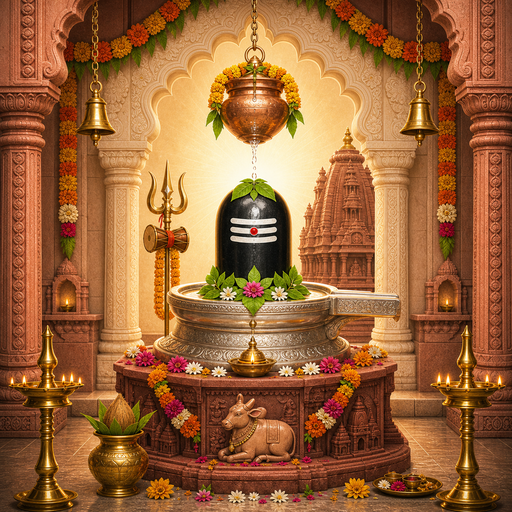
Grishneshwar is a Shiv temple in the village of Verul — one of the twelve Jyotirlingas, and traditionally regarded as the twelfth and last Jyotirlinga. It sits barely 1–1.5 km from the world-famous Ellora (Verul) caves, about 30 km from Chhatrapati Sambhajinagar (Aurangabad) city, at the foot of the Mahishadri hill. Its form is a red-stone Hemadpanti temple with a black-stone Shivling in the sanctum. The temple is best known for the legend of the devotee Ghushma (Kusuma) and her unbroken devotion to Shiv, and for its large annual Mahashivratri yatra.
This year's dates (2026)
- Mahashivratri — Grishneshwar's main annual yatra15 Feb
- First Shravani Somvar — also Nagpanchami17 Aug
- Second Shravani Somvar24 Aug
- Third Shravani Somvar — also Sankashti Chaturthi31 Aug
- Fourth (last) Shravani Somvar7 Sep
- Shri Ganesh Chaturthi14 Sep
- Kartik / Tripurari Pournima24 Nov
Deity & significance
Grishneshwar is one of the twelve Jyotirlingas — a Jyotirlinga being a swayambhu (self-manifested) form of Shiv's light. In many traditions Grishneshwar is regarded as the twelfth and last Jyotirlinga on the list, so it is a special kshetra (holy seat) for those completing the twelve-Jyotirlinga pilgrimage.
It is also one of the five Jyotirlingas that devotees in Maharashtra revere and visit most; the others are Trimbakeshwar, Bhimashankar, Aundha Nagnath and Parli Vaijnath. All five of Maharashtra's Jyotirlingas are introduced together on the Jyotirlinga hub page.
Note: in the shastrokta Dvadasha-Jyotirlinga list, the count firmly placed in Maharashtra is three; the identifications of Aundha Nagnath as Nageshwar and Parli Vaijnath as Vaidyanath are disputed. In popular devotion, however, all five are worshipped as Maharashtra's Jyotirlingas.
A significance rooted in devotion.
Grishneshwar's mahatmya (glory) is not one of war or the slaying of a demon, but of boundless devotion and forgiveness. As per the legend, Shiv appeared here through the devotee Ghushma's (Kusuma's) unwavering bhakti and stayed on in her name as “Ghushmeshwar” (the legend is below). This makes it a rare Jyotirlinga whose glory is a symbol of a woman's devotion and of kshama (forgiveness).
Tirtha and heritage together.
Because the UNESCO World Heritage Ellora (Kailasa) caves are right next door, both pilgrims and lovers of history and sculpture come here — you can experience tirtha and heritage in a single visit, which is Grishneshwar's distinctive draw. The temple is a nationally protected monument (ASI).
History & legend
Temple history.
According to a government source (Marathi Vishwakosh), Grishneshwar's original temple was built by Krishnaraja of the Rashtrakuta dynasty — the same house that carved the nearby Ellora-Kailasa cave. Later, in 1599, Maloji Bhosale, the patil of Verul (grandfather of Chhatrapati Shivaji Maharaj), carried out a renovation (jirnoddhar). Over time the temple was also destroyed — by some accounts in Aurangzeb's time, while other sources mention destruction by the Delhi Sultanate in the 13th–14th centuries; the sources differ on the phases of destruction.
Later, around 1730, Gautamibai (Gautamabai) Holkar, wife of Malharrao Holkar, built the present temple, and in 1769 Punyashlok Ahilyabai Holkar rebuilt the Shivalay tirth (the sacred kund/tank) beside the temple, as the government source states.
A common mix-up over the credit. Many popular sources say only that “Ahilyabai Holkar built the temple,” while some say “1729, Gautamabai Holkar.” The Marathi Vishwakosh reconciles both — the present temple was built by Gautamibai (around 1730), and the Shivalay tirth by Ahilyabai (1769).
The sthala-purana (legend).
Grishneshwar's original legend comes from the “Koti Rudra Samhita” of the Shiva Purana — Chapter 32 (the story of Sudeha and Sudharma) and Chapter 33 (the origin of the Ghushmeshwar Jyotirlinga). This ancient text is in the public domain, and the story is retold in many places too. In brief —
In the south, near the Devgiri hill, a Brahmin named Sudharma lived with his wife Sudeha. The couple had no children. Longing for a child, Sudeha herself arranged the marriage of her own younger sister Ghushma to Sudharma — vowing to herself that she would feel no jealousy.
Ghushma, for her part, worshipped Shiv with great devotion. Every day she would shape 101 clay (parthiv) Shivlingas with her own hands, worship them with a full heart, and immerse them in the nearby tank. By the power of this bhakti, through Shiv's grace she was blessed with a son. But the son slowly let jealousy enter Sudeha's mind; one night she killed Ghushma's sleeping son and cast his body into that same tank.
Even when she learned of this in the morning, Ghushma continued her daily Shiv-puja without grief, with an even mind. Pleased by this steadfast devotion, Shiv appeared, brought her son back to life, and asked her to seek a boon. Ghushma asked that her sister be forgiven and that Shiv remain there forever. At her request, Shiv stayed on as a linga by the name “Ghushmeshwar”; the tank came to be known as the “Shivalay” tirth. (The evolution of the name is told as: Kusumeshwar → Ghushmeshwar → Ghrishmeshwar → Grishneshwar.)
In some versions the devotee's name is Ghushma, in others Kusuma or Ghrishma; the details of the husband and the place also differ a little. The heart of the story — boundless devotion, forgiveness and Shiv's grace — is the same everywhere.
Architecture
Temple design
- The temple is built of reddish dressed stone; the Shivling in the sanctum, however, is of black stone. So its signature is a “red-stone temple with a black linga” (Marathi Vishwakosh).
- There is carving, sculpture and painting on the shikhara, roof and pillars; it is in the Hemadpanti style, with a Nandi before the main entrance (Marathi Vishwakosh).
Additional details
- The area is said to be about 44,000 sq ft (Wikipedia).
- By some accounts, the design shows a resemblance to South Indian architecture (rare in Maharashtra); a five-tiered shikhara and a court hall of about 24 pillars carved with tales of the gods.
- The walls are said to be carved with the Dashavatar of Vishnu and scenes from Shiv legends.
- Some articles call it the “smallest Jyotirlinga temple,” and one news report (a single source) calls it one of the few south-facing temples.
Shivalay tirth.
The sacred kund beside the temple, taken to be the very tank of the legend. Ahilyabai Holkar rebuilt it in 1769, as the government source states.
Festivals & yatra
The tithi is the real anchor of the date; the dates below come from each year's panchang (this site's 2026 panchang data) and shift automatically the next year. Each row links to that day's page. All the below are general festivals whose full details live on their own pages; only the festivals noted in Grishneshwar's own sources are listed here.
| Festival / yatra | Tithi | This year's date (2026) | Nakshatra | Type / more |
|---|---|---|---|---|
| Mahashivratri (main yatra) | Magh Krishna Trayodashi | 15 Feb 2026 | Uttarashadha | Grishneshwar's biggest annual yatra (Vishwakosh: “a large yatra every Shivratri”). See the full Mahashivratri page. |
| First Shravani Somvar | Shravan Shukla Panchami | 17 Aug 2026 | Chitra | Shravan is a celebrated month noted by the trust; also Nagpanchami. See the full Shravani Somvar page. |
| Second Shravani Somvar | Shravan Shukla Dwadashi | 24 Aug 2026 | Purvashadha | The second Monday of Shravan → Shravani Somvar. |
| Third Shravani Somvar | Shravan Krishna Tritiya | 31 Aug 2026 | Revati | Also Sankashti Chaturthi that day → Shravani Somvar. |
| Fourth (last) Shravani Somvar | Shravan Krishna Ekadashi | 7 Sep 2026 | Punarvasu | The last Monday of Shravan → Shravani Somvar. |
| Shri Ganesh Chaturthi | Bhadrapad Shukla Chaturthi | 14 Sep 2026 | Chitra | Noted in the trust page's celebrations. See the full Ganesh Chaturthi page. |
| Kartik / Tripurari Pournima | Kartik Shukla Pournima | 24 Nov 2026 | Krittika | Noted by the trust page; a deepotsav. See the full Tripurari Pournima page. |
Darshan & aarti timings
No exact darshan/aarti time is given on this page. Secondary and other sources give different figures — for example, the temple is said to open around 5:00–5:30 AM and close around 9:00–9:30 PM; some sources show a midday break from 12:00–1:00 PM; on festival days it opens earlier and closes later. The aarti times too differ from source to source. Since these figures conflict and no official schedule could be confirmed, they are not stated here.
Before you travel, check the darshan and aarti timings, the aarti names and the queue arrangement with the temple committee (mandir samiti). Times and arrangements change on festival days (Mahashivratri, Shravan, Ganesh Chaturthi, Kartik Pournima).
Special rituals here
- Sanctum entry (dress custom): by local tradition, men are said to enter the sanctum / touch the Shivling bare-chested (without a shirt, vest or the sacred thread worn over the shirt), as several sources note. This should be given as a local custom, not a universal rule; the dress/entry rules for women are not clear in the sources.
- Abhishek and parthiv-puja: devotees are said to perform abhishek on the Jyotirlinga and (following the legend) parthiv Shivling puja here; the exact rules, fees and registration follow the local arrangement.
- Shivalay tirth: taking darshan of / bathing at the Shivalay tirth before darshan is observed by local tradition.
Treat this ritual guidance as not a universal rule. If you wish to perform any vidhi, do so per your own local and family tradition, under the guidance of authorised priests; do not treat any booking portal as “official.”
How to reach
- Nearest — the Ellora caves (~1–1.5 km): Verul is the very village of the Ellora caves; after seeing the caves you can walk or go the short distance to Grishneshwar.
- By road / bus: about 30–31 km from Chhatrapati Sambhajinagar (Aurangabad) city; from the central bus stand (CBS) take an MSRTC bus towards Ellora/Kannad to Verul. Private taxis/cabs are also available.
- By rail: the nearest major station is Chhatrapati Sambhajinagar (Aurangabad) railway station, about 25–29 km; from there take a bus or taxi.
- By air: Chhatrapati Sambhajinagar Airport (IXU) is about 35–37 km.
The exact distances vary by a few km across sources → check on a map / with locals before you travel.
Nearby places
- Ellora (Verul) caves + the Kailasa cave — UNESCO World Heritage; about 1 km from the temple.
- Daulatabad (Devgiri) fort — about 11–15 km.
- Khuldabad — the tomb of Aurangzeb and Sufi dargahs.
- Bibi ka Maqbara and the Aurangabad caves — in Chhatrapati Sambhajinagar city.
Check the exact distances and entry times before you travel.
Travel tips
- Grishneshwar + Ellora in one day: since both are about 1 km apart, you can see the tirtha and the caves the same day. The Ellora caves are usually closed on Tuesdays — check the ASI schedule first.
- The bare-chested custom for men in the sanctum may mean removing a shirt / the sacred thread; carrying a small bag or an uparne/dhotar is convenient. Women should keep to modest dress.
- Mahashivratri brings a large yatra and crowds — arrive early in the morning and check the queue/parking arrangement beforehand.
- Times change on festival days → before you set out, check the darshan timing and rules with the temple committee.
Mantra & aarti
Shiv jap-mantra:
Om Namah Shivaya.
This panchakshari (five-syllable) mantra is addressed to Shiv and is chanted daily in Shiv temples. Devotees also say it during Jyotirlinga darshan and abhishek.
Shankar aarti — “Lavthavati Vikrala” (by Samarth Ramdas). It is traditionally sung after the puja in Shiv temples. Its meaning: Shiv is fearsome yet innocent, camphor-fair (karpur-gaura), radiant beside Parvati, and the one who drank the halahal poison of the churning of the ocean to become Neelkanth (the blue-throated one).
FAQ
- Which Jyotirlinga is Grishneshwar?
- One of the twelve Jyotirlingas, traditionally regarded as the twelfth and last. It is also one of the five Jyotirlingas that devotees visit in Maharashtra.
- Where is Grishneshwar? How far from the Ellora caves?
- In Verul village, about 1–1.5 km from the Ellora caves and about 30 km from Chhatrapati Sambhajinagar (Aurangabad) city. (Check the exact distance before you travel.)
- Who was Ghushma? What is the legend?
- Ghushma (Kusuma) was a boundless devotee of Shiv who shaped and worshipped 101 parthiv (clay) Shivlingas every day. Shiv brought her dead son back to life and stayed on as a linga in her name, “Ghushmeshwar” (Shiva Purana, Koti Rudra Samhita, Ch. 32–33). (The exact version of the legend should be checked.)
- Who built the Grishneshwar temple — Ahilyabai or Gautamibai?
- Per the government source, the present temple was built by Gautamibai Holkar (around 1730) and the Shivalay tirth by Ahilyabai Holkar (1769); earlier, in 1599, Maloji Bhosale had carried out a renovation.
- What are Grishneshwar's darshan timings?
- Sources give different figures; no exact time is given on this page — check the darshan and aarti timings with the temple committee.
- Why must men enter the sanctum bare-chested?
- Several sources say it is a local tradition (entering with the shirt/sacred thread removed); this should not be taken as a universal rule. Check the exact rules with the temple committee.
- Why is Grishneshwar called the last Jyotirlinga?
- In the traditional list of the twelve Jyotirlingas, Grishneshwar is counted twelfth and last; so the twelve-Jyotirlinga pilgrimage is taken to be completed here.
- What is the Shivalay tirth?
- The sacred kund beside the temple, taken to be the very tank of the legend. Ahilyabai Holkar rebuilt it in 1769.
Related Info
 Maha Shivratri15 Feb
- Shravani Somvar17 Aug
 Ganesh Chaturthi / Ganeshotsav14 Sep
 Jyotirlinga15 Feb
 Trimbakeshwar14 Jan
 Bhimashankar15 Feb
 Aundha Nagnath15 Feb
 Parli Vaijnath13 Feb
- Deoghar Baidyanath Dham15 Feb
- Dwarka Nageshwar15 Feb
- Kashi Vishwanath (Varanasi, Uttar Pradesh)15 Feb
- Kedarnath15 Feb
- Mahakaleshwar (Ujjain, Madhya Pradesh)15 Feb
- Mallikarjuna Jyotirlinga (Srisailam)15 Feb
- Omkareshwar (Madhya Pradesh)25 Jan
- Rameshwaram (Tamil Nadu)15 Feb
- Somnath15 Feb